
DP Intro - OBST
http://radford.edu/~nokie/classes/360/dp-opt-bst.html
Overview
Optimal Binary Search Trees - Problem
- Problem:
- Sorted set of keys k1,k2,...,knk1,k2,...,kn
- Key probabilities: p1,p2,...,pnp1,p2,...,pn
- What tree structure has lowest expected cost?
- Cost of searching for node ii
: cost(ki)=depth(ki)+1cost(ki)=depth(ki)+1
Expected Cost of tree =∑i=1ncost(ki)pi=∑i=1n(depth(ki)+1)pi=∑i=1ndepth(ki)pi+∑i=1npi=(∑i=1ndepth(ki)pi)+1Expected Cost of tree =∑i=1ncost(ki)pi=∑i=1n(depth(ki)+1)pi=∑i=1ndepth(ki)pi+∑i=1npi=(∑i=1ndepth(ki)pi)+1
Optimal BST - Example
- Example:
- Probability table (pipi
is the probabilty of key kiki
:
| ii | 1 | 2 | 3 | 4 | 5 |
| kiki | k1k1 | k2k2 | k3k3 | k4k4 | k5k5 |
| pipi | 0.25 | 0.20 | 0.05 | 0.20 | 0.30 |

- Given: k1<k2<k3<k4<k5k1<k2<k3<k4<k5
- Two BSTs
- Tree 1:
- k2/[k1,k4]/[nil,nil],[k3,k5]k2/[k1,k4]/[nil,nil],[k3,k5]
- cost = 0(0.20) + 1(0.25+0.20) +2(0.05+0.30) + 1 = 1.15 + 1
- Tree 2:
- k2/[k1,k5]/[nil,nil],[k4,nil]/[nil,nil],[nil,nil],[k3,nil],[nil,nil]k2/[k1,k5]/[nil,nil],[k4,nil]/[nil,nil],[nil,nil],[k3,nil],[nil,nil]
- cost = 0(0.20) + 1(0.25+0.30) +2(0.20) + 3(0.05) + 1 = 1.10 + 1
- Notice that a deeper tree has expected lower cost
Optimal BST - DP Approach
- Optimal BST TT
must have subtree T′T′
for keys ki…kjki…kj
which is optimal for those keys
- Cut and paste proof: if T′T′
not optimal, improving it will improve TT
, a contradiction
- Algorithm for finding optimal tree for sorted, distinct keys ki…kjki…kj
:
- For each possible root krkr
for i≤r≤ji≤r≤j
- Make optimal subtree for ki,…,kr−1ki,…,kr−1
- Make optimal subtree for kr+1,…,kjkr+1,…,kj
- Select root that gives best total tree
- Formula: e(i,j)e(i,j)
= expected number of comparisons for optimal tree for keys ki…kjki…kj
e(i,j)={0, if i=j+1mini≤r≤j{e(i,r−1)+e(r+1,j)+w(i,j)}, if i≤je(i,j)={0, if i=j+1mini≤r≤j{e(i,r−1)+e(r+1,j)+w(i,j)}, if i≤j
- where w(i,j)=∑k=ijpiw(i,j)=∑k=ijpi
is the increase in cost if ki…kjki…kj
is a subtree of a node
- Work bottom up and remember solution
Optimal BST - Algorithm and Performance
- Brute Force: try all tree configurations
- Ω(4n / n3/2) different BSTs with n nodes
- DP: bottom up with table: for all possible contiguous sequences of keys and all possible roots, compute optimal subtrees
    for size in 1 .. n loop             -- All sizes of sequences

        for i in 1 .. n-size+1 loop     -- All starting points of sequences

            j := i + size - 1

            e(i, j) := float'max;

            for r in i .. j loop        -- All roots of sequence ki .. kj

                t := e(i, r-1) + e(r+1, j) + w(i, j)

                if t < e(i, j)  then

                    e(i, j) := t

                    root(i, j) := r

                end if

            end loop

        end loop

    end loop
- Θ(n3)
- Can, of course, also use (memoized) recursion
http://www.geeksforgeeks.org/dynamic-programming-set-24-optimal-binary-search-tree/
Dynamic Programming | Set 24 (Optimal Binary Search Tree)
Given a sorted array keys[0.. n-1] of search keys and an array freq[0.. n-1] of frequency counts, where freq[i] is the number of searches to keys[i]. Construct a binary search tree of all keys such that the total cost of all the searches is as small as possible.
Let us first define the cost of a BST. The cost of a BST node is level of that node multiplied by its frequency. Level of root is 1.
Example 1

Input:  keys[] = {10, 12}, freq[] = {34, 50}

There can be following two possible BSTs

        10                       12

          \                     /

           12                 10

          I                     II

Frequency of searches of 10 and 12 are 34 and 50 respectively.

The cost of tree I is 34*1 + 50*2 = 134

The cost of tree II is 50*1 + 34*2 = 118

Example 2

Input:  keys[] = {10, 12, 20}, freq[] = {34, 8, 50}

There can be following possible BSTs

    10                12                 20         10              20

      \             /    \              /             \            /

      12          10     20           12               20         10

        \                            /                 /           \

         20                        10                12             12

     I               II             III             IV             V

Among all possible BSTs, cost of the fifth BST is minimum.

Cost of the fifth BST is 1*50 + 2*34 + 3*8 = 142
1) Optimal Substructure:
The optimal cost for freq[i..j] can be recursively calculated using following formula.
We need to calculate optCost(0, n-1) to find the result.
The idea of above formula is simple, we one by one try all nodes as root (r varies from i to j in second term). When we make rth node as root, we recursively calculate optimal cost from i to r-1 and r+1 to j.
We add sum of frequencies from i to j (see first term in the above formula), this is added because every search will go through root and one comparison will be done for every search.
2) Overlapping Subproblems
Following is recursive implementation that simply follows the recursive structure mentioned above.
// A naive recursive implementation of optimal binary search tree problem

#include <stdio.h>

#include <limits.h>

// A utility function to get sum of array elements freq[i] to freq[j]

int sum(int freq[], int i, int j);

// A recursive function to calculate cost of optimal binary search tree

int optCost(int freq[], int i, int j)

{

   // Base cases

   if (j < i)      // If there are no elements in this subarray

     return 0;

   if (j == i)     // If there is one element in this subarray

     return freq[i];

   // Get sum of freq[i], freq[i+1], ... freq[j]

   int fsum = sum(freq, i, j);

   // Initialize minimum value

   int min = INT_MAX;

   // One by one consider all elements as root and recursively find cost

   // of the BST, compare the cost with min and update min if needed

   for (int r = i; r <= j; ++r)

   {

       int cost = optCost(freq, i, r-1) + optCost(freq, r+1, j);

       if (cost < min)

          min = cost;

   }

   // Return minimum value

   return min + fsum;

}

// The main function that calculates minimum cost of a Binary Search Tree.

// It mainly uses optCost() to find the optimal cost.

int optimalSearchTree(int keys[], int freq[], int n)

{

     // Here array keys[] is assumed to be sorted in increasing order.

     // If keys[] is not sorted, then add code to sort keys, and rearrange

     // freq[] accordingly.

     return optCost(freq, 0, n-1);

}

// A utility function to get sum of array elements freq[i] to freq[j]

int sum(int freq[], int i, int j)

{

    int s = 0;

    for (int k = i; k <=j; k++)

       s += freq[k];

    return s;

}

// Driver program to test above functions

int main()

{

    int keys[] = {10, 12, 20};

    int freq[] = {34, 8, 50};

    int n = sizeof(keys)/sizeof(keys[0]);

    printf("Cost of Optimal BST is %d ", optimalSearchTree(keys, freq, n));

    return 0;

}
Output:
Cost of Optimal BST is 142
Time complexity of the above naive recursive approach is exponential. It should be noted that the above function computes the same subproblems again and again. We can see many subproblems being repeated in the following recursion tree for freq[1..4].
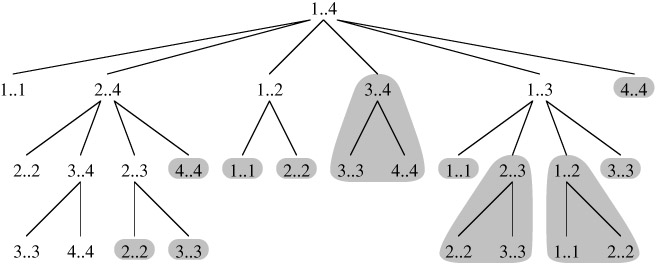
Since same suproblems are called again, this problem has Overlapping Subprolems property. So optimal BST problem has both properties (see thisand this) of a dynamic programming problem. Like other typical Dynamic Programming(DP) problems, recomputations of same subproblems can be avoided by constructing a temporary array cost[][] in bottom up manner.
Dynamic Programming Solution
Following is C/C++ implementation for optimal BST problem using Dynamic Programming. We use an auxiliary array cost[n][n] to store the solutions of subproblems. cost[0][n-1] will hold the final result. The challenge in implementation is, all diagonal values must be filled first, then the values which lie on the line just above the diagonal. In other words, we must first fill all cost[i][i] values, then all cost[i][i+1] values, then all cost[i][i+2] values. So how to fill the 2D array in such manner> The idea used in the implementation is same as Matrix Chain Multiplication problem, we use a variable ‘L’ for chain length and increment ‘L’, one by one. We calculate column number ‘j’ using the values of ‘i’ and ‘L’.
// Dynamic Programming code for Optimal Binary Search Tree Problem

#include <stdio.h>

#include <limits.h>

// A utility function to get sum of array elements freq[i] to freq[j]

int sum(int freq[], int i, int j);

/* A Dynamic Programming based function that calculates minimum cost of

   a Binary Search Tree. */

int optimalSearchTree(int keys[], int freq[], int n)

{

    /* Create an auxiliary 2D matrix to store results of subproblems */

    int cost[n][n];

    /* cost[i][j] = Optimal cost of binary search tree that can be

       formed from keys[i] to keys[j].

       cost[0][n-1] will store the resultant cost */

    // For a single key, cost is equal to frequency of the key

    for (int i = 0; i < n; i++)

        cost[i][i] = freq[i];

    // Now we need to consider chains of length 2, 3, ... .

    // L is chain length.

    for (int L=2; L<=n; L++)

    {

        // i is row number in cost[][]

        for (int i=0; i<=n-L+1; i++)

        {

            // Get column number j from row number i and chain length L

            int j = i+L-1;

            cost[i][j] = INT_MAX;

            // Try making all keys in interval keys[i..j] as root

            for (int r=i; r<=j; r++)

            {

               // c = cost when keys[r] becomes root of this subtree

               int c = ((r > i)? cost[i][r-1]:0) +

                       ((r < j)? cost[r+1][j]:0) +

                       sum(freq, i, j);

               if (c < cost[i][j])

                  cost[i][j] = c;

            }

        }

    }

    return cost[0][n-1];

}

// A utility function to get sum of array elements freq[i] to freq[j]

int sum(int freq[], int i, int j)

{

    int s = 0;

    for (int k = i; k <=j; k++)

       s += freq[k];

    return s;

}

// Driver program to test above functions

int main()

{

    int keys[] = {10, 12, 20};

    int freq[] = {34, 8, 50};

    int n = sizeof(keys)/sizeof(keys[0]);

    printf("Cost of Optimal BST is %d ", optimalSearchTree(keys, freq, n));

    return 0;

}
Output:
Cost of Optimal BST is 142
Notes
1) The time complexity of the above solution is O(n^4). The time complexity can be easily reduced to O(n^3) by pre-calculating sum of frequencies instead of calling sum() again and again.
2) In the above solutions, we have computed optimal cost only. The solutions can be easily modified to store the structure of BSTs also. We can create another auxiliary array of size n to store the structure of tree. All we need to do is, store the chosen ‘r’ in the innermost loop.
Please write comments if you find anything incorrect, or you want to share more information about the topic discussed above.
DP Intro - OBST的更多相关文章
- DP Intro - poj 2342 Anniversary party
今天开始做老师给的专辑,打开DP专辑 A题 Rebuilding Roads 直接不会了,发现是树形DP,百度了下了该题,看了老半天看不懂,想死的冲动都有了~~~~ 最后百度了下,树形DP入门,找到了 ...
- DP Intro - poj 1947 Rebuilding Roads
算法: dp[i][j]表示以i为根的子树要变成有j个节点的状态需要减掉的边数. 考虑状态转移的时候不考虑i的父亲节点,就当不存在.最后统计最少减去边数的 时候+1. 考虑一个节点时,有两种选择,要么 ...
- DP Intro - poj 1947 Rebuilding Roads(树形DP)
版权声明:本文为博主原创文章,未经博主允许不得转载. Rebuilding Roads Time Limit: 1000MS Memory Limit: 30000K Total Submissi ...
- DP Intro - Tree DP Examples
因为上次比赛sb地把一道树形dp当费用流做了,受了点刺激,用一天时间稍微搞一下树形DP,今后再好好搞一下) 基于背包原理的树形DP poj 1947 Rebuilding Roads 题意:给你一棵树 ...
- DP Intro - Tree POJ2342 Anniversary party
POJ 2342 Anniversary party (树形dp 入门题) Anniversary party Time Limit: 1000MS Memory Limit: 65536K To ...
- DP Intro - Tree DP
二叉苹果树 题目 有一棵苹果树,如果树枝有分叉,一定是分2叉(就是说没有只有1个儿子的结点) 这棵树共有N个结点(叶子点或者树枝分叉点),编号为1-N,树根编号一定是1. 我们用一根树枝两端连接的结点 ...
- BZOJ 1911: [Apio2010]特别行动队 [斜率优化DP]
1911: [Apio2010]特别行动队 Time Limit: 4 Sec Memory Limit: 64 MBSubmit: 4142 Solved: 1964[Submit][Statu ...
- 2013 Asia Changsha Regional Contest---Josephina and RPG(DP)
题目链接 http://acm.hdu.edu.cn/showproblem.php?pid=4800 Problem Description A role-playing game (RPG and ...
- AEAI DP V3.7.0 发布,开源综合应用开发平台
1 升级说明 AEAI DP 3.7版本是AEAI DP一个里程碑版本,基于JDK1.7开发,在本版本中新增支持Rest服务开发机制(默认支持WebService服务开发机制),且支持WS服务.RS ...
随机推荐
- css属性position的运用
随着web标准的规范化,网页的布局也随之千变万化.各种复杂漂亮有创意的页面布局冲 击这人们的视野,相比以前的table布局那就不是一等级的事儿.这个很大一部分功劳是css 样式的引入.而这个多样性布局 ...
- POJ - 2965 The Pilots Brothers' refrigerator(压位+bfs)
The game “The Pilots Brothers: following the stripy elephant” has a quest where a player needs to op ...
- C# 高斯消元项目运用
C# 高斯消元项目运用 最近项目涉及到一个需求,需要把指定数量的多个商品,混合装入到多个不同型号的箱子中(每种型号的箱子装入商品的种类和个数是固定的).这就涉及到解多元一次方程 针对多元一次方程一般用 ...
- go channel缓冲区的大小
go channel缓冲区的大小 len也可以作用于channel,代表现在channel缓冲区中还有多少数据没有读取.示例如下 c:=make(chan int,20) fmt.Println(&q ...
- 关于nosql的讲解
Data Base 关于nosql的讲解 nosql非关系型数据库. 优点: 1.可扩展 2.大数据量,高性能 3.灵活的数据模型 4.高可用 缺点: 1.不正式 2.不标准 非关系型数据库有哪些: ...
- c++最短路经典问题
一提起最短路,各位oier会想到什么呢? floyd,spfa,dij,或是bellman-ford? 其实,只要学会一种算法,大部分最短路问题就能很快解决了. 他就是堆优化的dijkstra. 首先 ...
- 钩子(hook)编程
一.钩子介绍 1.1钩子的实现机制 钩子英文名叫Hook,是一种截获windows系统中某应用程序或者所有进程的消息的一种技术.下图是windows应用程序传递消息的过程: 如在键盘中按下一键,操作系 ...
- 写excel
一.写excel import xlwt book = xlwt.Workbook()# 创建excel sheet = book.add_sheet('stu_info')# 加一个sheet sh ...
- Jmeter_远程启动
Jmeter 是Java 应用,对于CPU和内存的消耗比较大,因此,当需要模拟数以千计的并发用户时,使用单台机器模拟所有的并发用户就有些力不从心,甚至会引起JAVA内存溢出错误. 其实,Jmeter的 ...
- Leetcode 413. Arithmetic Slice 算术序列切片(动态规划,暴力)
Leetcode 413. Arithmetic Slice 算术序列切片(动态规划,暴力) 题目描述 如果一个数组1.至少三个元素2.两两之间差值相同,那么这个数组就是算术序列 比如下面的数组都是算 ...