
mybatis 源码分析(三)Executor 详解
本文将主要介绍 Executor 的整体结构和各子类的功能,并对比效率;
一、Executor 主体结构
1. 类结构
executor 的类结构如图所示:
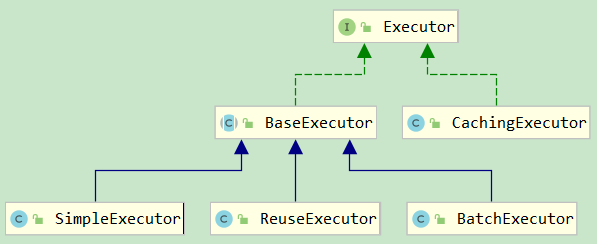
其各自的功能:
- BaseExecutor:基础执行器,封装了子类的公共方法,包括一级缓存、延迟加载、回滚、关闭等功能;
- SimpleExecutor:简单执行器,每执行一条 sql,都会打开一个 Statement,执行完成后关闭;
- ReuseExecutor:重用执行器,相较于 SimpleExecutor 多了 Statement 的缓存功能,其内部维护一个
Map<String, Statement>,每次编译完成的 Statement 都会进行缓存,不会关闭; - BatchExecutor:批量执行器,基于 JDBC 的
addBatch、executeBatch功能,并且在当前 sql 和上一条 sql 完全一样的时候,重用 Statement,在调用doFlushStatements的时候,将数据刷新到数据库; - CachingExecutor:缓存执行器,装饰器模式,在开启二级缓存的时候。会在上面三种执行器的外面包上 CachingExecutor;
2. Executor 的生命周期
初始化:
// DefaultSqlSessionFactory

private SqlSession openSessionFromDataSource(ExecutorType execType, TransactionIsolationLevel level, boolean autoCommit) {

  Transaction tx = null;

  try {

    final Environment environment = configuration.getEnvironment();

    final TransactionFactory transactionFactory = getTransactionFactoryFromEnvironment(environment);

    tx = transactionFactory.newTransaction(environment.getDataSource(), level, autoCommit);

    final Executor executor = configuration.newExecutor(tx, execType);

    return new DefaultSqlSession(configuration, executor, autoCommit);

  } catch (Exception e) {

    closeTransaction(tx); // may have fetched a connection so lets call close()

    throw ExceptionFactory.wrapException("Error opening session.  Cause: " + e, e);

  } finally {

    ErrorContext.instance().reset();

  }

}
关闭:
public void close() {

  try {

    executor.close(isCommitOrRollbackRequired(false));

    dirty = false;

  } finally {

    ErrorContext.instance().reset();

  }

}
所以 Executor 的生命周期和 SqlSession 是一样的,之所以要明确的指出这一点是因为 Executor 中包含了缓存的处理,并且因为 SqlSession 是线程不安全的,所以在使用 Executor 一级缓存的时候,就很容易发生脏读;后面还会通过具体示例演示;
3. query 方法
@Override

public <E> List<E> query(MappedStatement ms, Object parameter, RowBounds rowBounds, ResultHandler resultHandler) throws SQLException {

  BoundSql boundSql = ms.getBoundSql(parameter);   //获取绑定的sql

  CacheKey key = createCacheKey(ms, parameter, rowBounds, boundSql);  // hash(mappedStementId + offset + limit + sql + queryParams + environment)

  return query(ms, parameter, rowBounds, resultHandler, key, boundSql);

}

@SuppressWarnings("unchecked")

@Override

public <E> List<E> query(MappedStatement ms, Object parameter, RowBounds rowBounds, ResultHandler resultHandler, CacheKey key, BoundSql boundSql) throws SQLException {

  ErrorContext.instance().resource(ms.getResource()).activity("executing a query").object(ms.getId());

  if (closed) { throw new ExecutorException("Executor was closed."); }

  // 查询的时候一般不清楚缓存,但是可以通过 xml配置或者注解强制清除,queryStack == 0 是为了防止递归调用

  if (queryStack == 0 && ms.isFlushCacheRequired()) { clearLocalCache(); }

  List<E> list;

  try {

    queryStack++;

    // 首先查看一级缓存

    list = resultHandler == null ? (List<E>) localCache.getObject(key) : null;

    if (list != null) {

      handleLocallyCachedOutputParameters(ms, key, parameter, boundSql);

    } else {

      // 没有查到的时候直接到数据库查找

      list = queryFromDatabase(ms, parameter, rowBounds, resultHandler, key, boundSql);

    }

  } finally {

    queryStack--;

  }

  if (queryStack == 0) {

    // 延迟加载队列

    for (DeferredLoad deferredLoad : deferredLoads) {

      deferredLoad.load();

    }

    deferredLoads.clear();

    if (configuration.getLocalCacheScope() == LocalCacheScope.STATEMENT) {

  	  // 一级缓存本身不能关闭,但是可以设置作用范围 STATEMENT,每次都清除缓存

      clearLocalCache();

    }

  }

  return list;

}
4. update 方法
@Override

public int update(MappedStatement ms, Object parameter) throws SQLException {

  ErrorContext.instance().resource(ms.getResource()).activity("executing an update").object(ms.getId());

  if (closed) {

    throw new ExecutorException("Executor was closed.");

  }

  // update|insert|delete 方法首先会清除一级缓存

  clearLocalCache();

  return doUpdate(ms, parameter);

}
5. 模版方法
protected abstract int doUpdate(MappedStatement ms, Object parameter)

    throws SQLException;

protected abstract List<BatchResult> doFlushStatements(boolean isRollback)

    throws SQLException;

//query-->queryFromDatabase-->doQuery

protected abstract <E> List<E> doQuery(MappedStatement ms, Object parameter, RowBounds rowBounds, ResultHandler resultHandler, BoundSql boundSql)

    throws SQLException;
这里就是一个典型的模版模式了,子类都会实现自己模版方法;
二、BaseExecutor 子类
1. SimpleExecutor
@Override

public int doUpdate(MappedStatement ms, Object parameter) throws SQLException {

  Statement stmt = null;

  try {

    Configuration configuration = ms.getConfiguration();

    StatementHandler handler = configuration.newStatementHandler(this, ms, parameter, RowBounds.DEFAULT, null, null);

    stmt = prepareStatement(handler, ms.getStatementLog());

    return handler.update(stmt);

  } finally {

    closeStatement(stmt);

  }

}

@Override

public <E> List<E> doQuery(MappedStatement ms, Object parameter, RowBounds rowBounds, ResultHandler resultHandler, BoundSql boundSql) throws SQLException {

  Statement stmt = null;

  try {

    Configuration configuration = ms.getConfiguration();

    StatementHandler handler = configuration.newStatementHandler(wrapper, ms, parameter, rowBounds, resultHandler, boundSql);

    stmt = prepareStatement(handler, ms.getStatementLog());

    return handler.<E>query(stmt, resultHandler);

  } finally {

    closeStatement(stmt);

  }

}
从上面的代码也可以看到 SimpleExecutor 非常的简单,每次打开一个 Statement,使用完成以后关闭;
2. ReuseExecutor
private final Map<String, Statement> statementMap = new HashMap<String, Statement>();  // Statement 缓存

private Statement prepareStatement(StatementHandler handler, Log statementLog) throws SQLException {

  Statement stmt;

  BoundSql boundSql = handler.getBoundSql(); // 获取绑定的sql

  String sql = boundSql.getSql();

  if (hasStatementFor(sql)) { // 如果缓存中已经有了,直接得到Statement

    stmt = getStatement(sql);

  } else { // 如果缓存没有,就编译一个然后加入缓存

    Connection connection = getConnection(statementLog);

    stmt = handler.prepare(connection);

    putStatement(sql, stmt);

  }

  handler.parameterize(stmt);

  return stmt;

}
ReuseExecutor 就比 SimpleExecutor 多了一个 Statement 的缓存功能,其他的都是一样的;
3. BatchExecutor
首先需要明确一点 BachExecutor 是基于 JDBC 的 addBatch、executeBatch 功能的执行器,所以 BachExecutor 只能用于更新(insert|delete|update),不能用于查询(select),下面是一个 JDBC 的小 demo:
String url = "jdbc:mysql://localhost:3306/mybatis?serverTimezone=GMT";

String sql = "INSERT INTO user(username,password,address) VALUES (?,?,?)";

Class.forName("com.mysql.jdbc.Driver");

Connection conn = DriverManager.getConnection(url, "root", "root");

PreparedStatement stmt = conn.prepareStatement(sql);

for (int i = 0; i < 4000; i++) {

    stmt.setString(1, "test" + i);

    stmt.setString(2, "123456");

    stmt.setString(3, "test");

    stmt.addBatch();

}

stmt.executeBatch();
下面从源码来看一下 mybatis 是如何实现的:
private final List<Statement> statementList = new ArrayList<Statement>();        // 待处理的 Statement

private final List<BatchResult> batchResultList = new ArrayList<BatchResult>();  // 对应的结果集

private String currentSql;                                                       // 上一次执行 sql

private MappedStatement currentStatement;                                        // 上次执行的 MappedStatement

@Override

public int doUpdate(MappedStatement ms, Object parameterObject) throws SQLException {

  final Configuration configuration = ms.getConfiguration();

  final StatementHandler handler = configuration.newStatementHandler(this, ms, parameterObject, RowBounds.DEFAULT, null, null);

  final BoundSql boundSql = handler.getBoundSql();

  final String sql = boundSql.getSql();  // 本次执行的 sql

  final Statement stmt;

  // 当本次执行的 sql 和 MappedStatement 与上次的相同时,直接复用上一次的 Statement

  if (sql.equals(currentSql) && ms.equals(currentStatement)) {

    int last = statementList.size() - 1;

    stmt = statementList.get(last);

    BatchResult batchResult = batchResultList.get(last);

    batchResult.addParameterObject(parameterObject);

  } else {

    // 不同时,新建 Statement,并加入缓存

    Connection connection = getConnection(ms.getStatementLog());

    stmt = handler.prepare(connection);

    currentSql = sql;

    currentStatement = ms;

    statementList.add(stmt);

    batchResultList.add(new BatchResult(ms, sql, parameterObject));

  }

  handler.parameterize(stmt);

  handler.batch(stmt);  // 添加批处理任务

  return BATCH_UPDATE_RETURN_VALUE;  // 注意这里返回的不再是更新的行数,而是一个常量

}
BatchExecutor 的批处理添加过程相当于添加了一个没有返回值的异步任务,那么在什么时候执行异步任务,将数据更新到数据库呢,答案是处理 update 的任何操作,包括 select、commit、close等任何操作,具体执行的方法就是 doFlushStatements;此外需要注意的是 Batch 方式插入使用 useGeneratedKeys 获取主键,在提交完任务之后,并不能马上取到,因为此时 sql 语句还在缓存中没有真正执行,当执行完 Flush 之后,会通过回调的方式反射设置主键;
三、效率对比
几种执行器效率对比
| batch | Reuser | simple | foreach | foreach100 | |
|---|---|---|---|---|---|
| 100 | 369 | 148 | 151 | 68 | 70 |
| 1000 | 485 | 735 | 911 | 679 | 148 |
| 10000 | 2745 | 4064 | 4666 | 38607 | 1002 |
| 50000 | 8838 | 17788 | 19907 | 796444 | 3703 |
从上面的结果对比可以看到:
- 整体而言 reuser 比 simple 多了缓存功能,所以无论批处理的大小,其效率都要高一些;
- 此外在批处理量小的时候使用 foreach,效果还是可以的,但是当批量交大时,sql 编译的时间就大大增加了,当 foreach 固定批大小 + reuser 时,每次的 Statement 就可以重用,从表中也可以看到效率也时最高的;
- batch 的优点则是所有的更新语句都能用;
- 所以在配置的时候建议默认使用 reuser,而使用 foreach 和 batch 需要根据具体场景分析,如果更新比较多的时候,可以在批量更新的时候单独指定 ExecutorType.BATCH,如果批量插入很多的时候,可以固定批大小;
mybatis 源码分析(三)Executor 详解的更多相关文章
- 【集合框架】JDK1.8源码分析之ArrayList详解(一)
[集合框架]JDK1.8源码分析之ArrayList详解(一) 一. 从ArrayList字表面推测 ArrayList类的命名是由Array和List单词组合而成,Array的中文意思是数组,Lis ...
- nginx源码分析线程池详解
nginx源码分析线程池详解 一.前言 nginx是采用多进程模型,master和worker之间主要通过pipe管道的方式进行通信,多进程的优势就在于各个进程互不影响.但是经常会有人问道,n ...
- vuex 源码分析(六) 辅助函数 详解
对于state.getter.mutation.action来说,如果每次使用的时候都用this.$store.state.this.$store.getter等引用,会比较麻烦,代码也重复和冗余,我 ...
- vuex 源码分析(五) action 详解
action类似于mutation,不同的是Action提交的是mutation,而不是直接变更状态,而且action里可以包含任意异步操作,每个mutation的参数1是一个对象,可以包含如下六个属 ...
- Golang源码分析之目录详解
开源项目「go home」聚焦Go语言技术栈与面试题,以协助Gopher登上更大的舞台,欢迎go home~ 导读 学习Go语言源码的第一步就是了解先了解它的目录结构,你对它的源码目录了解多少呢? 目 ...
- Tomcat源码分析 | 一文详解生命周期机制Lifecycle
目录 什么是Lifecycle? Lifecycle方法 LifecycleBase 增加.删除和获取监听器 init() start() stop() destroy() 模板方法 总结 前言 To ...
- Java 容器源码分析之集合类详解
集合类说明及区别 Collection ├List │├LinkedList │├ArrayList │└Vector │ └Stack └Set Map ├Hashtable ├HashMap └W ...
- Cloudera Impala源码分析: SimpleScheduler调度策略详解包括作用、接口及实现等
问题导读:1.Scheduler任务中Distributed Plan.Scan Range是什么?2.Scheduler基本接口有哪些?3.QuerySchedule这个类如何理解?4.Simple ...
- 精尽MyBatis源码分析 - MyBatis 的 SQL 执行过程(一)之 Executor
该系列文档是本人在学习 Mybatis 的源码过程中总结下来的,可能对读者不太友好,请结合我的源码注释(Mybatis源码分析 GitHub 地址.Mybatis-Spring 源码分析 GitHub ...
- 精尽MyBatis源码分析 - SQL执行过程(三)之 ResultSetHandler
该系列文档是本人在学习 Mybatis 的源码过程中总结下来的,可能对读者不太友好,请结合我的源码注释(Mybatis源码分析 GitHub 地址.Mybatis-Spring 源码分析 GitHub ...
随机推荐
- Java编程思想:I/O的典型使用方式
import java.io.*; public class Test { public static void main(String[] args) { // BufferedInputFile. ...
- Java map笔记
Map 是一个键值对的集合 花和尚 豹子头 鲁智深 林冲 如果想要从map中获得值,可以根据键 Map<Key,velue> Map虽然是集合,但是和collection的接口无关 我们可 ...
- Flume框架的学习使用
Flume框架的学习使用 Flume简介 Flume提供一个分布式的,可靠的,对大数据量的日志进行高效收集.聚集.移动的服务. Flume基于流失架构,容错性强,也很灵活简单 Flume,kafka用 ...
- SQL Server 设置默认数据库
STEP 1 调用系统函数 查看SQL Server的当前用户名 SELECT SUSER_NAME(); NOTE : 系统函数的调用跟sql语句执行一样 Paste_Image.png 运行结果 ...
- mySQL相关函数的使用
获取执行SQL指令被影响的记录数或字段数 ·mysqlo_num_rows()函数:适用于执行SELECT语句,可以返回被筛选出来的记录数. 其语法如下,参数result为资源标识符 mysqlo_n ...
- Python基础总结之第五天开始【认识简单的条件语句,也可以叫判断语句】(新手可相互督促)
周五更新很累... 坚持,年薪20万又进了一步~~ python中的条件语句以[ if ]开头,条件语句成立时,运行该代码块,如果条件不成立,则跳过该代码块,执行后面的代码块. 简单的小示例: 输入性 ...
- iView学习笔记(一):Table基本操作(包含前后端示例代码)
iView表格操作 1.前端准备工作 首先新建一个项目,然后引入iView插件,配置好router npm安装iView npm install iview --save cnpm install i ...
- 腾讯云centos7 从零搭建laravel项目
目标,访问网站出现: -----------------------分割线---------------------------------------- 一.Laravel Homestead 环境 ...
- Redis项目实战---应用及理论(二)---Redis集群原理
一. Redis官方推荐集群方案:Redis Cluster 适用于redis3.0以后版本, redis cluster 是redis官方提供的分布式解决方案,在3.0版本后推出的,有 ...
- 加深对C#数据类型的认识
值类型: 值类型源于System.Value家族,每个值类型的对象都有一个独立的内存区域用于保存自己的值,值类型 所在的内存区域称之为栈(Stack),只要在代码中修改它,就会在内存区域保存这个值. ...