
mysql学习笔记4---mysql 复制---源代码
mysql:

c:底层

C++:相对上层

主备复制:主库通知备库来取

MYSQL复制源代码代码:SQL文件夹

int start_slave_thread(

#ifdef HAVE_PSI_INTERFACE

                       PSI_thread_key thread_key,

#endif

                       pthread_handler h_func, mysql_mutex_t *start_lock,

                       mysql_mutex_t *cond_lock,

                       mysql_cond_t *start_cond,

                       volatile uint *slave_running,

                       volatile ulong *slave_run_id,

                       Master_info* mi)

{

  pthread_t th;

  ulong start_id;

  int error;

  DBUG_ENTER("start_slave_thread");

  if (start_lock)

    mysql_mutex_lock(start_lock);

  if (!server_id)

  {

    if (start_cond)

      mysql_cond_broadcast(start_cond);

    if (start_lock)

      mysql_mutex_unlock(start_lock);

    sql_print_error("Server id not set, will not start slave");

    DBUG_RETURN(ER_BAD_SLAVE);

  }

  if (*slave_running)

  {

    if (start_cond)

      mysql_cond_broadcast(start_cond);

    if (start_lock)

      mysql_mutex_unlock(start_lock);

    DBUG_RETURN(ER_SLAVE_MUST_STOP);

  }

  start_id= *slave_run_id;

  DBUG_PRINT("info",("Creating new slave thread"));

  if ((error= mysql_thread_create(thread_key,

                          &th, &connection_attrib, h_func, (void*)mi)))

  {

    sql_print_error("Can't create slave thread (errno= %d).", error);

    if (start_lock)

      mysql_mutex_unlock(start_lock);

    DBUG_RETURN(ER_SLAVE_THREAD);

  }

  if (start_cond && cond_lock) // caller has cond_lock

  {

    THD* thd = current_thd;

    while (start_id == *slave_run_id && thd != NULL)

    {

      DBUG_PRINT("sleep",("Waiting for slave thread to start"));

      PSI_stage_info saved_stage= {, "", };

      thd->ENTER_COND(start_cond, cond_lock,

                      & stage_waiting_for_slave_thread_to_start,

                      & saved_stage);

      /*

        It is not sufficient to test this at loop bottom. We must test

        it after registering the mutex in enter_cond(). If the kill

        happens after testing of thd->killed and before the mutex is

        registered, we could otherwise go waiting though thd->killed is

        set.

      */

      if (!thd->killed)

        mysql_cond_wait(start_cond, cond_lock);

      thd->EXIT_COND(& saved_stage);

      mysql_mutex_lock(cond_lock); // re-acquire it as exit_cond() released

      if (thd->killed)

      {

        if (start_lock)

          mysql_mutex_unlock(start_lock);

        DBUG_RETURN(thd->killed_errno());

      }

    }

  }

  if (start_lock)

    mysql_mutex_unlock(start_lock);

  DBUG_RETURN();

}

/**

  Slave IO thread entry point.

  @param arg Pointer to Master_info struct that holds information for

  the IO thread.

  @return Always 0.

*/

pthread_handler_t handle_slave_io(void *arg)

{

  THD *thd= NULL; // needs to be first for thread_stack

  bool thd_added= false;

  MYSQL *mysql;

  Master_info *mi = (Master_info*)arg;

  Relay_log_info *rli= mi->rli;

  char llbuff[];

  uint retry_count;

  bool suppress_warnings;

  int ret;

  int binlog_version;

#ifndef DBUG_OFF

  uint retry_count_reg= , retry_count_dump= , retry_count_event= ;

#endif

  // needs to call my_thread_init(), otherwise we get a coredump in DBUG_ stuff

  my_thread_init();

  DBUG_ENTER("handle_slave_io");

..

}

/**

  Slave SQL thread entry point.

  @param arg Pointer to Relay_log_info object that holds information

  for the SQL thread.

  @return Always 0.

*/

pthread_handler_t handle_slave_sql(void *arg)

{

  THD *thd;                     /* needs to be first for thread_stack */

  bool thd_added= false;

  char llbuff[],llbuff1[];

  char saved_log_name[FN_REFLEN];

  char saved_master_log_name[FN_REFLEN];

  my_off_t saved_log_pos= ;

  my_off_t saved_master_log_pos= ;

  my_off_t saved_skip=

   if (exec_relay_log_event(thd,rli))

......................................

}

mysql_execute_command(THD *thd)

{

    。。。。。。。。。。。。

  case SQLCOM_SLAVE_START:

  {

    mysql_mutex_lock(&LOCK_active_mi);

    if (active_mi != NULL)

      res= start_slave(thd, active_mi,  /* net report*/);

    else

      my_message(ER_SLAVE_CONFIGURATION, ER(ER_SLAVE_CONFIGURATION),

                 MYF());

    mysql_mutex_unlock(&LOCK_active_mi);

    break;

    。。。。。。。。。。。。。。。。。。。

  }

  /**

  Top-level function for executing the next event in the relay log.

  This is called from the SQL thread.

  This function reads the event from the relay log, executes it, and

  advances the relay log position.  It also handles errors, etc.

  This function may fail to apply the event for the following reasons:

   - The position specfied by the UNTIL condition of the START SLAVE

     command is reached.

   - It was not possible to read the event from the log.

   - The slave is killed.

   - An error occurred when applying the event, and the event has been

     tried slave_trans_retries times.  If the event has been retried

     fewer times, 0 is returned.

   - init_info or init_relay_log_pos failed. (These are called

     if a failure occurs when applying the event.)

   - An error occurred when updating the binlog position.

  @retval 0 The event was applied.

  @retval 1 The event was not applied.

*/

static int exec_relay_log_event(THD* thd, Relay_log_info* rli)

{

  DBUG_ENTER("exec_relay_log_event");

  /*

     We acquire this mutex since we need it for all operations except

     event execution. But we will release it in places where we will

     wait for something for example inside of next_event().

   */

  mysql_mutex_lock(&rli->data_lock);

  /*

    UNTIL_SQL_AFTER_GTIDS requires special handling since we have to check

    whether the until_condition is satisfied *before* the SQL threads goes on

    a wait inside next_event() for the re

    。。。。。。。。。。。。

    }

    */

    exec_res= apply_event_and_update_pos(ptr_ev, thd, rli);

    apply_event_and_update_pos(Log_event** ptr_ev, THD* thd, Relay_log_info* rli)

 class Query_log_event: public Log_event

{

  LEX_STRING user;

  LEX_STRING host;

protected:

  Log_event::Byte* data_buf;

public:

  const char* query;

  const char* catalog;

  const char* db;

  /*

    If we already know the length of the query string

    we pass it with q_len, so we would not have to call strlen()

    otherwise, set it to 0, in which case, we compute it with strlen()

  */

  uint32 q_len;

  uint32 db_len;

  uint16 error_code;

  ulong thread_id;

  /*

    For events created by Query_log_event::do_apply_event (and

    Load_log_event::do_apply_event()) we need the *original* thread

    id, to be able to log the event with the original (=master's)

    thread id (fix for BUG#1686).

  */

  ulong slave_proxy_id;

  /*

    Binlog format 3 and 4 start to differ (as far as class members are

    concerned) from here.

  */

  uint catalog_len;            // <= 255 char; 0 means uninited

  /*

    We want to be able to store a variable number of N-bit status vars:

    (generally N=32; but N=64 for SQL_MODE) a user may want to log the number

    of affected rows (for debugging) while another does not want to lose 4

    bytes in this.

    The storage on disk is the following:

    status_vars_len is part of the post-header,

    status_vars are in the variable-length part, after the post-header, before

    the db & query.

    status_vars on disk is a sequence of pairs (code, value) where 'code' means

    'sql_mode', 'affected' etc. Sometimes 'value' must be a short string, so

    its first byte is its length. For now the order of status vars is:

    flags2 - sql_mode - catalog - autoinc - charset

    We should add the same thing to Load_log_event, but in fact

    LOAD DATA INFILE is going to be logged with a new type of event (logging of

    the plain text query), so Load_log_event would be frozen, so no need. The

    new way of logging LOAD DATA INFILE would use a derived class of

    Query_log_event, so automatically benefit from the work already done for

    status variables in Query_log_event.

 */

  uint16 status_vars_len;

  /*

    'flags2' is a second set of flags (on top of those in Log_event), for

    session variables. These are thd->options which is & against a mask

    (OPTIONS_WRITTEN_TO_BIN_LOG).

    flags2_inited helps make

    。。

    }

    */

    主库/备库 挂了,数据不一致

     :主健冲突,备库大于主库数据,,主库少了数据 ,主库挂了

    :备库比主库数据少

    set session sql_log_bin=;
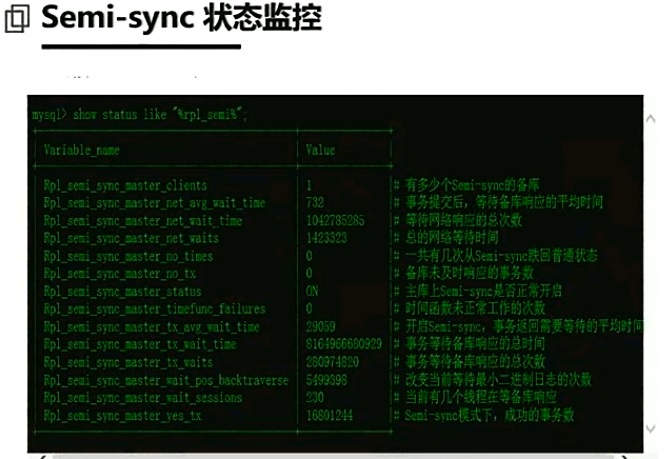
semi-sync安装---master

master 安装过程:

install plugin rpl_semi_sync_master soname 'semisync_master.so'

show variables like 'rpl_semi_sync_master_enabled'

值为ON,表示开启;否则检查失败原因

set global rpl_semi_sync_master_timeout=(利于观察)

set global rpl_semi_sync_master_wait_no_slave=

(是默认值,表示即使没有slave 也会以等待过期时间结束)
mysql学习笔记4---mysql 复制---源代码的更多相关文章
- MySQL学习笔记十七:复制特性
一.MySQL的复制是将主数据库(master)的数据复制到从(slave)数据库上,专业一点讲就是将主数据库DDL和DML操作的二进制日志传到从库上,然后从库对这些二进制日志进行重做,使得主数据库与 ...
- 吴裕雄--天生自然MySQL学习笔记:MySQL 安装
所有平台的 MySQL 下载地址为: MySQL 下载:https://dev.mysql.com/downloads/mysql/ 注意:安装过程我们需要通过开启管理员权限来安装,否则会由于权限不足 ...
- 吴裕雄--天生自然MySQL学习笔记:MySQL 运算符
要介绍 MySQL 的运算符及运算符的优先级. MySQL 主要有以下几种运算符: 算术运算符 比较运算符 逻辑运算符 位运算符 算术运算符 MySQL 支持的算术运算符包括: 在除法运算和模运算中, ...
- 吴裕雄--天生自然MySQL学习笔记:MySQL 导入数据
1.mysql 命令导入 使用 mysql 命令导入语法格式为: mysql -u用户名 -p密码 < 要导入的数据库数据(runoob.sql) 实例: # mysql -uroot -p12 ...
- 吴裕雄--天生自然MySQL学习笔记:MySQL 处理重复数据
有些 MySQL 数据表中可能存在重复的记录,有些情况允许重复数据的存在,但有时候我们也需要删除这些重复的数据. 防止表中出现重复数据 可以在 MySQL 数据表中设置指定的字段为 PRIMARY K ...
- 吴裕雄--天生自然MySQL学习笔记:MySQL 临时表
MySQL 临时表在我们需要保存一些临时数据时是非常有用的.临时表只在当前连接可见,当关闭连接时,Mysql会自动删除表并释放所有空间. MySQL临时表只在当前连接可见,如果使用PHP脚本来创建My ...
- 吴裕雄--天生自然MySQL学习笔记:MySQL 事务
MySQL 事务主要用于处理操作量大,复杂度高的数据.比如说,在人员管理系统中,你删除一个人员,你即需要删除人员的基本资料,也要删除和该人员相关的信息,如信箱,文章等等,这样,这些数据库操作语句就构成 ...
- 吴裕雄--天生自然MySQL学习笔记:MySQL GROUP BY 语句
GROUP BY 语句根据一个或多个列对结果集进行分组. 在分组的列上我们可以使用 COUNT, SUM, AVG,等函数. GROUP BY 语法 SELECT column_name, funct ...
- 吴裕雄--天生自然MySQL学习笔记:MySQL UNION 操作符
MySQL UNION 操作符用于连接两个以上的 SELECT 语句的结果组合到一个结果集合中.多个 SELECT 语句会删除重复的数据. 语法 MySQL UNION 操作符语法格式: SELECT ...
- 吴裕雄--天生自然MySQL学习笔记:MySQL 连接
使用mysql二进制方式连接 您可以使用MySQL二进制方式进入到mysql命令提示符下来连接MySQL数据库. 实例 以下是从命令行中连接mysql服务器的简单实例: [root@host]# my ...
随机推荐
- Latex 常用知识点存档
前言: 本篇仅作为自己的知识存档. $Latex$是什么,就不用介绍了,网上好多教程和知识点,当忘记的时候搜一下就可以了. 本科做美赛和毕设的时候用的$Latex$排版,最近开始在博客园写点东东,发现 ...
- http://rogerdudler.github.io/git-guide/index.zh.html
http://rogerdudler.github.io/git-guide/index.zh.html
- Realm for Android快速入门教程
介绍 如果你关注安卓开发的最新趋势,你可能已经听说过Realm.Realm是一个可以替代SQLite以及ORMlibraries的轻量级数据库. 相比SQLite,Realm更快并且具有很多现代数据库 ...
- Deep Learning论文笔记之(八)Deep Learning最新综述
Deep Learning论文笔记之(八)Deep Learning最新综述 zouxy09@qq.com http://blog.csdn.net/zouxy09 自己平时看了一些论文,但老感觉看完 ...
- 一个优秀的http实现框架
package com.ming; import com.mashape.unirest.http.HttpResponse; import com.mashape.unirest.http.Unir ...
- 深入详解SQL中的Null
深入详解SQL中的Null NULL 在计算机和编程世界中表示的是未知,不确定.虽然中文翻译为 “空”, 但此空(null)非彼空(empty). Null表示的是一种未知状态,未来状态,比如小明兜里 ...
- 转自 x_x的百度空间
空华人生 by 淡漠的心情 昨天,又昨天. 今天,又今天. 明天,又明天. 日历渐渐稀薄,忽然发现,那是时间的痕迹. 似乎,总是在麻木的等待. 何时,才能历尽. 再算算,我又还有多少天 ...
- 【转】Linux(ubuntu14.04)上编译Android4.4源码的环境搭建及编译全过程
原文网址:http://jileniao.net/linux-android-building.html sublime text让我伤心.本来很信任sublime text的自动保存功能,之前使用一 ...
- (转载)struct 与typdef struct的区别
(转载)http://blog.csdn.net/piratejk/article/details/3491226 1. 基本解释 typedef为C语言的关键字,作用是为一种数据类型定义一个新名字. ...
- Uninstall Tool 3.3.2.5315 简体中文注册版(彻底卸载软件)
Uninstall Tool Uninstall Tool是CrystalIdea Software出品的一款强大而灵活的Windows标准“添加/删除程序”工具的替代软件.它能快速,安全而方便的删除 ...