
Self-Taught Learning to Deep Networks
In this section, we describe how you can fine-tune and further improve the learned features using labeled data. When you have a large amount of labeled training data, this can significantly improve your classifier's performance.
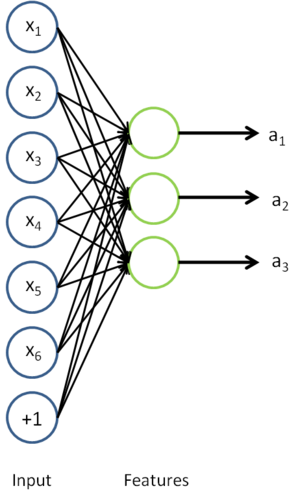
In self-taught learning, we first trained a sparse autoencoder on the unlabeled data. Then, given a new example
, we used the hidden layer to extract features
. This is illustrated in the following diagram:
We are interested in solving a classification task, where our goal is to predict labels
. We have a labeled training set
of
labeled examples. We showed previously that we can replace the original features
with features
computed by the sparse autoencoder (the "replacement" representation). This gives us a training set
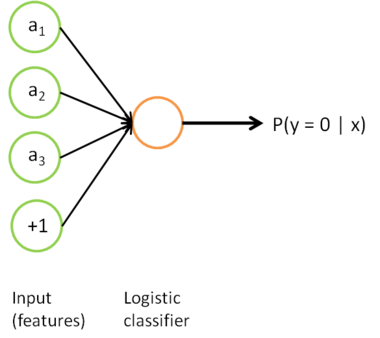
. Finally, we train a logistic classifier to map from the features
to the classification label
.
we can draw our logistic regression unit (shown in orange) as follows:
Now, consider the overall classifier (i.e., the input-output mapping) that we have learned using this method. In particular, let us examine the function that our classifier uses to map from from a new test example
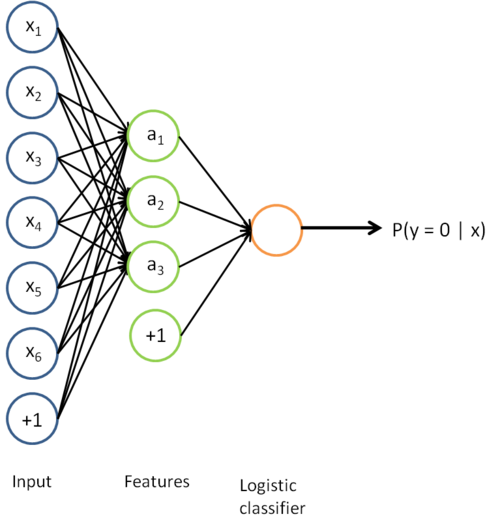
The parameters of this model were trained in two stages: The first layer of weights  mapping from the input to the hidden unit activations were trained as part of the sparse autoencoder training process. The second layer of weights
  mapping from the activations to the output was trained using logistic regression (or softmax regression).
But the form of our overall/final classifier is clearly just a whole big neural network. So, having trained up an initial set of parameters for our model (training the first layer using an autoencoder, and the second layer via logistic/softmax regression), we can further modify all the parameters in our model to try to further reduce the training error. In particular, we can fine-tune the parameters, meaning perform gradient descent (or use L-BFGS) from the current setting of the parameters to try to reduce the training error on our labeled training set .
When fine-tuning is used, sometimes the original unsupervised feature learning steps (i.e., training the autoencoder and the logistic classifier) are called pre-training. The effect of fine-tuning is that the labeled data can be used to modify the weights W(1) as well, so that adjustments can be made to the features a extracted by the layer of hidden units.
if we are using fine-tuning usually we will do so with a network built using the replacement representation. (If you are not using fine-tuning however, then sometimes the concatenation representation can give much better performance.)
When should we use fine-tuning? It is typically used only if you have a large labeled training set; in this setting, fine-tuning can significantly improve the performance of your classifier. However, if you have a large unlabeled dataset (for unsupervised feature learning/pre-training) and only a relatively small labeled training set, then fine-tuning is significantly less likely to help.
Self-Taught Learning to Deep Networks的更多相关文章
- 【论文考古】联邦学习开山之作 Communication-Efficient Learning of Deep Networks from Decentralized Data
B. McMahan, E. Moore, D. Ramage, S. Hampson, and B. A. y Arcas, "Communication-Efficient Learni ...
- Communication-Efficient Learning of Deep Networks from Decentralized Data
郑重声明:原文参见标题,如有侵权,请联系作者,将会撤销发布! Proceedings of the 20th International Conference on Artificial Intell ...
- Deep Learning 8_深度学习UFLDL教程:Stacked Autocoders and Implement deep networks for digit classification_Exercise(斯坦福大学深度学习教程)
前言 1.理论知识:UFLDL教程.Deep learning:十六(deep networks) 2.实验环境:win7, matlab2015b,16G内存,2T硬盘 3.实验内容:Exercis ...
- (转)Understanding, generalisation, and transfer learning in deep neural networks
Understanding, generalisation, and transfer learning in deep neural networks FEBRUARY 27, 2017 Thi ...
- 论文笔记之:UNSUPERVISED REPRESENTATION LEARNING WITH DEEP CONVOLUTIONAL GENERATIVE ADVERSARIAL NETWORKS
UNSUPERVISED REPRESENTATION LEARNING WITH DEEP CONVOLUTIONAL GENERATIVE ADVERSARIAL NETWORKS ICLR 2 ...
- 深度学习材料:从感知机到深度网络A Deep Learning Tutorial: From Perceptrons to Deep Networks
In recent years, there’s been a resurgence in the field of Artificial Intelligence. It’s spread beyo ...
- This instability is a fundamental problem for gradient-based learning in deep neural networks. vanishing exploding gradient problem
The unstable gradient problem: The fundamental problem here isn't so much the vanishing gradient pro ...
- [译]深度神经网络的多任务学习概览(An Overview of Multi-task Learning in Deep Neural Networks)
译自:http://sebastianruder.com/multi-task/ 1. 前言 在机器学习中,我们通常关心优化某一特定指标,不管这个指标是一个标准值,还是企业KPI.为了达到这个目标,我 ...
- Learning Combinatorial Embedding Networks for Deep Graph Matching(基于图嵌入的深度图匹配)
1. 文献信息 题目: Learning Combinatorial Embedding Networks for Deep Graph Matching(基于图嵌入的深度图匹配) 作者:上海交通大学 ...
随机推荐
- Python3基础笔记--常用模块
目录: 参考博客:Python 之路 Day5 - 常用模块学习 Py西游攻关之模块 一.time模块 二.random模块 三.os模块 四.sys模块 五.hashlib模块 六.logging模 ...
- SSD-2(代码部分介绍)
single shot multibox detectior tensorflow 代码 一.SSD重要参数设置 在ssd_vgg_300.py文件中初始化重要的网络参数,主要有用于生成默认框的特征层 ...
- linux傻瓜式安装lnmp
一.百度 https://lnmp.org/install.html 二.点击 <安装> 三.登录 linux cd /usr/local/ wget -c http://soft.vps ...
- python 代码编写规范
一 代码编排1 缩进.4个空格的缩进(编辑器都可以完成此功能),不使用Tap,更不能混合使用Tap和空格.2 每行最大长度79,换行可以使用反斜杠,最好使用圆括号.换行点要在操作符的后边敲回车.3 类 ...
- [HAOI2007][SDOI2005]反素数
题目:洛谷P1463.BZOJ1053.Vijos P1172.codevs2912. 题目大意:对于任何正整数x,其约数的个数记作g(x).例如g(1)=1.g(6)=4. 如果某个正整数x满足:g ...
- PHP -Casbin: 支持 ACL、RBAC、ABAC 多种模型的 PHP 权限管理框架
PHP-Casbin 是一个用 PHP 语言打造的轻量级开源访问控制框架( https://github.com/php-casbin... ),目前在 GitHub 开源.PHP-Casbin 采用 ...
- 移动端(手机端)页面自适应解决方案—rem布局篇
移动端(手机端)页面自适应解决方案-rem布局 假设设计妹妹给我们的设计稿尺寸为750 * 1340.结合网易.淘宝移动端首页html元素上的动态font-size属性.设计稿尺寸.前端与设计之间协作 ...
- caioj 1111 树形动态规划(TreeDP)6: 皇宫看守 (状态设计)
这道题的难点在于状态怎么设计 这道题要求全部都是安全的,所以我们做的时候自底向上每一个结点都要是安全的 结合前一题当前结点选和不选,我们可以分出四种情况出来 选 安全 选 不安全 不选 安全 不选 不 ...
- Hadoop集群管理--保证集群平稳地执行
本篇介绍为了保证Hadoop集群平稳地执行.须要深入掌握的知识.以及一些管理监控的手段,日常维护的工作. HDFS 永久性数据结构 对于管理员来说.深入了解namenode,辅助namecode和da ...
- Raphaeljs入门到精通(一)
<!DOCTYPE html> <html xmlns="http://www.w3.org/1999/xhtml"> <head> <t ...