
进程间通信和同步:pipe、FIFO、消息队列、信号量、共享内存、信号
一、半双工管道(pipe)

关于管道详细介绍可参考http://www.cnblogs.com/nufangrensheng/p/3560130.html。
1、管道实现父子进程间通信实例:
/* pipe.c */

#include <unistd.h>

#include <stdio.h>

#include <limits.h>

#include <sys/types.h>

#include <errno.h>

#include <stdlib.h>

#define MAXLINE 1024

int

main(void)

{

    int fd[2], pid;

    char buf[MAXLINE];

    if(pipe(fd) < 0)

    {

        perror("pipe error");

        exit(1);

    }

    if((pid = fork()) < 0)

    {

        perror("fork error");

        exit(1);

    }

    else if(pid == 0)    /* child */

    {

        close(fd[1]);    /* read from parent */

        if(read(fd[0], buf, MAXLINE) < 0)

        {

            perror("read error");

            exit(1);

        }

        printf("read from parent: %s\n", buf);

    }

    else            /* parent */

    {

        close(fd[0]);    /* send to child */

        if(write(fd[1], "hello, i am your parent", 24) != 24)

        {

            perror("write error");

            exit(1);

        }

        printf("send to  child OK!\n");

        wait(NULL);

    }

}
编译运行结果:

2、管道实现父子进程间同步实例:
/* pipe_sync.c */

#include <sys/types.h>

#include <errno.h>

#include <unistd.h>

#include <stdio.h>

#include <stdlib.h>

#include <unistd.h>

#define    BUFSIZE    1024

int fd1[2], fd2[2];

char c;

void tell_wait()

{

    if(pipe(fd1) < 0 || pipe(fd2) < 0)

    {

        perror("pipe error");

        exit(1);

    }

}

void tell_parent()

{

    if(write(fd1[1], "c", 1) != 1)

    {

        perror("write error");

        exit(1);

    }

}

void wait_parent()

{

    if(read(fd2[0], &c, 1) != 1)

    {

        perror("read error");

        exit(1);

    }

    if(c != 'p')

    {

        printf("wait_parent: invalid data\n");

        exit(1);

    }

}

void tell_child()

{

    if(write(fd2[1], "p", 1) != 1)

    {

        perror("write error");

        exit(1);

    }

}

void wait_child()

{

    if(read(fd1[0], &c, 1) != 1)

    {

        perror("read error");

        exit(1);

    }

    if(c != 'c')

    {

        printf("wait_child: invalid data");

        exit(1);

    }

}

int

main(void)

{

    int pid;

    tell_wait();

    if((pid = fork()) < 0)

    {

        perror("fork error");

        exit(1);

    }

    else if(pid == 0)

    {

        printf("child: first\n");

        tell_parent();

    }

    else

    {

        wait_child();

        printf("parent: after child\n");

    }

    return(0);

}
编译运行结果:

二、命名管道(FIFO)

在文件系统中命名管道是以设备特殊文件的形式存在的。
不同的进程可以通过命名管道共享数据。
关于FIFO详细介绍可参考http://www.cnblogs.com/nufangrensheng/p/3561632.html。
FIFO实现进程间通信实例:
/***************************

* **** FIFO server**********

***************************/

#include <stdio.h>

#include <stdlib.h>

#include <errno.h>

#include <unistd.h>

#include <fcntl.h>

#include <sys/types.h>

#include <sys/stat.h>

#define FIFO     "/home/zhu/network/fifo/myfifo"

#define OPEN_MODE    O_RDONLY

int

main(void)

{

    int fifofd;

    char buf[80];
unlink(FIFO); /* 防止FIFO已存在 */
 if(mkfifo(FIFO, 0777) == -1)

    {

        perror("mkfifo");

        exit(1);

    }

    if((fifofd = open(FIFO, OPEN_MODE)) < 0)

    {

        perror("open");

        exit(1);

    }

    read(fifofd, buf, sizeof(buf));

    printf("message from client: %s\n", buf);

    close(fifofd);

    return(0);

}
/***************************

* **** FIFO client**********

***************************/

#include <stdio.h>

#include <stdlib.h>

#include <errno.h>

#include <unistd.h>

#include <fcntl.h>

#include <sys/types.h>

#include <sys/stat.h>

#define FIFO     "/home/zhu/network/fifo/myfifo"

#define OPEN_MODE    O_WRONLY

int

main(void)

{

    int fifofd;

    char s[] = "hello,server!";

    if((fifofd = open(FIFO, OPEN_MODE)) < 0)

    {

        perror("open");

        exit(1);

    }

    write(fifofd, s, sizeof(s));

    printf("write message: %s\n", s);

    close(fifofd);

    return(0);

}
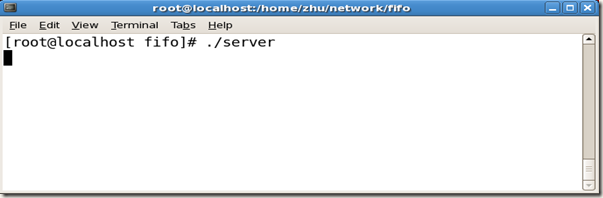
编译成功后,我们首先运行服务器(创建FIFO,等待客户发来消息,此时FIFO服务器阻塞):
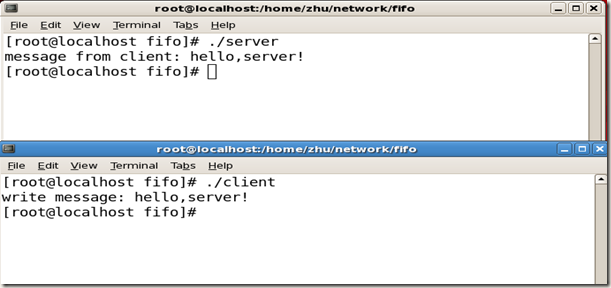
接着我们在另一个终端窗口运行客户程序,如下图所示,可以看出客户端已成功发送,服务器端也成功接收:
三、消息队列
消息队列是内核地址空间中的内部链表,通过Linux内核在各个进程之间传递内容。
关于消息队列详细介绍可参考http://www.cnblogs.com/nufangrensheng/p/3561820.html。
消息队列实现进程间通信实例:
/***************************

*******MSGQ server**********

***************************/

#include <sys/msg.h>

#include <sys/ipc.h>

#include <stdio.h>

#include <stdlib.h>

#include <errno.h>

#include <fcntl.h>

#include <unistd.h>

#include <sys/types.h>

#include <sys/stat.h>

#define msqpath    "/home/zhu/network/msgqueue/msq"

#define proj_id    'b'

struct mymesg {

    long mtype;

    char mtext[512];

};

int

main(void)

{

    key_t key;

    int msqid;

    struct msqid_ds buf;

    struct mymesg msg1;

    msg1.mtype = 1;

    sprintf(msg1.mtext, "hello");

    if((key = ftok(msqpath, proj_id)) < 0)

    {

        perror("ftok");

        exit(1);

    }

    if((msqid = msgget(key, IPC_CREAT)) < 0)

    {

        perror("msgget");

        exit(1);

    }

    if(msgsnd(msqid, &msg1, sizeof(msg1), IPC_NOWAIT) < 0)

    {

        perror("msgsnd");

        exit(1);

    }

    printf(“send message : hello\n”);

    if(msgctl(msqid, IPC_STAT, &buf) < 0)

    {

        perror("msgctl");

        exit(1);

    }

    printf("message queue # of messages is: %d\n", buf.msg_qnum);

    return(0);

}
/*****************************

**********MSGQ client*********

*****************************/

#include <sys/msg.h>

#include <sys/ipc.h>

#include <stdio.h>

#include <stdlib.h>

#include <errno.h>

#include <fcntl.h>

#include <unistd.h>

#include <sys/types.h>

#include <sys/stat.h>

#define msqpath    "/home/zhu/network/msgqueue/msq"

#define proj_id    'b'

struct mymesg {

    long mtype;

    char mtext[512];

};

int

main(void)

{

    key_t key;

    int msqid;

    struct msqid_ds buf;

    struct mymesg msg1;

    if((key = ftok(msqpath, proj_id)) < 0)

    {

        perror("ftok");

        exit(1);

    }

    if((msqid = msgget(key, IPC_EXCL)) < 0)

    {

        perror("msgget");

        exit(1);

    }

    if(msgrcv(msqid, &msg1, sizeof(msg1), 0, IPC_NOWAIT) < 0)

    {

        perror("msgrcv");

        exit(1);

    }

    printf("receive message : %s\n", msg1.mtext);

    if(msgctl(msqid, IPC_STAT, &buf) < 0)

    {

        perror("msgctl");

        exit(1);

    }

    printf("message queue # of messages is: %d\n", buf.msg_qnum);

    return(0);

}
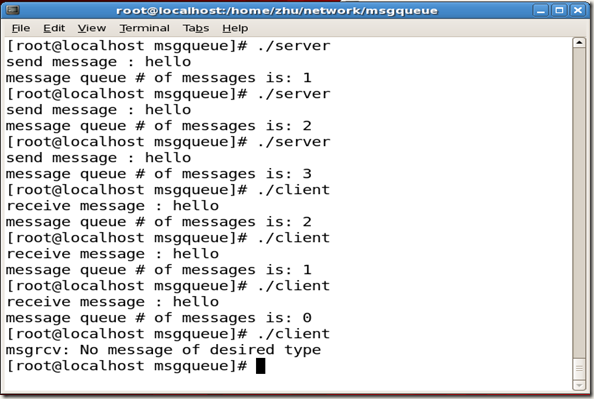
编译后运行结果如下:
四、信号量
信号量是一种计数器,用来控制对多个进程共享的资源所进行的访问。它们常常被用作一个锁机制,在某个进程正在对特定资源进行访问时,信号量可以防止另一个进程去访问它。
关于信号量详细介绍可参考http://www.cnblogs.com/nufangrensheng/p/3562046.html。
信号量实现资源控制实例:
#include <sys/types.h>

#include <linux/sem.h>

#include <linux/ipc.h>

#include <sys/stat.h>

#include <fcntl.h>

#include <stdio.h>

#include <stdlib.h>

#include <errno.h>

#include <unistd.h>

#define sempath    "/home/zhu/network/semaphore/sem"

#define proj_id    'c'

int

main(void)

{

    int semid, i;

    key_t    key;

    union semun sem, getsem;

    sem.val = 3;

    if((key = ftok(sempath, proj_id)) < 0)

    {

        perror("ftok");

        exit(1);

    }

    if((semid = semget(key, 1, IPC_CREAT)) < 0)

    {

        perror("semget");

        exit(1);

    }

    semctl(semid, 0, SETVAL, sem);

    semctl(semid, 0, GETVAL, sem);

    printf("# of usable semphore: %d\n", sem.val);

    struct sembuf sops = {0, -1, IPC_NOWAIT};

    for(i = 0; i < 4; i++)

    {

        printf(“%dth:”,i+1);
     fflush(stdout);

        if(semop(semid, &sops, 1) < 0)

        {

            perror("semop");

            exit(1);

        }
     printf("ask for one semaphore:success!\n");

    }

    return(0);

}
编译运行结果如下(因为我们把信号量值设置为3,所以第四次资源请求失败):

注意,在上面的程序中,包含的头文件#include <linux/sem.h> 和#include <linux/ipc.h>。而不是#include <sys/sem.h> #include <sys/ipc.h>。否则出现“storage of size of 'sem' isn't know”的错误。详细介绍请参考http://hi.baidu.com/yuhongyangcn/item/f52545b33c1b55a1eaba93ac。
关于POSIX信号量详情可参考http://www.cnblogs.com/nufangrensheng/p/3564306.html。
注意使用POSIX信号量时,除了要包含头文件<semaphore.h>外,在编译选项中还有加上-lrt选项,否则出现“undefined reference to”这样的编译错误。
五、共享内存
共享内存是在多个进程之间共享内存区域的一种进程间通信的方式,它是在多个进程间对内存段进行映射的方式实现内存共享的。这是最快的IPC方式。
关于共享内存详细介绍可参考http://www.cnblogs.com/nufangrensheng/p/3563712.html。
共享内存实现父子进程间通信(这里为了简化、突出共享内存的使用方式,并没有加入同步处理,而只是简单地使用sleep模拟同步):
#include <stdio.h>

#include <sys/types.h>

#include <sys/ipc.h>

#include <sys/shm.h>

#include <string.h>

static char msg[] = "hello, share memory!";

int

main(void)

{

    key_t key;

    char i, *shms, *shmc;

    pid_t pid;

    int shmid;

    key = ftok("/home/zhu/network/shmm/shm", 'a');

    shmid = shmget(key, 1024, IPC_CREAT | 0604);

    pid = fork();

    if( pid > 0)

    {

        shms = (char *)shmat(shmid, 0, 0);

        memcpy(shms, msg, strlen(msg) + 1);

        sleep(5);

        shmdt(shms);

    }

    else if(pid == 0)

    {

        shmc = (char *)shmat(shmid, 0, 0);

        sleep(2);

        printf("the content in the share memory is : %s\n", shmc);

        shmdt(shmc);

    }

    return(0);

}
运行结果:

六、信号
信号(signal)机制是UNIX系统中最为古老的进程之间的通信机制。它用于在一个或多个进程之间传递异步信号。
关于信号详细介绍可参考http://www.cnblogs.com/nufangrensheng/p/3514157.html。
进程间通信和同步:pipe、FIFO、消息队列、信号量、共享内存、信号的更多相关文章
- Linux进程间通信(消息队列/信号量+共享内存)
写在前面 不得不说,Deadline果真是第一生产力.不过做出来的东西真的是不堪入目,于是又花了一早上重写代码. 实验内容 进程通信的邮箱方式由操作系统提供形如 send()和 receive()的系 ...
- 进程间通信之信号量、消息队列、共享内存(system v的shm和mmap)+信号signal
进程间通信方式有:System v unix提供3种进程间通信IPC:信号量.消息队列.共享内存.此外,传统方法:信号.管道.socket套接字. [注意上述6种方式只能用户层进程间通信.内核内部有类 ...
- 8.7 进程间的通讯:管道、消息队列、共享内存、信号量、信号、Socket
进程间的通讯 进程间为什么需要通讯? 共享数据.数据传输.消息通知.进程控制 进程间的通讯有哪些类型? 首先,联系前面讲过的知识,进程之间的用户地址空间是相互独立的,不能进行互相访问,但是,内核空间却 ...
- boost进程间通信经常使用开发一篇全(消息队列,共享内存,信号)
本文概要: 敏捷开发大家想必知道并且评价甚高,缩短开发周期,提高开发质量.将大project独立为不同的小app开发,整个开发过程,程序可用可測,所以提高了总体的质量.基于这样的开发模式和开发理念,进 ...
- 四十九、进程间通信——System V IPC 之消息队列
49.1 System V IPC 介绍 49.1.1 System V IPC 概述 UNIX 系统存在信号.管道和命名管道等基本进程间通讯机制 System V 引入了三种高级进程间通信机制 消息 ...
- Linux进程间通信(七):消息队列 msgget()、msgsend()、msgrcv()、msgctl()
下面来说说如何用不用消息队列来进行进程间的通信,消息队列与命名管道有很多相似之处.有关命名管道的更多内容可以参阅我的另一篇文章:Linux进程间通信 -- 使用命名管道 一.什么是消息队列 消息队列提 ...
- c/c++ linux 进程间通信系列6,使用消息队列(message queue)
linux 进程间通信系列6,使用消息队列(message queue) 概念:消息排队,先进先出(FIFO),消息一旦出队,就从队列里消失了. 1,创建消息队列(message queue) 2,写 ...
- Linux进程间通信IPC学习笔记之消息队列(SVR4)
Linux进程间通信IPC学习笔记之消息队列(SVR4)
- PHP进程通信基础——信号量+共享内存通信
PHP进程通信基础--信号量+共享内存通信 由于进程之间谁先执行并不确定,这取决于内核的进程调度算法,其中比较复杂.由此有可能多进程在相同的时间内同时访问共享内存,从而造成不可预料的错误.信号量这个名 ...
- μC/OS-II 任务的同步与通信 --- 消息队列
简介 使用消息队列可以在任务之间传递多条消息.消息队列由三个部分组成:事件控制块.消息队列和消息. 当把事件控制块成员 OSEventType 的值置为 OS_EVENT_TYPE_Q 时,该事件控制 ...
随机推荐
- 求n个数中的最大或最小k个数
//求n个数中的最小k个数 public static void TestMin(int k, int n) { Random rd = new Ra ...
- Office 365 plans, SharePoint Online, and SharePoint 2013 on-premises 功能对比列表
Andrew ConnellSharePoint大牛整理了一个各个版本SharePoint功能对比列表,是SharePoint相关人员必备资料.赶紧收藏起来. SharePoint 2013 Feat ...
- visualC/C++连接MySql数据库
vs连接数据库其实就是将mysql数据库.h头文件接口.lib链接文件和dll执行文件加入到项目中.下面是配置如何加入. 转于http://www.cnblogs.com/justinzhang/ar ...
- find命令之exec
find是我们很常用的一个Linux命令,但是我们一般查找出来的并不仅仅是看看而已,还会有进一步的操作,这个时候exec的作用就显现出来了. exec解释: -exec 参数后面跟的是command ...
- ssh+dwr 的使用源码案例
加入dwr.jar包 ======jsp=============== <!DOCTYPE HTML PUBLIC "-//W3C//DTD HTML 4.01 Transitiona ...
- SQL Server sql 操作
1.重命名表将表OLD重命名为NEW: EXEC sp_rename 'OLD','NEW' 2.重命名列将表table1中的列old重命名为new: EXEC sp_rename 'table1.o ...
- Holding Bin-Laden Captive!_hdu_1085(DP).java
/* * 9607741 2013-11-17 18:04:23 Accepted 1085 187MS 5700K 1251 B Java zhangyi http://acm.hdu.edu. ...
- Server-U_详细配置
1.首先绿化 Server-U,运行 2.打开Server-U自动弹出如下图:如果不自动弹出,那点击界面上的 新建域 ------ 先有域再有用户,用户在域里面 4. 输入“名称”和“说明”,其中“ ...
- 函数 MultiByteToWideChar() 详解
函数原型: int MultiByteToWideChar( UINT CodePage, DWORD dwFlags, LPCSTR lpMultiByteStr, int cchMultiByte ...
- DOM2
DOM级别 文档类型: 节点类型: 判断节点类型(注意Node对象): <div id="container">这是一个元素节点</div> <scr ...