
tensorflow的官方强化学习库agents的相关内容及一些注意事项
源代码地址:
https://github.com/tensorflow/agents
TensorFlow给出的官方文档说明:
https://tensorflow.google.cn/agents
相关视频:
https://www.youtube.com/watch?v=U7g7-Jzj9qo
https://www.youtube.com/watch?v=tAOApRQAgpc
https://www.youtube.com/watch?v=52DTXidSVWc&list=PLQY2H8rRoyvxWE6bWx8XiMvyZFgg_25Q_&index=2
-----------------------------------------------------------
框架实现的算法:
论文1:
论文3:
论文4:
论文5:
论文6:
论文7:
论文8:
论文9:
论文10:
====================================
1. gym的环境版本有要求,给出具体安装及Atari的安装:
pip install gym[atari]==0.23.0
pip install gym[accept-rom-license]
=====================================
2. 代码的逻辑bug
tf_agents/specs/array_spec.py 代码bug:
def sample_bounded_spec(spec, rng):

  """Samples the given bounded spec.

  Args:

    spec: A BoundedSpec to sample.

    rng: A numpy RandomState to use for the sampling.

  Returns:

    An np.array sample of the requested spec.

  """

  tf_dtype = tf.as_dtype(spec.dtype)

  low = spec.minimum

  high = spec.maximum

  if tf_dtype.is_floating:

    if spec.dtype == np.float64 and np.any(np.isinf(high - low)):

      # The min-max interval cannot be represented by the np.float64. This is a

      # problem only for np.float64, np.float32 works as expected.

      # Spec bounds are set to read only so we can't use argumented assignment.

      low = low / 2

      high = high / 2

    return rng.uniform(

        low,

        high,

        size=spec.shape,

    ).astype(spec.dtype)

  else:

    if spec.dtype == np.int64 and np.any(high - low < 0):

      # The min-max interval cannot be represented by the tf_dtype. This is a

      # problem only for int64.

      low = low / 2

      high = high / 2

    if np.any(high < tf_dtype.max):

      high = np.where(high < tf_dtype.max, high + 1, high)

    elif spec.dtype != np.int64 or spec.dtype != np.uint64:

      # We can still +1 the high if we cast it to the larger dtype.

      high = high.astype(np.int64) + 1

    if low.size == 1 and high.size == 1:

      return rng.randint(

          low,

          high,

          size=spec.shape,

          dtype=spec.dtype,

      )

    else:

      return np.reshape(

          np.array([

              rng.randint(low, high, size=1, dtype=spec.dtype)

              for low, high in zip(low.flatten(), high.flatten())

          ]), spec.shape)
这个代码的意思就是在给定区间能进行均匀抽样,但是由于区间可能过大因此导致无法使用库函数抽样,因此需要对区间进行压缩。
当抽样的数据类型为np.float64时,由代码:
np.array(np.zeros(10), dtype=np.float64)+np.finfo(np.float64).max-np.finfo(np.float64).min

np.random.uniform(size=10, low=np.finfo(np.float64).min, high=np.finfo(np.float64).max)

可以知道,当类型为np.float64时,如果抽样区间过大会(超出数值表示范围)导致无法抽样,因此进行压缩区间:
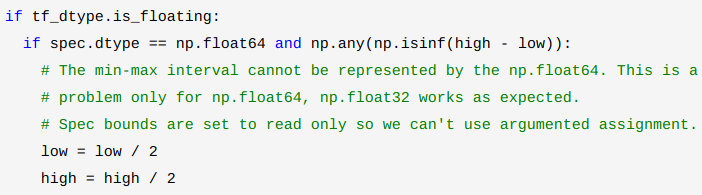
当数据类型为np.float32时,虽然也会存在超出表示范围的问题:
np.array(np.zeros(10), dtype=np.float32)+np.finfo(np.float32).max-np.finfo(np.float32).min

但是由于函数 np.random.uniform 的计算中会把np.float32转为np.float64,因此不会出现报错,如下:
np.random.uniform(size=10, low=np.finfo(np.float32).min, high=np.finfo(np.float32).max)

---------------------------------------------------
当数值类型为int时,区间访问过大的检测代码为:
np.any(high - low < 0)
原因在意np.float类型数值超出表示范围会表示为infi变量,但是int类型则会以溢出形式表现,如:

但是在使用numpy.random.randint 函数时,即使范围为最大范围也没有报错:
np.random.randint(size=10000, low=tf.as_dtype(np.int64).min, high=tf.as_dtype(np.int64).max)

np.random.randint(size=10000, low=np.iinfo(np.int64).min, high=np.iinfo(np.int64).max)

而且即使由于high值是取开区间的,我们对high值加1以后也没有报错:
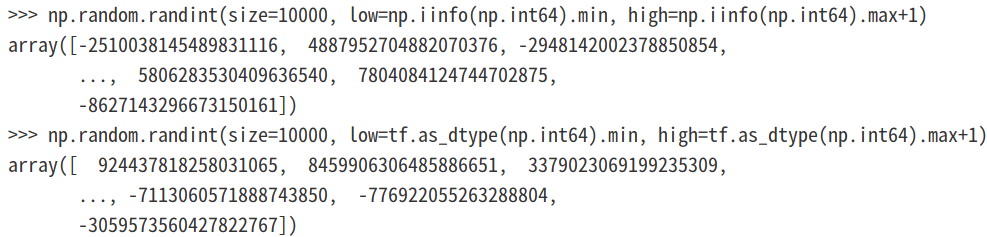
但是需要注意,此时传给np.random.randint函数中的low和high数值都为python数据类型int而不是numpy中的np.int64,下面我们看下numpy.float64类型是否会溢出:
当以数组形式传递最高high值并使其保持np.float64类型,发现使用high+1就会溢出:
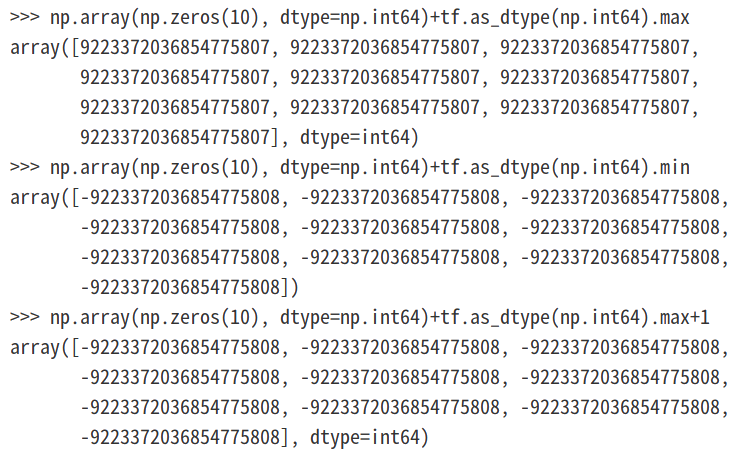
可以看到使用最大范围+1作为high值会导致报错:
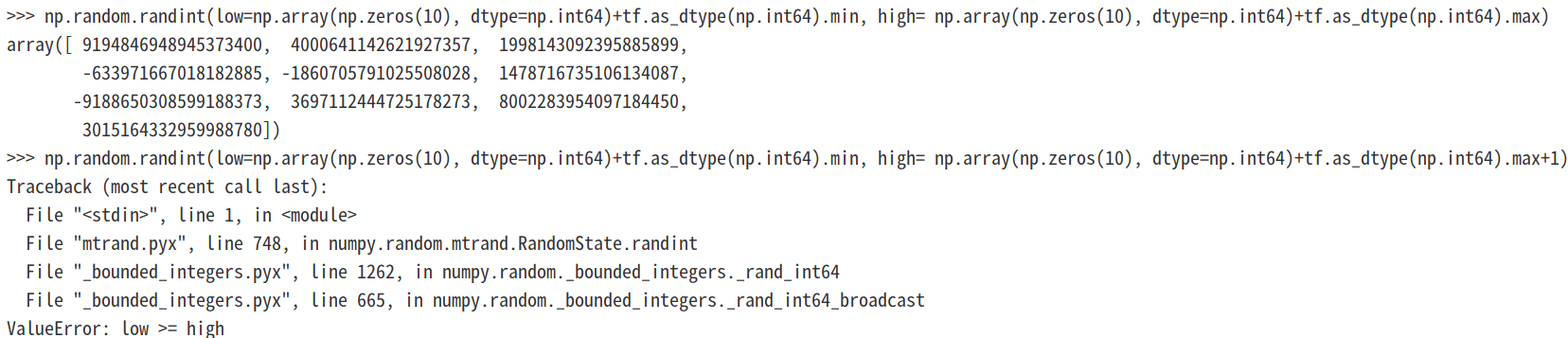
可以看到在使用numpy.random.randint时对上下限还是要注意的,虽然numpy.random.randint对上限是开区间,但是+1操作是很可能引起溢出错误的。
这也就是为什么 high+1操作之前要做判断了,如下:
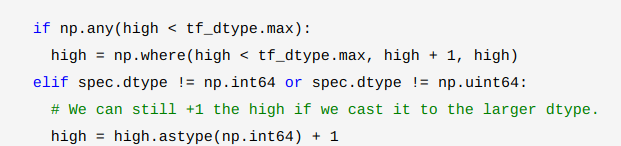
不过如果数据类型不为np.int64,并且也不为np.uint64,那么我们依然可以把high值转为np.int64后在+1 ,但是上面的逻辑判断是有一定问题的,这些修正后如下:

总的修改后的代码为:
def sample_bounded_spec(spec, rng):

  """Samples the given bounded spec.

  Args:

    spec: A BoundedSpec to sample.

    rng: A numpy RandomState to use for the sampling.

  Returns:

    An np.array sample of the requested spec.

  """

  tf_dtype = tf.as_dtype(spec.dtype)

  low = spec.minimum

  high = spec.maximum

  if tf_dtype.is_floating:

    if spec.dtype == np.float64 and np.any(np.isinf(high - low)):

      # The min-max interval cannot be represented by the np.float64. This is a

      # problem only for np.float64, np.float32 works as expected.

      # Spec bounds are set to read only so we can't use argumented assignment.

      low = low / 2

      high = high / 2

    return rng.uniform(

        low,

        high,

        size=spec.shape,

    ).astype(spec.dtype)

  else:

    if spec.dtype == np.int64 and np.any(high - low < 0):

      # The min-max interval cannot be represented by the tf_dtype. This is a

      # problem only for int64.

      low = low / 2

      high = high / 2

    if np.any(high < tf_dtype.max):

      high = np.where(high < tf_dtype.max, high + 1, high)

    elif spec.dtype != np.int64 and spec.dtype != np.uint64:

      # We can still +1 the high if we cast it to the larger dtype.

      high = high.astype(np.int64) + 1

    if low.size == 1 and high.size == 1:

      return rng.randint(

          low,

          high,

          size=spec.shape,

          dtype=spec.dtype,

      )

    else:

      return np.reshape(

          np.array([

              rng.randint(low, high, size=1, dtype=spec.dtype)

              for low, high in zip(low.flatten(), high.flatten())

          ]), spec.shape)
加入对np.uint64类型的判断:
def sample_bounded_spec(spec, rng):

  """Samples the given bounded spec.

  Args:

    spec: A BoundedSpec to sample.

    rng: A numpy RandomState to use for the sampling.

  Returns:

    An np.array sample of the requested spec.

  """

  tf_dtype = tf.as_dtype(spec.dtype)

  low = spec.minimum

  high = spec.maximum

  if tf_dtype.is_floating:

    if spec.dtype == np.float64 and np.any(np.isinf(high - low)):

      # The min-max interval cannot be represented by the np.float64. This is a

      # problem only for np.float64, np.float32 works as expected.

      # Spec bounds are set to read only so we can't use argumented assignment.

      low = low / 2

      high = high / 2

    return rng.uniform(

        low,

        high,

        size=spec.shape,

    ).astype(spec.dtype)

  else:

    if spec.dtype == np.int64 and np.any(high - low < 0):

      # The min-max interval cannot be represented by the tf_dtype. This is a

      # problem only for int64.

      low = low / 2

      high = high / 2

    if spec.dtype == np.uint64 and np.any(high >= np.iinfo(np.int64).max):

      low = low / 2

      high = high / 2

    if np.any(high < tf_dtype.max):

      high = np.where(high < tf_dtype.max, high + 1, high)

    elif spec.dtype != np.int64 and spec.dtype != np.uint64:

      # We can still +1 the high if we cast it to the larger dtype.

      high = high.astype(np.int64) + 1

    if low.size == 1 and high.size == 1:

      return rng.randint(

          low,

          high,

          size=spec.shape,

          dtype=spec.dtype,

      )

    else:

      return np.reshape(

          np.array([

              rng.randint(low, high, size=1, dtype=spec.dtype)

              for low, high in zip(low.flatten(), high.flatten())

          ]), spec.shape)
===========================================
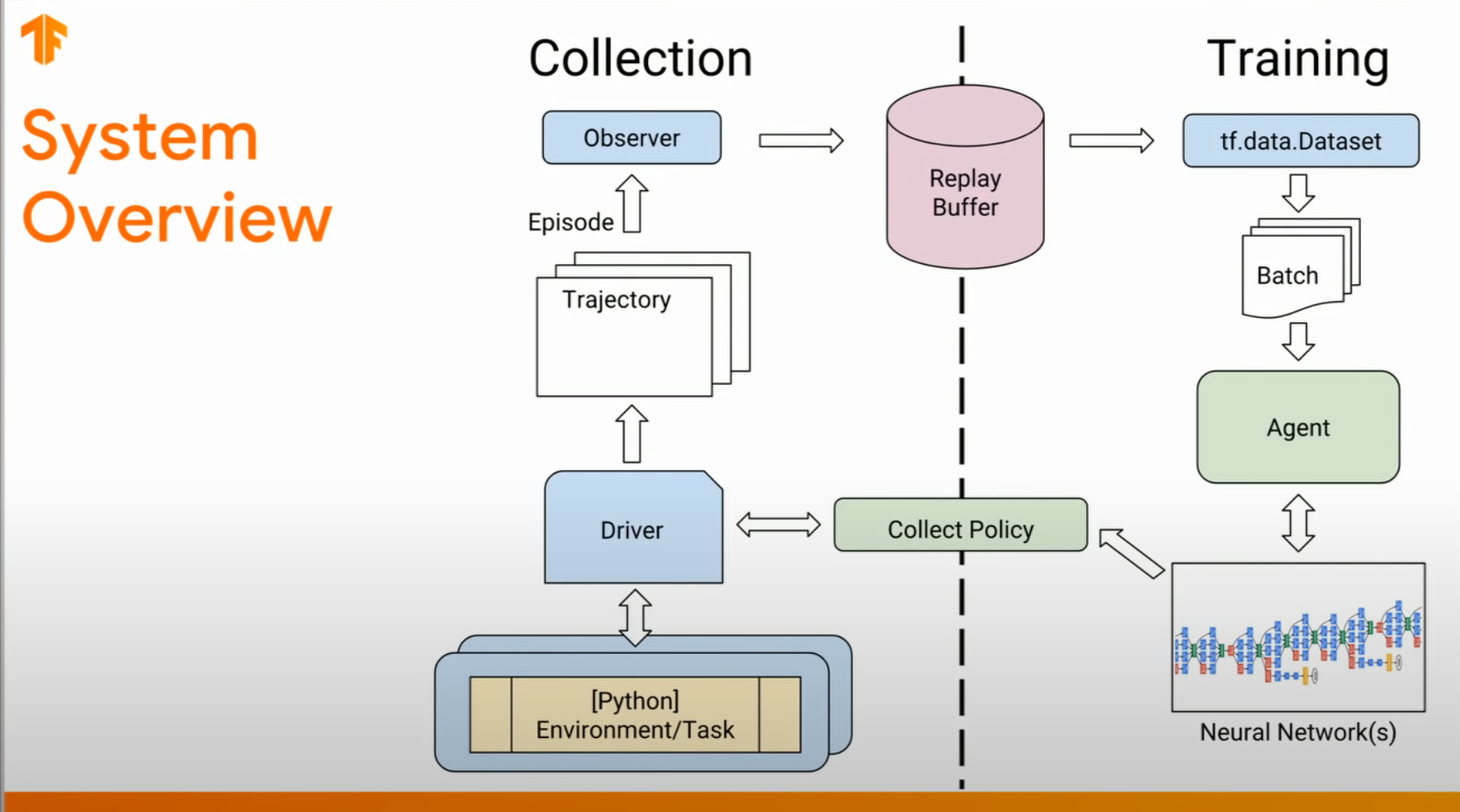
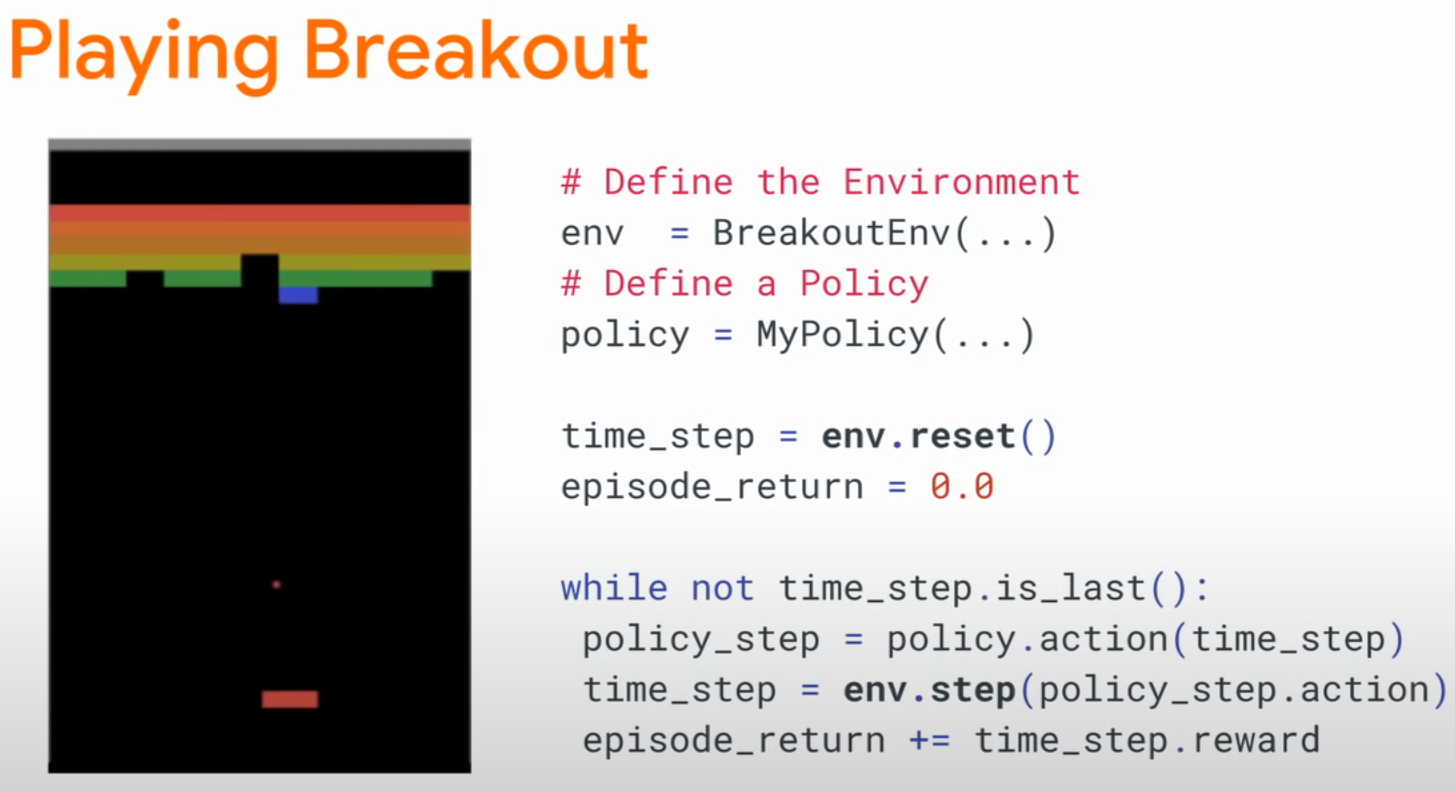
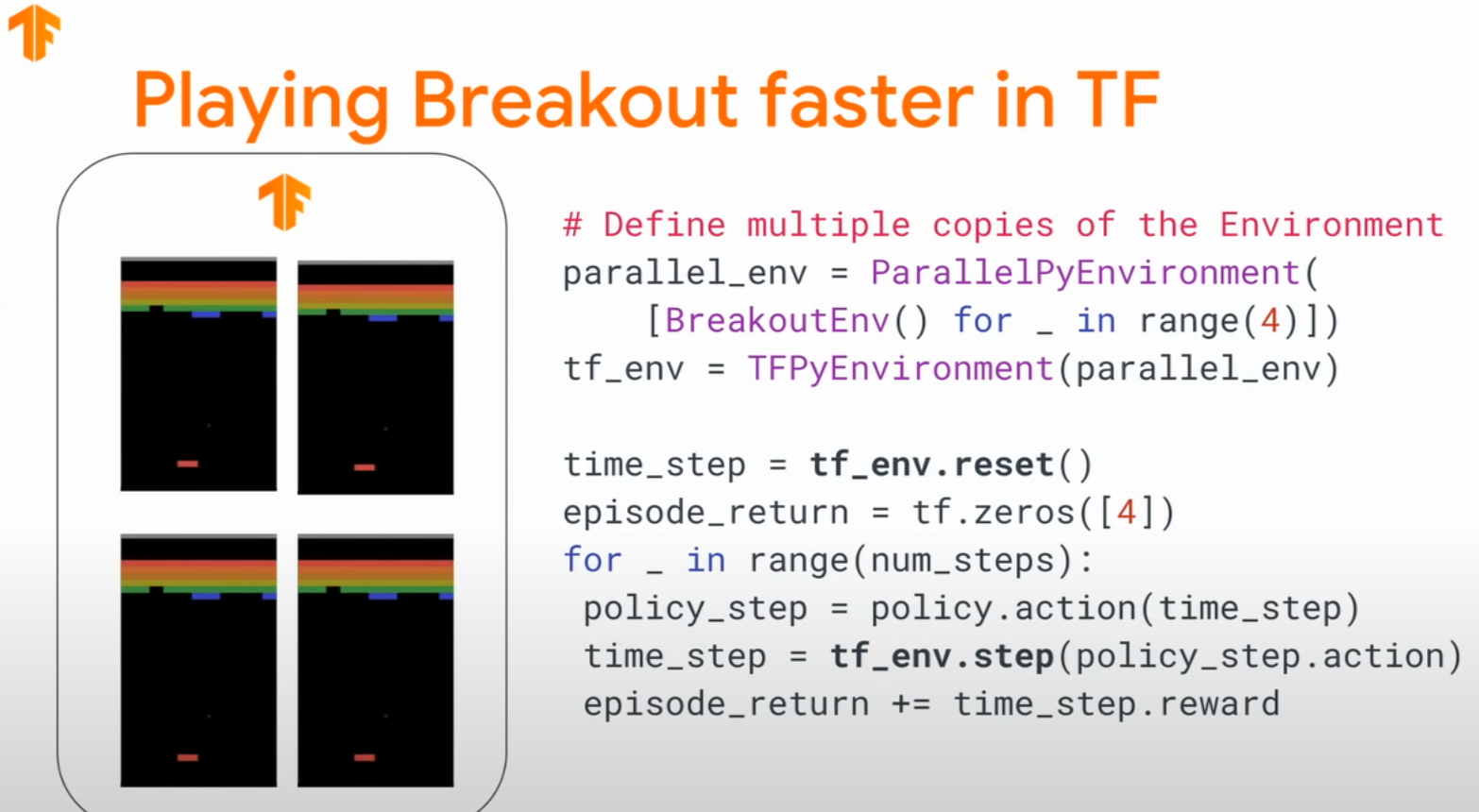
tf-agents框架的交互逻辑代码:
===========================================



tensorflow的官方强化学习库agents的相关内容及一些注意事项的更多相关文章
- 学习笔记之html5相关内容
写一下昨天学习的html5的相关内容,首先谈下初次接触html5的感受.以前总是听说html5是如何的强大,如何的将要改变世界.总是充满了神秘感.首先来谈一下我接触的第一个属性是 input的里面的 ...
- 强化学习之四:基于策略的Agents (Policy-based Agents)
本文是对Arthur Juliani在Medium平台发布的强化学习系列教程的个人中文翻译,该翻译是基于个人分享知识的目的进行的,欢迎交流!(This article is my personal t ...
- 强化学习之三:双臂赌博机(Two-armed Bandit)
本文是对Arthur Juliani在Medium平台发布的强化学习系列教程的个人中文翻译,该翻译是基于个人分享知识的目的进行的,欢迎交流!(This article is my personal t ...
- DQN 强化学习
pytorch比tenserflow简单. 所以我们模仿用tensorflow写的强化学习. 学习资料: 本节的全部代码 Tensorflow 的 100行 DQN 代码 我制作的 DQN 动画简介 ...
- 强化学习之七:Visualizing an Agent’s Thoughts and Actions
本文是对Arthur Juliani在Medium平台发布的强化学习系列教程的个人中文翻译,该翻译是基于个人分享知识的目的进行的,欢迎交流!(This article is my personal t ...
- 强化学习之六:Deep Q-Network and Beyond
本文是对Arthur Juliani在Medium平台发布的强化学习系列教程的个人中文翻译,该翻译是基于个人分享知识的目的进行的,欢迎交流!(This article is my personal t ...
- 强化学习之五:基于模型的强化学习(Model-based RL)
本文是对Arthur Juliani在Medium平台发布的强化学习系列教程的个人中文翻译,该翻译是基于个人分享知识的目的进行的,欢迎交流!(This article is my personal t ...
- 强化学习之三点五:上下文赌博机(Contextual Bandits)
本文是对Arthur Juliani在Medium平台发布的强化学习系列教程的个人中文翻译,该翻译是基于个人分享知识的目的进行的,欢迎交流!(This article is my personal t ...
- 强化学习之二:Q-Learning原理及表与神经网络的实现(Q-Learning with Tables and Neural Networks)
本文是对Arthur Juliani在Medium平台发布的强化学习系列教程的个人中文翻译.(This article is my personal translation for the tutor ...
- 深度强化学习(DRL)专栏(一)
目录: 1. 引言 专栏知识结构 从AlphaGo看深度强化学习 2. 强化学习基础知识 强化学习问题 马尔科夫决策过程 最优价值函数和贝尔曼方程 3. 有模型的强化学习方法 价值迭代 策略迭代 4. ...
随机推荐
- Thread交互及interrupt示例
package com.test.docxml; /** Thread交互及interrupt示例 * 线程模拟:一个在睡觉,一个在敲墙,敲墙完成之后,把睡觉的吵醒了. */ public class ...
- injectionIII iOS代码注入工具(下)
injectionIII iOS代码注入工具(下) 本文将解决如何使用injectionIII对主页热重载,如果对injectionIII不了解的同学请回到上篇查看 Vaccine 简单地说Vacci ...
- 对Transformer的一些理解
在学习Transformer这个模型前对seq2seq架构有个了解时很有必要的 先上图 输入和输出 首先理解模型时第一眼应该理解输入和输出最开始我就非常纠结 有一个Inputs,一个Outputs(s ...
- DASCTF X GFCTF 2024|四月开启第一局 [PWN]详解
DASCTF X GFCTF 2024|四月开启第一局[PWN] wp(详解) 1.dynamic_but_static 题目保护情况 64位程序,没有开canary和pie保护,got表可改 64位 ...
- python配置国内pypi镜像源操作步骤
使用pip config命令设置默认镜像源,使用国内的源,提高安装速度 操作步骤 临时方式pip install xxx -i https://pypi.tuna.tsinghua.edu.cn/si ...
- [oeasy]python00134_[趣味拓展]python起源_历史_Guido人生_ABC编程语言_Tanenbaum
python 历史 回忆上次内容 颜文字是kaomoji 把字符变成一种图画的方法 一层叠一层 很多好玩儿的kaomoji是一层层堆叠起来的meme 添加图片注释,不超过 140 字(可选 ...
- [oeasy]python0022_ python虚拟机_反编译_cpu架构_二进制字节码_汇编语言
程序本质 回忆上次内容 python3 的程序是一个 5.3M 的可执行文件 我们通过which命令找到这个python3.8的位置 将这个python3.8复制到我们的用户目录下 这个文件 ...
- JavaScript实现防抖函数
什么是防抖?防抖就是避免快速多次点击后执行过多的函数调用,就是本来你点击支付宝支付后不小心在点击一次,导致支付函数被调用了两次,还都执行了,付了两次钱. 防抖函数的思想就是将函数延迟调用,延迟时间内不 ...
- 《Programming from the Ground Up》阅读笔记:p75-p87
<Programming from the Ground Up>学习第4天,p75-p87总结,总计13页. 一.技术总结 1.persistent data p75, Data whic ...
- 计算复杂性学习笔记(TCS笔记)
感觉最近太摆了,每天很空虚,不愿意搞应试那一套,还是得学点东西.还是准备一边学tcs一边搞搞oi好打icpc,搞这个纯属兴趣,也是填个坑.最近进了一个初中生建的数学交流群,感觉群里初中生也很厉害,开始 ...