
033.Python的__del__析构方法he__call__方法
一 __del__ 魔术方法(析构方法)
1.1 介绍
- 触发时机:当对象被内存回收的时候自动触发[1.页面执行完毕回收所有变量 2.所有对象被del的时候]
- 功能:对象使用完毕后资源回收
- 参数:一个self接受对象
- 返回值:无
1.2 页面执行完毕回收所有变量
class Plane():

        def __init__(self,name):

                self.name = name

        def fly(self):

                print ("我的飞机是{}飞的很快".format(self.name))

        def __del__(self):

                print ("析构被触发")

obj = Plane("高超音速")

obj.fly()
执行
[root@node10 python]# python3 test.py

我的飞机是高超音速飞的很快

析构被触发
1.3 所有对象被del的时候
删除对象
class Plane():

        def __init__(self,name):

                self.name = name

        def fly(self):

                print ("我的飞机是{}飞的很快".format(self.name))

        def __del__(self):

                print ("析构被触发")

obj = Plane("高超音速")

print ("<=======================start del=========================>")

del obj

print ("<=======================end del=========================>")
执行
[root@node10 python]# python3 test.py

<=======================start del=========================>

析构被触发

<=======================end del=========================>
当只删除一个对象,还有剩余对象,也不会触发
class Plane():

        def __init__(self,name):

                self.name = name

        def fly(self):

                print ("我的飞机是{}飞的很快".format(self.name))

        def __del__(self):

                print ("析构被触发")

obj = Plane("高超音速")

obj2 = obj

print ("<=======================start del=========================>")

del obj

print ("<=======================end del=========================>")
执行,是在页面执行完毕是触发
[root@node10 python]# python3 test.py

<=======================start del=========================>

<=======================end del=========================>

析构被触发
1.4 删除所有对象
- 两个不同的变量指向同一个对象,只有把这两个变量都删除了,
- 这个对象没有变量引用了,才会真正的删除对象.
class Plane():

        def __init__(self,name):

                self.name = name

        def fly(self):

                print ("我的飞机是{}飞的很快".format(self.name))

        def __del__(self):

                print ("析构被触发")

obj = Plane("高超音速")

obj2 = obj

print ("<=======================start del=========================>")

del obj

del obj2

print ("<=======================end del=========================>")
执行
[root@node10 python]# python3 test.py

<=======================start del=========================>

析构被触发

<=======================end del=========================>
1.5 模拟文件读的操作
fp = open("ceshi.txt","r",encoding="utf-8")

res = fp.read()

print (res)
执行
[root@node10 python]# cat ceshi.txt

君临天下

[root@node10 python]# python3 test.py

君临天下
有这个文件,就创建一个对象
fp = open("ceshi.txt","r",encoding="utf-8")

res = fp.read()

fp.close()

print (res)

import os

class ReadFile():

        def __new__(cls,name):

                if os.path.exists(name):

                        return object.__new__(cls)

                return print("没有这个文件")

obj=ReadFile("ceshi.txt")

print (obj)
执行
[root@node10 python]# python3 test.py

君临天下

<__main__.ReadFile object at 0x7f5c2271b518>
如果不存在
fp = open("ceshi.txt","r",encoding="utf-8")

res = fp.read()

fp.close()

print (res)

import os

class ReadFile():

        def __new__(cls,name):

                if os.path.exists(name):

                        return object.__new__(cls)

                return print("没有这个文件")

obj=ReadFile("ceshii11.txt")

print (obj)
执行
[root@node10 python]# python3 test.py

君临天下

没有这个文件

None
1.6 对对象进行初始化
import os

class ReadFile():

        def __new__(cls,name):

                if os.path.exists(name):

                        return object.__new__(cls)

                return print("没有这个文件")

        def __init__(self,name):

                self.fp = open("ceshi.txt","r",encoding="utf-8")

        def readcontent(self):

                res = self.fp.read()

                return (res)

        def __del__(self):

                self.fp.close()

obj=ReadFile("ceshi.txt")

print (obj)

res = obj.readcontent()

print (res)
执行
[root@node10 python]# python3 test.py

<__main__.ReadFile object at 0x7f601b50e470>

君临天下
如果文件不存在
import os

class ReadFile():
       #创建对象

        def __new__(cls,name):

                if os.path.exists(name):

                        return object.__new__(cls)

                return print("没有这个文件")

        def __init__(self,name):
          #把文件对象赋值给该对象的fp成员属性

                self.fp = open("ceshi.txt","r",encoding="utf-8")
      #读取文件内容

        def readcontent(self):

                res = self.fp.read()

                return (res)
     #关闭文件

        def __del__(self):

                self.fp.close()

obj=ReadFile("ceshi111.txt")

print (obj)

res = obj.readcontent()

print (res)
执行

二 __call__ 魔术方法
2.1 介绍
- 触发时机:把对象当作函数调用的时候自动触发
- 功能: 模拟函数化操作
- 参数: 参数不固定,至少一个self参数
- 返回值: 看需求
2.2 基本用法
把对象当成函数进行调用,自动触发__call__
class MyClass():

        def __call__(self):

                print ("call方法被调用")

obj = MyClass()

obj()
执行
[root@node10 python]# python3 test.py

call方法被调用
如果没有__call__调用就会出错
class MyClass():
#       def __call__(self):

#               print ("call方法被调用")

                pass

obj = MyClass()

obj()
执行报错

2.3 模拟购物过程
class Shopping():

        def __init__(self,who):

                self.who = who

        def step1(self):

                print ("{}出门".format(self.who))

        def step2(self):

                print ("{}开车去商场".format(self.who))

        def step3(self):

                print ("{}买完东西回家".format(self.who))

obj = Shopping("女朋友")

obj.step1()

obj.step2()

obj.step3()
执行
[root@node10 python]# python3 test.py

女朋友出门

女朋友开车去商场

女朋友买完东西回家
2.4 使用__call__方法
class Shopping():

        def __init__(self,who):

                self.who = who

        def __call__(self):

                self.step1()

                self.step2()

                self.step3()

        def step1(self):

                print ("{}出门".format(self.who))

        def step2(self):

                print ("{}开车去商场".format(self.who))

        def step3(self):

                print ("{}买完东西回家".format(self.who))

obj = Shopping("女朋友")

obj()
执行
[root@node10 python]# python3 test.py

女朋友出门

女朋友开车去商场

女朋友买完东西回家
2.5 优化1
class Shopping():

        def __init__(self,who):

                self.who = who

        def __call__(self,shop):

                self.shop = shop

                print ("我的{}要去{}".format(self.who,self.shop))

                self.step1()

                self.step2()

                self.step3()

        def step1(self):

                print ("{}出门".format(self.who))

        def step2(self):

                print ("{}开车去商场".format(self.who))

        def step3(self):

                print ("{}买完东西回家".format(self.who))

obj = Shopping("女朋友")

obj("购物")
执行
[root@node10 python]# python3 test.py

我的女朋友要去购物

女朋友出门

女朋友开车去商场

女朋友买完东西回家
2.6 不使用初始化
class Shopping():

        def __call__(self,who):

                self.who = who

                print ("我的{}要去购物".format(self.who))

                self.step1()

                self.step2()

                self.step3()

        def step1(self):

                print ("{}出门".format(self.who))

        def step2(self):

                print ("{}开车去商场".format(self.who))

        def step3(self):

                print ("{}买完东西回家".format(self.who))

obj = Shopping()

obj("女朋友")
执行
[root@node10 python]# python3 test.py

我的女朋友要去购物

女朋友出门

女朋友开车去商场

女朋友买完东西回家
2.7 优化2
class Shopping():

        def __call__(self,who,shop):

                self.who = who

                self.shop = shop

                print ("我的{}要去{}".format(self.who,self.shop))

                self.step1()

                self.step2()

                self.step3()

        def step1(self):

                print ("{}出门".format(self.who))

        def step2(self):

                print ("{}开车去商场".format(self.who))

        def step3(self):

                print ("{}买完东西回家".format(self.who))

obj = Shopping()

obj("女朋友","购物")
执行
[root@node10 python]# python3 test.py

我的女朋友要去购物

女朋友出门

女朋友开车去商场

女朋友买完东西回家
2.8 模拟内置int强转方法 myint
import math

class MyInt():

        def __call__(self,num):

                if isinstance(num,bool):

                        if num == True:

                                return 1

                        else:

                                return 0

                elif isinstance(num,int):

                        return num

                elif isinstance(num,float):

                        if num < 0:

                                return math.ceil(num)

                        else:

                                return math.floor(num)

myint = MyInt()

print (myint(True))

print (myint(False))

print ("<int type>")

print (myint(55))

print ("<float type>")

print (myint(6.9))

print (myint(-6.9))
执行
[root@node10 python]# python3 test.py

1

0

<int type>

55

<float type>

6

-6
判断字符串类型
import math

class MyInt():

        # sign 代表符号,默认正值

        def myfunc(self,strvar,sign = 1):

                isnull = strvar.lstrip("0")

                # 判断是否处理完的字符串是不是空的,如果是空的,这个串是"0000.."是因为eval("")会出现错误

                if isnull == "":

                        return 0

                res = eval(strvar) * sign

                return res

        def __call__(self,num):

                if isinstance(num,bool):

                        if num == True:

                                return 1

                        else:

                                return 0

                elif isinstance(num,int):

                        return num

                elif isinstance(num,float):

                        if num < 0:

                                return math.ceil(num)

                        else:

                                return math.floor(num)

                elif isinstance(num,str):

                        if (num[0] == "+" or num[0] == "-") and num[1:].isdecimal():

                                if num[0] == "+":

                                        sign = 1

                                else:

                                        sign = -1

                                return self.myfunc(num[1:],sign)

                        elif num.isdecimal():

                                return self.myfunc(num)

                else: return "对不起,处理不了这个数据类型"

myint = MyInt()

print (myint(True))

print (myint(False))

print ("<int type>")

print (myint(55))

print ("<float type>")

print (myint(6.9))

print (myint(-6.9))

print ("<str type>")

print(myint("11122233"),type(myint("11122233")))

# print(myint("00001223"))

print(myint("-11122233"),type(myint("-11122233")))

print(myint([1,2,3,4]))
执行
[root@node10 python]# python3 test.py

1

0

<int type>

55

<float type>

6

-6

<str type>

11122233 <class 'int'>

-11122233 <class 'int'>
对不起,处理不了这个数据类型
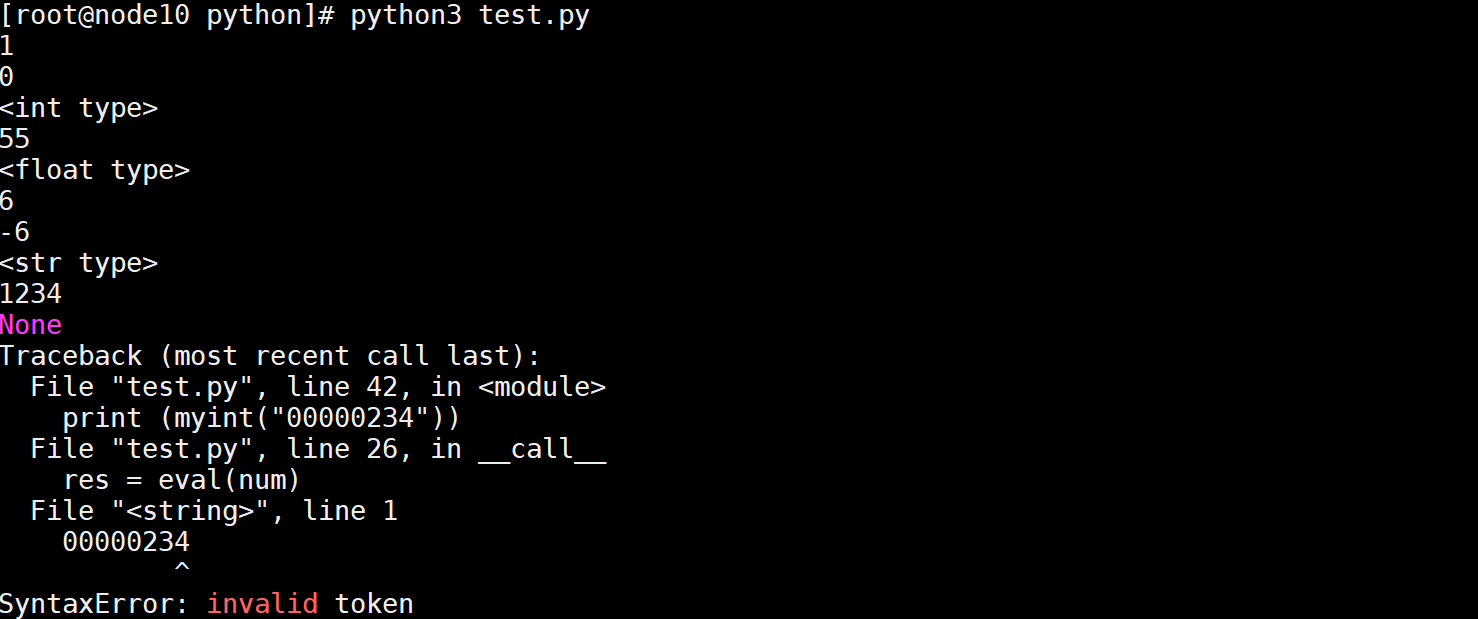
使用eval可以转化为数字,但是在特殊情况下并不能执行
但是空值,带-号的会
[root@node10 python]# cat test.py

import math

class MyInt():

        # sign 代表符号,默认正值

        def myfunc(self,strvar,sign = 1):

                isnull = strvar.lstrip("0")

                # 判断是否处理完的字符串是不是空的,如果是空的,这个串是"0000.."

                if isnull == "":

                        return 0

                res = eval(strvar) * sign

                return res

        def __call__(self,num):

                if isinstance(num,bool):

                        if num == True:

                                return 1

                        else:

                                return 0

                elif isinstance(num,int):

                        return num

                elif isinstance(num,float):

                        if num < 0:

                                return math.ceil(num)

                        else:

                                return math.floor(num)

                elif isinstance(num,str):

                        if num.isdecimal():
                   #或者使用self.myfunc(num)
                   res = eval(num)

                                return res

                else: return "对不起,处理不了这个数据类型"

myint = MyInt()

print (myint(True))

print (myint(False))

print ("<int type>")

print (myint(55))

print ("<float type>")

print (myint(6.9))

print (myint(-6.9))

print ("<str type>")

print (myint("1234"))

print (myint("-234"))

print (myint("00000234"))
执行
2.9 使用__call__方法实现装饰器
普通方式
class Show():

        def showtime(func):

                def newfunc():

                        print ("准备演出")

                        func()

                        print ("退出演出")

                return newfunc

@Show.showtime

def func():

        print ("张靓颖正在鸟巢演出")

func()
执行
[root@node10 python]# python3 test.py

准备演出

张靓颖正在鸟巢演出

退出演出
使用__call__
[root@node10 python]# cat test.py

class Show():

        def __call__(self,func):

                return self.showtime(func)

        def showtime(self,func):

                def newfunc():

                        print ("准备演出")

                        func()

                        print ("退出演出")

                return newfunc

@Show()       #@obj =>func =  obj(func) => 返回的新函数替换旧函数

def func():

        print ("张靓颖正在鸟巢演出")

func()
执行
[root@node10 python]# python3 test.py

准备演出

张靓颖正在鸟巢演出

退出演出
@有两个作用
(1)自动把装饰器下面的函数当成参数进行传递

(2)把返回的新函数,自动赋值,用来替换旧函数
执行过程
Show()返回一个obj对象
@obj发动技能,把参数传递给obj
obj(func)返回newfunc
@发动技能,把新函数替换旧函数
func = newfunc,则func()就等价于newfunc()
033.Python的__del__析构方法he__call__方法的更多相关文章
- python - class内置方法 doc/module/del(析构方法)/cal 方法
__doc__ # __doc__ #摘要信息 #这个属性不会继承给子类 class Test(): """这是摘要信息""" pass x ...
- 【python】-- 类的装饰器方法、特殊成员方法
装饰器方法 类的另外的特性,装饰器方法:静态方法(staticmethod).类方法(classmethod).属性方法(property) 一.静态方法 在方法名前加上@staticmethod装饰 ...
- 【python学习笔记】9.魔法方法、属性和迭代器
[python学习笔记]9.魔法方法.属性和迭代器 魔法方法:xx, 收尾各有两个下划线的方法 __init__(self): 构造方法,创建对象时候自动执行,可以为其增加参数, 父类构造方法不会被自 ...
- python面向对象 : 反射和内置方法
一. 反射 1. isinstance()和issubclass() isinstance( 对象名, 类名) : 判断对象所属关系,包括父类 (注:type(对象名) is 类名 : 判断对象所属 ...
- __del__,item系列 ,hash方法,__eq__,
# 构造方法 申请一个空间# 析构方法 释放一个空间 # 某个对象借用了操作系统的资源,还要通过析构方法归还回去:文件资源 网络资源 # 垃圾回收机制 class A: def __del__(sel ...
- [ python ] 类中的一些特殊方法
item系列 __getitem__(self, item) 对象通过 object[key] 触发 __setitem__(self, key, value) 对象通过 object[key] = ...
- Python面向对象之常用的特殊方法(5)
Python面向对象里面有很多特殊方法,例如__init__(构造方法),__del__(析构方法),这些方法对于面向对象编程非常重要,下面列出一些常用的特殊方法 (1)__call__ class ...
- Python构造器及析构器:__init__与__new__及__del__
__init__与__new__这两个魔法方法组成了Python类对象的构造器,在Python类实例化时,其实最先调用的不是__init__而是__new__.__new__是负责实例化对象的,而__ ...
- Python面向对象之反射,双下方法
一. 反射 反射的概念是由Smith在1982年首次提出的,主要是指程序可以访问.检测和修改它本身状态或行为的一种能力(自省).这一概念的提出很快引发了计算机科学领域关于应用反射性的研究.它首先被程序 ...
随机推荐
- 消息中间件-RabbitMQ基本使用
RabbitMQ是实现了高级消息队列协议(AMQP)的开源消息代理软件(亦称面向消息的中间件).RabbitMQ服务器是用Erlang语言编写的,而集群和故障转移是构建在开放电信平台框架上的.所有主要 ...
- Java(25-40)【数据类型转换、运算符、方法入门】
1.ASCII编码表 0--48 A--65 a--97 2. Unicode万国码 字符'中'为20013 3.算数运算符 double类型的加上int类型结果为double byte short ...
- 0703-可视化工具tensorboard和visdom
0703-可视化工具tensorboard和visdom 目录 一.可视化工具概述 二.TensorBoard 三.Visdom 3.1 visdom 概述 3.2 visdom 的常用操作 3.3 ...
- Selenium3自动化测试【15】元素定位之Class、Name
@ 目录 1.name定位 2.class定位 1.name定位 通过name定位是另外一种常用的定位元素的方式. 当一个元素存在name属性时,可以使用name定位,依旧以Bing搜索框为例(nam ...
- git 配置ssh
git 配置ssh 生成一个个人账号/邮箱的sshkey ssh-keygen -t rsa -C "youremail@yourcompany.com" -f ~/.ssh/XX ...
- hdu1671 字典树记录前缀出现次数
题意: 给你一堆电话号,问你这些电话号后面有没有相互冲突的,冲突的条件是当前这个电话号是另一个电话号的前缀,比如有 123456789 123,那么这两个电话号就冲突了,直接输出NO. 思 ...
- hdu4302 set或者线段树
题意: 一条蛇生活在一个管子里,然后管子上面的某些位置会一次出现食物,每次蛇都会吃最近的食物,吃完之后就原地不动,等待下一次吃食物,如果有两个食物距离蛇一样远并且都是最近的,那么蛇不会掉头 ...
- SMTP、POP3和IMAP邮件协议
目录 SMTP POP IMAP 总结 DNS记录中的MX记录 今天入职第一天,公司让配置个人的内网.外网邮箱,这可把我给搞晕了,本来以前就对邮箱这块不是很了解,平时也不怎么用邮箱,顶多有个QQ邮箱而 ...
- Windows核心编程 第三章 内核对象
第3章内核对象 在介绍Windows API的时候,首先要讲述内核对象以及它们的句柄.本章将要介绍一些比较抽象的概念,在此并不讨论某个特定内核对象的特性,相反只是介绍适用于所有内核对象的特性. 首先介 ...
- jquery简单实现tab选项卡效果
html: <ul class="tab"> <li>最新</li> <li class="cur">热门< ...