
2.5BatchNormalzation
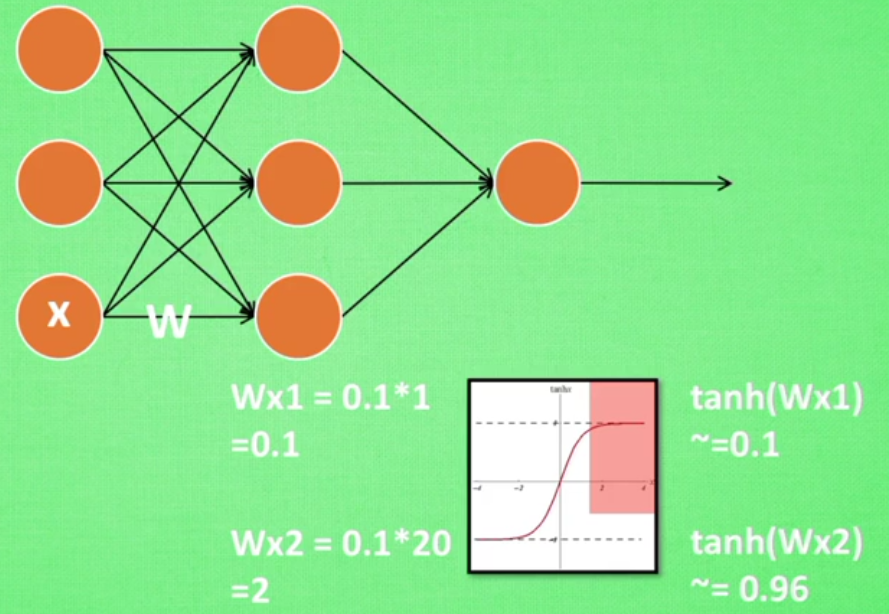
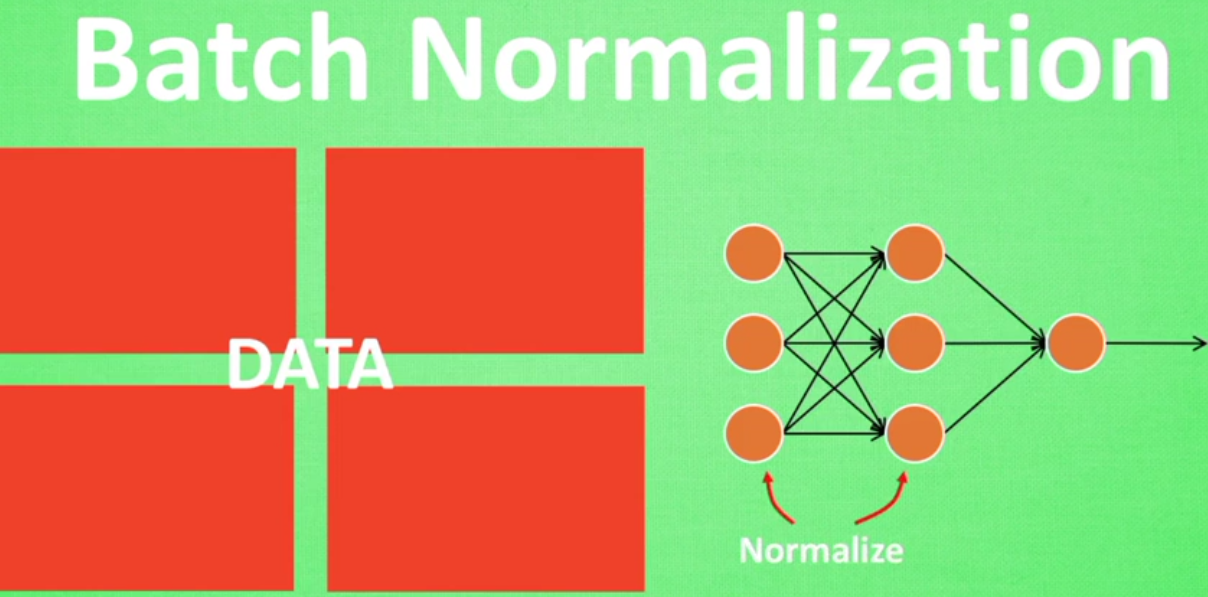
BatchNormalzation是一种解决深度神经网络层数太多,而没有办法有效前向传递的问题,因为每层的输出值都会有不同的均值和方差,所以输出数据的分布也不一样。
如果对于输入的X*W本身得到的值通过tanh激活函数已经输出为1,在通过下一层的神经元之后结果并没有什么改变,因为该值已经很大(神经网络过敏感问题)
对于这种情况我们可以首先做一些批处理正则化



可以看出没有BN的时候,每层的值迅速全部都变为0,也可以说,所有的神经元迅速都已经死去了,而有BN,relu之后,每层的值都能有一个比较好的分布效果
大部分神经元都还活着

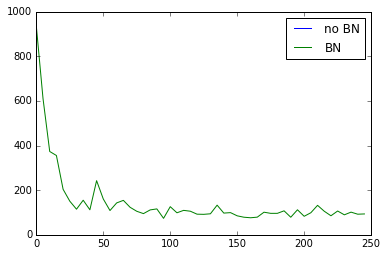
relu下的误差对比,no BN的曲线是没有的,很快消失

如果改为tanh,误差变化如下

"""

Build two networks.

1. Without batch normalization

2. With batch normalization

Run tests on these two networks.

"""

#  Batch Normalization

import numpy as np

import tensorflow as tf

import matplotlib.pyplot as plt

ACTIVATION = tf.nn.relu #tf.nn.tanh

N_LAYERS = 7

N_HIDDEN_UNITS = 30

def fix_seed(seed=1):

    # reproducible

    np.random.seed(seed)

    tf.set_random_seed(seed)

def plot_his(inputs, inputs_norm):

    # plot histogram for the inputs of every layer

    for j, all_inputs in enumerate([inputs, inputs_norm]):

        for i, input in enumerate(all_inputs):

            plt.subplot(2, len(all_inputs), j*len(all_inputs)+(i+1))

            plt.cla()

            if i == 0:

                the_range = (-7, 10)

            else:

                the_range = (-1, 1)

            plt.hist(input.ravel(), bins=15, range=the_range, color='#FF5733')

            plt.yticks(())

            if j == 1:

                plt.xticks(the_range)

            else:

                plt.xticks(())

            ax = plt.gca()

            ax.spines['right'].set_color('none')

            ax.spines['top'].set_color('none')

        plt.title("%s normalizing" % ("Without" if j == 0 else "With"))

    plt.draw()

    plt.pause(0.01)

def built_net(xs, ys, norm):

    def add_layer(inputs, in_size, out_size, activation_function=None, norm=False):

        # weights and biases (bad initialization for this case)

        Weights = tf.Variable(tf.random_normal([in_size, out_size], mean=0., stddev=1.))

        biases = tf.Variable(tf.zeros([1, out_size]) + 0.1)

        # fully connected product

        Wx_plus_b = tf.matmul(inputs, Weights) + biases

        # normalize fully connected product

        if norm:

            # Batch Normalize

            fc_mean, fc_var = tf.nn.moments(

                Wx_plus_b,

                axes=[0],   # the dimension you wanna normalize, here [0] for batch

                            # for image, you wanna do [0, 1, 2] for [batch, height, width] but not channel

            )

            scale = tf.Variable(tf.ones([out_size]))

            shift = tf.Variable(tf.zeros([out_size]))

            epsilon = 0.001

            # apply moving average for mean and var when train on batch

            ema = tf.train.ExponentialMovingAverage(decay=0.5)

            def mean_var_with_update():

                ema_apply_op = ema.apply([fc_mean, fc_var])

                with tf.control_dependencies([ema_apply_op]):

                    return tf.identity(fc_mean), tf.identity(fc_var)

            mean, var = mean_var_with_update()

            #all parmeter batch normalization

            Wx_plus_b = tf.nn.batch_normalization(Wx_plus_b, mean, var, shift, scale, epsilon)

            # similar with this two steps:

            # Wx_plus_b = (Wx_plus_b - fc_mean) / tf.sqrt(fc_var + 0.001)

            # Wx_plus_b = Wx_plus_b * scale + shift

        # activation

        if activation_function is None:

            outputs = Wx_plus_b

        else:

            outputs = activation_function(Wx_plus_b)

        return outputs

    fix_seed(1)

    if norm:

        # BN for the first input

        fc_mean, fc_var = tf.nn.moments(

            xs,

            axes=[0],

        )

        scale = tf.Variable(tf.ones([1]))

        shift = tf.Variable(tf.zeros([1]))

        epsilon = 0.001

        # apply moving average for mean and var when train on batch

        ema = tf.train.ExponentialMovingAverage(decay=0.5)

        def mean_var_with_update():

            ema_apply_op = ema.apply([fc_mean, fc_var])

            with tf.control_dependencies([ema_apply_op]):

                return tf.identity(fc_mean), tf.identity(fc_var)

        mean, var = mean_var_with_update()

        xs = tf.nn.batch_normalization(xs, mean, var, shift, scale, epsilon)

    # record inputs for every layer

    layers_inputs = [xs]

    # build hidden layers

    for l_n in range(N_LAYERS):

        layer_input = layers_inputs[l_n]

        in_size = layers_inputs[l_n].get_shape()[1].value

        output = add_layer(

            layer_input,    # input

            in_size,        # input size

            N_HIDDEN_UNITS, # output size

            ACTIVATION,     # activation function

            norm,           # normalize before activation

        )

        layers_inputs.append(output)    # add output for next run

    # build output layer

    prediction = add_layer(layers_inputs[-1], 30, 1, activation_function=None)

    cost = tf.reduce_mean(tf.reduce_sum(tf.square(ys - prediction), reduction_indices=[1]))

    train_op = tf.train.GradientDescentOptimizer(0.001).minimize(cost)

    return [train_op, cost, layers_inputs]

# make up data

fix_seed(1)

x_data = np.linspace(-7, 10, 2500)[:, np.newaxis]

np.random.shuffle(x_data)

noise = np.random.normal(0, 8, x_data.shape)

y_data = np.square(x_data) - 5 + noise

# plot input data

plt.scatter(x_data, y_data)

plt.show()

xs = tf.placeholder(tf.float32, [None, 1])  # [num_samples, num_features]

ys = tf.placeholder(tf.float32, [None, 1])

#create 2 neuralnetwork

train_op, cost, layers_inputs = built_net(xs, ys, norm=False)   # without BN

train_op_norm, cost_norm, layers_inputs_norm = built_net(xs, ys, norm=True) # with BN

sess = tf.Session()

if int((tf.__version__).split('.')[1]) < 12 and int((tf.__version__).split('.')[0]) < 1:

    init = tf.initialize_all_variables()

else:

    init = tf.global_variables_initializer()

sess.run(init)

# record cost

cost_his = []

cost_his_norm = []

record_step = 5

plt.ion()

plt.figure(figsize=(7, 3))

for i in range(250):

    if i % 50 == 0:

        # plot histogram

        all_inputs, all_inputs_norm = sess.run([layers_inputs, layers_inputs_norm], feed_dict={xs: x_data, ys: y_data})

        plot_his(all_inputs, all_inputs_norm)

    # train on batch

    sess.run([train_op, train_op_norm], feed_dict={xs: x_data[i*10:i*10+10], ys: y_data[i*10:i*10+10]})

    if i % record_step == 0:

        # record cost

        cost_his.append(sess.run(cost, feed_dict={xs: x_data, ys: y_data}))

        cost_his_norm.append(sess.run(cost_norm, feed_dict={xs: x_data, ys: y_data}))

plt.ioff()

plt.figure()

plt.plot(np.arange(len(cost_his))*record_step, np.array(cost_his), label='no BN')     # no norm

plt.plot(np.arange(len(cost_his))*record_step, np.array(cost_his_norm), label='BN')   # norm

plt.legend()

plt.show()
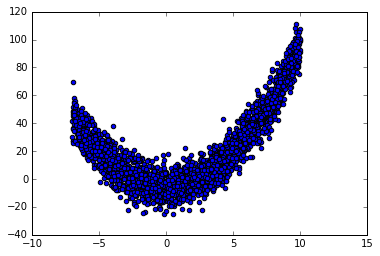
数据集图示

2.5BatchNormalzation的更多相关文章
随机推荐
- python 使用模板模式和工厂模式的混合设计开发各种邮件客户端发送邮件
1.使用模板模式和工厂模式的混合设计开发各种邮件客户端发送邮件. 2.模板模式的目的:能保证快速开发各种邮箱客户端,子类只需要重写模板类邮箱的抽象方法即可.之后再开发任何邮箱就只要加一个类,写3行代码 ...
- UML类图关系(转,添加了实例)
UML类图关系(泛化 .继承.实现.依赖.关联.聚合.组合) 在UML类图中,常见的有以下几种关系: 泛化(Generalization), 实现(Realization),关联(Associati ...
- PHP+Oracle Instant Client
<?php <b>●Oracleとの接続テスト</b> <hr> <?php // Oracleとの接続 $conn = OCILogon(" ...
- 简单思考 如何用PHP输出本周的周三日期
简单思考 如何用PHP输出本周的周三日期?比如今天2017-10-31 计算本周周三应该是2017-11-01 自己动脑筋想一想,然后给我留言或者评论
- Nginx(五)-- 配置文件之Rewrite
Rewrite支持URL重写 1.常用指令以及语法 1) if指令 if语法: if 空格 (condition) {} 条件: 1. “=” 来判断相等,用于字符的比较 ...
- Disruptor LMAX学习
http://lmax-exchange.github.io/disruptor/ http://bruce008.iteye.com/blog/1408075 http://code.google. ...
- 国内CDN加速现状
什么是CDN CDN的全称是Content Delivery Network,即内容分发网络.是位于网络层与应用层之间的网络应用,其目的是通过在现有的Internet中增加一层新的网络架构,将网站的内 ...
- Swift - 类型转换(as as! as?)
swift 类型转换 一,as 1,as使用场合 (1)从派生类转换为基类,向上转型(upcasts) class Animal {} class Cat: Animal {} let cat = C ...
- Android开发懒人库 -- ButterKnife (转载)
ButterKnife:8.1.0的使用 http://www.jianshu.com/p/0392199a682b http://www.cnblogs.com/flyme/p/4517560. ...
- JDK下载链接
所有的存档页面 http://www.oracle.com/technetwork/cn/java/archive-139210-zhs.html