
Tensorflow 循环神经网络 基本 RNN 和 LSTM 网络 拟合、预测sin曲线
时序预测一直是比较重要的研究问题,在统计学中我们有各种的模型来解决时间序列问题,但是最近几年比较火的深度学习中也有能解决时序预测问题的方法,另外在深度学习领域中时序预测算法可以解决自然语言问题等。
在网上找到了 tensorflow 中 RNN 和 LSTM 算法预测 sin 曲线的代码,效果不错。
LSTM:
#encoding:UTF-8

import random

import numpy as np

import tensorflow as tf

from tensorflow.contrib.rnn.python.ops import core_rnn

from tensorflow.contrib.rnn.python.ops import core_rnn_cell

def build_data(n):

    xs = []

    ys = []

    for i in range(0, 2000):

        k = random.uniform(1, 50)

        x = [[np.sin(k + j)] for j in range(0, n)]

        y = [np.sin(k + n)]

        # x[i] = sin(k + i) (i = 0, 1, ..., n-1)

        # y[i] = sin(k + n)

        xs.append(x)

        ys.append(y)

    train_x = np.array(xs[0: 1500])

    train_y = np.array(ys[0: 1500])

    test_x = np.array(xs[1500:])

    test_y = np.array(ys[1500:])

    return (train_x, train_y, test_x, test_y)

length = 10

time_step_size = length

vector_size = 1

batch_size = 10

test_size = 10

# build data

(train_x, train_y, test_x, test_y) = build_data(length)

print(train_x.shape, train_y.shape, test_x.shape, test_y.shape)

X = tf.placeholder("float", [None, length, vector_size])

Y = tf.placeholder("float", [None, 1])

# get lstm_size and output predicted value

W = tf.Variable(tf.random_normal([10, 1], stddev=0.01))

B = tf.Variable(tf.random_normal([1], stddev=0.01))

def seq_predict_model(X, w, b, time_step_size, vector_size):

    # input X shape: [batch_size, time_step_size, vector_size]

    # transpose X to [time_step_size, batch_size, vector_size]

    X = tf.transpose(X, [1, 0, 2])

    # reshape X to [time_step_size * batch_size, vector_size]

    X = tf.reshape(X, [-1, vector_size])

    # split X, array[time_step_size], shape: [batch_size, vector_size]

    X = tf.split(X, time_step_size, 0)

    # LSTM model with state_size = 10

    cell = core_rnn_cell.BasicLSTMCell(num_units=10,

                                       forget_bias=1.0,

                                       state_is_tuple=True)

    outputs, _states = core_rnn.static_rnn(cell, X, dtype=tf.float32)

    # Linear activation

    return tf.matmul(outputs[-1], w) + b, cell.state_size

pred_y, _ = seq_predict_model(X, W, B, time_step_size, vector_size)

loss = tf.square(tf.subtract(Y, pred_y))

train_op = tf.train.GradientDescentOptimizer(0.001).minimize(loss)

with tf.Session() as sess:

    tf.global_variables_initializer().run()

    # train

    for i in range(50):

        # train

        for end in range(batch_size, len(train_x), batch_size):

            begin = end - batch_size

            x_value = train_x[begin: end]

            y_value = train_y[begin: end]

            sess.run(train_op, feed_dict={X: x_value, Y: y_value})

        # randomly select validation set from test set

        test_indices = np.arange(len(test_x))

        np.random.shuffle(test_indices)

        test_indices = test_indices[0: test_size]

        x_value = test_x[test_indices]

        y_value = test_y[test_indices]

        # eval in validation set

        val_loss = np.mean(sess.run(loss,

                                    feed_dict={X: x_value, Y: y_value}))

        print('Run %s' % i, val_loss)

    for b in range(0, len(test_x), test_size):

        x_value = test_x[b: b + test_size]

        y_value = test_y[b: b + test_size]

        pred = sess.run(pred_y, feed_dict={X: x_value})

        for i in range(len(pred)):

            print(pred[i], y_value[i], pred[i] - y_value[i])
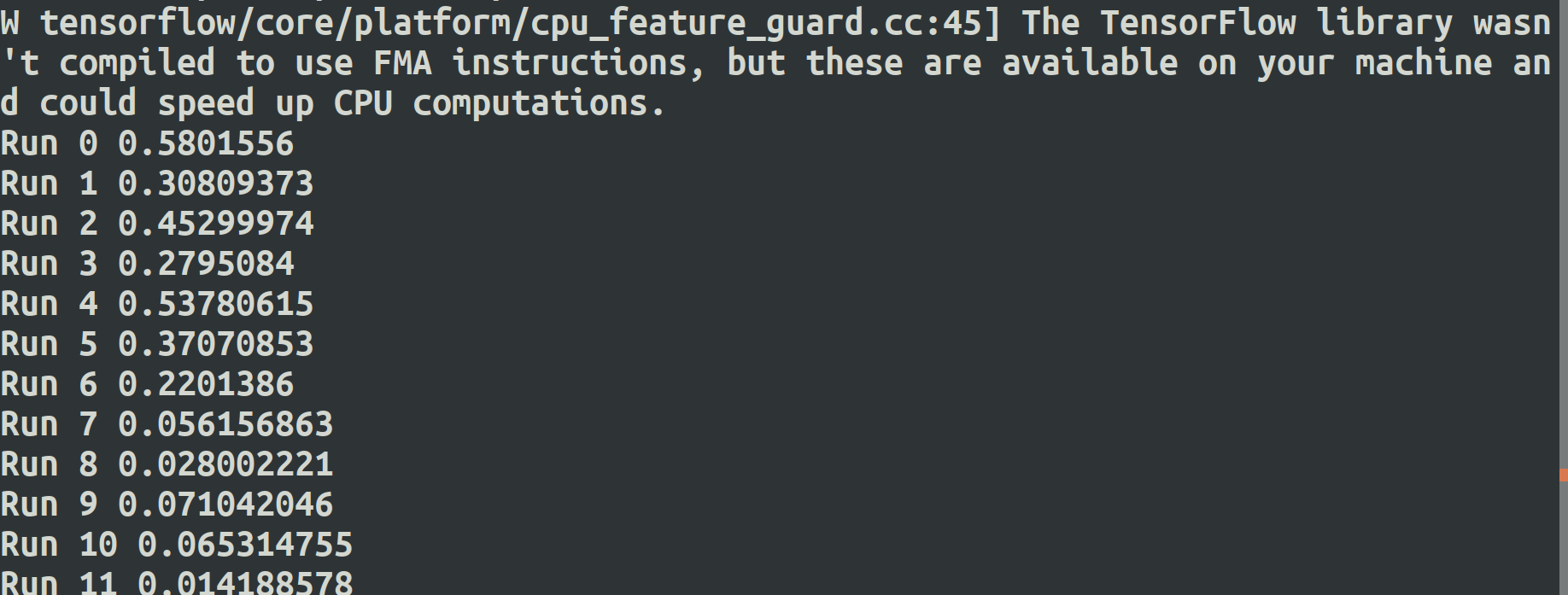
RNN :
import random

import numpy as np

import tensorflow as tf

from tensorflow.contrib.rnn.python.ops import core_rnn

from tensorflow.contrib.rnn.python.ops import core_rnn_cell

def build_data(n):

    xs = []

    ys = []

    for i in range(0, 2000):

        k = random.uniform(1, 50)

        x = [[np.sin(k + j)] for j in range(0, n)]

        y = [np.sin(k + n)]

        # x[i] = sin(k + i) (i = 0, 1, ..., n-1)

        # y[i] = sin(k + n)

        xs.append(x)

        ys.append(y)

    train_x = np.array(xs[0: 1500])

    train_y = np.array(ys[0: 1500])

    test_x = np.array(xs[1500:])

    test_y = np.array(ys[1500:])

    return (train_x, train_y, test_x, test_y)

length = 10

time_step_size = length

vector_size = 1

batch_size = 10

test_size = 10

# build data

(train_x, train_y, test_x, test_y) = build_data(length)

print(train_x.shape, train_y.shape, test_x.shape, test_y.shape)

X = tf.placeholder("float", [None, length, vector_size])

Y = tf.placeholder("float", [None, 1])

# get lstm_size and output predicted value

W = tf.Variable(tf.random_normal([10, 1], stddev=0.01))

B = tf.Variable(tf.random_normal([1], stddev=0.01))

def seq_predict_model(X, w, b, time_step_size, vector_size):

    # input X shape: [batch_size, time_step_size, vector_size]

    # transpose X to [time_step_size, batch_size, vector_size]

    X = tf.transpose(X, [1, 0, 2])

    # reshape X to [time_step_size * batch_size, vector_size]

    X = tf.reshape(X, [-1, vector_size])

    # split X, array[time_step_size], shape: [batch_size, vector_size]

    X = tf.split(X, time_step_size, 0)

    cell = core_rnn_cell.BasicRNNCell(num_units=10)

    initial_state = tf.zeros([batch_size, cell.state_size])

    outputs, _states = core_rnn.static_rnn(cell, X, initial_state=initial_state)

    # Linear activation

    return tf.matmul(outputs[-1], w) + b, cell.state_size

pred_y, _ = seq_predict_model(X, W, B, time_step_size, vector_size)

loss = tf.square(tf.subtract(Y, pred_y))

train_op = tf.train.GradientDescentOptimizer(0.001).minimize(loss)

with tf.Session() as sess:

    tf.global_variables_initializer().run()

    # train

    for i in range(50):

        # train

        for end in range(batch_size, len(train_x), batch_size):

            begin = end - batch_size

            x_value = train_x[begin: end]

            y_value = train_y[begin: end]

            sess.run(train_op, feed_dict={X: x_value, Y: y_value})

        # randomly select validation set from test set

        test_indices = np.arange(len(test_x))

        np.random.shuffle(test_indices)

        test_indices = test_indices[0: test_size]

        x_value = test_x[test_indices]

        y_value = test_y[test_indices]

        # eval in validation set

        val_loss = np.mean(sess.run(loss,

                                    feed_dict={X: x_value, Y: y_value}))

        print('Run %s' % i, val_loss)

    for b in range(0, len(test_x), test_size):

        x_value = test_x[b: b + test_size]

        y_value = test_y[b: b + test_size]

        pred = sess.run(pred_y, feed_dict={X: x_value})

        for i in range(len(pred)):

            print(pred[i], y_value[i], pred[i] - y_value[i])

-------------------------------------------------------------------
Tensorflow 循环神经网络 基本 RNN 和 LSTM 网络 拟合、预测sin曲线的更多相关文章
- 深度学习项目——基于循环神经网络(RNN)的智能聊天机器人系统
基于循环神经网络(RNN)的智能聊天机器人系统 本设计研究智能聊天机器人技术,基于循环神经网络构建了一套智能聊天机器人系统,系统将由以下几个部分构成:制作问答聊天数据集.RNN神经网络搭建.seq2s ...
- 大话循环神经网络(RNN)
在上一篇文章中,介绍了 卷积神经网络(CNN)的算法原理,CNN在图像识别中有着强大.广泛的应用,但有一些场景用CNN却无法得到有效地解决,例如: 语音识别,要按顺序处理每一帧的声音信息,有些结果 ...
- Coursera Deep Learning笔记 序列模型(一)循环序列模型[RNN GRU LSTM]
参考1 参考2 参考3 1. 为什么选择序列模型 序列模型能够应用在许多领域,例如: 语音识别 音乐发生器 情感分类 DNA序列分析 机器翻译 视频动作识别 命名实体识别 这些序列模型都可以称作使用标 ...
- 【学习笔记】循环神经网络(RNN)
前言 多方寻找视频于博客.学习笔记,依然不能完全熟悉RNN,因此决定还是回到书本(<神经网络与深度学习>第六章),一点点把啃下来,因为这一章对于整个NLP学习十分重要,我想打好基础. 当然 ...
- TensorFlow(十一):递归神经网络(RNN与LSTM)
RNN RNN(Recurrent Neural Networks,循环神经网络)不仅会学习当前时刻的信息,也会依赖之前的序列信息.由于其特殊的网络模型结构解决了信息保存的问题.所以RNN对处理时间序 ...
- CNN(卷积神经网络)、RNN(循环神经网络)、DNN,LSTM
http://cs231n.github.io/neural-networks-1 https://arxiv.org/pdf/1603.07285.pdf https://adeshpande3.g ...
- 深度学习之循环神经网络(RNN)
循环神经网络(Recurrent Neural Network,RNN)是一类具有短期记忆能力的神经网络,适合用于处理视频.语音.文本等与时序相关的问题.在循环神经网络中,神经元不但可以接收其他神经元 ...
- TensorFlow——循环神经网络基本结构
1.导入依赖包,初始化一些常量 import collections import numpy as np import tensorflow as tf TRAIN_DATA = "./d ...
- [深度学习]理解RNN, GRU, LSTM 网络
Recurrent Neural Networks(RNN) 人类并不是每时每刻都从一片空白的大脑开始他们的思考.在你阅读这篇文章时候,你都是基于自己已经拥有的对先前所见词的理解来推断当前词的真实含义 ...
随机推荐
- 实现多层DIV叠加的js事件穿透
前几天做的一个功能:在地图上加载标注,这个标注是列表,就直接放的 DIV. 后来发现,当鼠标在这个标注上面的时候,滚动鼠标滚轮,地图的缩放功能失效. 想了下,应该是最上面的标注 DIV 拦截了滚轮滚动 ...
- (三)WCF之契约
自从我们接收ITOO项目之后,就必须跟WCF打交道,既然必须直面WCF,我就对WCF进行了研究(还不是很深入,是自己目前的理解).之前对WCF的一些基础知识进行了简单的介绍,本篇重点来介绍WCF的契约 ...
- PHP Web 木马扫描器
直接放在网站根目录运行即可 <?php /**************PHP Web木马扫描器************************/ /* [+] 版本: v1.0 */ /* [+ ...
- 「NOI2012」骑行川藏
「NOI2012」骑行川藏 题目描述 蛋蛋非常热衷于挑战自我,今年暑假他准备沿川藏线骑着自行车从成都前往拉萨. 川藏线的沿途有着非常美丽的风景,但在这一路上也有着很多的艰难险阻,路况变化多端,而蛋蛋的 ...
- Oracle 序号函数
Oracle提供的序号函数:以emp表为例:1: rownum 最简单的序号 但是在order by之前就确定值.select rownum,t.* from emp t order by ename ...
- Spring源码窥探之:@Value
1. 首先定义实体 /** * @author 70KG * @Title: Apple * @Description: 苹果实体 * @date 2018/10/22下午9:26 * @From w ...
- 自用 微信小程序跳小程序
"window": { "navigationBarTextStyle": "black", "navigationBarTitl ...
- snmp-trap
snmpd作为一个服务,本身有系统的一些信息,外部可以通过snmp -get ,walk来获取,前提是被控主机开启了snmpd服务, snmptrap理解为一个陷阱,等着掉进来猎物,就是一个收数据的服 ...
- 11、spark内核架构剖析与宽窄依赖
一.内核剖析 1.内核模块 1.Application 2.spark-submit 3.Driver 4.SparkContext 5.Master 6.Worker 7.Executor 8.Jo ...
- 【一起来烧脑】一步React.JS学会体系
[外链图片转存失败(img-cn4fbVDq-1563575047348)(https://upload-images.jianshu.io/upload_images/11158618-8c6f3d ...