
List的同步类比较
TL;NRs
CopyOnWriteArrayList类在多线程顺序读取上有很大的优势,但在随机读取上反而有较大的劣势,且在写入方面性能极差。Vector类在顺序读取方面性能较差,但在随机读取方面有较大的优势,写入方面性能也还可以。
1,引言
java线程安全的List实现有以下三种:
new Vector<>()Collections.synchronizedList(new ArrayList<>())new CopyOnWriteArrayList<>()
通常认为使用了synchronized会导致运行变慢,那么在java针对synchronized进行一系列优化后,现在的情况如何呢?为了检验这一说法,写了一个验证程序进行验证。
2,验证代码
以ArrayList作为基础,分别测试4种List的顺序写入(0 ~ 1 << 24)、顺序读取和随机读取,各十轮。据此编写代码。代码太长了,所以放到最后
3,测试平台
垃圾笔记本,使用Intel酷睿i5 7200U
java版本为java 12,HotSpot虚拟机
4,测试结果
单位:毫秒
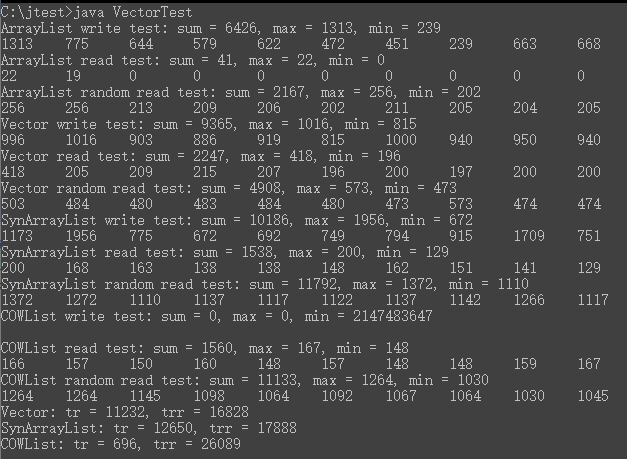
5,结果分析
ArrayList(A)、Vector(V)、Collections.synchronizedList(new ArrayList<>())(S)、以及CopyOnWriteArrayList(C)四种类型的结果分别如下
十轮写入,单位毫秒
| A | V | S | C | |
|---|---|---|---|---|
| 总时间 | 6426 | 9365 | 10186 | inf |
| 最大时间 | 1313 | 1016 | 1096 | inf |
| 最小时间 | 239 | 815 | 672 | inf |
十轮单线程顺序读,单位毫秒
| A | V | S | C | |
|---|---|---|---|---|
| 总时间 | 41 | 2247 | 1538 | 1560 |
| 最大时间 | 22 | 418 | 200 | 167 |
| 最小时间 | 0 | 196 | 129 | 148 |
十轮单线程随机读,单位毫秒
| A | V | S | C | |
|---|---|---|---|---|
| 总时间 | 2167 | 4908 | 11792 | 11133 |
| 最大时间 | 256 | 573 | 1372 | 1264 |
| 最小时间 | 202 | 473 | 1110 | 1030 |
十线程顺序读,单位毫秒
| V | S | C | |
|---|---|---|---|
| 总时间 | 11232 | 12650 | 696 |
十线程随机读,单位毫秒
| V | S | C | |
|---|---|---|---|
| 总时间 | 16828 | 17888 | 26089 |
6,结论
单线程写入性能:A > V = S >>>> C
单线程顺序读取性能:A >> S = C > V
单线程随机读取性能:A > V > S = C
20线程顺序读取性能:C >> V > S
20线程随机读取性能:V > S >> C
COW顺序读取性能较好,随机读取性能较差,写入性能极差。
Vector随机读取性能较好,顺序读取性能和写入性能较差。
附录 测试代码
import java.util.*;

import java.util.concurrent.*;

public class VectorTest {

    private static final int CNT = 1 << 24;

    private static final Random rand = new Random();

    public static void main(String[] args) throws InterruptedException {

        int writeRound = 10, readRound = 10, randomReadRound = 10;

        int nRead = 20, nRandomRead = 20;

        List<Integer> lsA = new ArrayList<>();

        List<Integer> lsV = new Vector<>();

        List<Integer> lsS = Collections.synchronizedList(new ArrayList<>());

        List<Integer> lsC = new CopyOnWriteArrayList<>();

        test(lsA, "ArrayList", writeRound, readRound, randomReadRound);

        test(lsV, "Vector", writeRound, readRound, randomReadRound);

        test(lsS, "SynArrayList", writeRound, readRound, randomReadRound);

        lsC.addAll(lsA);

        test(lsC, "COWList", 0, readRound, randomReadRound);

        multiThreadTest(lsV, "Vector", nRead, nRandomRead);

        multiThreadTest(lsS, "SynArrayList", nRead, nRandomRead);

        multiThreadTest(lsC, "COWList", nRead, nRandomRead);

    }

    private static void test(List<Integer> list, String name, int writeRound, int readRound, int randomReadRound) {

        int max = 0, min = Integer.MAX_VALUE, sum = 0;

        int[] w = new int[writeRound], r = new int[readRound], rr = new int[randomReadRound];

        for (int i = 0; i < writeRound; i++) {

            list.clear();

            int v = w[i] = writeTest(list);

            max = Math.max(max, v);

            min = Math.min(min, v);

            sum += v;

        }

        System.out.printf("%s write test: sum = %d, max = %d, min = %d\n", name, sum, max, min);

        for (int v : w) System.out.printf("%d\t", v);

        System.out.println();

        sum = max = 0;

        min = Integer.MAX_VALUE;

        for (int i = 0; i < readRound; i++) {

            int v = r[i] = readTest(list);

            max = Math.max(max, v);

            min = Math.min(min, v);

            sum += v;

        }

        System.out.printf("%s read test: sum = %d, max = %d, min = %d\n", name, sum, max, min);

        for (int v : r) System.out.printf("%d\t", v);

        System.out.println();

        sum = max = 0;

        min = Integer.MAX_VALUE;

        for (int i = 0; i < randomReadRound; i++) {

            int v = rr[i] = randomReadTest(list);

            max = Math.max(max, v);

            min = Math.min(min, v);

            sum += v;

        }

        System.out.printf("%s random read test: sum = %d, max = %d, min = %d\n", name, sum, max, min);

        for (int v : rr) System.out.printf("%d\t", v);

        System.out.println();

    }

    private static int writeTest(List<Integer> list) {

        long t0 = System.currentTimeMillis();

        for (int i = 0; i < CNT; i++) list.add(i);

        long t1 = System.currentTimeMillis();

        return (int)(t1 - t0);

    }

    private static int readTest(List<Integer> list) {

        long t0 = System.currentTimeMillis();

        for (int i = 0; i < CNT; i++) list.get(i);

        long t1 = System.currentTimeMillis();

        return (int)(t1 - t0);

    }

    private static int randomReadTest(List<Integer> list) {

        long t0 = System.currentTimeMillis();

        for (int i = 0; i < CNT; i++) list.get(rand.nextInt(CNT));

        long t1 = System.currentTimeMillis();

        return (int)(t1 - t0);

    }

    private static List<Integer> ls;

    private static long t2 = 0;

    private static CountDownLatch cdl;

    public static class ThreadRead extends Thread {

        public void run() {

            for (int i = 0; i < CNT; i++) ls.get(i);

            long t1 = System.currentTimeMillis();

            t2 = Math.max(t1, t2);

            cdl.countDown();

        }

    }

    public static class ThreadRandomRead extends Thread {

        public void run() {

            for (int i = 0; i < CNT; i++) ls.get(rand.nextInt(CNT));

            long t1 = System.currentTimeMillis();

            t2 = Math.max(t1, t2);

            cdl.countDown();

        }

    }

    private static void multiThreadTest(List<Integer> list, String name, int nRead, int nRandomRead) throws InterruptedException {

        int tr = 0, trr = 0;

        ls = list;

        cdl = new CountDownLatch(nRead);

        long t0 = System.currentTimeMillis();

        for (int i = 0; i < nRead; i++) {

            new ThreadRead().start();

        }

        cdl.await();

        tr = (int)(t2 - t0);

        cdl = new CountDownLatch(nRandomRead);

        t2 = 0;

        t0 = System.currentTimeMillis();

        for (int i = 0; i < nRandomRead; i++) {

            new ThreadRandomRead().start();

        }

        cdl.await();

        trr = (int)(t2 - t0);

        System.out.printf("%s: tr = %d, trr = %d\n", name, tr, trr);

    }

}
List的同步类比较的更多相关文章
- Java中多线程同步类 CountDownLatch
在多线程开发中,常常遇到希望一组线程完成之后在执行之后的操作,java提供了一个多线程同步辅助类,可以完成此类需求: 类中常见的方法: 其中构造方法:CountDownLatch(int count) ...
- 16.同步类容器Collections.synchronized
voctor动态数组.同步类容器,底层实现基于:Collections.synchronized package demo5; import java.util.ArrayList; import j ...
- 15.同步类容器Vector
同步类容器1 1.线程都是安全的. 2.在某些场景下需要加锁来保护“复合操作” a.迭代:反复去访问元素.遍历完容器所有的元素 b.跳转:根据下标制定去访问查找元素 c.条件运算 3.复合操作在多线程 ...
- Java线程同步类容器和并发容器(四)
同步类容器都是线程安全的,在某些场景下,需要枷锁保护符合操作,最经典ConcurrentModifiicationException,原因是当容器迭代的过程中,被并发的修改了内容. for (Iter ...
- 同步类容器和并发类容器——ConcurrentMap、CopyOnWrite、Queue
一 同步类容器同步类容器都是线程安全的,但在某些场景中可能需要加锁来保证复合操作. 符合操作如:迭代(反复访问元素,遍历完容器中所有元素).跳转(根据指定的顺序找到当前元素的下一个元素).条件运算. ...
- Java多线程信号量同步类CountDownLatch与Semaphore
信号量同步是指在不同线程之间,通过传递同步信号量来协调线程执行的先后次序.CountDownLatch是基于时间维度的Semaphore则是基于信号维度的. 1:基于执行时间的同步类CountDown ...
- 同步类的基础AbstractQueuedSynchronizer(AQS)
同步类的基础AbstractQueuedSynchronizer(AQS) 我们之前介绍了很多同步类,比如ReentrantLock,Semaphore, CountDownLatch, Reentr ...
- 解读java同步类CountDownLatch
同步辅助类: CountDownLatch是一个同步辅助类,在jdk5中引入,它允许一个或多个线程等待其他线程操作完成之后才执行. 实现原理 : CountDownLatch是通过计数器的方式来实现, ...
- synchronized 线程同步-类级别锁定
1.demo 说明:代码中通过 printNum 方法传入参数判断 a.b 分别对 num 这个参数的值进行了修改. package demo1; import sun.applet.Main; pu ...
随机推荐
- JS倒计时(刷新页面不影响)的实现思路
最近在做一个项目,用到了点击按钮实现倒计时,这个用js来实现很简单.但是遇到了一个问题 页面刷新后js重新加载导致 倒计时重新开始,或者直接初始化了 后来通过 cookie 保存来实现了js倒计时,关 ...
- 从零搭建react+ts组件库(封装antd)
为什么会有这样一篇文章?因为网上的教程/示例只说了怎么做,没有系统详细的介绍引入这些依赖.为什么要这样配置,甚至有些文章还是错的!迫于技术洁癖,我希望更多的开发小伙伴能够真正的理解一个项目搭建各个方面 ...
- go-zero 微服务实战系列(一、开篇)
前言 在社区中经常看到有人问有没有基于 go-zero 的比较完整的项目参考,该类问题本质上是想知道基于 go-zero 的项目的最佳实践.完整的项目应该是一个完整的产品功能,包含产品需求.架构设计. ...
- 10个常见触发IO瓶颈的高频业务场景
摘要:本文从应用业务优化角度,以常见触发IO慢的业务SQL场景为例,指导如何通过优化业务去提升IO效率和降低IO. 本文分享自华为云社区<GaussDB(DWS)性能优化之业务降IO优化> ...
- ExtJS配置TabPanel可以拖拽Tab标签页
1.环境说明 ExtJS版本:7.4.0.42 Sencha Cmd: v7.5.1.20 开发工具:WebStorm 2022.1.1 PS:如果是老版本的ExtJS,引入Ext.ux.TabReo ...
- 记录人生中的第一个bug
对象的引用 使用**只是拷贝了字典的最外层,加个deepcopy可以实现深拷贝,递归的去复制对象 bug来源: 在一次将数据库里的数据转成json格式过程中,在遍历数据库对象时,对象的引用不当,导致最 ...
- 【时序数据库InfluxDB】Windows环境下配置InfluxDB+数据可视化,以及使用 C#进行简单操作的代码实例
前言:如题.直接上手撸,附带各种截图,就不做介绍了. 1.influxDB的官网下载地址 https://portal.influxdata.com/downloads/ 打开以后,如下图所示,可以 ...
- windows如何结束某个端口的进程
netstat -ano | findstr 端口号 (查询端口号被哪个进程占用) tasklist | findstr 进程PID (根据PID找到进程名称) taskkill -PID 进程PID ...
- colab解压.tar.gz文件指令
!tar -zxvf flower_photos.tar.gz 成功后如图:
- Linux系列之查找命令
前言 Linux 有四个常用的查找命令:locate.whereis.which 和 find.本文介绍它们的区别和简单用法. locate命令 这个命令将检查你的整个文件系统,并找到该关键词的每一次 ...