
【论文阅读】ICLR 2022: Scene Transformer: A unified architecture for predicting future trajectories of multiple agents
ICLR 2022: Scene Transformer: A unified architecture for predicting future trajectories of multiple agents
Type: ICLR
Year: 2022
组织: waymo
参考与前言
- openreivew
https://openreview.net/forum?id=Wm3EA5OlHsG
Scene Transformer: A unified architecture for predicting multiple agent trajectories
1. Motivation
主要受语言模型方法 language modeling approach 启发而来
问题场景
任务:多agent的轨迹预测问题
难点:因为agent本身行为的多样性 (diverse),加之对彼此轨迹的影响(influence)
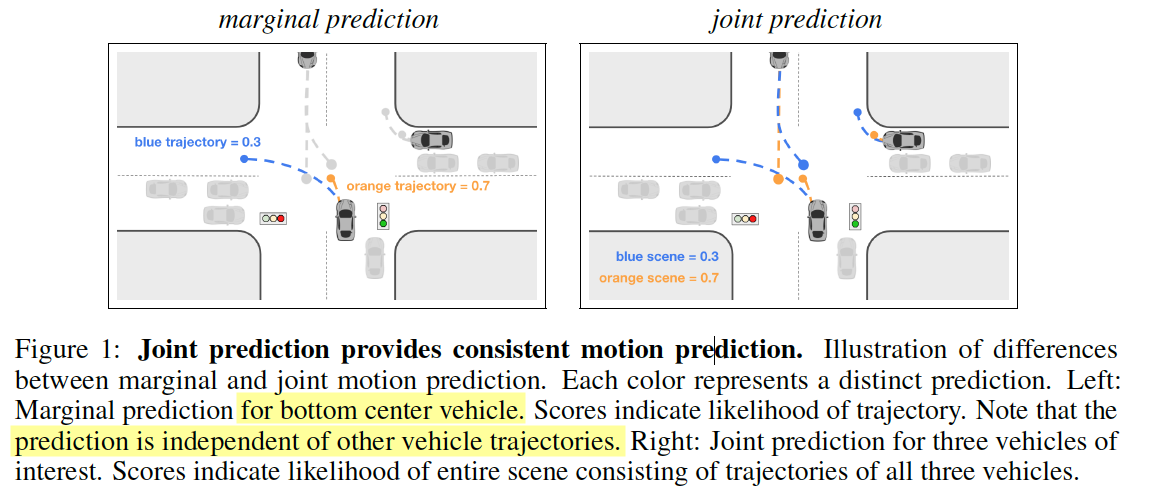
之前工作主要聚焦在根据过去动作预测 单独 agent的未来轨迹,然后根据各自的预测来进行规划;但是呢 independent predictions 并不利于表示未来状态下 不同agent之间的交互问题,从而引申规划时也是sub-optimal的轨迹
- marginal prediction:未来时刻 不同agent预测的轨迹可能会有冲突部分,即两者相交
- joint prediction:在同一未来时刻,不同agent的预测轨迹不会冲突, respect each others’ prediction
Contribution
formulate a model 去同时(jointly)预测所有的agent行为,producing consistent future 来解释agent之间的行为
以下为原文,这个贡献的格式和jjh说的TRO格式好像,名词方法为主语
A novel, scene-centric approach that allows us to gracefully switch training the model to produce either marginal (independent) and joint agent predictions in a single feed-forward pass.
仅在单个feed-forward中进行marginal和joint prediction之间的切换
A permutation equivariant Transformer-based architecture factored over agents, time, and road graph elements that exploits the inherent symmetries of the problem.
使用与 transformer 相同(等价)的permutation 来将agents, time和road graph都考虑在系统内
A masked sequence modeling approach that enables us to condition on hypothetical agent futures at inference time, enabling conditional motion prediction or goal conditioned prediction.
masked sequence modeling 能使我们将未来考虑在内,时间意义上
问题区:
摘要的方法没看懂,三个一个都没看懂.... TBD阅读到后面在回答这个问题吧
Through combining a scene-centric approach, agent permutation equivariant model, and a sequence masking strategy
- 介绍中引入scene-centric说的是为了scaling to large numbers of agents,但是在贡献中却说的是切换?emmm 是数量大了就切换?小了就joint?
评估时为什么是marginal and joint motion predictions,后者可以理解,前者的marginal是什么预测?单独agent的预测与真值对比嘛?
后面介绍部分解释了,见前面解释
为什么要切换 为什么[要切换](https://www.notion.so/ICLR-2022-Scene-Transformer-A-unified-architecture-for-predicting-future-trajectories-of-multiple--37a700f54efb4e4f87eee9f682c6a0d5)?直接整体进行joint prediction不是更好吗?
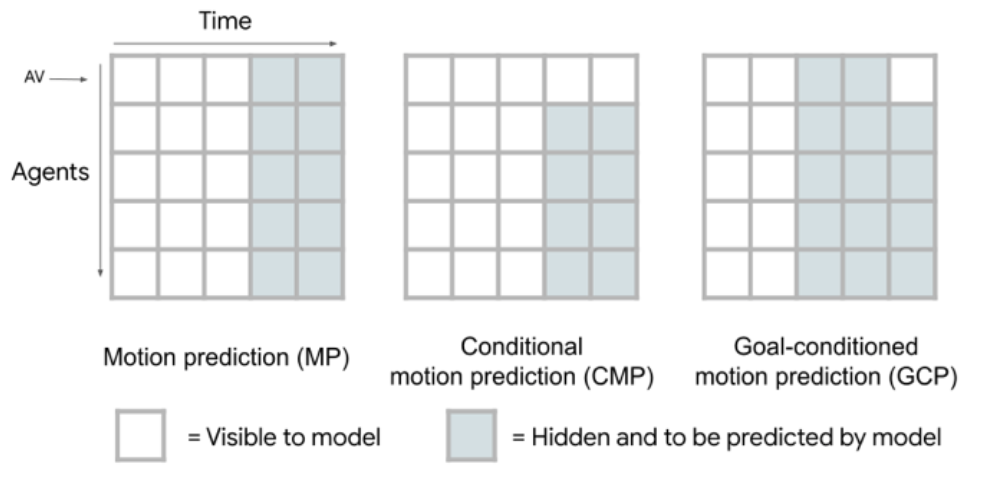
方法处说明了 是不同的任务之间都可以用这一个网络进行,主要任务是:motion prediction、conditional motion prediction、goal-conditioned prediction
transformer?attention 机制?考虑时形式以vector形式吗?
方法中有具体介绍,静止的road graph用feature vector形式,动态的比如红绿灯是one feature vector per object形式
没看懂最后一条贡献,因为在第二条里已经说明了使用transform类似机制将time考虑进内,mask squence 建模原因有重复?
- 是直接对未来的agent进行假设嘛?可能是前情提要知识缺的有点多,可能得套娃比较多
mask的原因其实是切换... The approach is flexible, enabling us to simultaneously train a single model for MP, CMP, GCP.
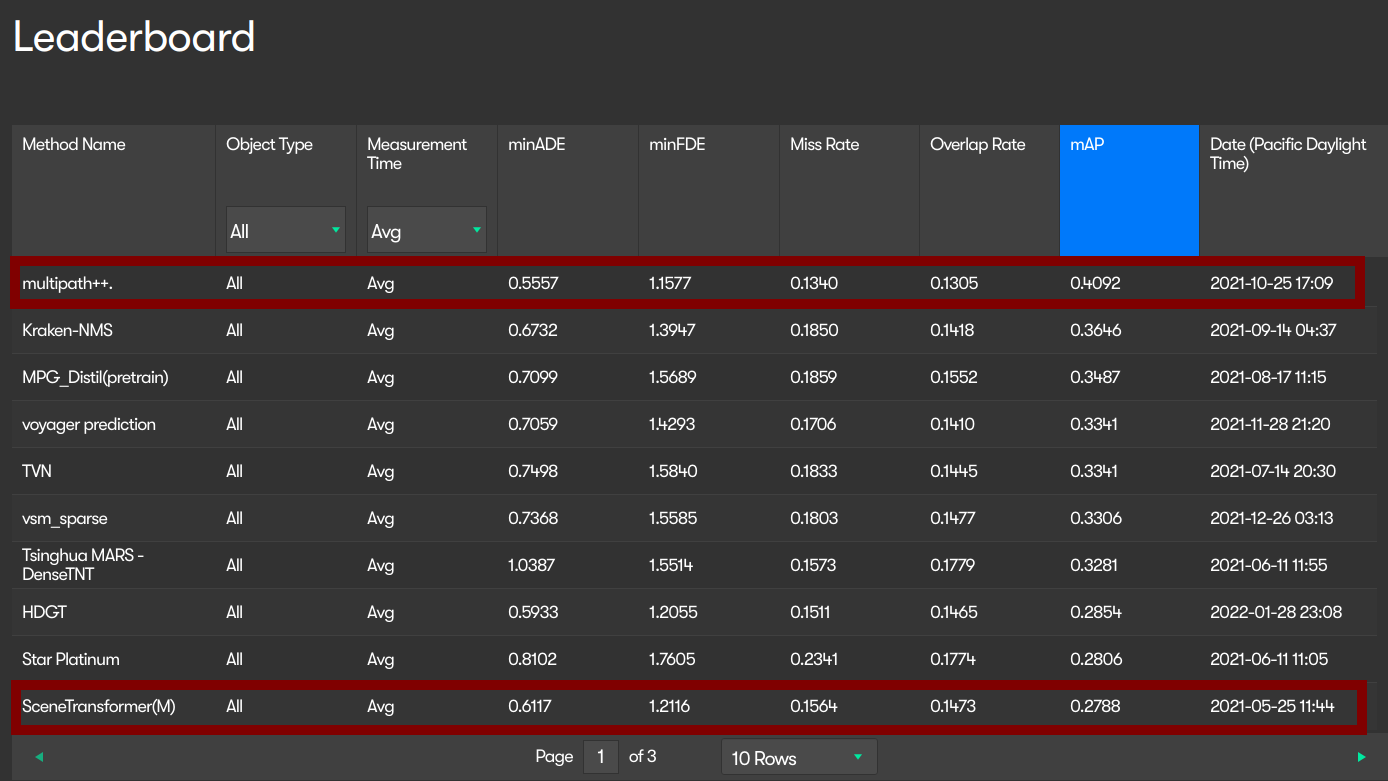
如果有榜的话 不是第一,也可以称自己为state-of-art嘛?毕竟这篇在waymo online 排行榜中,排名挺后的
2. Method
相关工作主要是围绕,此处仅做简单总结,主要是前情提要知识补充 可能能解答上面的问题
motion prediction框架:说明成功的模型大多都会考虑agent motion history和道路结构(包括lane, stop line, 红绿灯等等);
相关方式:
- 直接将输入渲染为多通道的鸟瞰图 top-down image,然后使用卷积,但是receptive field并不利于capturing spatially-distant intersection
- entity-centric approach:可以将agent的历史状态使用sequence modeling方式例如 RNN,进行编码,其中将道路结构中 pose 信息和 semantic type 都编码(比如以piecewise-linear segments)进入系统;使用如下方法将信息进行聚合:employ pooling, soft-attention, graph neural networks
scene-centric 和 agent-centric representation:主要是讨论 representation encoding所用的框架
- 以scene-level 作为坐标系,rasterized top-down image,虽然能有效的表示world状态在common的坐标系下,但是丧失了一些潜在的pose信息
- 以agent-coordinate 为坐标系,但是随着agent数量上升 同时 交互的数量也会二次方上升。
后续说明 waymo的另一篇工作LaneGCN就是以agent为中心 但是实在global frame下做的。同时也不需要将场景表示成为图像的形式
Representing multi-agent futures:主要是如何表示多agent的未来状态,常用的有直接对每个agent的轨迹使用权重
问题区:
第二点提到的representation不就是第一点里面的相关方式嘛?感觉这篇文章好多地方有耦合 方法和方法之间的原因很像,为何不直接总结成一个?
一个是representation,一个是以什么为中心进行
2.1 输入与输出
输入
a feature for every agent at every time step
在模型中 是一个3d tensor,A 个 agents,每个里面有D个特征维度,在时间T steps,同时在每层layers中我们都想保持住这样的size:\([A,T,D]\)
注意在decoder中有多的一个维度:F potential futures
输出
an output for every agent at every time step
2.2 框架
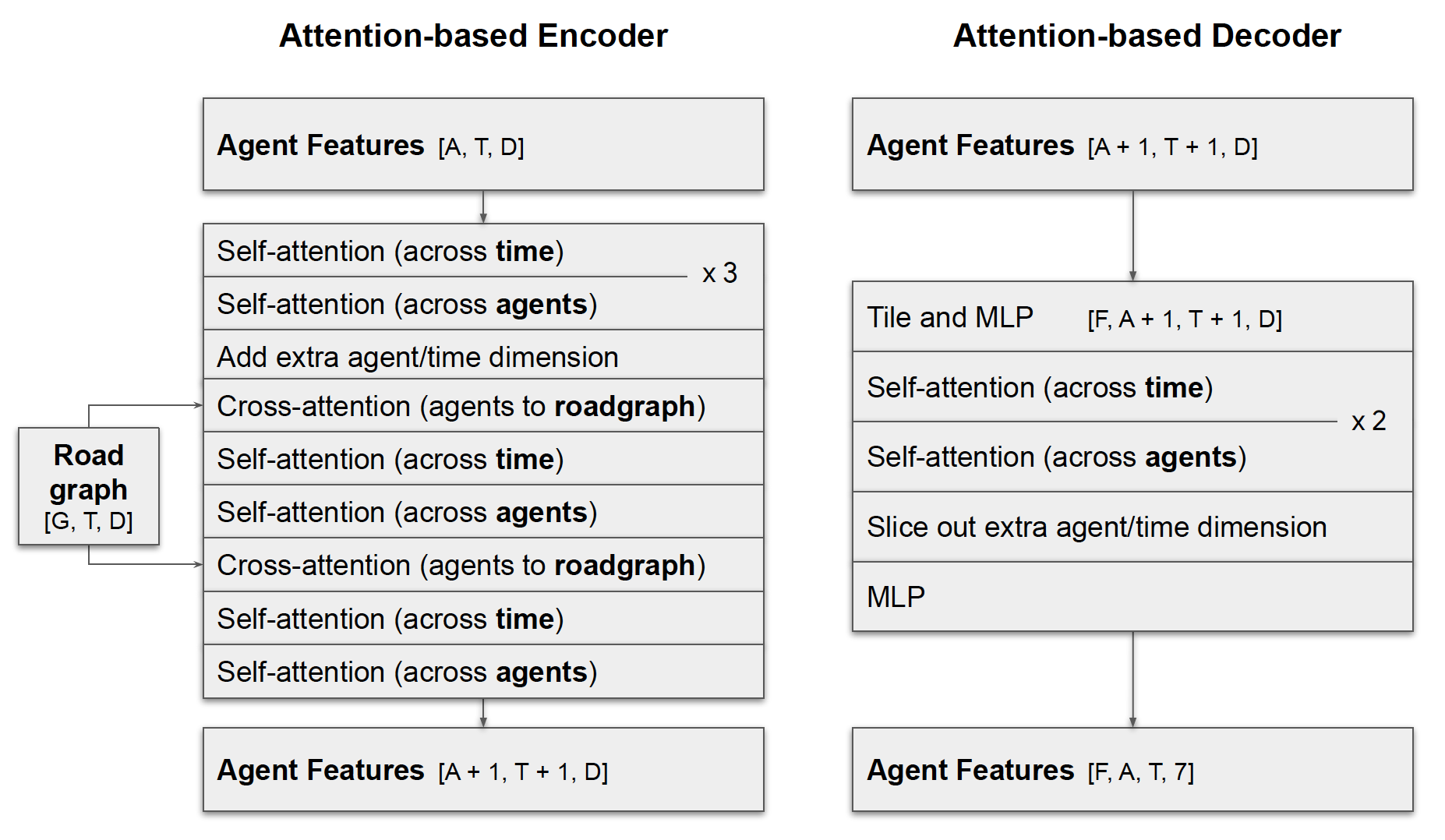
整体模型名称:scene transformer,一共有三个阶段:
- 将agents和road graph embed到一个高维空间
- employ attention-based network 去 encode agents和road graph之间的交互
- 使用attention-based network 去 decode multiple future
mask
对于多任务的切换主要用mask来实现,如下图所示,在做MP的时候时间维度上有mask被遮挡,但是如果是CMP则自身的motion提供未来时间内motion,GCP的话就是提供最远时间T的AV motion
A. Scene-Centric Representation
此点主要是以什么为中心进行场景周围信息的获取,正如前面相关工作中提到的,此处以场景为中心 也就是使用 an agent of interest’s position 作为原点,对所有的road graph和agents进行编码;以agent为中心的话,就是对每个agent分别进行以其为原点的计算
此步中细节步骤为:
- 为每个agent生成 time step内的feature,if time step is visible
- 使用 PointNet 为static road graph和其余的元素 learning one feature vecctor per polyline,其中交通标志 sign为长度为1的polylines
- 为dynamics road graph 比如在空间上是静止的在时间上是变换的红绿灯,生成为 one feature vector per object
所有的以上类别都具有xyz位置信息,以其选定好的agent作为居中,对剩余类别进行居中 旋转等处理,再使用sinusoidal position embeddings
B. Encoding Ttansformer
和基本的attention并无太大区别,query, key, value为需要学习的线性层,每个都乘一下输入 x,比如:\(Q=W_qx\),如上图的encoder和decoder框图,其中decoder最后接了两层MLP然后 predict 7 outputs,其中前六个对应的是:三个是在给定时间下的agent的三维与the agent of interest之间的绝对坐标,and 三个是不确定性 遵循Laplace 分布的参数。后一个是heading
为了寻求更高效的self-attention,仅在时间层上使模型独立于agent进行平滑轨迹的学习,同样的仅在agent层上使模型独立于time进行interaction的之间的学习,类似于解耦,如上图decoder部分下面,交替进行两次
与road graph之间是cross attention
C. Predicting Probabilities for each Futures
预测的是概率分数,不论是joint里的每个未来的情况打分还是marginal model里对轨迹的打分。所以我们需要一个feature representation去总结 scene和each agent.
根据agent和time下 对agent feature tensor进行分别求和,然后加到additional artificial agent and time,所以internal representation就会变成 \([A+1,T+1,D]\)
然后作为decoder的输入,经过两层 MLP+softmax 得到等价的probabilities for each features
D. Joint and Marginal Loss Formulation
首先对于所有的agent都有一个displacement loss and time step to build a loss tensor of shape \([F]\),但是我们仅将最接近于真值的进行back-propagate反向传播;对于marginal的预测呢 则是每个agent都是单独的对待,也就是得到了displacement loss是 \([F,A]\),但是并不aggregate across agents而是为每个agent选取最小的loss然后反向
问题区:
encode和decode都是一个attention-based network... 那
有框图解释了两者的设计方式
这里的预计motion 是根据规划得到的吗?规划是deterministic的吗?还是直接针对的是数据集
应该是数据集,所以可以直接获取未来数据集内的motion进行此任务
an agent of interest’s position 是感兴趣的agent的位置吧... 为啥写的这么绕.. select an interest agent’s position不好吗...
选择指标是?
脚注和open reivew中也有审稿人问了 hhh,脚注说明了 对于waymo是 自身车辆,对于Argoverse是需要预测的车辆
这里的所有是指? 这里的[所有是指?](https://www.notion.so/ICLR-2022-Scene-Transformer-A-unified-architecture-for-predicting-future-trajectories-of-multiple--37a700f54efb4e4f87eee9f682c6a0d5)所有?整张地图的道路结构?还是选取了以选择定的agent 画了框?
3. 实验
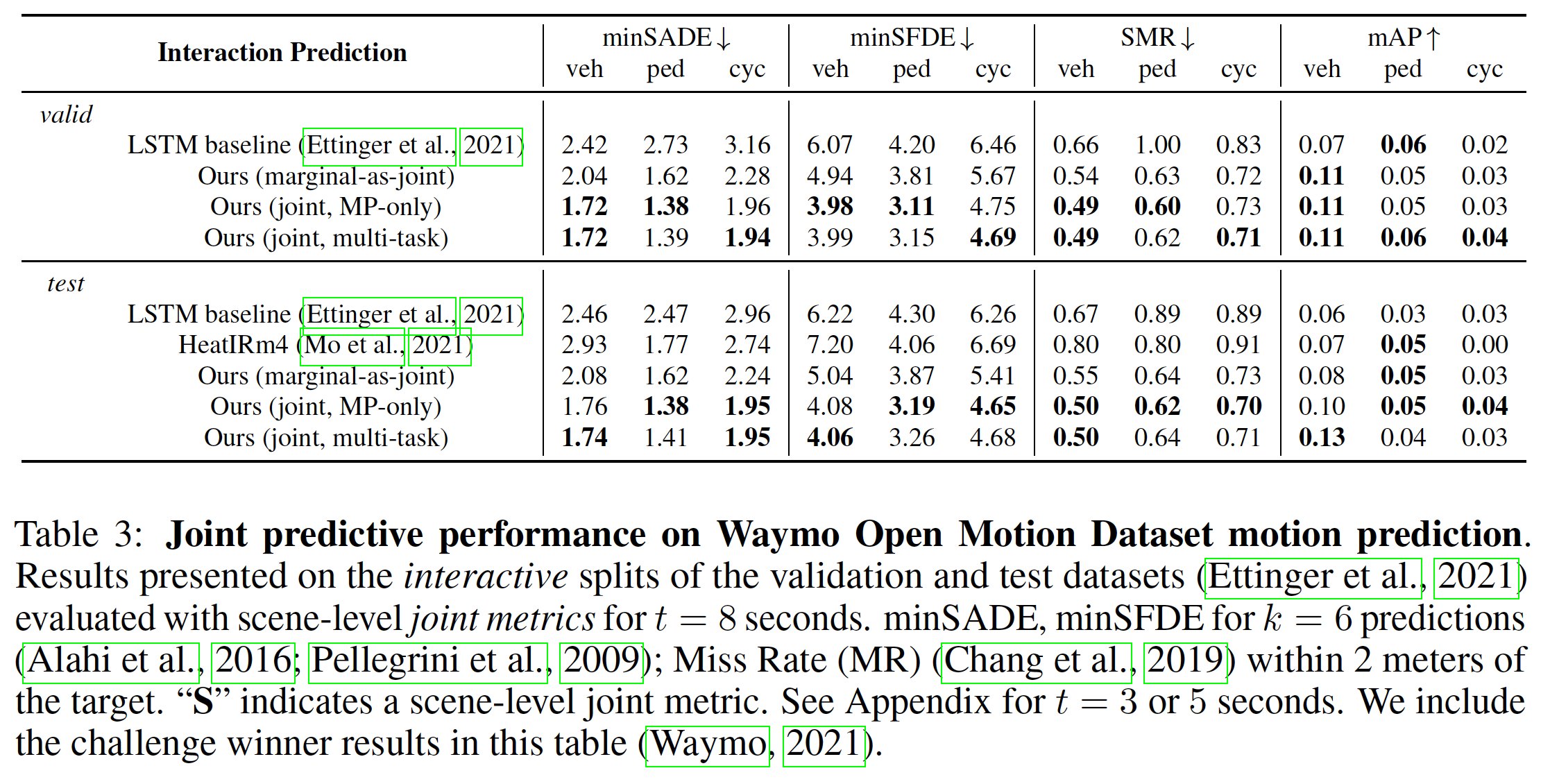
指标为预测中场景的minADE, minFDE, miss rate和mAP,基本上都是用来测量 how close the top k trajectories are to ground truth observation,也就是预测的轨迹离真值有多近
- L2: A simple and common distance-based metric is to measure the L2 norm between a given trajectory and the ground truth
- minADE: reports the L2 norm of the trajectory with the minimal distance
- minFDE: reports the L2 norm of the trajectory with the smallest distance only evaluated at the final location of the trajectory.
本文所有的是MR, mAP,对于joint future则是scene-level下的minSADE, minSFDE, SMR
- miss rate (MR) and mean average precision (mAP) to capture how well a model predicts all of the future trajectories of agents probabilistically
主要就贴一下实验表格等

场景分析图:
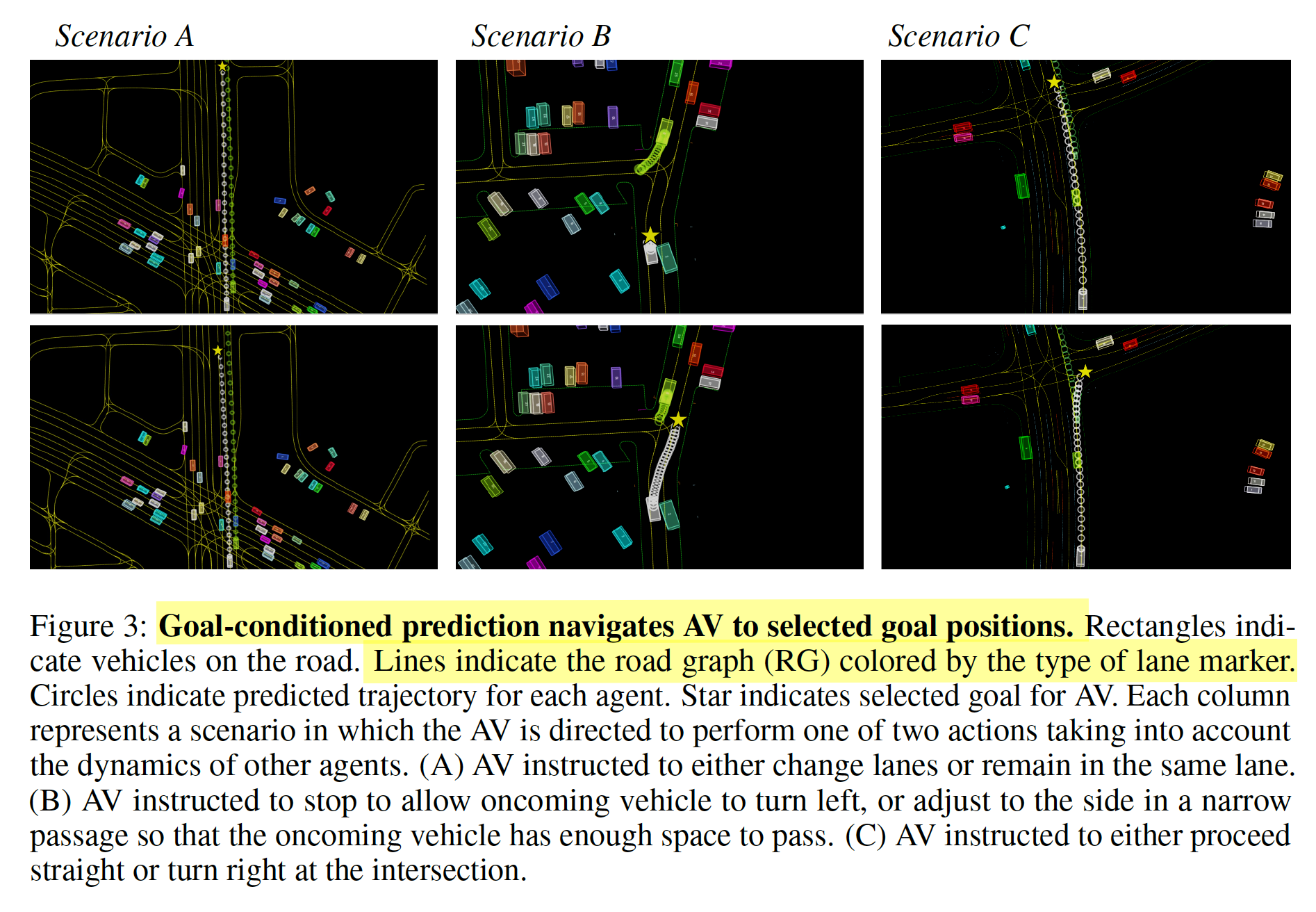
指明不同的目标点,预测也会随之变换,响应前文提出的switch task GCP
4. Conclusion
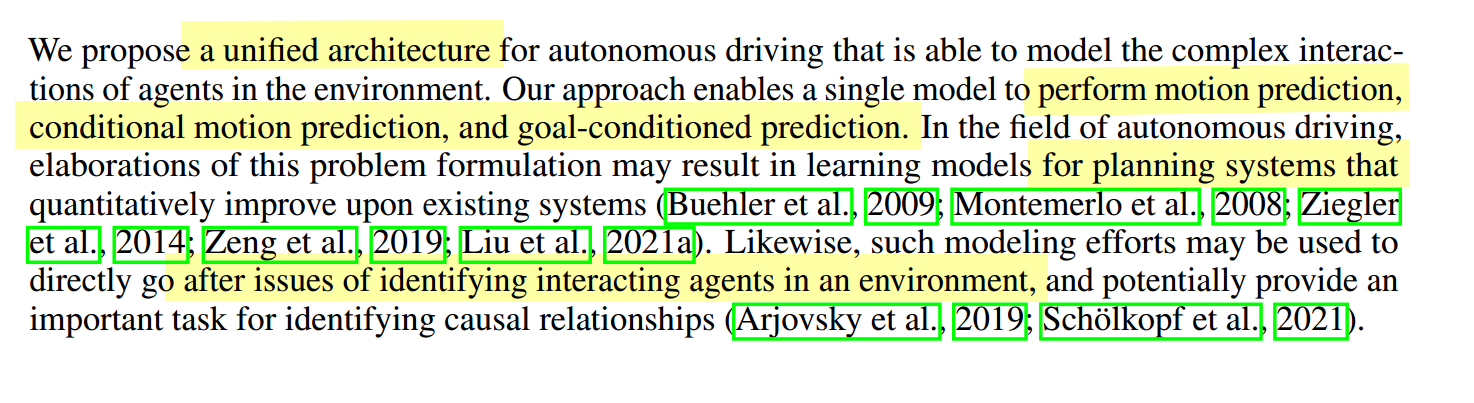
碎碎念
正如CJ哥所言:waymo必然不开源;但是吧 每个论文的附录都特别仔细到 让我这种小白菜觉得 哇 emm 似乎可以复现呢,但是这篇可能没细看附录的原因 有好几个地方还是有点存疑的,hhhh。所以主要重点看看他们的框架是怎么搭的 更为重要,waymo三篇基本都是自己设计的网络不走resnet或者regnet 有预训练的参数。更多细节 要是感兴趣的话 建议读一下原文的附录部分,网络参数等都介绍的较为详细
这一篇虽不及MP3惊艳,但似乎奠定了应该用vector的形式去做预测 类似于CJ哥在multipath++笔记中提到,vectornet有一统的趋势。其实pointnet之类的在17年的就提出了 进来以pointnet → vectornet → 再到现在的一系列基本都是attention下的各种玩法
open review值得一看 还是这种开放审稿的有意思啊,因为有审稿人对GCP的结果说明产生了问题,类似于建议作者在CARLA做 就是以目标点的condition prediction其实已经很像planning了,基本就是 加一下控制器,然后作者谢谢提醒,我知道(内心OS:但是我不做hhhh)
另外贴一下 我在前面说的 online leaderboard 下 确实排名不高,不过按提交时间的话 就另说了
赠人点赞 手有余香 ;正向回馈 才能更好开放记录 hhh
【论文阅读】ICLR 2022: Scene Transformer: A unified architecture for predicting future trajectories of multiple agents的更多相关文章
- 论文阅读(Xiang Bai——【PAMI2017】An End-to-End Trainable Neural Network for Image-based Sequence Recognition and Its Application to Scene Text Recognition)
白翔的CRNN论文阅读 1. 论文题目 Xiang Bai--[PAMI2017]An End-to-End Trainable Neural Network for Image-based Seq ...
- 论文阅读:Prominent Object Detection and Recognition: A Saliency-based Pipeline
论文阅读:Prominent Object Detection and Recognition: A Saliency-based Pipeline 如上图所示,本文旨在解决一个问题:给定一张图像, ...
- YOLO: You Only Look Once论文阅读摘要
论文链接: https://arxiv.org/pdf/1506.02640.pdf 代码下载: https://github.com/gliese581gg/YOLO_tensorflow Abst ...
- BERT 论文阅读笔记
BERT 论文阅读 BERT: Pre-training of Deep Bidirectional Transformers for Language Understanding 由 @快刀切草莓君 ...
- [论文阅读] ALM-HCS(高对比场景自适应对数映射)
[论文阅读] ALM-HCS(高对比场景自适应对数映射) 文章: Adaptive Logarithmic Mapping for Displaying High Contrast Scenes 1. ...
- BITED数学建模七日谈之三:怎样进行论文阅读
前两天,我和大家谈了如何阅读教材和备战数模比赛应该积累的内容,本文进入到数学建模七日谈第三天:怎样进行论文阅读. 大家也许看过大量的数学模型的书籍,学过很多相关的课程,但是若没有真刀真枪地看过论文,进 ...
- 论文阅读笔记 - YARN : Architecture of Next Generation Apache Hadoop MapReduceFramework
作者:刘旭晖 Raymond 转载请注明出处 Email:colorant at 163.com BLOG:http://blog.csdn.net/colorant/ 更多论文阅读笔记 http:/ ...
- 论文阅读笔记 - Mesos: A Platform for Fine-Grained ResourceSharing in the Data Center
作者:刘旭晖 Raymond 转载请注明出处 Email:colorant at 163.com BLOG:http://blog.csdn.net/colorant/ 更多论文阅读笔记 http:/ ...
- Deep Reinforcement Learning for Dialogue Generation 论文阅读
本文来自李纪为博士的论文 Deep Reinforcement Learning for Dialogue Generation. 1,概述 当前在闲聊机器人中的主要技术框架都是seq2seq模型.但 ...
随机推荐
- java基础复习记录
java基础复习记录(数组.对象.异常) 数组 数组的定义 数组是相同类型数据的有序集合.如:篮球队就是一个数组,队员球服上有号码,相当于索引.通过某一个的某一个号码来确认是某一个队员.数组中索引从0 ...
- CF416E题解
题意:对于所有的 \((u,v)\),询问有多少条边在这两个点的最短路边集之并内. 考虑对于每一个 \(u\) 建立最短路 DAG 图,问题变成询问唯一的度数为 \(0\) 的节点到所有节点路径的并集 ...
- ArcMap操作随记(12)
1.[取色器]工具 [自定义]|[自定义模式]|[命令] 2.批量修改符号 [符号系统]→右键,[所有符号的属性] 3.将地图元素转换为图形 转换工具 4.好看的地图边框 [布局视图]→数据框上右键→ ...
- 使用ntp 实现时间同步
1.首先安装NTP [root@localhost /]# yum install ntp -y2.查看是否安装成功 rpm -qa|grep ntp [root@hadoop102 桌面]# vi ...
- Net中事件的用法之二
1.委托与事件的区别 事件对权限做了控制 1.委托可以直接调用 事件不可以直接调用 2.委托允许外面直接赋值 事件不允许外面直接赋值 2.事件与委托的实例比较 using System; using ...
- 【深度学习 01】线性回归+PyTorch实现
1. 线性回归 1.1 线性模型 当输入包含d个特征,预测结果表示为: 记x为样本的特征向量,w为权重向量,上式可表示为: 对于含有n个样本的数据集,可用X来表示n个样本的特征集合,其中行代表样本,列 ...
- 怎么样把ModelMap里面的数据放入Session里面?
答:可以在类上面加上@SessionAttributes注解,里面包含的字符串就是要放入session里面的key.
- 为什么 wait()方法和 notify()/notifyAll()方法要在同步块 中被调用 ?
这是 JDK 强制的,wait()方法和 notify()/notifyAll()方法在调用前都必须先获得对 象的锁
- java-idea创建maven管理web项目不能解析EL的解决方法
默认会原样输出: 这是由于这样子创建的web.xml的版本不够高 2.5之前web.xml文件中的头定义中,el表达式默认是忽略不解析的,故需要显示声明解析el表达式 所以我们要修改版本: 再< ...
- Servlet之间的关联