
VC 运行时库的引用区别 /MD、/MDd 和 /MT、/MTd和DllMain函数
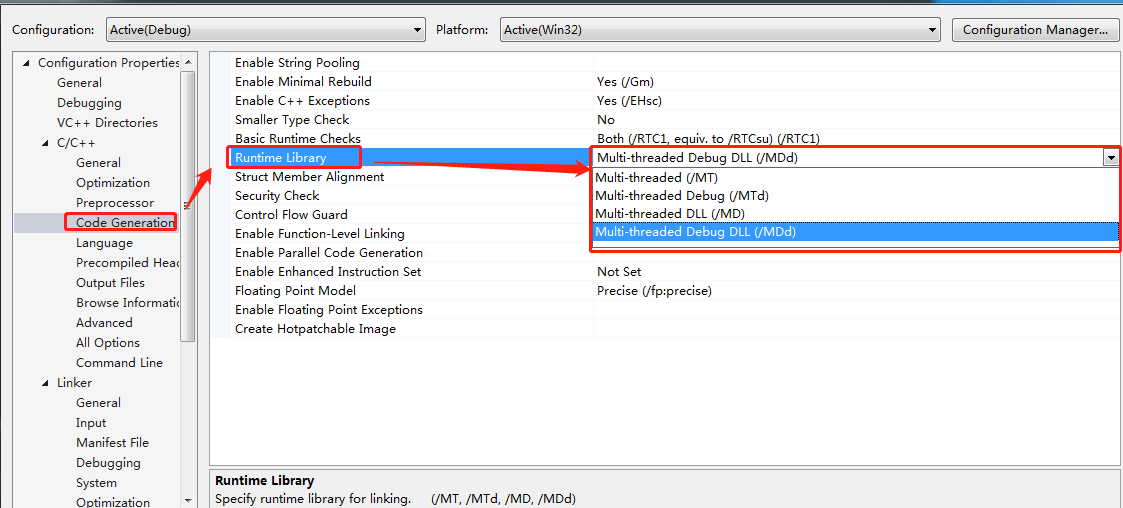
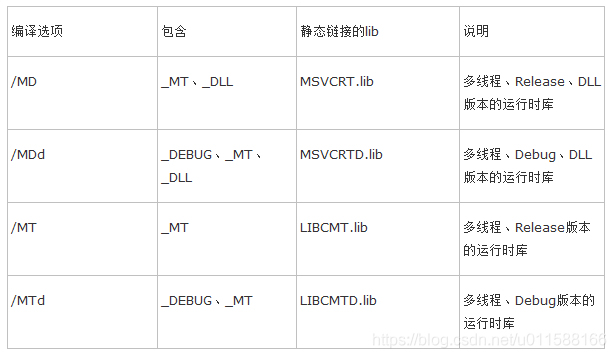
/MT和/MTd表示采用多线程CRT库的静态lib版本。该选项会在编译时将运行时库以静态lib的形式完全嵌入。该选项生成的可执行文件运行时不需要运行时库dll的参加,会获得轻微的性能提升,但最终生成的二进制代码因链入庞大的运行时库实现而变得非常臃肿。当某项目以静态链接库的形式嵌入到多个项目,则可能造成运行时库的内存管理有多份,最终将导致致命的“Invalid Address specified to RtlValidateHeap”问题。另外托管C++和CLI中不再支持/MT和/MTd选项。
/MD和/MDd表示采用多线程CRT库的动态dll版本,会使应用程序使用运行时库特定版本的多线程DLL。链接时将按照传统VC链接dll的方式将运行时库MSVCRxx.DLL的导入库MSVCRT.lib链接,在运行时要求安装了相应版本的VC运行时库可再发行组件包(当然把这些运行时库dll放在应用程序目录下也是可以的)。 因/MD和/MDd方式不会将运行时库链接到可执行文件内部,可有效减少可执行文件尺寸。当多项目以MD方式运作时,其内部会采用同一个堆,内存管理将被简化,跨模块内存管理问题也能得到缓解。
结论:/MD和/MDd将是潮流所趋,/ML和/MLd方式请及时放弃,/MT和/MTd在非必要时最好也不要采用了
DllMain函数(说白了一般就是在加载卸载DLL时被调用)
MSDN官方说明:DllMain entry point (Process.h) - Win32 apps | Microsoft Docs
An optional entry point into a dynamic-link library (DLL). When the system starts or terminates a process or thread, it calls the entry-point function for each loaded DLL using the first thread of the process. The system also calls the entry-point function for a DLL when it is loaded or unloaded using the LoadLibrary and FreeLibrary functions.
Example
BOOL WINAPI DllMain(

    HINSTANCE hinstDLL,  // handle to DLL module

    DWORD fdwReason,     // reason for calling function

    LPVOID lpReserved )  // reserved

{

    // Perform actions based on the reason for calling.

    switch( fdwReason )

    {

        case DLL_PROCESS_ATTACH:

         // Initialize once for each new process.

         // Return FALSE to fail DLL load.

            break;

        case DLL_THREAD_ATTACH:

         // Do thread-specific initialization.

            break;

        case DLL_THREAD_DETACH:

         // Do thread-specific cleanup.

            break;

        case DLL_PROCESS_DETACH:

         // Perform any necessary cleanup.

            break;

    }

    return TRUE;  // Successful DLL_PROCESS_ATTACH.

}
This is an example from the Dynamic-Link Library Entry-Point Function.
Warning
There are significant limits on what you can safely do in a DLL entry point. See General Best Practices for specific Windows APIs that are unsafe to call in DllMain. If you need anything but the simplest initialization then do that in an initialization function for the DLL. You can require applications to call the initialization function after DllMain has run and before they call any other functions in the DLL.
Syntax
BOOL WINAPI DllMain(

  _In_ HINSTANCE hinstDLL,

  _In_ DWORD     fdwReason,

  _In_ LPVOID    lpvReserved

);
Parameters
hinstDLL [in]
-
A handle to the DLL module. The value is the base address of the DLL. The HINSTANCE of a DLL is the same as the HMODULE of the DLL, so hinstDLL can be used in calls to functions that require a module handle.
fdwReason [in]
-
The reason code that indicates why the DLL entry-point function is being called. This parameter can be one of the following values.
TABLE 1 Value Meaning - DLL_PROCESS_ATTACH
- 1
The DLL is being loaded into the virtual address space of the current process as a result of the process starting up or as a result of a call to LoadLibrary. DLLs can use this opportunity to initialize any instance data or to use the TlsAlloc function to allocate a thread local storage (TLS) index.
The lpReserved parameter indicates whether the DLL is being loaded statically or dynamically.- DLL_PROCESS_DETACH
- 0
The DLL is being unloaded from the virtual address space of the calling process because it was loaded unsuccessfully or the reference count has reached zero (the processes has either terminated or called FreeLibrary one time for each time it called LoadLibrary).
The lpReserved parameter indicates whether the DLL is being unloaded as a result of a FreeLibrary call, a failure to load, or process termination.
The DLL can use this opportunity to call the TlsFree function to free any TLS indices allocated by using TlsAlloc and to free any thread local data.
Note that the thread that receives the DLL_PROCESS_DETACH notification is not necessarily the same thread that received the DLL_PROCESS_ATTACH notification.- DLL_THREAD_ATTACH
- 2
The current process is creating a new thread. When this occurs, the system calls the entry-point function of all DLLs currently attached to the process. The call is made in the context of the new thread. DLLs can use this opportunity to initialize a TLS slot for the thread. A thread calling the DLL entry-point function with DLL_PROCESS_ATTACH does not call the DLL entry-point function with DLL_THREAD_ATTACH.
Note that a DLL's entry-point function is called with this value only by threads created after the DLL is loaded by the process. When a DLL is loaded using LoadLibrary, existing threads do not call the entry-point function of the newly loaded DLL.- DLL_THREAD_DETACH
- 3
A thread is exiting cleanly. If the DLL has stored a pointer to allocated memory in a TLS slot, it should use this opportunity to free the memory. The system calls the entry-point function of all currently loaded DLLs with this value. The call is made in the context of the exiting thread.
lpvReserved [in]
-
If fdwReason is DLL_PROCESS_ATTACH, lpvReserved is NULL for dynamic loads and non-NULL for static loads.
If fdwReason is DLL_PROCESS_DETACH, lpvReserved is NULL if FreeLibrary has been called or the DLL load failed and non-NULL if the process is terminating.
Return value
When the system calls the DllMain function with the DLL_PROCESS_ATTACH value, the function returns TRUE if it succeeds or FALSE if initialization fails. If the return value is FALSE when DllMain is called because the process uses the LoadLibrary function, LoadLibrary returns NULL. (The system immediately calls your entry-point function with DLL_PROCESS_DETACH and unloads the DLL.) If the return value is FALSE when DllMain is called during process initialization, the process terminates with an error. To get extended error information, call GetLastError.
When the system calls the DllMain function with any value other than DLL_PROCESS_ATTACH, the return value is ignored.
Remarks
DllMain is a placeholder for the library-defined function name. You must specify the actual name you use when you build your DLL. For more information, see the documentation included with your development tools.
During initial process startup or after a call to LoadLibrary, the system scans the list of loaded DLLs for the process. For each DLL that has not already been called with the DLL_PROCESS_ATTACH value, the system calls the DLL's entry-point function. This call is made in the context of the thread that caused the process address space to change, such as the primary thread of the process or the thread that called LoadLibrary. Access to the entry point is serialized by the system on a process-wide basis. Threads in DllMain hold the loader lock so no additional DLLs can be dynamically loaded or initialized.
If the DLL's entry-point function returns FALSE following a DLL_PROCESS_ATTACH notification, it receives a DLL_PROCESS_DETACH notification and the DLL is unloaded immediately. However, if the DLL_PROCESS_ATTACH code throws an exception, the entry-point function will not receive the DLL_PROCESS_DETACH notification.
There are cases in which the entry-point function is called for a terminating thread even if the entry-point function was never called with DLL_THREAD_ATTACH for the thread:
- The thread was the initial thread in the process, so the system called the entry-point function with the DLL_PROCESS_ATTACH value.
- The thread was already running when a call to the LoadLibrary function was made, so the system never called the entry-point function for it.
When a DLL is unloaded from a process as a result of an unsuccessful load of the DLL, termination of the process, or a call to FreeLibrary, the system does not call the DLL's entry-point function with the DLL_THREAD_DETACH value for the individual threads of the process. The DLL is only sent a DLL_PROCESS_DETACH notification. DLLs can take this opportunity to clean up all resources for all threads known to the DLL.
When handling DLL_PROCESS_DETACH, a DLL should free resources such as heap memory only if the DLL is being unloaded dynamically (the lpReserved parameter is NULL). If the process is terminating (the lpvReserved parameter is non-NULL), all threads in the process except the current thread either have exited already or have been explicitly terminated by a call to the ExitProcess function, which might leave some process resources such as heaps in an inconsistent state. In this case, it is not safe for the DLL to clean up the resources. Instead, the DLL should allow the operating system to reclaim the memory.
If you terminate a process by calling TerminateProcess or TerminateJobObject, the DLLs of that process do not receive DLL_PROCESS_DETACH notifications. If you terminate a thread by calling TerminateThread, the DLLs of that thread do not receive DLL_THREAD_DETACH notifications.
The entry-point function should perform only simple initialization or termination tasks. It must not call the LoadLibrary or LoadLibraryEx function (or a function that calls these functions), because this may create dependency loops in the DLL load order. This can result in a DLL being used before the system has executed its initialization code. Similarly, the entry-point function must not call the FreeLibrary function (or a function that calls FreeLibrary) during process termination, because this can result in a DLL being used after the system has executed its termination code.
Because Kernel32.dll is guaranteed to be loaded in the process address space when the entry-point function is called, calling functions in Kernel32.dll does not result in the DLL being used before its initialization code has been executed. Therefore, the entry-point function can call functions in Kernel32.dll that do not load other DLLs. For example, DllMain can create synchronization objects such as critical sections and mutexes, and use TLS. Unfortunately, there is not a comprehensive list of safe functions in Kernel32.dll.
Calling functions that require DLLs other than Kernel32.dll may result in problems that are difficult to diagnose. For example, calling User, Shell, and COM functions can cause access violation errors, because some functions load other system components. Conversely, calling functions such as these during termination can cause access violation errors because the corresponding component may already have been unloaded or uninitialized.
Because DLL notifications are serialized, entry-point functions should not attempt to communicate with other threads or processes. Deadlocks may occur as a result.
For information on best practices when writing a DLL, see https://docs.microsoft.com/windows/win32/dlls/dynamic-link-library-best-practices.
If your DLL is linked with the C run-time library (CRT), the entry point provided by the CRT calls the constructors and destructors for global and static C++ objects. Therefore, these restrictions for DllMain also apply to constructors and destructors and any code that is called from them.
Consider calling DisableThreadLibraryCalls when receiving DLL_PROCESS_ATTACH, unless your DLL is linked with static C run-time library (CRT).
Requirements
| Requirement | Value |
|---|---|
| Minimum supported client | Windows XP [desktop apps only] |
| Minimum supported server | Windows Server 2003 [desktop apps only] |
| Header |
|
VC 运行时库的引用区别 /MD、/MDd 和 /MT、/MTd和DllMain函数的更多相关文章
- VC 运行时库 /MD、/MDd 和 /MT、/MTd
这里总结下他们的区别,后面的那个'd'是代表DEBUG版本,没有'd'的就是RELEASE版本了. 首先说/MT /MT是 "multithread, static version ” 意思 ...
- VC运行时库(/MD、/MT等)
VC项目属性→配置属性→C/C++→代码生成→运行时库 可以采用的方式有:多线程(/MT).多线程调试(/MTd).多线程DLL(/MD).多线程调试DLL(/MDd).单线程(/ML).单线程调试( ...
- VC运行时库/MD、/MDd、/MT、/MTd说明
http://blog.csdn.net/holybin/article/details/26134153 VC运行时库设置:VC项目属性->配置属性->C/C++->代码生成-&g ...
- vs2015部署---下一代VC运行时库系统:the Universal CRT
前言 其实the Universal CRT(通用C运行时库)已经不能算是“下一代”,因为它已经在前两年伴随着Visual Studio 2015和Windows10发布.但是由于之前使用VS2015 ...
- /MD, /MDD, /ML, /MT,/MTD(使用运行时库)
1. VC编译选项 多线程(/MT)多线程调试(/MTd)多线程 DLL (/MD)多线程调试 DLL (/MDd) 2. C 运行时库 ...
- 定位vc运行时库问题 依赖问题,屡试不爽的一招
用vc 菜单 文件| 打开|指定EXE或DLL,如有指定运行时库,则PE文件的资源中可以看到manifest 配置节 然后据此判断EXE依赖的运行时库, 再根据编译选项调整 运行时库设置
- VC编译选项 md /mdd /ml /mt/mtd
VC编译选项 多线程(/MT)多线程调试(/MTd)多线程 DLL (/MD)多线程调试 DLL (/MDd)C 运行时库 库文件Single threa ...
- VC C运行时库(CRTL)的几个版本及选用
分类: Windows 2008-12-23 10:01 987人阅读 评论(0) 收藏 举报ciostreammfclibrary多线程import最近做项目碰到了一个关于在动态库中使用MFC以及在 ...
- [转帖]运行时库(runtime library)
运行时库(runtime library) https://blog.csdn.net/xitie8523/article/details/82712105 没学过这些东西 或者当时上课没听 又或者 ...
- Visual C++中对运行时库的支持
原文地址:http://blog.csdn.net/wqvbjhc/article/details/6612099 一.什么是C运行时库 1)C运行时库就是 C run-time library,是 ...
随机推荐
- Java--判空方法
方法有StringUtils.isBlank() , StringUtils.isNotBlank() , StringUtils.isEmpty(); 使用关系 StringUtils.isNotE ...
- tool/js - ChineseToPinyin 汉语转拼音
tool/js - ChineseToPinyin 汉语转拼音 Convert_Pinyin.js js如何简单实现汉字转成拼音的功能 pinyin-pro 官网 npm npm 安装 npm ins ...
- mysql拼接多条字段
转 未合并情况 SELECTa.id,b.name AS "role"FROM sys_user aINNER JOIN sys_user_role c ON a.id=c.use ...
- Appium 入门
Appium安装总体需要以下几个步骤: 安装JDK 官网www.oracle.com去下载安装,尽量下载JDK7及以上的版本.然后去设置环境变量: 在系统变量下新建变量JAVA_HOME变量值指向JD ...
- docker之rabbitmq delayed message exchange
创建dockerfile FROM rabbitmq:3.9.11-management-alpine COPY rabbitmq_delayed_message_exchange-3.9.0.ez ...
- Linux配置文件和网络常用命令总结
Linux应用配置大全 Linux网络基本配置 最小化安装的话是没有ifconfig命令的需要使用yum search ifconfig查找,然后yum install net-tools.x86_6 ...
- C++ Gui Qt4 第二章
这一章需要使用在控制台使用qmake 使用qmake的时候要先配置qmake的环境变量 找到qmake所在的目录,添加环境变量即可 在使用的时候要先跳转到源文件所在的目录 课本中说qmake可以自动检 ...
- 模拟ATM系统 —— 用户注册、登录和用户操作页设计 、查询账号、退出账号功能
开发工具:idea 一.项目步骤: 1.系统准备.首页设计 2.用户开户功能 3.用户登录功能 4.用户操作页设计 .查询账号.退出账号功能 5.用户存款功能 6.用户取款功能 7.用户转账功能 8. ...
- 处理uniapp激励广告
使用uniapp查看广告 激励视频广告组件.激励视频广告组件是一个原生组件,并且是一个全局单例.层级比上屏 Canvas 高,会覆盖在上屏 Canvas 上.激励视频 广告组件默认是隐藏的,需要调用 ...
- 05 Java 数组
Java 数组 一.什么是数组 数组是相同类型数据的有序集合 数组描述的是相同类型的若干个数据,按照一定的顺序排列组合而成 其中每一个数据称为数组元素,每个数组元素可以通过下标来访问它们 二.数组的声 ...