
Kubernetes集群调度增强之超容量扩容
作者:京东科技 徐宪章
1 什么是超容量扩容
超容量扩容功能,是指预先调度一定数量的工作节点,当业务高峰期或者集群整体负载较高时,可以使应用不必等待集群工作节点扩容,从而迅速完成应用横向扩容。通常情况下HPA、ClusterAutosacler和超容量扩容同时使用以满足负载敏感度高的业务场景。
超容量扩容功能是通过K8S应用优先级设置和ClusterAutosaler共同作用实现的,通过调整低优先级空载应用的数量,使集群已调度资源保持在较高的状态,当其他高优先级应用因为HPA或者手动调整应用分片数量时,可以通过驱逐空载的方式腾空调度资源却保高优先级应用可以在第一时间调度并创建。当空载应用从被驱逐转变为等到状态时,ClusterAutosaler此时对集群机型扩容,确保下次高优先级应用调度时,有足够的空载应用可以被驱逐。
超容量扩容功能的核心为OverprovisionAutoscaler(超容量扩容)和ClusterAutosaler(集群自动扩容),两者都需要通过不断调整参数配置去适配多重业务需求需求。
超容量扩容功能在一定程度上降低了资源使用饱和度,通过增加成本提高了集群和应用的稳定性,实际业务场景中需要根据需求进行取舍并合理配置。
2 什么情况下需要使用超容量扩容
当集群值开启Hpa和Autoscaler时,在发生节点扩容的情况下,应用调度时间通常为4-12分钟,主要取决于创建工作节点资源以及工作节点从加入集群到Ready的总耗时。以下为最佳和最差效率分析
最佳案例场景-4分钟
• 30秒 - 目标指标值更新:30-60秒
• 30秒 - HPA检查指标值:30秒 - >30秒 - HPA检查指标值:30秒 - >
• <2秒 - Pods创建之后进入pending状态<2秒 -Pods创建之后进入pending状态
• <2秒 - CA看到pending状态的pods,之后调用来创建node 1秒<2秒 -CA看到pending状态的pods,之后调用来创建node 1秒
• 3分钟 - cloud provider创建工作节点,之后加入k8s之后等待node变成ready
最糟糕的情况 - 12分钟
• 60 秒 —目标指标值更新
• 30 秒 — HPA检查指标值
• < 2 秒 — Pods创建之后进入pending状态
• < 2 秒 —CA看到pending状态的pods,之后调用来创建node 1秒
• 10 分钟 — cloud provider创建工作节点,之后加入k8s之后等待node变成ready
两种场景下,创建工作节点耗时占比超过75%,如果可以降低或者完全不考虑该时间,将大大提高应用扩容速度,配合超容量扩容功能可以大大增强集群和业务稳定性。超容量扩容主要用于对应用负载敏感度较高的业务场景
大促备战
流计算/实时计算
Devops系统
其他调度频繁的业务场景
3 如何开启超容量扩容
超容量扩容功能以ClusterAutoscaler为基础,配合OverprovisionAutoscaler实现。以京东公有云Kubernetes容器服务为例
3.1 开启ClusterAutoscaler
https://cns-console.jdcloud.com/host/nodeGroups/list
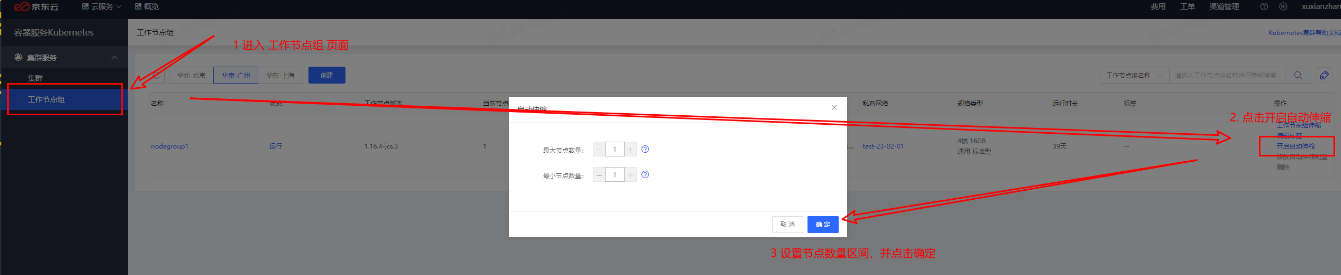
• 进入 “kubernetes容器服务”->“工作节点组”
• 选择需要对应节点组,点击开启自动伸缩
• 设置节点数量区间,并点击确定
3.2 部署OverprovisionAutoscaler
1 部署控制器及配置
apiVersion: apps/v1

kind: Deployment

metadata:

  name: overprovisioning-autoscaler

  namespace: default

  labels:

    app: overprovisioning-autoscaler

    owner: cluster-autoscaler-overprovisioning

spec:

  selector:

    matchLabels:

      app: overprovisioning-autoscaler

      owner: cluster-autoscaler-overprovisioning

  replicas: 1

  template:

    metadata:

      labels:

        app: overprovisioning-autoscaler

        owner: cluster-autoscaler-overprovisioning

    spec:

      serviceAccountName: cluster-proportional-autoscaler

      containers:

        - image: jdcloud-cn-north-1.jcr.service.jdcloud.com/k8s/cluster-proportional-autoscaler:v1.16.3

          name: proportional-autoscaler

          command:

            - /autoscaler

            - --namespace=default

            ## 注意这里需要根据需要指定上述的configmap的名称

            ## /overprovisioning-autoscaler-ladder/overprovisioning-autoscaler-linear

            - --configmap=overprovisioning-autoscaler-{provision-mode}

            ## 预热集群应用(类型)/ 名称,基准应用和空值应用需要在同一个命名空间下

            - --target=deployment/overprovisioning

            - --logtostderr=true

            - --v=2

          imagePullPolicy: IfNotPresent

          volumeMounts:

            - name: host-time

              mountPath: /etc/localtime

      volumes:

        - name: host-time

          hostPath:

            path: /etc/localtime

---

kind: ServiceAccount

apiVersion: v1

metadata:

  name: cluster-proportional-autoscaler

  namespace: default

---

kind: ClusterRole

apiVersion: rbac.authorization.k8s.io/v1

metadata:

  name: cluster-proportional-autoscaler

rules:

  - apiGroups: [""]

    resources: ["nodes"]

    verbs: ["list", "watch"]

  - apiGroups: [""]

    resources: ["replicationcontrollers/scale"]

    verbs: ["get", "update"]

  - apiGroups: ["extensions","apps"]

    resources: ["deployments/scale", "replicasets/scale","deployments","replicasets"]

    verbs: ["get", "update"]

  - apiGroups: [""]

    resources: ["configmaps"]

    verbs: ["get", "create"]

---

kind: ClusterRoleBinding

apiVersion: rbac.authorization.k8s.io/v1

metadata:

  name: cluster-proportional-autoscaler

subjects:

  - kind: ServiceAccount

    name: cluster-proportional-autoscaler

    namespace: default

roleRef:

  kind: ClusterRole

  name: cluster-proportional-autoscaler

  apiGroup: rbac.authorization.k8s.io

---

apiVersion: scheduling.k8s.io/v1

kind: PriorityClass

metadata:

  name: overprovisioning

value: -1

globalDefault: false

description: "Priority class used by overprovisioning."
2 部署空载应用
apiVersion: apps/v1

kind: Deployment

metadata:

  name: overprovisioning

  namespace: default

  labels:

    app: overprovisioning

    owner: cluster-autoscaler-overprovisioning

spec:

  replicas: 1

  selector:

    matchLabels:

      app: overprovisioning

      owner: cluster-autoscaler-overprovisioning

  template:

    metadata:

      annotations:

        autoscaler.jke.jdcloud.com/overprovisioning: "reserve-pod"

      labels:

        app: overprovisioning

        owner: cluster-autoscaler-overprovisioning

    spec:

      priorityClassName: overprovisioning

      containers:

        - name: reserve-resources

          image: jdcloud-cn-east-2.jcr.service.jdcloud.com/k8s/pause-amd64:3.1

          resources:

            requests:

              ## 根据预热预期设置配置的分片数量及单分片所需资源

              cpu: 7

          imagePullPolicy: IfNotPresent
3.3 验证超容量扩容功能是否正常
1 验证Autoscaler
• 查看autoscaler控制器是否Running
• 不断创建测试应用,应用需求资源略微小于节点组单节点可调度资源
• 观察集群节点状态,当资源不足导致pod 等待中状态时,autocalser是否会按照预设(扩容等待、扩容冷却、最大节点数量等)进行扩容
• 开启集群自动缩容,删除测试应用,观察集群节点资源Request到达阈值后是否发生缩容。
2 验证OverprovisionAutoscaler
• 查看OverprovisionAutoscaler控制器是否Running
• 不断创建测试应用,当发生autoscaler后,空载应用数量是否会根据配置发生变化
• 当业务应用pendding后,空载应用是否会发生驱逐,并调度业务应用
4 设置OverprovisionAutoscaler及ClusterAutoscaler参数
4.1 配置ClusterAutoscaler
1 ca参数说明
| 参数名称 | 默认值 | 参数说明 |
|---|---|---|
| scan_interval | 20s | How often cluster is reevaluated for scale up or down |
| max_nodes_total | 0 | Maximum number of nodes in all node groups |
| estimator | binpacking | Type of resource estimator to be used in scale up. |
| expander | least-waste | Type of node group expander to be used in scale up |
| max_empty_bulk_delete | 15 | Maximum number of empty nodes that can be deleted at the same time |
| max_graceful_termination_sec | 600 | Maximum number of seconds CA waits for pod termination when trying to scale down a node |
| max_total_unready_percentage | 45 | Maximum percentage of unready nodes in the cluster. After this is exceeded, CA halts operations |
| ok_total_unready_count | 100 | Number of allowed unready nodes, irrespective of max-total-unready-percentage |
| max_node_provision_time | 900s | Maximum time CA waits for node to be provisioned |
| scale_down_enabled | true | Should CA scale down the cluster |
| scale_down_delay_after_add | 600s | How long after scale up that scale down evaluation resumes |
| scale_down_delay_after_delete | 10s | How long after node deletion that scale down evaluation resumes, defaults to scanInterval |
| scale_down_delay_after_failure | 180s | How long after scale down failure that scale down evaluation resumes |
| scale_down_unneeded_time | 600s | How long a node should be unneeded before it is eligible for scale down |
| scale_down_unready_time | 1200s | How long an unready node should be unneeded before it is eligible for scale down |
| scale_down_utilization_threshold | 0.5 | Node utilization level, defined as sum of requested resources divided by capacity, below which a node can be considered for scale down |
| balance_similar_node_groups | false | Detect similar node groups and balance the number of nodes between them |
| node_autoprovisioning_enabled | false | Should CA autoprovision node groups when needed |
| max_autoprovisioned_node_group_count | 15 | The maximum number of autoprovisioned groups in the cluster |
| skip_nodes_with_system_pods | true | If true cluster autoscaler will never delete nodes with pods from kube-system (except for DaemonSet or mirror pods) |
| skip_nodes_with_local_storage | true | If true cluster autoscaler will never delete nodes with pods with local storage, e.g. EmptyDir or HostPath', NOW(), NOW(), 1); |
2 推荐配置
# 其他保持默认

scan_interval=10s

max_node_provision_time=180s

scale_down_delay_after_add=180s

scale_down_delay_after_delete=180s

scale_down_unneeded_time=300s

scale_down_utilization_threshold=0.4
4.2 配置OverprovisionAutoscaler
OverprovisionAutoscaler的配置有线性配置和阶梯配置两种方式,两种配置方式只能选择一种.
1 线性配置(ladder)
线性配置,通过配置总体CPU核数以及节点数量和空载应用数量的比例实现线性资源预留,空载应用数量总是和CPU总量以及节点数量成正比,精度会根据空载应用CPU资源request变化,request值越小,精度月高,当配置发生冲突时,取符合线性关系的空载应用数量最大值.
节点数量满足配置中min和max的区间
preventSinglePointFailure,当为true时,Running状态的空载应用分片数满足线性关系;当为false时,Failer/Running状态的空载应用分片数满足线性关系
includeUnschedulableNodes,是否考虑不可调度节点
kind: ConfigMap

apiVersion: v1

metadata:

  name: overprovisioning-autoscaler-linear

  namespace: default

data:

  linear: |-

    {

      "coresPerReplica": 2,

      "nodesPerReplica": 1,

      "min": 1,

      "max": 100,

      "includeUnschedulableNodes": false,

      "preventSinglePointFailure": true

    }
2 阶梯配置(linear)
阶梯配置,通过配置总体CPU核数或者节点数量和空载应用数量的矩阵实现阶梯状资源预留,空载应用数量符合CPU总量以及节点数量的分布状态,当配置发生冲突时,取符合区间分布的空载应用数量最大值
kind: ConfigMap

apiVersion: v1

metadata:

  name: overprovisioning-autoscaler-ladder

  namespace: default

data:

  ladder: |-

    {

      "coresToReplicas":

      [

        [ 1,1 ],

        [ 50,3 ],

        [ 200,5 ],

        [ 500,7 ]

      ],

      "nodesToReplicas":

      [

        [ 1,1 ],

        [ 3,4 ],

        [ 10,5 ],

        [ 50,20 ],

        [ 100,120 ],

        [ 150,120 ]

      ]

    }
Kubernetes集群调度增强之超容量扩容的更多相关文章
- Kubernetes集群调度器原理剖析及思考
简述 云环境或者计算仓库级别(将整个数据中心当做单个计算池)的集群管理系统通常会定义出工作负载的规范,并使用调度器将工作负载放置到集群恰当的位置.好的调度器可以让集群的工作处理更高效,同时提高资源利用 ...
- kubernetes系列(十五) - 集群调度
1. 集群调度简介 2. 调度过程 2.1 调度过程概览 2.2 Predicate(预选) 2.3 Priorities(优选) 3. 调度的亲和性 3.1 node亲和性 3.1.1 node亲和 ...
- 美团点评Kubernetes集群管理实践
背景 作为国内领先的生活服务平台,美团点评很多业务都具有非常显著.规律的”高峰“和”低谷“特征.尤其遇到节假日或促销活动,流量还会在短时间内出现爆发式的增长.这对集群中心的资源弹性和可用性有非常高的要 ...
- Docker学习-Kubernetes - 集群部署
Docker学习 Docker学习-VMware Workstation 本地多台虚拟机互通,主机网络互通搭建 Docker学习-Docker搭建Consul集群 Docker学习-简单的私有Dock ...
- 阿里巴巴大规模神龙裸金属 Kubernetes 集群运维实践
作者 | 姚捷(喽哥)阿里云容器平台集群管理高级技术专家 本文节选自<不一样的 双11 技术:阿里巴巴经济体云原生实践>一书,点击即可完成下载. 导读:值得阿里巴巴技术人骄傲的是 2019 ...
- 【转载】浅析从外部访问 Kubernetes 集群中应用的几种方式
一般情况下,Kubernetes 的 Cluster Network 是属于私有网络,只能在 Cluster Network 内部才能访问部署的应用.那么如何才能将 Kubernetes 集群中的应用 ...
- Kubernetes集群
Kubernetes已经成为当下最火热的一门技术,未来一定也会有更好的发展,围绕着云原生的周边产物也越来越多,使得上云更加便利更加有意义,本文主要讲解一些蔚来汽车从传统应用落地到Kubernetes集 ...
- linux运维、架构之路-Kubernetes集群部署
一.kubernetes介绍 Kubernetes简称K8s,它是一个全新的基于容器技术的分布式架构领先方案.Kubernetes(k8s)是Google开源的容器集群管理系统(谷歌内部 ...
- 052.Kubernetes集群管理-故障排错指南
一 故障指南 1.1 常见问题排障 为了跟踪和发现在Kubernetes集群中运行的容器应用出现的问题,常用如下查错方法: 查看Kubernetes对象的当前运行时信息,特别是与对象关联的Event事 ...
- Kubernetes集群搭建 ver1.20.5
目录 部署方式 1. 基础环境准备 1.1 基础初始化 1.2 安装docker 2. 部署harbor及haproxy高可用反向代理 2.1 镜像加速配置 2.2 高可用master可配置 3. 初 ...
随机推荐
- HTTPS的实现原理 ---- 核心 SSL/TLS协议
是在应用层和 传输层之间 添加的 安全层(SSL/TLS协议) 端口号 :HTTP 默认是 80,HTTPS 默认是 443. URL 前缀 :HTTP 的 URL 前缀是 http://,HTTPS ...
- 基于百度智能云api下的车牌识别系统
车牌识别在高速公路中有着广泛的应用,比如我们常见的电子收费(ETC)系统和交通违章车辆的检测,除此之外像小区或地下车库门禁也会用到,基本上凡是需要对车辆进行身份检测的地方都会用到. 简介 车牌识别系统 ...
- 树莓派3B+ wifi设置
环境: 硬件:树莓派 3b+ 固件:2018-04-18-raspbian-stretch.img 一.树莓派配置 1.1.wifi配置方法一(已测试,ok) 参考: https://www.cnbl ...
- CatDCGAN项目复现与对抗网络初识
CatDCGAN项目复现与对抗网络初识 作者 CarpVexing 日期 100521 禁止转载 目录 CatDCGAN项目复现与对抗网络初识 引言 CatDCGAN项目基本信息 复现项目的准备工作 ...
- abp框架+mysql 数据库 执行批量新增和修改
protected override async Task ExecuteAsync(CancellationToken stoppingToken) { while (!stoppingToken. ...
- C++基础之字符输出 cout
找了一些视频教程,课程的示例是输入一个三角形 要输入这样的图案,思路是可以进行拆解,分为两三角形分别输出,先输入一部分,比如,先输出上半部分三角形: 找到规律,可以发现,上面的三角形是7颗星,也就是说 ...
- 2---JVM启动参数有哪些?
也要以说JVM启动的时候可以调整哪些参数,来进行调优.JVM 为垃圾收集器.堆大小和运行时编译器提供与平台相关的默认选择. 性能取决于堆的大小.应用程序维护的实时数据量以及可用处理器的数量和速度.. ...
- 【LuckyFrame研究】环境准备
LuckyFrame官方使用手册:http://www.luckyframe.cn/book/yhsc/syschyy-24.html LuckyFrame在码云平台或是GitHub上都是分成二个项目 ...
- angularJS依赖注入的个人理解
依赖注入:一句话 --- 没事你不要来找我,有事我会去找你. AngularJS 5个核心组件用来作为依赖注入: value factory service provider constant ...
- vlan概述
一.vlan是什么? vlan顾名思义就是虚拟局域网Virtual Local Area Network,为什么要划分vlan?划分vlan可以控制广播,增强网络安全性,简化网络管理. 二.vlan的 ...