
LDO current regulator for power LED
LDO current regulator for power LED
Challenge
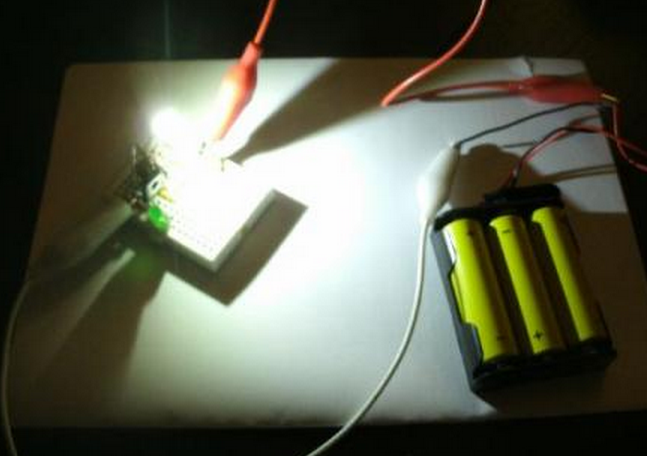
You've got a power LED? Great! Build a flash light!
What does the spec say? "Voltage: 3.6 .. 3.8 V, power 3 W." Okay. This means that it draws some 800 mA. Three mignon cells give 4.5 V for at least three hours. So we add a resistor of 1.2 Ohm and we are safe. If the LED runs at 3.6 V this gives 750 mA and 2.8 W while the resistor voltage is 0.9 V resulting in 0.675 W for the resistor. So we take a resistor that can stand 1 W. Simple, isn't it?
Yes and no. The LED in this simple circuit will glow but what happens if voltage drops because batteries go flat? If voltage drops by 10 % you'll get 4.05 V and current drops by some 50 % meaning that you need rather full batteries to get a reasonable amount of light from your LED. First idea is to put a voltage regulator between the batteries and the circuit and adapt the resistor to its output voltage. However, finding a suitable regulator is tricky. You need a low dropout voltage to let the LED work at full brightness when batteries voltage becomes low.
BJT Current Limiter
We can do better! To stabilize brightness we have to regulate the power consumption of the LED by controlling the current. Wikipedia [1] shows a simple circuit of two transistors and three resistors limiting current independent of supply voltage. We change this circuit by removing resistor R2 which is not really needed. What about dropout voltage? Clearly, there is VCEsat of Q2 which can be in the area of 0.2 V at current around 1 A (for BC640, BD13x, BD23x, BD43x...). However, there is the additional voltage of the emitter resistor which equals VBEon of Q1, typically some 0.7 .. 0.9 V. So we get a total dropout voltage of VBEon1 + VCEsat2 resulting in some 1.0 V.
This dropout voltage is too high for three mignon cells. If you are not keen on energy efficiency and ready to carry four mignon cells then you are done.
Rail to Rail Operational Amplifier
But we can do even more better! The two transistor current limiter is a control loop sensing the current by a resistor and keeping the voltage equal to VBE of a transistor. What about reducing this voltage? There are operational amplifiers with rail to rail input and output meaning that they can handle voltages from VSS to VDD. There are numerous such parts like the MC33201.
Have a look at this current limiter circuit in Wikipedia [2]. Voltage over the sense resistor is kept equal to voltage over z-diode. Okay, there are no z-diodes of really low voltage. Since the amplifier has high input impedance we can use a voltage regulator and simply reduce the voltage using a voltage divider.

One point still to notice is output current of the amplifier. If we use a BD139 transistor this will give us a current gain of 40 or more meaning that the amplifier has to deliver 20 mA which is okay for the MC33201. If the transistor needs higher base current than the amplifier can deliver we have to at an emitter follower between amplifier and transistor.
In our 3 W LED example we can use a resistor of 0.33 Ohm delivering a voltage of some 0.25 V in operation which can be handled by the op amp. Now add VCEsat of 0.2 V and get less than .5 V dropout. Okay, this is a little cheating becuse VCEsat would requires 80 mA which won't be delivered by an MC33201.
Dimming
Brightness can be controlled by reference voltage. Simply use a potentiometer as voltage divider. Or connect the amplifier input to another circuit like a multivibrator to flash the light or to some rectifier and low pass for a light organ.
Future Work
If we are controlling brightness using a mirocontroller with ADC and DAC or PWM we can even drop the Op Amp. Feedback voltage will be digitized by the ADC, then a PID program computes output voltage and DAC or PWM with RC low pass control power transistor. This gives opportunity for additional functionality like touch pad control, remote control, or automatices.
Using a MOSFET instead of a BJT might further reduce dropout voltage. For instance, MCP87xx have very low RDS and low threshold voltage making them suitable also for the microcontroller idea running the controller at 2 V or so.
Final Remarks
There is an instructable [3] showing how to build a power LED driver. This article mainly describes a discrete circuit similar to the two BJT circuit in [1] but with Q2 replaced by a power MOS transistor. MOS transistos can give lower dropout voltage but we need really high power high price transistor.
References
[1] Current limiting http://en.wikipedia.org/wiki/Current_limiting#Single_Power-supply_circuits
[2] Op-amp current sources http://en.wikipedia.org/wiki/Current_source#Op-amp_current_sources
[3] High Power LED Driver Circuits http://www.instructables.com/id/Circuits-for-using-High-Power-LED-s/step6/The-new-stuff-Constant-Current-Source-1/
LDO current regulator for power LED的更多相关文章
- Linux regulator framework(1) - 概述【转】
转自蜗窝科技:http://www.wowotech.net/pm_subsystem/regulator_framework_overview.html 1. 前言 Regulator,中文名翻译为 ...
- ADC Power Supplies
http://www.planetanalog.com/author.asp?section_id=3041&doc_id=563055 Jonathan Harris, Product Ap ...
- Linux下Power Management开发总结
本文作为一个提纲挈领的介绍性文档,后面会以此展开,逐渐丰富. 1. 前言 在 <开发流程>中介绍了PM开发的一般流程,重点是好的模型.简单有效的接口参数.可量化的测试环境以及可独性强的输出 ...
- Linux电源管理-Linux regulator framework概述
前言 1. 什么是regulator? regulator翻译为"调节器",分为voltage regulator(电压调节器)和current(电流调节器).一般电源 ...
- Current Sourcing (拉電流) and Current Sinking(灌電流)
Current Sourcing and Sinking Current sourcing and sinking is often mentioned in relation to electron ...
- 5、regulator系统的概念及测试
概念:Regulator : 电源芯片, 比如电压转换芯片Consumer : 消费者,使用电源的部件, Regulator是给Consumer供电的machine : 单板,上面焊接有Regulat ...
- 2019.1.3 WLAN 802.11 a/b/g PHY Specification and EDVT Measurement II - Transmit Spectrum Mask & Current Consumption
Transmit Spectrum Mask Specification – 802.11b SpecificationFor 802.11b 18.4.7.3The transmitted spec ...
- 8. [mmc subsystem] host(第二章)——sdhci
一.sdhci core说明 1.sdhci说明 具体参考<host(第一章)--概述> SDHC:Secure Digital(SD) Host Controller,是指一套sd ho ...
- linux kernel menuconfig【转载】
原文网址:http://www.cnblogs.com/kulin/archive/2013/01/04/linux-core.html Linux内核裁减 (1)安装新内核: i)将新内核copy到 ...
随机推荐
- CS229 笔记04
CS229 笔记04 Logistic Regression Newton's Method 根据之前的讨论,在Logistic Regression中的一些符号有: \[ \begin{eqnarr ...
- ioctl函数详细说明(网络)
ioctl 函数 本函数影响由fd 参数引用的一个打开的文件. #include<unistd.h> int ioctl( int fd, int request, .../* void ...
- Oracle 数据库和监听器开机自启动两种实现方法
数据库和监听器开机自启动 编辑oratab文件: 修改:orcl:/u01/app/oracle/product/11.2.0/db_1:N orcl:/u01/app/or ...
- centos7系统下安装配置jdk、tomcat教程
JDK安装与配置 1.下载linux版本的jdk,我下的版本是jdk6.0,下载rpm版本的. 可通过百度搜索文件名:jdk-6u45-linux-x64-rpm.bin下载 也可通过oracle官网 ...
- The project cannot be built until its prerequisite base-service is built. Cleaning and building all projects is recommended
参考网址:http://chiangfai.iteye.com/blog/2223661,谢谢! 果然如文中所述,close,重新编译即可!
- Android 5.0 行为变更
Android 5.0 除了提供诸多新特性和功能外,还对系统和 API 行为做出了各种变更.本文重点介绍您应该了解并在开发应用时加以考虑的一些主要变更. 如果您之前发布过 Android 应用,请注意 ...
- tomcat错误信息解决方案【严重:StandardServer.await: create[8005]】
错误信息: 严重: StandardServer.await: create[8005]: java.net.BindException: Address already in use: JVM ...
- Zookeeper+Curator 分布式锁
本来想着基于zk临时节点,实现一下分布式锁,结果发现有curator框架.PS:原声API真的难用,连递归创建path都没有? 配置curator maven的时候,md配置了好几个小时,最后发现集中 ...
- spark sql中保存数据的几种方式
从官网来copy过来的几种模式描述: Scala/Java Python Meaning SaveMode.ErrorIfExists(default) "error"(defau ...
- centos7 firewall 相关
1.centos 6 是iptables, 7 开始就以firewalld代替iptables; 2.systemctl stop firewalld.service 停 systemctl sta ...