
rtp header
rtp协议基于udp传输,流媒体音视频数据被封装在rtp中,通过rtp协议进行实时的传输。
一、rtp协议头格式

The RTP header has a minimum size of 12 bytes. After the header, optional header extensions may be present. This is followed by the RTP payload, the format of which is determined by the particular class of application.[20] The fields in the header are as follows:
- Version: (2 bits) Indicates the version of the protocol. Current version is 2.[21]
- P (Padding): (1 bit) Used to indicate if there are extra padding bytes at the end of the RTP packet. A padding might be used to fill up a block of certain size, for example as required by an encryption algorithm. The last byte of the padding contains the number of padding bytes that were added (including itself).[13]:12[21]
- X (Extension): (1 bit) Indicates presence of an Extension header between standard header and payload data. This is application or profile specific.[21]
- CC (CSRC count): (4 bits) Contains the number of CSRC identifiers (defined below) that follow the fixed header.[13]:12
- M (Marker): (1 bit) Used at the application level and defined by a profile. If it is set, it means that the current data has some special relevance for the application.[13]:13
- PT (Payload type): (7 bits) Indicates the format of the payload and determines its interpretation by the application. This is specified by an RTP profile. For example, see RTP Profile for audio and video conferences with minimal control(RFC 3551).[22]
- Sequence number: (16 bits) The sequence number is incremented by one for each RTP data packet sent and is to be used by the receiver to detect packet loss and to restore packet sequence. The RTP does not specify any action on packet loss; it is left to the application to take appropriate action. For example, video applications may play the last known frame in place of the missing frame.[23] According to RFC 3550, the initial value of the sequence number should be random to make known-plaintext attacks on encryption more difficult.[13]:13 RTP provides no guarantee of delivery, but the presence of sequence numbers makes it possible to detect missing packets.[1]
- Timestamp: (32 bits) Used by the receiver to play back the received samples at appropriate time and interval. When several media streams are present, the timestamps may be independent in each stream.[b] The granularity of the timing is application specific. For example, an audio application that samples data once every 125 µs (8 kHz, a common sample rate in digital telephony) would use that value as its clock resolution. Video streams typically use a 90 kHz clock. The clock granularity is one of the details that is specified in the RTP profile for an application.[23]
- SSRC: (32 bits) Synchronization source identifier uniquely identifies the source of a stream. The synchronization sources within the same RTP session will be unique.[13]:15
- CSRC: (32 bits each, number indicated by CSRC count field) Contributing source IDs enumerate contributing sources to a stream which has been generated from multiple sources.[13]:15
- Header extension: (optional, presence indicated by Extension field) The first 32-bit word contains a profile-specific identifier (16 bits) and a length specifier (16 bits) that indicates the length of the extension (EHL = extension header length) in 32-bit units, excluding the 32 bits of the extension header.[13]:17
上面针对rtp头的解释,最为重要的就是seq 和 timestamp,seq需要保证连续,timestamp对视频数据来说,需要时间毫秒数 x 90,
对于音频则是时间毫秒数 x 80
二、rtp协议头定义
rtp协议头字节序为网络字节序,也就是大端模式:
rfc3550中的rtp头结构体定义
  /*

     * RTP data header

     */

    typedef struct {

        unsigned int version:;   /* protocol version */

        unsigned int p:;         /* padding flag */

        unsigned int x:;         /* header extension flag */

        unsigned int cc:;        /* CSRC count */

        unsigned int m:;         /* marker bit */

        unsigned int pt:;        /* payload type */

        unsigned int seq:;      /* sequence number */

        u_int32 ts;               /* timestamp */

        u_int32 ssrc;             /* synchronization source */

        u_int32 csrc[];          /* optional CSRC list */

    } rtp_hdr_t;
rtp封包时,一般设置version, payloadtype,seq,timestamp,ssrc 即可。
可以按照大端模式直接填充上述的结构体
也可以直接封包,下面的例子:
 // Prepare the 12 byte RTP header

   RtpBuf[]  = 0x80;                               // RTP version

   RtpBuf[]  = 0x1a + (marker_bit << );           // JPEG payload (26) and marker bit

   RtpBuf[]  = m_SequenceNumber >> ;

   RtpBuf[]  = m_SequenceNumber & 0x0FF;           // each packet is counted with a sequence counter

   RtpBuf[]  = (m_Timestamp & 0xFF000000) >> ;   // each image gets a timestamp

   RtpBuf[]  = (m_Timestamp & 0x00FF0000) >> ;

   RtpBuf[]  = (m_Timestamp & 0x0000FF00) >> ;

   RtpBuf[]  = (m_Timestamp & 0x000000FF);

   RtpBuf[]  = 0x13;                               // 4 byte SSRC (sychronization source identifier)

   RtpBuf[]  = 0xf9;                               // we just an arbitrary number here to keep it simple

   RtpBuf[] = 0x7e;

   RtpBuf[] = 0x67;
三、wireshark抓包出的rdp包,可以根据包头的版本号和负载类型筛选出rtp包
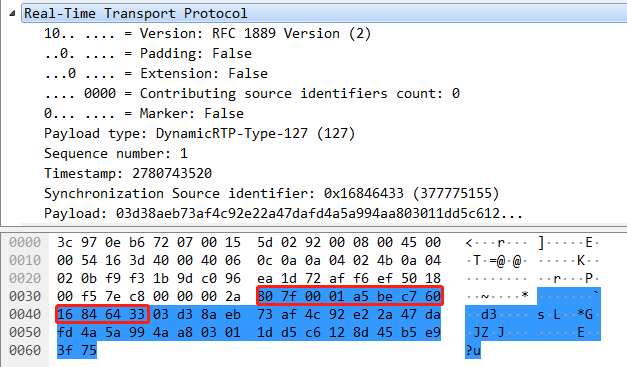
0x80 =1000 0000 version = 2
0x7f =1111 1111
0x00 01 = 0000 0000 0000 0001 seq = 1
0xa5 be c7 60 = 10100101101111101100011101100000 timestamp = 2780743520
引用:
1、https://en.wikipedia.org/wiki/Real-time_Transport_Protocol
2、https://tools.ietf.org/html/rfc3550
rtp header的更多相关文章
- (转载)H.264码流的RTP封包说明
H.264的NALU,RTP封包说明(转自牛人) 2010-06-30 16:28 H.264 RTP payload 格式 H.264 视频 RTP 负载格式 1. 网络抽象层单元类型 (NALU) ...
- 自己动手写RTP服务器——关于RTP协议
转自:http://blog.csdn.net/baby313/article/details/7353605 本文会带领着你一步步动手实现一个简单的RTP传输服务器,旨在了解RTP流媒体传输协议以及 ...
- H.264 基础及 RTP 封包详解
转自:http://my.oschina.net/u/1431835/blog/393315 一. h264基础概念 1.NAL.Slice与frame意思及相互关系 1 frame的数据可以分为多个 ...
- RTMP/RTP/RTSP/RTCP的区别
RTCP RTMP/RTP/RTSP/RTCP的区别 http://blog.csdn.net/frankiewang008/article/details/7665547 流媒体协议介绍(rtp/r ...
- 庖丁解牛-----Live555源码彻底解密(RTP解包)
Live555 客户端解包 以testRTSPClient.cpp为例讲解: Medium<-MediaSource<-FramedSource<-RTPSource<-Mul ...
- 庖丁解牛-----Live555源码彻底解密(RTP打包)
本文主要讲解live555的服务端RTP打包流程,根据MediaServer讲解RTP的打包流程,所以大家看这篇文章时,先看看下面这个链接的内容; 庖丁解牛-----Live555源码彻底解密(根据M ...
- 基于RTP的H264视频数据打包解包类
from:http://blog.csdn.net/dengzikun/article/details/5807694 最近考虑使用RTP替换原有的高清视频传输协议,遂上网查找有关H264视频RTP打 ...
- 用实例分析H264 RTP payload
用实例分析H264 RTP payload H264的RTP中有三种不同的基本负载(Single NAL,Non-interleaved,Interleaved) 应用程序可以使用第一个字节来识别. ...
- RTP封装h264
网络抽象层单元类型 (NALU): NALU头由一个字节组成,它的语法如下: +---------------+ |0|1|2|3|4|5|6|7| +-+-+-+-+-+-+-+ ...
随机推荐
- 第04章:MongoDB基本概念
① 数据库 MongoDB的一个实例可以拥有一个或多个相互独立的数据库,每个数据库都有自己的集合 集合 集合可以看作是拥有动态模式的表 文档 文档是MongoDB中基本的数据单元,类似于RDB ...
- oracle如何快速导入导出文本格式数据
导出工具:sqluldr2工具说明:sqluldr2再以安装oracle客户端的环境下下无需再安装其它软件,只需将对应的软件包拷贝至对应目录,即可运行导出数据导出示例:--linux环境导出示例:/d ...
- [转]两表join的multi update语句在MySQL中的执行流程分析
出自:http://hedengcheng.com/?p=209 两表join的multi update语句,执行结果与预计不一致的分析过程 — multi update结论在实际应用中,不要轻易使用 ...
- Effective C++ 随笔(3)
条款12: 以对象管理资源 两种只能指针: std:auto_ptr<> 当使用copy操作室,原先的智能指针指向为null std:tr1:share_ptr<int> sp ...
- 强大的DataGrid组件[1]
说明:DataGrid组件是Silverlight数据组件中最为常用并且是功能最为强大的数据组件.因此,对开发者而言,深入了解其特性是十分有必要的.本文先介绍该组件的基本特性,接着通过几个简单实例来说 ...
- 20169207《Linux内核原理与分析》第六周作业
这周的作业同样分为两部分,第一部分的学习MOOC第四节[扒开系统调用的三层皮],并结合实验楼的实验四深入学习.第二部分阅读学习教材「Linux内核设计与实现 (Linux Kernel Develop ...
- web-day11
第11章WEB11-Cookie&Session篇 今日任务 显示用户的上次访问时间 登录系统以后显示商品浏览记录 购买商品将商品添加到购物车 系统登录的验证码的校验 教学导航 教学目标 了解 ...
- Codeforces816A Karen and Morning 2017-06-27 15:11 43人阅读 评论(0) 收藏
A. Karen and Morning time limit per test 2 seconds memory limit per test 512 megabytes input standar ...
- codeforces966 A
这题主要就是考虑y1两侧的最近的电梯和楼梯 当时主要是考虑 如果电梯在y1和y2中间的话 那么直接做电梯就是最优解 如果在y2右边就用abs去算 然后发现其实只考虑 y1的左右两边的电梯和楼 ...
- js-倒计时原理
<!DOCTYPE html><html> <head> <meta charset="UTF-8"> ...