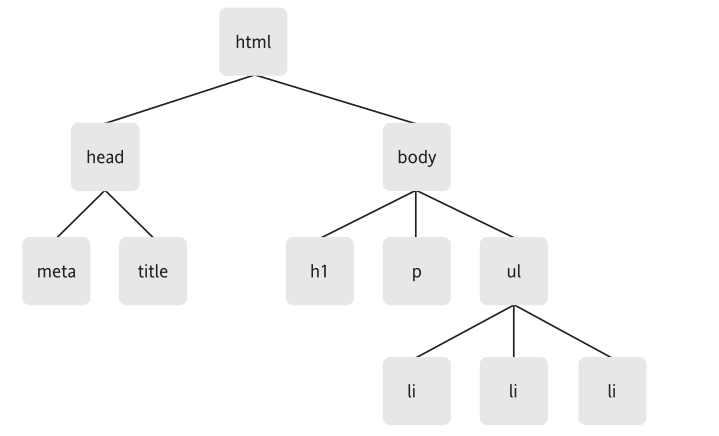
DOM : Document Object Model
D is for document :
The DOM cant work without a document . When you create a web page and load it in a web browser, the DOM comes to life. It takes the document that you have written and turns it into
an object .
O is for Objects : Just as we see before.
M is for Model :
The M in DOM stands for Model, but it could just as easily stand for Map.
The DOM represents the web page thats currently loaded in the browser window. The browser
provides a map (or a model) of the page. You can use JavaScript to read this map.
The most important convention used by the DOM is the representation of a document as a tree.
More specifically, the document is represented as a family tree.

However, instead of using the term family tree, its more accurate to call a document a node tree.
Nodes :
A document is a collection of nodes, with nodes as the branches and leaves on the document tree.
There are a number of defferent types of nodes. Lets take a quick look at three of them :
element nodes, text nodes, attribute nodes.
Element nodes :
such as <body> <p> <ul> , Elemnets are the basic building blocks of documents on the Web, and
its the arrangement of these elements in a document that gives the document its structure.
Text nodes:
if a document consisted purely of empty elements, it would have a structure, but the document
itself wouldnt contain much content. On the web, most content is provided by text.
such as <p>Dont forget to buy this stuff</p> , "Dont forget to buy this stuff" is a text node.
In XHTML, text nodes are always enclosed within element nodes.
Attribute nodes:
Attributes are used to give more specific information about an element.
<p title = "a gentle reminder"> Dont forget to buy this stuff. </p>
In DOM, title = "a gentle reminder" is an attribute node.

Because attributes are always placed within opening tags, attribute nodes are always contained
within element nodes. Not all elements contain attribute, but all attributes are contained by elements.
In fact, each element in a document is an object. Using the DOM, you can "get" at all of these
elements .
Getting Elements :
Three DOM methods allow you to access element nodes by ID, tag name, and class name.
getElementById() :
usage : document.getElementById(id) :
this method will return a specific object in the document model.
you can use the typeof to test this : eg :
alert( typeof document.getElementById("purchases") ) ;
getElementsByTagName() :
usage : element.getElementByTagName( tag );
Even if there is only one element with the specified tag name, getElementByTagName still returns
an array. The length of the array will be simply 1.
you can also use a wildcard(通配符) with getElementByTagName, which means you can make an
array with every single element. eg :
alert ( document.getElementsByTagName("*").length ) ;
you can also combine getElementsByTagName with getElementById. eg :
var shopping = document.getElementById("purchases") ;
var items = shopping.getElementsByTagName("*") ;
alert( items.length );
getElementsByClassName()
It also behaves in the same way as getElementsByTagName by returning an array of elements with a common class name.The getElementsByClassName method is quite useful, but it’s supported by only modern browsers. To make up for this lack of support, DOM scripters have needed to roll their own getElementsByClassName function using existing DOM methods, sort of like a rite of passage.
function getElementsByClassName(node, classname) {

    if (node.getElementsByClassName) {

        // Use the existing method

        return node.getElementsByClassName(classname);

     } else {

        var results = new Array();

        var elems = node.getElementsByTagName("*");

            for (var i=0; i<elems.length; i++) {

                if (elems[i].className.indexOf(classname) != -1) {

                  results[results.length] = elems[i];

               }

         }

        return results;

    }

}
Before you may write like this :
var shopping = document.getElementById("purchases");
var sales = shopping.getElementsByClassName("sale");
With this function, you can write the code like this :
var shopping = document.getElementById("purchases");
var sales = getElementsByClassName(shopping, "sale");
Here's a quick summary of what you've seen so far :
- A document is a tree of nodes.
- There are different types of nodes : elements, attributes, text, and so on
- you can go straight to a specific element node using getElementById.
- you can go directly to a collection of element nodes using getElementsByTagName or getElementsByClassName
- Every one of these nodes is an object.
Getting and Setting Attributes :
getAttribute()
usage : object.getAttribute( attribute ) ;
Unlike the other methods you've seen before, you cant use getAttribute on the document object.
It can be used on only an element node object.
SetAttribute()
usage : object.setAttribute(attribute, value);
- HTML与DOM BOM javascript
1.什么是DOM? 简单说就是DOM规定了HTML,XML等的一些文档映射规范,使JavaScript可以根据这些规范来进行获取元素,在元素上进行各种操作,使得用户页面可以动态的变化,从而大大使页面的 ...
- 第61节:Java中的DOM和Javascript技术
Java中的DOM和Javascript技术 DOM是一门技术,是文档对象模型.所需的文档只有标记型文档,如我们所学的html文档(文档中的所有标签都封装成为对象了) DOM: 为Document O ...
- DOM与JavaScript、jQuery之间的关系
DOM(document object model) 其实是浏览器内元素对象的一个总称 我们用JavaScript对网页进行的所有操作都是通过DOM进行的.DOM属于浏览器,而不是JavaScript ...
- javascript+dom 做javascript图片库
废话不多说 直接贴代码 <!DOCTYPE html><html lang="en"><head> <meta charset=" ...
- DOM(JavaScript高程笔记)
一.节点层次 1.Node类型 if (someNode.nodeType == 1){ // 适用于所有浏览器 alert("Node is an element."); } N ...
- html dom与javascript的关系 -我们用JavaScript对网页(HTML)进行的所有操作都是通过DOM进行的
一,什么是DOM (参考源http://www.cnblogs.com/chaogex/p/3959723.html) DOM是什么 DOM全称为The Document Object Model,应 ...
- HTML(DOM)与JavaScript嵌套数组之间相互转换
html2ja:将html目标元素解析为JavaScript数组字面量,每项的值为tagName, className, id等CSS选择器组合: showJa:将html2ja生成的数组缩进格式化显 ...
- DOM,javascript,Web API之间的关系——onclick 引起的思考与调研
平时习惯了用js操作dom树来与html页面进行交互,基本都是通过web API接口实现的,最近看闭包和原生js的知识点比较多,昨天无意中看到了onclick中的this指向问题,遂用native j ...
- Html 内嵌 选择器属性 Dom操作 JavaScript 事件
HTML标签: 一.通用标签(一般标签) 1.格式控制标签 <font color="#6699aa" face="楷体" size="24&q ...
随机推荐
- .bak文件数据还原
.bak文件还原(见下图) 1.连接上数据库,右键数据库,选择新建数据库,输入你要还原数据库的名称 2.数据库右键-->任务-->还原-->数据库,弹出窗口选择[源设备],选择.ba ...
- Regexp:常用的几个正则表达式
1.isEmail /** * * @desc 判断是否为邮箱地址 * @param {String} str * @return {Boolean} */ function isEmail(str) ...
- jQuery中$(function(){})与(function($){})(jQuery)、$(document).ready(function(){})等的区别讲解
1.(function($){...})(jQuery); (1).原理: 这实际上是匿名函数,如下: function(arg){...} 这就定义了一个匿名函数,参数为arg:而调用函 ...
- UINavigationControlle 之 UINavigationBar及navigationItem关系探讨
在设置标题栏时常常遇到修改标题.修改返回按钮标题.增加一些按钮等需求,实现过程中一般会把UINavigationController.UINavigationBar.navigationItem及se ...
- 性能调优--大事务与Alwayson 之间的关系
最近性能调优的事比较多,所以摘一些比较有特点的 案例分享下. 业务系统用的是sql server 2016 ,搭建的ALWAYSON 两节点的 群集,今天早上突然辅助 副本的只读库出现大量的等待导致系 ...
- POJ 3041 Asteroids (对偶性,二分图匹配)
题目:POJ 3041 Asteroids http://poj.org/problem?id=3041 分析: 把位置下标看出一条边,这显然是一个二分图最小顶点覆盖的问题,Hungary就好. 挑战 ...
- Android(java)学习笔记90:TextView 添加超链接(两种实现方式)
1. TextView添加超链接: TextView添加超链接有两种方式,它们有区别于WebView: (1)方式1: LinearLayout layout = new LinearLayout(t ...
- 【洛谷2279】[HNOI2003] 消防局的设立(贪心)
点此看题面 大致题意: 给你\(N\)个点(其中\(1\)号点为根),并告诉你编号为\(2\sim N\)的点的父亲(\(fa[i]<i\)),现在要在树上选择尽量少的关键点(消防局),使得任意 ...
- 【转】android调试工具DDMS的使用详解
具体可见http://developer.android.com/tools/debugging/ddms.html. DDMS为IDE和emultor.真正的android设备架起来了一座桥梁.开发 ...
- 破解 D-H 协议
756: 破解 D-H 协议 时间限制: 1 Sec 内存限制: 128 MB提交: 78 解决: 18[提交] [状态] [讨论版] [命题人:admin] 题目描述 Diffie-Hellma ...