
1.1 BASIC PROGRAMMING MODEL(算法 Algorithms 第4版)
1.1.1
  private static void exercise111()

    {

        StdOut.println("1.1.1:");

        StdOut.println((0+15)/2);

        StdOut.println(2.0e-6 * 100000000.1);

        StdOut.println(true && false || true && true);

        StdOut.println();

    }

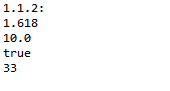
1.1.2
  private static void exercise112()

    {

        StdOut.println("1.1.2:");

        StdOut.println((1 + 2.236)/2);

        StdOut.println(1 + 2 + 3 + 4.0);

        StdOut.println(4.1 >= 4);

        StdOut.println(1 + 2 + "3");

        StdOut.println();

    }
1.1.3
  private static void exercise113(String[] args)

    {

        StdOut.println("1.1.3:");

        boolean equalflag = true;

        for(int i = 1; i < args.length; i++){

            int prev = Integer.parseInt(args[i-1]);

            int current = Integer.parseInt(args[i]);

            if(prev != current){

                equalflag = false;

            }

        }

        if(equalflag)

            StdOut.println("equal");

        else

            StdOut.println("not equal");

        StdOut.println();

    }

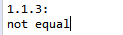


这里不进行异常处理
1.1.4
只有c是对的。
1.1.5
    private static void exercise115()

    {

        StdOut.println("1.1.5:");

        StdOut.println("please input two doubles");

        double x = StdIn.readDouble();

        double y = StdIn.readDouble();

        if(x >= 0 && x <= 1 && y >= 0 && y <= 1) {

            StdOut.println(true);

        }

        else {

            StdOut.println(false);

        }

        StdOut.println();

    }

1.1.6
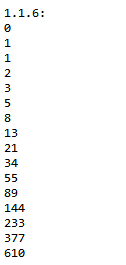
    private static void exercise116()

    {

        StdOut.println("1.1.6:");

        int f = 0;

        int g = 1;

        for(int i = 0; i <= 15; i++) {

            StdOut.println(f);

            f = f + g;

            g = f - g;

        }

        StdOut.println();

    }
上述程序求得是f15,其中fn=fn-1 + fn-2 其中f0 = 0, f1 = 1
1.1.7
    private static void exercise117()

    {

        StdOut.println("1.1.7:");

        double t = 9.0;

        while(Math.abs(t-9.0/t) > 0.01)

            t = (9.0/t + t) / 2.0;

        StdOut.printf("%.5f\n", t);

        int sum = 0;

        for(int i = 1; i < 1000; i++)

            for(int j =0; j < i; j++)

                sum++;

        StdOut.println(sum);

        int s = 0;

        for(int i = 1; i < 1000; i *= 2)

            for(int j = 0; j < 1000; j++)

                s++;

        StdOut.println(s);

        StdOut.println();

    }

上述程序中
a 不知道求得是什么
b 求得是1 + 2 + 3 + …… + 999 = ((1+999) * 999 )/ 2 = 499500
c 求得是1000 * (⌊log2999⌋ + 1) = 10000
1.1.8
    private static void exercise118()

    {

        StdOut.println("1.1.8:");

        //print char type

        System.out.println('b');

        //print int type

        System.out.println('b' + 'c');

        //print char type

        System.out.println((char) ('a' + 4));

        StdOut.println();

    }

注释解释了原因
1.1.9
    private static void exercise119()

    {

        StdOut.println("1.1.9:");

        StdOut.println("please input a int N");

        int n = StdIn.readInt();

        StdOut.println(Integer.toBinaryString(n));

        StdOut.println();

    }

1.1.10
没有给数组分配内存
1.1.11-1.1.13略
1.1.14
    private static void exercise1114()

    {

        StdOut.println("1.1.14:");

        StdOut.println("please input a N(Integer) to compute lg2N");

        int n = StdIn.readInt();

        int lg2n = lg(n);

        StdOut.printf("the largest int not larger than lg2N is %d\n", lg2n);

        StdOut.println();

    }

    public static int lg(int N)

    {

        int lg2N = 0;

        //IllegalArgument Exception

        if(!(N > 0))

            throw new IllegalArgumentException("argument N in function lg should larger than 0");

        for(N = N/2; N >= 1; N = N/2)

            lg2N ++;

        return lg2N;

    }


1.1.15
    private static void exercise1115() {

        int[] test = {

            1,6,3,4,1,4,0,2,7,5,7,6,8,0,5,3,2,8

        };

        int[] result;

        StdOut.println("1.1.15:");

        StdOut.printf("total: %d\n", test.length);

        result = histogram(test, 9);

        StdOut.println(Arrays.toString(result));

        StdOut.println();

    }

    public static int[] histogram(int[] a, int M)

    {

        int[] b = new int[M];

        for(int i = 0; i < a.length; i++)

        {

            //the value of array a should be [0,M)

            //if no, ignore

            if(a[i] < M && a[i] >= 0) {

                b[a[i]] ++;

            }

        }

        return b;

    }

1.1.16
    private static void exercise1116()

    {

        StdOut.println("1.1.16:");

        StdOut.println(exR1(6));

        StdOut.println();

    }

    public static String exR1(int n)

    {

        if(n <= 0)

        {

            return "";

        }

        return exR1(n-3) + n + exR1(n-2) + n;

    }

解析:
exR1(6) = exR1(3) + 6 + exR1(4) + 6
exR1(3) = exR1(0) + 3 + exR1(1) + 3
exR1(0) = ""
exR1(1) = exR1(-2) + 1 + exR1(-1) + 1
exR1(-2) = ""
exR1(-1) = ""
exR1(1) = "11"
exR1(3) = "3113"
exR1(4) = exR1(1) + 4 + exR1(2) + 4
exR1(1) = "11" 省略再次递归过程
exR1(2) = exR1(-1) + 2 + exR1(0) + 2
exR1(-1) = ""
exR1(0) = ""
exR1(2) = "22"
exR1(4) = "114224"
exR1(6) = "311361142246"
1.1.17
    public static String exR2(int n) {

        if(n <= 0)

            return "";

        String s = exR2(n-3) + n + exR2(n-2) +n;

        return s;

    }
应该改为上述程序。否则会一直递归下去,没有停止。
1.1.18
    private static void exercise1118() {

        StdOut.println("1.1.18:");

        StdOut.println(mystery(2, 25));

        StdOut.println(mystery(3, 11));

        StdOut.println(mystery1(2, 25));

        StdOut.println(mystery1(3, 11));

        StdOut.println("");

    }

    public static int mystery(int a, int b) {

        if(b == 0) return 0;

        if(b % 2 == 0) return mystery(a+a, b/2);

        return mystery(a+a, b/2) + a;

    }

    public static int mystery1(int a, int b) {

        if(b == 0) return 1;

        if(b % 2 == 0) return mystery1(a*a, b/2);

        return mystery1(a*a, b/2) * a;

    }

mystery函数是计算a*b
mystery1函数是计算a^b
1.1.19
  private static void exercise1119()

    {

        StdOut.println("1.1.19:");

        for(int N = 0; N < 100; N++)

        {

            Date date=new Date();

            DateFormat format=new SimpleDateFormat("yyyy-MM-dd HH:mm:ss");

            String time=format.format(date);

            StdOut.println(time);

            StdOut.println(N + " " + fibonacci(N));

        }

        for(int N = 0; N < 100; N++)

        {

            Date date=new Date();

            DateFormat format=new SimpleDateFormat("yyyy-MM-dd HH:mm:ss");

            String time=format.format(date);

            StdOut.println(time);

            StdOut.println(N + " " + fibonacciarray(N));

        }

        StdOut.println();

    }

    public static long fibonacci(int N)

    {

        //when N larger than 92, it will overflow

        //IllegalArgument Exception

        if(N < 0)

            throw new IllegalArgumentException("argument N in function fibonacci should be nonnegative integer");

        if(N == 0) return 0;

        if(N == 1) return 1;

        return fibonacci(N-1) + fibonacci(N-2);

    }

    public static long fibonacciarray(int N)

    {

        //IllegalArgument Exception

        if(N < 0)

            throw new IllegalArgumentException("argument N in function fibonacciarray should be nonnegative integer");

        if(N == 0)

            return 0;

        if(N == 1)

            return 1;

        //when N larger than 92, it will overflow

        long[] result = new long[N+1];

        result[0] = 0;result[1] = 1;

        for(int i = 2; i <= N; i++)

        {

            result[i] = result[i-1] + result[i-2];

        }

        return result[N];

    }
测试结果是58,用时49分17秒。
fibonacci函数的递归方式有问题,重复计算了很多。
fibonacciarray函数是用内存来换取时间的做法。
当N大于92时,就会溢出。
1.1.20
    private static void exercise1120()

    {

        StdOut.println("1.1.20:");

        for(int i = 0; i < 10; i++)

        {

            StdOut.println(i + " " + lnFactorialN(i));

        }

        StdOut.println(-1 + " " + lnFactorialN(-1));

        StdOut.println();

    }

    public static double lnFactorialN(int N)

    {

        //IllegalArgument Exception

        if(N < 0)

            throw new IllegalArgumentException("argument N in function lnFactorialN should be nonnegative integer");

        if(N == 0)

            return 0;

        return Math.log(N) + lnFactorialN(N-1);

    }

1.1.21
   private static void exercise1121()

    {

        StdOut.println("1.1.21:");

        StdOut.println("please input your name and two integers followed by a newline");

        String name = null;

        int first, second;

        if(StdIn.hasNextLine())

        {

            name = StdIn.readString();

            first = StdIn.readInt();

            second = StdIn.readInt();

            StdOut.printf("%-10s|%-10d|%-10d|%-10.3f", name, first, second, (first*1.0)/second);

        }

        StdOut.println();

    }

1.1.22 1.1.23 1.1.28
//exercise 1.1.22

//exercise 1.1.23

//exercise 1.1.28

package com.qiusongde;

import java.util.ArrayList;

import java.util.Arrays;

import java.util.Iterator;

import edu.princeton.cs.algs4.In;

import edu.princeton.cs.algs4.StdIn;

import edu.princeton.cs.algs4.StdOut;

public class BinarySearch {

    public static int rank(int key, int[] a)

    {

        //a is empty

        if(a == null)

            return -1;

        StdOut.println("Search for " + key);

        return rank(key, a, 0, a.length - 1, 0);

    }

    public static int rank(int key, int[] a, int lo, int hi, int depth)

    {

        //a is empty

        if(a == null)

            return -1;

        //indented by the depth of the recursion

        for(int i = 0; i < depth; i++)

            StdOut.print(" ");

        //print information about lo and hi

        StdOut.printf("lo is %d, hi is %d\n", lo, hi);

        if(lo > hi)

            return -1;

        int mid = lo + (hi - lo) / 2;

        if(key < a[mid])

            return rank(key, a, lo, mid - 1, ++depth);

        else if(key > a[mid])

            return rank(key, a, mid + 1, hi, ++depth);

        else

            return mid;

    }

    private static int[] removeDuplicate(int[] input)

    {

        int[] result;

        ArrayList<Integer> list = new ArrayList<Integer>();

        list.add(input[0]);

        for(int i = 1; i < input.length; i++)

        {

            if(input[i] != input[i-1])

                list.add(input[i]);

        }

        result = new int[list.size()];

        for(int i = 0;i < list.size(); i++)

            result[i] = list.get(i);

        return result;

    }

    public static void main(String[] args) {

        //it is better to judge the length of args

        if(args.length < 2)

        {

            StdOut.println("Usage: BinarySearch whitelistfile [option]");

            StdOut.println("option: + to print numbers from StdIn that are not in the whitelistfile");

            StdOut.println("option: - to print numbers from StdIn that are in the whitelistfile");

            return;

        }

        int[] whitelist = In.readInts(args[0]);

        boolean printwhiteflag = false;

        if(args[1].equals("+"))

            printwhiteflag = false;

        else if(args[1].equals("-"))

            printwhiteflag = true;

        Arrays.sort(whitelist);

        StdOut.println(Arrays.toString(whitelist));

        whitelist = removeDuplicate(whitelist);

        StdOut.println(Arrays.toString(whitelist));

        //when redirect standard input stream to a file

        //the application cannot terminate

        while(!StdIn.isEmpty())

        {

            //read key

            int key = StdIn.readInt();

            int index = rank(key, whitelist);

            //if not in whitelist, print

            if(index == -1 && printwhiteflag ==false)

                StdOut.println(key);

            //if in whitelist, print

            if(index != -1 && printwhiteflag == true)

                StdOut.println(key);

        }

    }

}


[10, 10, 11, 12, 16, 18, 18, 23, 29, 33, 48, 48, 54, 57, 68, 77, 84, 98]

[10, 11, 12, 16, 18, 23, 29, 33, 48, 54, 57, 68, 77, 84, 98]

Search for 23

lo is 0, hi is 14

 lo is 0, hi is 6

  lo is 4, hi is 6

23

Search for 50

lo is 0, hi is 14

 lo is 8, hi is 14

  lo is 8, hi is 10

   lo is 8, hi is 8

    lo is 9, hi is 8

Search for 10

lo is 0, hi is 14

 lo is 0, hi is 6

  lo is 0, hi is 2

   lo is 0, hi is 0

10

Search for 99

lo is 0, hi is 14

 lo is 8, hi is 14

  lo is 12, hi is 14

   lo is 14, hi is 14

    lo is 15, hi is 14

Search for 18

lo is 0, hi is 14

 lo is 0, hi is 6

  lo is 4, hi is 6

   lo is 4, hi is 4

18

Search for 23

lo is 0, hi is 14

 lo is 0, hi is 6

  lo is 4, hi is 6

23

Search for 98

lo is 0, hi is 14

 lo is 8, hi is 14

  lo is 12, hi is 14

   lo is 14, hi is 14

98

Search for 84

lo is 0, hi is 14

 lo is 8, hi is 14

  lo is 12, hi is 14

84

Search for 11

lo is 0, hi is 14

 lo is 0, hi is 6

  lo is 0, hi is 2

11

Search for 10

lo is 0, hi is 14

 lo is 0, hi is 6

  lo is 0, hi is 2

   lo is 0, hi is 0

10

Search for 48

lo is 0, hi is 14

 lo is 8, hi is 14

  lo is 8, hi is 10

   lo is 8, hi is 8

48

Search for 77

lo is 0, hi is 14

 lo is 8, hi is 14

  lo is 12, hi is 14

   lo is 12, hi is 12

77

Search for 13

lo is 0, hi is 14

 lo is 0, hi is 6

  lo is 0, hi is 2

   lo is 2, hi is 2

    lo is 3, hi is 2

Search for 54

lo is 0, hi is 14

 lo is 8, hi is 14

  lo is 8, hi is 10

54

Search for 98

lo is 0, hi is 14

 lo is 8, hi is 14

  lo is 12, hi is 14

   lo is 14, hi is 14

98

Search for 77

lo is 0, hi is 14

 lo is 8, hi is 14

  lo is 12, hi is 14

   lo is 12, hi is 12

77

Search for 77

lo is 0, hi is 14

 lo is 8, hi is 14

  lo is 12, hi is 14

   lo is 12, hi is 12

77

Search for 68

lo is 0, hi is 14

 lo is 8, hi is 14

68
1.1.24 1.1.30
//exercise 1.1.24

//exercise 1.1.30

package com.qiusongde;

import edu.princeton.cs.algs4.StdOut;

public class Euclid {

    public static void main(String[] args) {

        //it is better to judge the length of args

        if(args.length < 2)

        {

            StdOut.println("Usage: Euclid p q");

            return;

        }

        int p = Integer.parseInt(args[0]);

        int q = Integer.parseInt(args[1]);

        int result = gcd(p,q);

        if(result == -1)

            StdOut.println("p and q both must larger than 0");

        else

            StdOut.printf("the greatest common divisor of %d and %d is %d\n", p, q, result);

        boolean[][] test = isRelaPrime(10, 10);

        for(int i = 0; i < test.length; i++){

            StdOut.printf("%-6d", i);

            for(int j = 0; j < test[i].length; j++)

            {

                StdOut.printf("%-6s", test[i][j] + "");

            }

            StdOut.printf("\n");

        }

    }

    public static boolean[][] isRelaPrime(int M, int N)

    {

        //error

        if(M < 0 || N < 0)

            return null;

        boolean[][] result = new boolean[M][N];

        for(int i = 0; i < M; i++)

            for(int j = 0; j < N; j++)

            {

                if(gcd(i, j) == 1)

                    result[i][j] = true;

                else

                    result[i][j] = false;

            }

        return result;

    }

    public static int gcd(int p, int q)

    {

        //if p or q isn't nonnegative, error

        if(p < 0 || q < 0)

            return -1;

//        StdOut.println(p + " " + q);

        if(q == 0)

            return p;

        int r = p % q;

        return gcd(q, r);

    }

}


当i或j为0时的处理不知是否正确。
1.1.27
package com.qiusongde;

import edu.princeton.cs.algs4.StdOut;

public class Exercise1127 {

    public static void main(String[] args) {

        StdOut.println(binomial(10, 5, 0.8) + "");

        StdOut.println(binomialarray(10, 5, 0.8) + "");

    }

    public static double binomial(int N, int k, double p)

    {

        if(N == 0 && k == 0)

            return 1.0;

        if (N < 0 || k < 0)

            return 0.0;

        return (1.0 - p) * binomial(N-1, k, p) + p * binomial(N-1, k-1, p);

    }

    public static double binomialarray(int N, int k, double p)

    {

        if(N == 0 && k == 0)

            return 1.0;

        if(N < 0 || k < 0)

            return 0.0;

        //k > 0 or N > 0

        //index cannot be negative, so add one per dimension

        double binomial[][] = new double[N+2][k+2];

        //plus one per dimension

        for(int i = 0; i < N + 2; i++)

            for(int j = 0; j < k + 2; j++)

            {

                if(i == 1 && j == 1)

                    binomial[i][j] = 1.0;

                else if(i == 0 || j == 0)

                    binomial[i][j] = 0.0;

                else

                    binomial[i][j] = (1.0 - p) * binomial[i-1][j]

                            + p * binomial[i-1][j-1];

            }

        return binomial[N+1][k+1];

    }

}

1.1.29
package com.qiusongde;

import java.util.Arrays;

import edu.princeton.cs.algs4.In;

import edu.princeton.cs.algs4.StdIn;

import edu.princeton.cs.algs4.StdOut;

public class Exercise1129 {

    public static void main(String[] args) {

        //it is better to judge the length of args

        if(args.length < 1)

        {

            StdOut.println("Usage: BinarySearch whitelistfile");

            return;

        }

        int[] whitelist = In.readInts(args[0]);

        Arrays.sort(whitelist);

        StdOut.println(Arrays.toString(whitelist));

        //when redirect standard input stream to a file

        //the application cannot terminate

        while(!StdIn.isEmpty())

        {

            //read key

            int key = StdIn.readInt();

            int smallernumber = rank(key, whitelist);

            int equalnumber = count(key, whitelist);

            StdOut.println("the number of elements that are smaller than the key is: " + smallernumber);

            StdOut.println("the number of elements that equal the key is: " + equalnumber);

        }

    }

    //return the number of elements that are smaller than the key

    //the array has been sorted

    public static int rank(int key, int[] a)

    {

        int lo = 0;

        int hi = a.length - 1;

        while(lo <= hi)

        {

            int mid = lo + (hi - lo) / 2;

            if(key < a[mid])

                hi = mid - 1;

            else if(key > a[mid])

                lo = mid + 1;

            else{

                //a[mid] == key

                while(--mid >= 0 && a[mid] == key);

                //mid < 0 or a[mid] < key

                return ++mid;

            }

        }

        //if key isn't in array a

        //hi is lower than lo

        //key is between a[hi] and a[lo], so the number should be lo

        return lo;

    }

    //return the number of elements equal to the key

    public static int count(int key, int[] a)

    {

        //the number, lower than key

        int index = rank(key, a);

        int result = 0;

        while(index < a.length && a[index++] == key)

            result++;

        return result;

    }

}


[10, 10, 11, 12, 16, 18, 18, 23, 29, 33, 48, 48, 54, 57, 68, 77, 84, 98]

23

the number of elements that are smaller than the key is: 7

the number of elements that equal the key is: 1

50

the number of elements that are smaller than the key is: 12

the number of elements that equal the key is: 0

10

the number of elements that are smaller than the key is: 0

the number of elements that equal the key is: 2

99

the number of elements that are smaller than the key is: 18

the number of elements that equal the key is: 0

18

the number of elements that are smaller than the key is: 5

the number of elements that equal the key is: 2

23

the number of elements that are smaller than the key is: 7

the number of elements that equal the key is: 1

98

the number of elements that are smaller than the key is: 17

the number of elements that equal the key is: 1

84

the number of elements that are smaller than the key is: 16

the number of elements that equal the key is: 1

11

the number of elements that are smaller than the key is: 2

the number of elements that equal the key is: 1

10

the number of elements that are smaller than the key is: 0

the number of elements that equal the key is: 2

48

the number of elements that are smaller than the key is: 10

the number of elements that equal the key is: 2

77

the number of elements that are smaller than the key is: 15

the number of elements that equal the key is: 1

13

the number of elements that are smaller than the key is: 4

the number of elements that equal the key is: 0

54

the number of elements that are smaller than the key is: 12

the number of elements that equal the key is: 1

98

the number of elements that are smaller than the key is: 17

the number of elements that equal the key is: 1

77

the number of elements that are smaller than the key is: 15

the number of elements that equal the key is: 1

77

the number of elements that are smaller than the key is: 15

the number of elements that equal the key is: 1

68

the number of elements that are smaller than the key is: 14

the number of elements that equal the key is: 1
1.1.31
package com.qiusongde;

import edu.princeton.cs.algs4.StdDraw;

import edu.princeton.cs.algs4.StdOut;

import edu.princeton.cs.algs4.StdRandom;

public class Exercise1131 {

    private static class Point

    {

        double x, y;

        public Point(double x, double y)

        {

            //should add some Exception

            this.x = x;

            this.y = y;

        }

        public double getX()

        {

            return x;

        }

        public double getY()

        {

            return y;

        }

    }

    public static void main(String[] args) {

        if(args.length < 2)

        {

            StdOut.println("Usage: Exercise1131 N p");

            StdOut.println("N is a nonnegative integer, p is a double value[0,1]");

            return;

        }

        //command argument

        int N = Integer.parseInt(args[0]);

        double probability = Double.valueOf(args[1]);

        if(N < 0)

        {

            StdOut.println("N must be a nonnegative integer");

            return;

        }

        if(probability < 0 || probability > 1)

        {

            StdOut.println("p must be between 0 and 1");

            return;

        }

        //the drawing area is between 0 and 1 by default

        //coordinates for circle and point

        double centerX = 0.5;

        double centerY = 0.5;

        double R = 0.4;

        Point[] points = new Point[N];

        //generate points

        for(int i = 0; i < N; i++){

            double x  = R * Math.cos(360.0 / N * i * Math.PI / 180.0);

            double y  = R * Math.sin(360.0 / N * i * Math.PI / 180.0);

            points[i] = new Point(centerX + x, centerY +y);

        }

        //draw circle

        StdDraw.setPenRadius(0.01);

        StdDraw.circle(centerX, centerY, R);

        //draw points

        StdDraw.setPenRadius(0.05);

        for(int i = 0; i < N; i++){

            StdDraw.point(points[i].getX(), points[i].getY());

        }

        //draw lines

        StdDraw.setPenColor(StdDraw.GRAY);

        StdDraw.setPenRadius(0.01);

        for(int i = 0; i < N; i++)

        {

            for(int j = i + 1; j < N; j++)

            {

                //probability, to draw a gray line connecting each pair of points

                if(StdRandom.bernoulli(probability))

                    StdDraw.line(points[i].getX(), points[i].getY(),

                            points[j].getX(), points[j].getY());

            }

        }

    }

}


1.1.32
//exercise 1.1.32

package com.qiusongde;

import edu.princeton.cs.algs4.StdDraw;

import edu.princeton.cs.algs4.StdIn;

import edu.princeton.cs.algs4.StdOut;

public class Histogram {

    public static void main(String[] args)

    {

        //usage

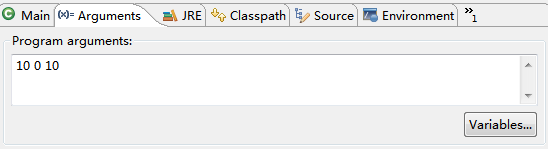
        if(args.length < 3)

        {

            StdOut.println("Usage: Histogram N l r");

            StdOut.println("Dividing [l,r) into N equal-sized intervals");

            StdOut.println("N must larger than 0, r must larger than l");

            return;

        }

        int N = Integer.parseInt(args[0]);

        if(!(N > 0))

        {

            StdOut.println("N must larger than 0");

            return;

        }

        double l = Double.parseDouble(args[1]);

        double r = Double.parseDouble(args[2]);

        if(!(r > l))

        {

            StdOut.println("r must larger than l");

            return;

        }

        double interval = (r - l) / N;

        int[] count = new int[N];

        int sum = 0;

        while(!StdIn.isEmpty())

        {

            double temp = StdIn.readDouble();

            //count[i] count the range [ l+i*interval, l+(i+1)interval )

            int i = (int) ((temp - l) / interval);

            //i should be between 0 and N-1, otherwise ignore it

            if(i >= 0 && i <= N-1)

            {

                count[i]++;

                sum ++;

            }

        }

        //draw the result

        StdDraw.setXscale(l, r);

        StdDraw.setYscale(0, sum);

        for(int i = 0; i < N; i++)

        {

            double centerX = l + (i + 0.5) * interval;

            double centerY = count[i] / 2.0;

            double rw = (0.25 * interval);//leave some space

            double rh = count[i] / 2.0;

            StdDraw.filledRectangle(centerX, centerY, rw, rh);

        }

    }

}


1.1.34
N Y N N N Y Y Y
1.1.35
//exercise 1.1.35

package com.qiusongde;

import java.util.Arrays;

import edu.princeton.cs.algs4.StdOut;

import edu.princeton.cs.algs4.StdRandom;

public class DiceSimulation {

    private static boolean match3Decimal(double a, double b)

    {

        //a and b are both between 0 and 1

//        if(Math.abs(a - b) < 0.0001)

        if( (int)(a*1000) == (int)(b*1000))

            return true;

        else

            return false;

    }

    private static boolean checkExactResult(double[] a, double[] b)

    {

        if(a.length != b.length)

            return false;

        for(int i = 0; i < a.length; i++)

        {

            if(match3Decimal(a[i], b[i]))

                continue;

            else

                return false;

        }

        return true;

    }

    public static void main(String[] args) {

        int SIDES = 6;//[1,6]

        double[] theoryp = new double[2*SIDES+1];//[0,1] will not be used

        //count

        for(int i = 1; i <= SIDES; i++)

            for(int j = 1; j <= SIDES; j++)

                theoryp[i+j] += 1.0;

        //

        for(int k = 2; k <= 2*SIDES; k++)

            theoryp[k] /= 36.0;

        StdOut.println(Arrays.toString(theoryp));

        int[] simulationcount = new int[2*SIDES+1];

        double[] simulationfreq = new double[2*SIDES+1];

        long N = 0;

        while(true)

        {

            N++;

            int a = StdRandom.uniform(1, SIDES + 1);//[1,SIDES]

            int b = StdRandom.uniform(1, SIDES + 1);//[1,SIDES]

            simulationcount[a+b] ++;

//            StdOut.println(N);

//            StdOut.println(a + " " + b);

            //refresh

            for(int l = 2; l <= 2*SIDES; l++)

                simulationfreq[l] = (simulationcount[l] * 1.0) / N;

            //match the exact results to three decimal places

            if(checkExactResult(theoryp, simulationfreq)){

                break;

            }

        }

        StdOut.println(N);

        StdOut.println(Arrays.toString(simulationfreq));

    }

}
[0.0, 0.0, 0.027777777777777776, 0.05555555555555555, 0.08333333333333333, 0.1111111111111111, 0.1388888888888889, 0.16666666666666666, 0.1388888888888889, 0.1111111111111111, 0.08333333333333333, 0.05555555555555555, 0.027777777777777776]

1016258

[0.0, 0.0, 0.027505810532364814, 0.055725022582848054, 0.08382320237577466, 0.111000356208758, 0.13895979170643674, 0.1663947540880367, 0.1384618866468948, 0.1113191728871999, 0.08348667365964155, 0.05547410204888916, 0.027849227263155616]
1.1.36
//exercise 1136

//exercise 1137

package com.qiusongde;

import java.util.Arrays;

import edu.princeton.cs.algs4.StdOut;

import edu.princeton.cs.algs4.StdRandom;

public class ShuffleTest {

    public static void shuffle(double[] a)

    {

        int N = a.length;

        for(int i = 0; i < N; i++)

        {

            // Exchange a[i] with random element in a[i..N-1]

            int r = i + StdRandom.uniform(N-i);

            double temp = a[i];

            a[i] = a[r];

            a[r] = temp;

        }

    }

    public static void badshuffle(double[] a)

    {

        int N = a.length;

        for(int i = 0; i < N; i++)

        {

            // Exchange a[i] with random element in a[0..N-1]

            int r = StdRandom.uniform(N);

            double temp = a[i];

            a[i] = a[r];

            a[r] = temp;

        }

    }

    public static void main(String[] args) {

        int M = 4;//the size of an array

        int N = 100000;//times of shuffle

        double[] init = new double[M];//array init

        //array result, row i---value, column j----position

        //result[i][j]---the number of times i wound up j

        int[][] result = new int[M][M];

        for(int i=0; i<N; i++){//ith shuffle

            //initial array init before each shuffle

            for(int j = 0; j < M; j++)

                init[j] = j;

            //shuffle array init

            shuffle(init);

//            badshuffle(init);

            //record result

            for(int k = 0; k < M; k++){

                int row = (int)init[k];//value

                int col = k;//position

                result[row][col] ++;

            }

        }

        for(int i=0; i<M; i++){

            StdOut.println(Arrays.toString(result[i]));

        }

    }

}

1.1.37
//exercise 1136

//exercise 1137

package com.qiusongde;

import java.util.Arrays;

import edu.princeton.cs.algs4.StdOut;

import edu.princeton.cs.algs4.StdRandom;

public class ShuffleTest {

    public static void shuffle(double[] a)

    {

        int N = a.length;

        for(int i = 0; i < N; i++)

        {

            // Exchange a[i] with random element in a[i..N-1]

            int r = i + StdRandom.uniform(N-i);

            double temp = a[i];

            a[i] = a[r];

            a[r] = temp;

        }

    }

    public static void badshuffle(double[] a)

    {

        int N = a.length;

        for(int i = 0; i < N; i++)

        {

            // Exchange a[i] with random element in a[0..N-1]

            int r = StdRandom.uniform(N);

            double temp = a[i];

            a[i] = a[r];

            a[r] = temp;

        }

    }

    public static void main(String[] args) {

        int M = 4;//the size of an array

        int N = 100000;//times of shuffle

        double[] init = new double[M];//array init

        //array result, row i---value, column j----position

        //result[i][j]---the number of times i wound up j

        int[][] result = new int[M][M];

        for(int i=0; i<N; i++){//ith shuffle

            //initial array init before each shuffle

            for(int j = 0; j < M; j++)

                init[j] = j;

            //shuffle array init

//            shuffle(init);

            badshuffle(init);

            //record result

            for(int k = 0; k < M; k++){

                int row = (int)init[k];//value

                int col = k;//position

                result[row][col] ++;

            }

        }

        for(int i=0; i<M; i++){

            StdOut.println(Arrays.toString(result[i]));

        }

    }

}
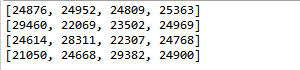
1.1.39
//exercise 1.1.39

package com.qiusongde;

import java.util.Arrays;

import edu.princeton.cs.algs4.StdOut;

import edu.princeton.cs.algs4.StdRandom;

public class RandomMatch {

    private static int[] geneSixDigitArray(int N)

    {

        int[] result = new int[N];

        for(int i = 0; i < N; i++)

        {

            result[i] = StdRandom.uniform(1000000);

        }

        return result;

    }

    public static int rank(int key, int[] a)

    {

        int lo = 0;

        int hi = a.length - 1;

        while(lo <= hi)

        {

            int mid = lo + (hi - lo) / 2;

            if(key < a[mid])

                hi = mid - 1;

            else if(key > a[mid])

                lo = mid + 1;

            else{

                return mid;

            }

        }

        return -1;

    }

    public static void main(String[] args) {

        int T = 40;

        int[] valueNs = {1000, 10000, 100000, 1000000};

        for(int i = 0; i < valueNs.length; i++)

        {//for each value of N

            double averagecommon = 0;

            for(int j = 0; j < T; j++)

            {//for every trial

                int commonnumber = 0;

                //generate two arrays of N values

                int[] testone = geneSixDigitArray(valueNs[i]);

                int[] testtwo = geneSixDigitArray(valueNs[i]);

                //sorting before search

                Arrays.sort(testtwo);

                //seraching

                for(int k = 0; k < testone.length; k++)

                {

                    if(rank(testone[k], testtwo) != -1)

                        commonnumber ++;

                }

                averagecommon += commonnumber;

            }

            //average number over the T trials

            averagecommon = averagecommon / (double)T;

            StdOut.printf("%d\t%f\n", valueNs[i], averagecommon);

        }

    }

}

1.1 BASIC PROGRAMMING MODEL(算法 Algorithms 第4版)的更多相关文章
- Algorithms 4th - 1.1 Basic Programming Model - CREATIVE PROBLEMS
欢迎交流 1.1.26 public class TestApp { public static void main(String[] args) { int a = StdIn.readInt(); ...
- Algorithms 4th - 1.1 Basic Programming Model - EXERCISES
欢迎交流 1.1.1 a. 7 b. 200.0000002 c. true 1.1.2 a. 1.618 b. 10.0 c. true d. 33 1.1.3 public class MainA ...
- 1.2 Data Abstraction(算法 Algorithms 第4版)
1.2.1 package com.qiusongde; import edu.princeton.cs.algs4.Point2D; import edu.princeton.cs.algs4.St ...
- Udacity并行计算课程笔记-The GPU Programming Model
一.传统的提高计算速度的方法 faster clocks (设置更快的时钟) more work over per clock cycle(每个时钟周期做更多的工作) more processors( ...
- 【Udacity并行计算课程笔记】- lesson 1 The GPU Programming Model
一.传统的提高计算速度的方法 faster clocks (设置更快的时钟) more work over per clock cycle(每个时钟周期做更多的工作) more processors( ...
- PatentTips - Heterogeneous Parallel Primitives Programming Model
BACKGROUND 1. Field of the Invention The present invention relates generally to a programming model ...
- .NET “底层”异步编程模式——异步编程模型(Asynchronous Programming Model,APM)
本文内容 异步编程类型 异步编程模型(APM) 参考资料 首先澄清,异步编程模式(Asynchronous Programming Patterns)与异步编程模型(Asynchronous Prog ...
- HttpWebRequest - Asynchronous Programming Model/Task.Factory.FromAsyc
Posted by Shiv Kumar on 23rd February, 2011 The Asynchronous Programming Model (or APM) has been aro ...
- Programming Model
上级:https://www.cnblogs.com/hackerxiaoyon/p/12747387.html Dataflow Programming Model 数据流的开发模型 Levels ...
随机推荐
- 选择一个 Python Web 框架:Django vs Flask vs Pyramid
Pyramid, Django, 和 Flask都是优秀的框架,为项目选择其中的哪一个都是伤脑筋的事.我们将会用三种框架实现相同功能的应用来更容易的对比三者.也可以直接跳到框架实战(Framework ...
- 几种Tab的实现方法
转载请注明出处,谢谢! 学了这久Android,今天来总结一下几种Tab的实现方法 实现方法一: ViewPage来实现 首先创建一个top.xml布局和一个bottom.xml布局,然后在主界面中通 ...
- ListView嵌套两个EditText相关显示问题
这里说明:本人第一次写博客,可能写的不算太好.可是这个相关类型的研究与拓展,是项目中比較难得的.所以开一篇博客来总结和思考.先让我们看看项目需求. 项目需求说明: 1.须要在点击EditText的时候 ...
- hibernate oneToMany 缓存
@OneToMany(mappedBy="carFieldType", cascade={CascadeType.ALL}, fetch = FetchType.EAGER)@Ca ...
- 【Python】删除字符串的空白
在程序中,额外的空白可能让人迷惑,对于程序员来说,'python'跟'python '看起来几乎一样,但是对于程序来说,可是千差万别 (lstrip)删除开头空白 >>> Langu ...
- Material Design Get Started
使用Material Design设计应用: Take a look at the material design specification. Apply the material theme to ...
- jQuery--基础(查询标签)
浅谈jQuery使用背景 jQuery是使用原生js写成的一个库,使用简单,提高开发效率.在用js冗杂的代码解决的问题中,大部分都可以用jQuery来快速解决. 例如: js中查询网页中ID为&quo ...
- 【BLE】CC2541之自己定义按键
本篇博文最后改动时间:2017年01月06日,11:06. 一.简单介绍 本文以SimpleBLEPeripheral为例.介绍怎样将普通IO口(P12)自己定义为按键. 注:本文加入按键方法不与协议 ...
- nginx could not build the server_names_hash 解决方法
nginx “nginx could not build the server_names_hash”解决方法 给一个服务器下增加了一些站点别名,差不多有20多个. 重启nginx时候,提示: cou ...
- golang中字符串的查找方法小结
1)func Contains(s, substr string) bool这个函数是查找某个字符是否在这个字符串中存在,存在返回true 示例如下: import ( "fmt" ...