
tensorflow零起点快速入门(2)
指定设备与矩阵乘法
使用tf.device("/gpu:0")用于指定设备进行运算。
在使用jupyter notebook的时候,可能会出现使用异常,需要使用config=tf.ConfigProto(allow_soft_placement=True)来处理。
该运行结果为12。属于叉乘。点乘使用另外的multiply。
config=tf.ConfigProto(allow_soft_placement=True)

with tf.Session(config=config) as sess:

    with tf.device("/gpu:0"):

        matrix1=tf.constant([[3,3]])

        matrix2=tf.constant([[2],[2]])

        product=tf.matmul(matrix1,matrix2)

        result=sess.run(product)

        print(result)
建立简单的张量流图计算
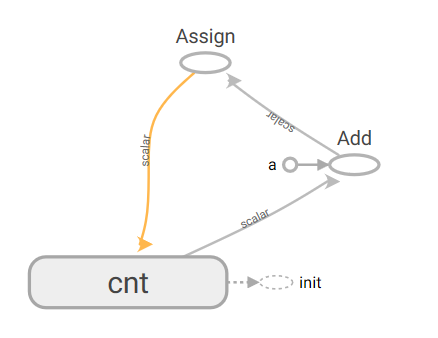
图为上述。cnt+a得到y,y通过assign赋值给cnt。
运行过程中,初始化变量后,通过每次运行assign,即完成了输出效果:1,2,3
config=tf.ConfigProto(allow_soft_placement=True)

cnt=tf.Variable(0,name="cnt")

a=tf.constant(1,name="a")

y=tf.add(cnt,a)

y2=tf.assign(cnt,y)

init=tf.initialize_all_variables()

with tf.Session(config=config) as ss:

    ss.run(init)

    xss=ss.run(cnt)

    for xc in range(3):

        ys2=ss.run(y2)

        print(ys2)

    xsum=tf.summary.FileWriter(".",ss.graph)
点乘数据
可以使用一维,二维,等进行点乘,只要数据对应即可。使用feed_dict进行数据输入。run后的返回值即为数据输出。
a=tf.placeholder(tf.float32,name='ta')

b=tf.placeholder(tf.float32,name='tb')

c=tf.multiply(a,b,name='tc')

config=tf.ConfigProto(allow_soft_placement=True)

init=tf.initialize_all_variables()

with tf.Session(config=config) as ss:

    ss.run(init)

    xss=ss.run([c],feed_dict={a:[7,2],b:[2,2]})

    print(xss)

    xsum=tf.summary.FileWriter(".",ss.graph)
也可写成如下形式:将变量分离出来定义。
a=tf.placeholder(tf.float32,name='ta')

b=tf.placeholder(tf.float32,name='tb')

c=tf.multiply(a,b,name='tc')

config=tf.ConfigProto(allow_soft_placement=True)

init=tf.initialize_all_variables()

a_data=[[1,2,3],[4,5,6]]

b_data=[[2,3,4],[5,6,7]]

with tf.Session(config=config) as ss:

    ss.run(init)

    xss=ss.run([c],feed_dict={a:a_data,b:b_data})

    print(xss)

    xsum=tf.summary.FileWriter(".",ss.graph)
run过程的一些写法
书写过程中,可以使用中括号,然后输出(本次输出为【7,21】)
a=tf.constant(3,name='ta')

b=tf.constant(2,name='tb')

c=tf.constant(5,name='tc')

m1=tf.add(b,c,name='m1')

m2=tf.multiply(a,m1,name='m2')

config=tf.ConfigProto(allow_soft_placement=True)

with tf.Session(config=config) as ss:

    xss=ss.run([m1,m2])

    print(xss)

    xsum=tf.summary.FileWriter(".",ss.graph)
也可以如下所代表的批量输出:
y2,w2,l2=ss.run(y),ss.run(w),ss.run(loss)
构建单神经元的神经网络
y=w*x
loss=(y-y_)^2
使用学习率为0.025的梯度下降,最小化loss。
定义完模型后,通过tf.summary.scalar控制tensorboard输出scalar数据图,显示数据的变化情况。
然后进行运算,最终的结果,通过saver=tf.train.Saver()的一些方法保存模型(训练后的模型)
w=tf.Variable(0.8,name='weight')

x=tf.constant(2.0,name='input')

y=tf.multiply(w,x,name='output')

y_=tf.constant(0.0,name='correct_value')

loss=tf.pow(y-y_,2,name='loss')

train_step=tf.train.GradientDescentOptimizer(0.025).minimize(loss)

with tf.name_scope('summar'):

    for value in [x,w,y,y_,loss]:

        tf.summary.scalar(value.op.name,value)

    #tf.summary.histogram('histogram',w)

    #tf.summary.histogram('loss',loss)

    summaries=tf.summary.merge_all()

config=tf.ConfigProto(allow_soft_placement=True)

init=tf.initialize_all_variables()

with tf.Session(config=config) as ss:

    xsum=tf.summary.FileWriter(".",ss.graph)

    xss=ss.run(init)

    for i in range(100):

        x_data=ss.run(summaries)

        xsum.add_summary(x_data,i)

        x_data=ss.run(train_step)

        y2,w2,l2=ss.run(y),ss.run(w),ss.run(loss)

        print(i,' ',y2,' ',w2,' ',l2,' ')

    saver=tf.train.Saver()

    saver.save(ss,'tmp/.')
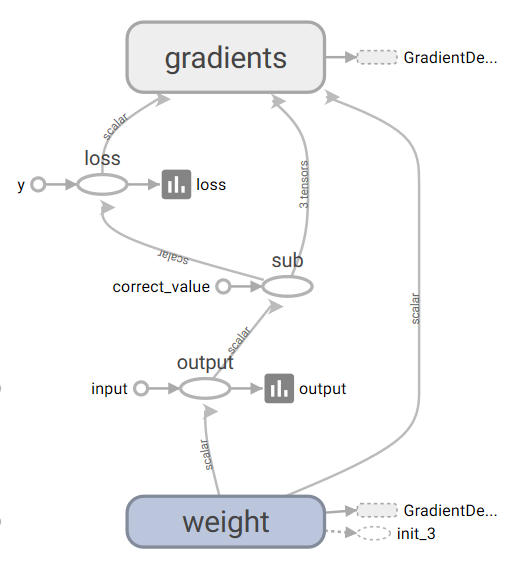

构建的张量图如上,点击其中的一些空心圆,可以查看其数值,操作,在gradient模块中,点开可以看到内部详细的结构。
通过上述代码,在summer中归并了一些scalar图如下:
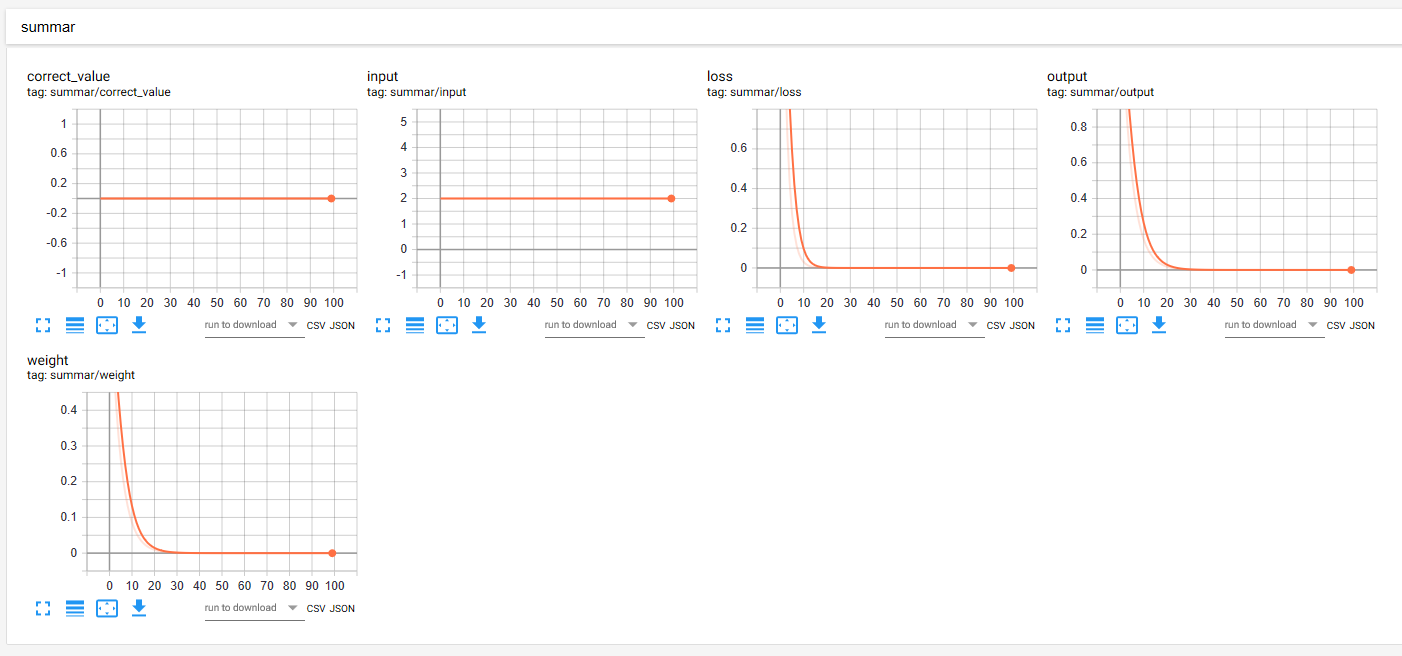
在迭代100次后,输出为:

模型保存读取
参阅:https://blog.csdn.net/Tan_HandSome/article/details/79303269
认为有两个文件保存,一个是meta文件保存模型,一个是checkpoint文件保存变量。至于其他文件的更新和变动还没有考虑。
下面一例:
使用w4=w3*b1
其中w3=w1+w2
实际保存的模型是这样,实际保存的变量,除掉placeholder占位符,只有b1=2一个值。
import tensorflow as tf

#Prepare to feed input, i.e. feed_dict and placeholders

w1 = tf.placeholder("float", name="w1")

w2 = tf.placeholder("float", name="w2")

b1= tf.Variable(2.0,name="bias")

feed_dict ={w1:4,w2:8}

#Define a test operation that we will restore

w3 = tf.add(w1,w2)

w4 = tf.multiply(w3,b1,name="op_to_restore")

sess = tf.Session()

sess.run(tf.global_variables_initializer())

#Create a saver object which will save all the variables

saver = tf.train.Saver()

#Run the operation by feeding input

print(sess.run(w4,feed_dict))

#Prints 24 which is sum of (w1+w2)*b1

#Now, save the graph

saver.save(sess, './save/my_test_model',global_step=1000)
另外开一个程序,运行如下:
因为b1保存了,所以这里占位符输入了13,17,然后计算的结果就是30*2了。
import tensorflow as tf

sess=tf.Session()

#First let's load meta graph and restore weights

saver = tf.train.import_meta_graph('my_test_model-1000.meta')

saver.restore(sess,tf.train.latest_checkpoint('./'))

# Now, let's access and create placeholders variables and

# create feed-dict to feed new data

graph = tf.get_default_graph()

w1 = graph.get_tensor_by_name("w1:0")

w2 = graph.get_tensor_by_name("w2:0")

feed_dict ={w1:13.0,w2:17.0}

#Now, access the op that you want to run.

op_to_restore = graph.get_tensor_by_name("op_to_restore:0")

print(sess.run(op_to_restore,feed_dict))

#This will print 60 which is calculated

#using new values of w1 and w2 and saved value of b1.
tensorflow零起点快速入门(2)的更多相关文章
- tensorflow零起点快速入门(3)
创造并运行数据 创造了-3到3的32条数据,然后通过sess.run获取并显示输出数据. x=tf.linspace(-3.0,3.0,32) print(x) sess=tf.Session() r ...
- tensorflow零起点快速入门(1)
导入: 其中的TF_CPP_MIN_LOG_LEVEL据说是为了忽略警告,但是我这里没有意义(numpy的一些警告) import tensorflow as tf import os os.envi ...
- tensorflow零起点快速入门(5) --强化学习摘录截图
tf.random_normal_initializer tf的GraphKeys用法 tf.reduce_mean tf.squared_difference 非tf中的zip,python的zip ...
- tensorflow零起点快速入门(4) --入门常用API
tf.reduce_mean https://blog.csdn.net/he_min/article/details/78694383 计算均值,全部数字的均值,纵向一维的均值,横向一维的均值 tf ...
- TensorFlow 2.0 快速入门指南 | iBooker·ApacheCN
原文:TensorFlow 2.0 Quick Start Guide 协议:CC BY-NC-SA 4.0 自豪地采用谷歌翻译 不要担心自己的形象,只关心如何实现目标.--<原则>,生活 ...
- 序言 - PHP零基础快速入门
我为什么要写<PHP零基础快速入门>? 原因: PHP 真心简单,适合零基础的人快速入门掌握,身边的人学习一两周上手开发的比比皆是: 市面上的文章或书籍对初学者并不友好,多半枯燥乏味,我相 ...
- 零基础快速入门web学习路线(含视频教程)
下面小编专门为广大web学习爱好者汇总了一条完整的自学线路:零基础快速入门web学习路线(含视频教程)(绝对纯干货)适合初学者的最新WEB前端学习路线汇总! 在当下来说web前端开发工程师可谓是高福利 ...
- 零基础快速入门SpringBoot2.0 (一)
零基础快速入门SpringBoot2.0 (一) 一.SpringBoot2.x依赖环境和版本新特性说明 简介:讲解新版本依赖环境和springboot2新特性概述 1.依赖版本jdk8以上, Spr ...
- 小D课堂 - 零基础入门SpringBoot2.X到实战_第1节零基础快速入门SpringBoot2.0_1、SpringBoot2.x课程介绍和高手系列知识点
1 ======================1.零基础快速入门SpringBoot2.0 5节课 =========================== 1.SpringBoot2.x课程全套介绍 ...
随机推荐
- pwn学习日记Day5 基础知识积累
知识杂项 int mprotect(const void *start, size_t len, int prot); mprotect()函数把自start开始的.长度为len的内存区的保护属性修改 ...
- 网站title,meta,description如何设置,长度大小多少合适!
转自:http://www.os1010.com/archives/1682 如 何 把 握 html 网 页 中 的 meta 标 签 对于高级的搜索引擎来说,html 的meta 标签并不是什么新 ...
- spring cloud之docker微服务客户端注册eureka问题
正常我们起一个微服务注册到eureka他的实例id是默认这样的主机名称:服务名称:服务端口号, 如果配置eureka.instance.prefer-ip-address=true则实例id为主机Ip ...
- Fluent Ribbon Control Suite和AvalonDock 控件库
Fluent Ribbon Control Suite 是一个Ribbon控件,可以用来创建Office 2010 样式的用户界面,支持MVVM,最近快要更新了,将会有Office 2013 样式的主 ...
- PLSQL连接本地oracle或远程oracle数据库,实现随意切换
转: PLSQL连接本地oracle或远程oracle数据库,实现随意切换 置顶 2018年01月12日 19:36:45 前方一片光明 阅读数 43542 版权声明:本文为博主原创文章,未经博主 ...
- powershell自动添加静态IP
声明:其中脚本有参考其他作者,由于当时参考仓促,未能把作者一一列出,有机会会再找出原作者文件链接并附上,请见谅 参考: https://ss64.com/nt/netsh.html https://w ...
- 使用Mock 测试 controller层
package action; import org.junit.Before;import org.junit.Test;import org.junit.runner.RunWith;import ...
- (转)Linux用户登录记录日志和相关查看命令汇总
原文地址:http://www.cnblogs.com/lizhaoxian/p/5981029.html # 1 utmp.wtmp.btmp文件 Linux用户登录信息放在三个文件中: 1 /va ...
- Image组件的使用
// 注意图片放置的目录问题 <Image source = {require('./img/logo.png')} style = {styles4.imageStyle}/> 注意要导 ...
- springboot-springmvc
0依赖 <!-- jsp --> <dependency> <groupId>org.apache.tomcat.embed</groupId> < ...