
c语言实行泛型hashmap
代码出处:A simple string hashmap in C https://github.com/petewarden/c_hashmap
main.c
(main2是官方源代码,main是博主写的代码,实现了String类型及Char类型的存取,看官可以根据以下代码触类旁通,限于博主的c语言
功底有限,此处的实现仅为poc代码,不保证严谨性以及稳定性,如果使用到生产环境请多斟酌,测试,如果你有更完善的代码分享,将感激不尽)
/*

* A unit test and example of how to use the simple C hashmap

*/

#include <stdlib.h>

#include <stdio.h>

#include <assert.h>

#include "hashmap.h"

#define KEY_MAX_LENGTH (256)

#define KEY_PREFIX ("somekey")

#define KEY_COUNT (1024*1024)

typedef struct data_struct_s

{

    char key_string[KEY_MAX_LENGTH];

    int number;

} data_struct_t;

typedef struct data_struct_String

{

    char key_string[KEY_MAX_LENGTH];

    char str[];

} ds_String;

typedef struct data_struct_Char

{

    char key_string[KEY_MAX_LENGTH];

    char ch;

}ds_Char;

void hashmap_putString(map_t *map, ds_String *string)

{

    hashmap_put(map, string->key_string, string);

}

void hashmap_getStringValue(map_t *map, char* key)

{

    ds_String *out;

    hashmap_get(map, key, (void**)(&out));

    printf("key:%s, value:%s\n", out->key_string, out->str);

}

void hashmap_putChar(map_t *map, ds_Char *ch)

{

    hashmap_put(map, ch->key_string, ch);

}

void hashmap_getCharValue(map_t *map, char* key)

{

    ds_Char *out;

    hashmap_get(map, key, (void**)(&out));

    printf("key:%s, value:%c\n", out->key_string, out->ch);

}

int main()

{

    map_t mymap;

    mymap = hashmap_new();

    ds_String *str;

    ds_Char *ch;

    str = malloc(sizeof(ds_String));

    ch = malloc(sizeof(ds_Char));

    //写入String值

    snprintf(str->key_string, KEY_MAX_LENGTH, "%s%d", "str", );

    strcpy(str->str, "hello World");

    hashmap_putString(mymap, str);

    hashmap_getStringValue(mymap, str->key_string);

    //写入Char

    ch->ch = 'A';

    snprintf(ch->key_string, KEY_COUNT, "%s%d", "ch", );

    hashmap_putChar(mymap, ch);

    hashmap_getCharValue(mymap, ch->key_string);

}

int main2(char* argv, int argc)

{

    int index;

    int error;

    map_t mymap;

    char key_string[KEY_MAX_LENGTH];

    data_struct_t* value;

    mymap = hashmap_new();

    /* First, populate the hash map with ascending values */

    for (index = ; index<KEY_COUNT; index += )

    {

        /* Store the key string along side the numerical value so we can free it later */

        value = malloc(sizeof(data_struct_t));

        snprintf(value->key_string, KEY_MAX_LENGTH, "%s%d", KEY_PREFIX, index);

        value->number = index;

        error = hashmap_put(mymap, value->key_string, value);

        assert(error == MAP_OK);

    }

    /* Now, check all of the expected values are there */

    for (index = ; index<KEY_COUNT; index += )

    {

        snprintf(key_string, KEY_MAX_LENGTH, "%s%d", KEY_PREFIX, index);

        error = hashmap_get(mymap, key_string, (void**)(&value));

        /* Make sure the value was both found and the correct number */

        assert(error == MAP_OK);

        assert(value->number == index);

    }

    /* Make sure that a value that wasn't in the map can't be found */

    snprintf(key_string, KEY_MAX_LENGTH, "%s%d", KEY_PREFIX, KEY_COUNT);

    error = hashmap_get(mymap, key_string, (void**)(&value));

    /* Make sure the value was not found */

    assert(error == MAP_MISSING);

    /* Free all of the values we allocated and remove them from the map */

    for (index = ; index<KEY_COUNT; index += )

    {

        snprintf(key_string, KEY_MAX_LENGTH, "%s%d", KEY_PREFIX, index);

        error = hashmap_get(mymap, key_string, (void**)(&value));

        assert(error == MAP_OK);

        error = hashmap_remove(mymap, key_string);

        assert(error == MAP_OK);

        free(value);

    }

    /* Now, destroy the map */

    hashmap_free(mymap);

    return ;

}
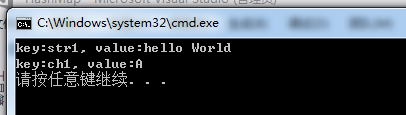
输出结果
hashmap.h
/*

 * Generic hashmap manipulation functions

 *

 * Originally by Elliot C Back - http://elliottback.com/wp/hashmap-implementation-in-c/

 *

 * Modified by Pete Warden to fix a serious performance problem, support strings as keys

 * and removed thread synchronization - http://petewarden.typepad.com

 */

#ifndef __HASHMAP_H__

#define __HASHMAP_H__

#define MAP_MISSING -3  /* No such element */

#define MAP_FULL -2     /* Hashmap is full */

#define MAP_OMEM -1     /* Out of Memory */

#define MAP_OK 0     /* OK */

/*

 * any_t is a pointer.  This allows you to put arbitrary structures in

 * the hashmap.

 */

typedef void *any_t;

/*

 * PFany is a pointer to a function that can take two any_t arguments

 * and return an integer. Returns status code..

 */

typedef int (*PFany)(any_t, any_t);

/*

 * map_t is a pointer to an internally maintained data structure.

 * Clients of this package do not need to know how hashmaps are

 * represented.  They see and manipulate only map_t's.

 */

typedef any_t map_t;

/*

 * Return an empty hashmap. Returns NULL if empty.

*/

extern map_t hashmap_new();

/*

 * Iteratively call f with argument (item, data) for

 * each element data in the hashmap. The function must

 * return a map status code. If it returns anything other

 * than MAP_OK the traversal is terminated. f must

 * not reenter any hashmap functions, or deadlock may arise.

 */

extern int hashmap_iterate(map_t in, PFany f, any_t item);

/*

 * Add an element to the hashmap. Return MAP_OK or MAP_OMEM.

 */

extern int hashmap_put(map_t in, char* key, any_t value);

/*

 * Get an element from the hashmap. Return MAP_OK or MAP_MISSING.

 */

extern int hashmap_get(map_t in, char* key, any_t *arg);

/*

 * Remove an element from the hashmap. Return MAP_OK or MAP_MISSING.

 */

extern int hashmap_remove(map_t in, char* key);

/*

 * Get any element. Return MAP_OK or MAP_MISSING.

 * remove - should the element be removed from the hashmap

 */

extern int hashmap_get_one(map_t in, any_t *arg, int remove);

/*

 * Free the hashmap

 */

extern void hashmap_free(map_t in);

/*

 * Get the current size of a hashmap

 */

extern int hashmap_length(map_t in);

#endif __HASHMAP_H__
hashmap.c
/*

 * Generic map implementation.

 */

#include "hashmap.h"

#include <stdlib.h>

#include <stdio.h>

#include <string.h>

#define INITIAL_SIZE (256)

#define MAX_CHAIN_LENGTH (8)

/* We need to keep keys and values */

typedef struct _hashmap_element{

    char* key;

    int in_use;

    any_t data;

} hashmap_element;

/* A hashmap has some maximum size and current size,

 * as well as the data to hold. */

typedef struct _hashmap_map{

    int table_size;

    int size;

    hashmap_element *data;

} hashmap_map;

/*

 * Return an empty hashmap, or NULL on failure.

 */

map_t hashmap_new() {

    hashmap_map* m = (hashmap_map*) malloc(sizeof(hashmap_map));

    if(!m) goto err;

    m->data = (hashmap_element*) calloc(INITIAL_SIZE, sizeof(hashmap_element));

    if(!m->data) goto err;

    m->table_size = INITIAL_SIZE;

    m->size = ;

    return m;

    err:

        if (m)

            hashmap_free(m);

        return NULL;

}

/* The implementation here was originally done by Gary S. Brown.  I have

   borrowed the tables directly, and made some minor changes to the

   crc32-function (including changing the interface). //ylo */

  /* ============================================================= */

  /*  COPYRIGHT (C) 1986 Gary S. Brown.  You may use this program, or       */

  /*  code or tables extracted from it, as desired without restriction.     */

  /*                                                                        */

  /*  First, the polynomial itself and its table of feedback terms.  The    */

  /*  polynomial is                                                         */

  /*  X^32+X^26+X^23+X^22+X^16+X^12+X^11+X^10+X^8+X^7+X^5+X^4+X^2+X^1+X^0   */

  /*                                                                        */

  /*  Note that we take it "backwards" and put the highest-order term in    */

  /*  the lowest-order bit.  The X^32 term is "implied"; the LSB is the     */

  /*  X^31 term, etc.  The X^0 term (usually shown as "+1") results in      */

  /*  the MSB being 1.                                                      */

  /*                                                                        */

  /*  Note that the usual hardware shift register implementation, which     */

  /*  is what we're using (we're merely optimizing it by doing eight-bit    */

  /*  chunks at a time) shifts bits into the lowest-order term.  In our     */

  /*  implementation, that means shifting towards the right.  Why do we     */

  /*  do it this way?  Because the calculated CRC must be transmitted in    */

  /*  order from highest-order term to lowest-order term.  UARTs transmit   */

  /*  characters in order from LSB to MSB.  By storing the CRC this way,    */

  /*  we hand it to the UART in the order low-byte to high-byte; the UART   */

  /*  sends each low-bit to hight-bit; and the result is transmission bit   */

  /*  by bit from highest- to lowest-order term without requiring any bit   */

  /*  shuffling on our part.  Reception works similarly.                    */

  /*                                                                        */

  /*  The feedback terms table consists of 256, 32-bit entries.  Notes:     */

  /*                                                                        */

  /*      The table can be generated at runtime if desired; code to do so   */

  /*      is shown later.  It might not be obvious, but the feedback        */

  /*      terms simply represent the results of eight shift/xor opera-      */

  /*      tions for all combinations of data and CRC register values.       */

  /*                                                                        */

  /*      The values must be right-shifted by eight bits by the "updcrc"    */

  /*      logic; the shift must be unsigned (bring in zeroes).  On some     */

  /*      hardware you could probably optimize the shift in assembler by    */

  /*      using byte-swap instructions.                                     */

  /*      polynomial $edb88320                                              */

  /*                                                                        */

  /*  --------------------------------------------------------------------  */

static unsigned long crc32_tab[] = {

      0x00000000L, 0x77073096L, 0xee0e612cL, 0x990951baL, 0x076dc419L,

      0x706af48fL, 0xe963a535L, 0x9e6495a3L, 0x0edb8832L, 0x79dcb8a4L,

      0xe0d5e91eL, 0x97d2d988L, 0x09b64c2bL, 0x7eb17cbdL, 0xe7b82d07L,

      0x90bf1d91L, 0x1db71064L, 0x6ab020f2L, 0xf3b97148L, 0x84be41deL,

      0x1adad47dL, 0x6ddde4ebL, 0xf4d4b551L, 0x83d385c7L, 0x136c9856L,

      0x646ba8c0L, 0xfd62f97aL, 0x8a65c9ecL, 0x14015c4fL, 0x63066cd9L,

      0xfa0f3d63L, 0x8d080df5L, 0x3b6e20c8L, 0x4c69105eL, 0xd56041e4L,

      0xa2677172L, 0x3c03e4d1L, 0x4b04d447L, 0xd20d85fdL, 0xa50ab56bL,

      0x35b5a8faL, 0x42b2986cL, 0xdbbbc9d6L, 0xacbcf940L, 0x32d86ce3L,

      0x45df5c75L, 0xdcd60dcfL, 0xabd13d59L, 0x26d930acL, 0x51de003aL,

      0xc8d75180L, 0xbfd06116L, 0x21b4f4b5L, 0x56b3c423L, 0xcfba9599L,

      0xb8bda50fL, 0x2802b89eL, 0x5f058808L, 0xc60cd9b2L, 0xb10be924L,

      0x2f6f7c87L, 0x58684c11L, 0xc1611dabL, 0xb6662d3dL, 0x76dc4190L,

      0x01db7106L, 0x98d220bcL, 0xefd5102aL, 0x71b18589L, 0x06b6b51fL,

      0x9fbfe4a5L, 0xe8b8d433L, 0x7807c9a2L, 0x0f00f934L, 0x9609a88eL,

      0xe10e9818L, 0x7f6a0dbbL, 0x086d3d2dL, 0x91646c97L, 0xe6635c01L,

      0x6b6b51f4L, 0x1c6c6162L, 0x856530d8L, 0xf262004eL, 0x6c0695edL,

      0x1b01a57bL, 0x8208f4c1L, 0xf50fc457L, 0x65b0d9c6L, 0x12b7e950L,

      0x8bbeb8eaL, 0xfcb9887cL, 0x62dd1ddfL, 0x15da2d49L, 0x8cd37cf3L,

      0xfbd44c65L, 0x4db26158L, 0x3ab551ceL, 0xa3bc0074L, 0xd4bb30e2L,

      0x4adfa541L, 0x3dd895d7L, 0xa4d1c46dL, 0xd3d6f4fbL, 0x4369e96aL,

      0x346ed9fcL, 0xad678846L, 0xda60b8d0L, 0x44042d73L, 0x33031de5L,

      0xaa0a4c5fL, 0xdd0d7cc9L, 0x5005713cL, 0x270241aaL, 0xbe0b1010L,

      0xc90c2086L, 0x5768b525L, 0x206f85b3L, 0xb966d409L, 0xce61e49fL,

      0x5edef90eL, 0x29d9c998L, 0xb0d09822L, 0xc7d7a8b4L, 0x59b33d17L,

      0x2eb40d81L, 0xb7bd5c3bL, 0xc0ba6cadL, 0xedb88320L, 0x9abfb3b6L,

      0x03b6e20cL, 0x74b1d29aL, 0xead54739L, 0x9dd277afL, 0x04db2615L,

      0x73dc1683L, 0xe3630b12L, 0x94643b84L, 0x0d6d6a3eL, 0x7a6a5aa8L,

      0xe40ecf0bL, 0x9309ff9dL, 0x0a00ae27L, 0x7d079eb1L, 0xf00f9344L,

      0x8708a3d2L, 0x1e01f268L, 0x6906c2feL, 0xf762575dL, 0x806567cbL,

      0x196c3671L, 0x6e6b06e7L, 0xfed41b76L, 0x89d32be0L, 0x10da7a5aL,

      0x67dd4accL, 0xf9b9df6fL, 0x8ebeeff9L, 0x17b7be43L, 0x60b08ed5L,

      0xd6d6a3e8L, 0xa1d1937eL, 0x38d8c2c4L, 0x4fdff252L, 0xd1bb67f1L,

      0xa6bc5767L, 0x3fb506ddL, 0x48b2364bL, 0xd80d2bdaL, 0xaf0a1b4cL,

      0x36034af6L, 0x41047a60L, 0xdf60efc3L, 0xa867df55L, 0x316e8eefL,

      0x4669be79L, 0xcb61b38cL, 0xbc66831aL, 0x256fd2a0L, 0x5268e236L,

      0xcc0c7795L, 0xbb0b4703L, 0x220216b9L, 0x5505262fL, 0xc5ba3bbeL,

      0xb2bd0b28L, 0x2bb45a92L, 0x5cb36a04L, 0xc2d7ffa7L, 0xb5d0cf31L,

      0x2cd99e8bL, 0x5bdeae1dL, 0x9b64c2b0L, 0xec63f226L, 0x756aa39cL,

      0x026d930aL, 0x9c0906a9L, 0xeb0e363fL, 0x72076785L, 0x05005713L,

      0x95bf4a82L, 0xe2b87a14L, 0x7bb12baeL, 0x0cb61b38L, 0x92d28e9bL,

      0xe5d5be0dL, 0x7cdcefb7L, 0x0bdbdf21L, 0x86d3d2d4L, 0xf1d4e242L,

      0x68ddb3f8L, 0x1fda836eL, 0x81be16cdL, 0xf6b9265bL, 0x6fb077e1L,

      0x18b74777L, 0x88085ae6L, 0xff0f6a70L, 0x66063bcaL, 0x11010b5cL,

      0x8f659effL, 0xf862ae69L, 0x616bffd3L, 0x166ccf45L, 0xa00ae278L,

      0xd70dd2eeL, 0x4e048354L, 0x3903b3c2L, 0xa7672661L, 0xd06016f7L,

      0x4969474dL, 0x3e6e77dbL, 0xaed16a4aL, 0xd9d65adcL, 0x40df0b66L,

      0x37d83bf0L, 0xa9bcae53L, 0xdebb9ec5L, 0x47b2cf7fL, 0x30b5ffe9L,

      0xbdbdf21cL, 0xcabac28aL, 0x53b39330L, 0x24b4a3a6L, 0xbad03605L,

      0xcdd70693L, 0x54de5729L, 0x23d967bfL, 0xb3667a2eL, 0xc4614ab8L,

      0x5d681b02L, 0x2a6f2b94L, 0xb40bbe37L, 0xc30c8ea1L, 0x5a05df1bL,

      0x2d02ef8dL

   };

/* Return a 32-bit CRC of the contents of the buffer. */

unsigned long crc32(const unsigned char *s, unsigned int len)

{

  unsigned int i;

  unsigned long crc32val;

  crc32val = ;

  for (i = ;  i < len;  i ++)

    {

      crc32val =

    crc32_tab[(crc32val ^ s[i]) & 0xff] ^

      (crc32val >> );

    }

  return crc32val;

}

/*

 * Hashing function for a string

 */

unsigned int hashmap_hash_int(hashmap_map * m, char* keystring){

    unsigned long key = crc32((unsigned char*)(keystring), strlen(keystring));

    /* Robert Jenkins' 32 bit Mix Function */

    key += (key << );

    key ^= (key >> );

    key += (key << );

    key ^= (key >> );

    key += (key << );

    key ^= (key >> );

    key += (key << );

    key ^= (key >> );

    /* Knuth's Multiplicative Method */

    key = (key >> ) * ;

    return key % m->table_size;

}

/*

 * Return the integer of the location in data

 * to store the point to the item, or MAP_FULL.

 */

int hashmap_hash(map_t in, char* key){

    int curr;

    int i;

    /* Cast the hashmap */

    hashmap_map* m = (hashmap_map *) in;

    /* If full, return immediately */

    if(m->size >= (m->table_size/)) return MAP_FULL;

    /* Find the best index */

    curr = hashmap_hash_int(m, key);

    /* Linear probing */

    for(i = ; i< MAX_CHAIN_LENGTH; i++){

        if(m->data[curr].in_use == )

            return curr;

        if(m->data[curr].in_use ==  && (strcmp(m->data[curr].key,key)==))

            return curr;

        curr = (curr + ) % m->table_size;

    }

    return MAP_FULL;

}

/*

 * Doubles the size of the hashmap, and rehashes all the elements

 */

int hashmap_rehash(map_t in){

    int i;

    int old_size;

    hashmap_element* curr;

    /* Setup the new elements */

    hashmap_map *m = (hashmap_map *) in;

    hashmap_element* temp = (hashmap_element *)

        calloc( * m->table_size, sizeof(hashmap_element));

    if(!temp) return MAP_OMEM;

    /* Update the array */

    curr = m->data;

    m->data = temp;

    /* Update the size */

    old_size = m->table_size;

    m->table_size =  * m->table_size;

    m->size = ;

    /* Rehash the elements */

    for(i = ; i < old_size; i++){

        int status;

        if (curr[i].in_use == )

            continue;

        status = hashmap_put(m, curr[i].key, curr[i].data);

        if (status != MAP_OK)

            return status;

    }

    free(curr);

    return MAP_OK;

}

/*

 * Add a pointer to the hashmap with some key

 */

int hashmap_put(map_t in, char* key, any_t value){

    int index;

    hashmap_map* m;

    /* Cast the hashmap */

    m = (hashmap_map *) in;

    /* Find a place to put our value */

    index = hashmap_hash(in, key);

    while(index == MAP_FULL){

        if (hashmap_rehash(in) == MAP_OMEM) {

            return MAP_OMEM;

        }

        index = hashmap_hash(in, key);

    }

    /* Set the data */

    m->data[index].data = value;

    m->data[index].key = key;

    m->data[index].in_use = ;

    m->size++;

    return MAP_OK;

}

/*

 * Get your pointer out of the hashmap with a key

 */

int hashmap_get(map_t in, char* key, any_t *arg){

    int curr;

    int i;

    hashmap_map* m;

    /* Cast the hashmap */

    m = (hashmap_map *) in;

    /* Find data location */

    curr = hashmap_hash_int(m, key);

    /* Linear probing, if necessary */

    for(i = ; i<MAX_CHAIN_LENGTH; i++){

        int in_use = m->data[curr].in_use;

        if (in_use == ){

            if (strcmp(m->data[curr].key,key)==){

                *arg = (m->data[curr].data);

                return MAP_OK;

            }

        }

        curr = (curr + ) % m->table_size;

    }

    *arg = NULL;

    /* Not found */

    return MAP_MISSING;

}

/*

 * Iterate the function parameter over each element in the hashmap.  The

 * additional any_t argument is passed to the function as its first

 * argument and the hashmap element is the second.

 */

int hashmap_iterate(map_t in, PFany f, any_t item) {

    int i;

    /* Cast the hashmap */

    hashmap_map* m = (hashmap_map*) in;

    /* On empty hashmap, return immediately */

    if (hashmap_length(m) <= )

        return MAP_MISSING;

    /* Linear probing */

    for(i = ; i< m->table_size; i++)

        if(m->data[i].in_use != ) {

            any_t data = (any_t) (m->data[i].data);

            int status = f(item, data);

            if (status != MAP_OK) {

                return status;

            }

        }

    return MAP_OK;

}

/*

 * Remove an element with that key from the map

 */

int hashmap_remove(map_t in, char* key){

    int i;

    int curr;

    hashmap_map* m;

    /* Cast the hashmap */

    m = (hashmap_map *) in;

    /* Find key */

    curr = hashmap_hash_int(m, key);

    /* Linear probing, if necessary */

    for(i = ; i<MAX_CHAIN_LENGTH; i++){

        int in_use = m->data[curr].in_use;

        if (in_use == ){

            if (strcmp(m->data[curr].key,key)==){

                /* Blank out the fields */

                m->data[curr].in_use = ;

                m->data[curr].data = NULL;

                m->data[curr].key = NULL;

                /* Reduce the size */

                m->size--;

                return MAP_OK;

            }

        }

        curr = (curr + ) % m->table_size;

    }

    /* Data not found */

    return MAP_MISSING;

}

/* Deallocate the hashmap */

void hashmap_free(map_t in){

    hashmap_map* m = (hashmap_map*) in;

    free(m->data);

    free(m);

}

/* Return the length of the hashmap */

int hashmap_length(map_t in){

    hashmap_map* m = (hashmap_map *) in;

    if(m != NULL) return m->size;

    else return ;

}
c语言实行泛型hashmap的更多相关文章
- C++应该被看成是个语言集合——四种语言(C语言,OO语言,泛型语言,STL)
至少有三种语言: 一,C++ is C 二,C++ is an OO language 三,C++ is a genetic programming language 有的童鞋觉得难,可能是没有看清楚 ...
- C语言泛型编程——泛型冒泡排序
在实际编程中,常常会需要一些方法(函数),比如排序,它们具体实现基本一致,仅仅只有参数类型不同, 那么可不可以有一种通用的函数,不管是什么类型的参数都可以通用呢? 泛型编程:泛型即是指具有在多种数据类 ...
- Java泛型的历史
为什么Java泛型会有当前的缺陷? 之前的章节里已经说明了Java泛型擦除会导致的问题,C++和C#的泛型都是在运行时存在的,难道Java天然不支持“真正的泛型”吗? 事实上,在Java1.5在200 ...
- Java泛型
什么是泛型? 泛型(Generic type 或者 generics)是对 Java 语言的类型系统的一种扩展,以支持创建可以按类型进行参数化的类.可以把类型参数看作是使用参数化类型时指定的类型的一个 ...
- Java泛型总结
1. 什么是泛型?泛型(Generic type 或者 generics)是对 Java 语言的类型系统的一种扩展,以支持创建可以按类型进行参数化的类.可以把类型参数看作是使用参数化类型时指定的类型的 ...
- Java泛型的好处
java 泛型是java SE 1.5的新特性,泛型的本质是参数化类型,也就是说所操作的数据类型被指定为一个参数.这种参数类型可以用在类.接口和方法的创建中,分别称为泛型类.泛型接口.泛型方法. ...
- java泛型的讲解
java泛型 什么是泛型? 泛型(Generic type 或者 generics)是对 Java 语言的类型系统的一种扩展,以支持创建可以按类型进行参数化的类.可以把类型参数看作是使用参数化类型时指 ...
- java中的泛型(转)
什么是泛型? 泛型(Generic type 或者 generics)是对 Java 语言的类型系统的一种扩展,以支持创建可以按类型进行参数化的类.可以把类型参数看作是使用参数化类型时指定的类型的一个 ...
- java泛型【收藏】
什么是泛型? 泛型(Generic type 或者 generics)是对 Java 语言的类型系统的一种扩展,以支持创建可以按类型进行参数化的类.可以把类型参数看作是使用参数化类型时指定的类型的一个 ...
随机推荐
- 01 数据库sql
1, 关于mysql,常去的地方有:https://www.yiibai.com/mysql, http://tool.oschina.net/apidocs/apidoc?api=mysql-5.1 ...
- shell 入门及常用命令
1.shell 是什么 shell是指一种程序, 它是和linux沟通的桥梁, 这个应用程序提供了一个界面,用户通过这个界面访问操作系统内核的服务, Ken Thompson 的 sh 是第一种 Un ...
- Educational Codeforces Round 37 (Rated for Div. 2)C. Swap Adjacent Elements (思维,前缀和)
Educational Codeforces Round 37 (Rated for Div. 2)C. Swap Adjacent Elements time limit per test 1 se ...
- kotlin函数加强
在之前已经接触过了kotlin的函数了,这里再次加强学习下它,下面开始吧! Kotlin函数编写规则: 对照函数来理解其写法: 演练巩固: ①.编写函数, 实现四则运算. 接着来实现其它三个运算: 然 ...
- LocalDateTime、LocalDate、Long、Date、String 相互转换
DateTimeFormatter dateTimeFormatter1 = DateTimeFormatter.ofPattern("yyyy-MM-dd HH:mm:ss"); ...
- JavaScript教程——数据类型概述
简介 JavaScript 语言的每一个值,都属于某一种数据类型.JavaScript 的数据类型,共有六种.(ES6 又新增了第七种 Symbol 类型的值,本教程不涉及.) 数值(number): ...
- python之抽象类&abc模块+虚拟子类®ister
抽象类和接口: java 我们先从java讲起,没有java基础的可以略过. (挖坑) python 在python并没有抽象类之说,或者说抽象类=接口类(区别于接口) 继承有两种用途: 一:继承基类 ...
- django session 加密cookie型
a. 配置 settings.py SESSION_ENGINE = 'django.contrib.sessions.backends.signed_cookies' # 引 ...
- ibatis调用存储过程(无返回参数)
ibatis调用存储过程例子: java: getSqlMapClientTemplate().insert(sql, paraMap) ibatis xml: <parameterMap id ...
- mysql数据库系统学习(一)---一条SQL查询语句是如何执行的?
本文基于----MySQL实战45讲(极客时间----林晓斌 )整理----->https://time.geekbang.org/column/article/68319 一.第一节:一条sq ...