
【面试专栏】JAVA CAS(Conmpare And Swap)原理
1. CAS简介
在计算机科学中,比较和交换(Conmpare And Swap)是用于实现多线程同步的原子指令。它将内存位置的内容与给定值进行比较,只有在相同的情况下,将该内存位置的内容修改为新的给定值。这是作为单个原子操作完成的。
原子性保证新值基于最新信息计算;如果该值在同一时间被另一个线程更新,则写入将失败。操作结果必须说明是否进行替换;这可以通过一个简单的布尔响应(这个变体通常称为比较和设置),或通过返回从内存位置读取的值来完成。
查看JUC(java.util.concurrent)下的atomic包:
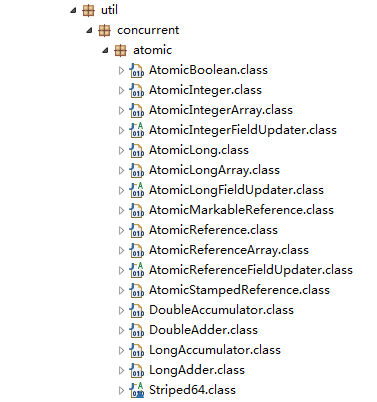
2. CAS在Java中的应用
以AtomicInteger为例:
package java.util.concurrent.atomic;

import java.util.function.IntUnaryOperator;

import java.util.function.IntBinaryOperator;

import sun.misc.Unsafe;

/**

 * An {@code int} value that may be updated atomically.  See the

 * {@link java.util.concurrent.atomic} package specification for

 * description of the properties of atomic variables. An

 * {@code AtomicInteger} is used in applications such as atomically

 * incremented counters, and cannot be used as a replacement for an

 * {@link java.lang.Integer}. However, this class does extend

 * {@code Number} to allow uniform access by tools and utilities that

 * deal with numerically-based classes.

 *

 * @since 1.5

 * @author Doug Lea

*/

public class AtomicInteger extends Number implements java.io.Serializable {

    private static final long serialVersionUID = 6214790243416807050L;

    // setup to use Unsafe.compareAndSwapInt for updates

    private static final Unsafe unsafe = Unsafe.getUnsafe();

    private static final long valueOffset;

    static {

        try {

            valueOffset = unsafe.objectFieldOffset

                (AtomicInteger.class.getDeclaredField("value"));

        } catch (Exception ex) { throw new Error(ex); }

    }

    private volatile int value;

    /**

     * Creates a new AtomicInteger with the given initial value.

     *

     * @param initialValue the initial value

     */

    public AtomicInteger(int initialValue) {

        value = initialValue;

    }

    /**

     * Creates a new AtomicInteger with initial value {@code 0}.

     */

    public AtomicInteger() {

    }

    /**

     * Gets the current value.

     *

     * @return the current value

     */

    public final int get() {

        return value;

    }

    /**

     * Sets to the given value.

     *

     * @param newValue the new value

     */

    public final void set(int newValue) {

        value = newValue;

    }

    /**

     * Eventually sets to the given value.

     *

     * @param newValue the new value

     * @since 1.6

     */

    public final void lazySet(int newValue) {

        unsafe.putOrderedInt(this, valueOffset, newValue);

    }

    /**

     * Atomically sets to the given value and returns the old value.

     *

     * @param newValue the new value

     * @return the previous value

     */

    public final int getAndSet(int newValue) {

        return unsafe.getAndSetInt(this, valueOffset, newValue);

    }

    /**

     * Atomically sets the value to the given updated value

     * if the current value {@code ==} the expected value.

     *

     * @param expect the expected value

     * @param update the new value

     * @return {@code true} if successful. False return indicates that

     * the actual value was not equal to the expected value.

     */

    public final boolean compareAndSet(int expect, int update) {

        return unsafe.compareAndSwapInt(this, valueOffset, expect, update);

    }

    /**

     * Atomically sets the value to the given updated value

     * if the current value {@code ==} the expected value.

     *

     * <p><a href="package-summary.html#weakCompareAndSet">May fail

     * spuriously and does not provide ordering guarantees</a>, so is

     * only rarely an appropriate alternative to {@code compareAndSet}.

     *

     * @param expect the expected value

     * @param update the new value

     * @return {@code true} if successful

     */

    public final boolean weakCompareAndSet(int expect, int update) {

        return unsafe.compareAndSwapInt(this, valueOffset, expect, update);

    }

    /**

     * Atomically increments by one the current value.

     *

     * @return the previous value

     */

    public final int getAndIncrement() {

        return unsafe.getAndAddInt(this, valueOffset, 1);

    }

    /**

     * Atomically decrements by one the current value.

     *

     * @return the previous value

     */

    public final int getAndDecrement() {

        return unsafe.getAndAddInt(this, valueOffset, -1);

    }

    /**

     * Atomically adds the given value to the current value.

     *

     * @param delta the value to add

     * @return the previous value

     */

    public final int getAndAdd(int delta) {

        return unsafe.getAndAddInt(this, valueOffset, delta);

    }

    /**

     * Atomically increments by one the current value.

     *

     * @return the updated value

     */

    public final int incrementAndGet() {

        return unsafe.getAndAddInt(this, valueOffset, 1) + 1;

    }

    /**

     * Atomically decrements by one the current value.

     *

     * @return the updated value

     */

    public final int decrementAndGet() {

        return unsafe.getAndAddInt(this, valueOffset, -1) - 1;

    }

    /**

     * Atomically adds the given value to the current value.

     *

     * @param delta the value to add

     * @return the updated value

     */

    public final int addAndGet(int delta) {

        return unsafe.getAndAddInt(this, valueOffset, delta) + delta;

    }

    /**

     * Atomically updates the current value with the results of

     * applying the given function, returning the previous value. The

     * function should be side-effect-free, since it may be re-applied

     * when attempted updates fail due to contention among threads.

     *

     * @param updateFunction a side-effect-free function

     * @return the previous value

     * @since 1.8

     */

    public final int getAndUpdate(IntUnaryOperator updateFunction) {

        int prev, next;

        do {

            prev = get();

            next = updateFunction.applyAsInt(prev);

        } while (!compareAndSet(prev, next));

        return prev;

    }

    /**

     * Atomically updates the current value with the results of

     * applying the given function, returning the updated value. The

     * function should be side-effect-free, since it may be re-applied

     * when attempted updates fail due to contention among threads.

     *

     * @param updateFunction a side-effect-free function

     * @return the updated value

     * @since 1.8

     */

    public final int updateAndGet(IntUnaryOperator updateFunction) {

        int prev, next;

        do {

            prev = get();

            next = updateFunction.applyAsInt(prev);

        } while (!compareAndSet(prev, next));

        return next;

    }

    /**

     * Atomically updates the current value with the results of

     * applying the given function to the current and given values,

     * returning the previous value. The function should be

     * side-effect-free, since it may be re-applied when attempted

     * updates fail due to contention among threads.  The function

     * is applied with the current value as its first argument,

     * and the given update as the second argument.

     *

     * @param x the update value

     * @param accumulatorFunction a side-effect-free function of two arguments

     * @return the previous value

     * @since 1.8

     */

    public final int getAndAccumulate(int x,

                                      IntBinaryOperator accumulatorFunction) {

        int prev, next;

        do {

            prev = get();

            next = accumulatorFunction.applyAsInt(prev, x);

        } while (!compareAndSet(prev, next));

        return prev;

    }

    /**

     * Atomically updates the current value with the results of

     * applying the given function to the current and given values,

     * returning the updated value. The function should be

     * side-effect-free, since it may be re-applied when attempted

     * updates fail due to contention among threads.  The function

     * is applied with the current value as its first argument,

     * and the given update as the second argument.

     *

     * @param x the update value

     * @param accumulatorFunction a side-effect-free function of two arguments

     * @return the updated value

     * @since 1.8

     */

    public final int accumulateAndGet(int x,

                                      IntBinaryOperator accumulatorFunction) {

        int prev, next;

        do {

            prev = get();

            next = accumulatorFunction.applyAsInt(prev, x);

        } while (!compareAndSet(prev, next));

        return next;

    }

    //......

}
可以看出自JDK1.5就开始引入CAS来解决多线程中的并发问题。
查看方法源码,可以看出所有的CAS操作都是通过sun.misc包下Unsafe类实现的。而sun.misc包存在于JDK的rt.jar包,是由JVM本地实现。
Unsafe是CAS的核心类。由于Java无法直接访问底层系统,则需要通过本地(native)来访问。Unsafe可以直接操作特定内存的数,其内部方法可以像C语言的指针一样直接操作内存。
注意:Unsafe类的所有方法都是native修饰的,即Unsafe类的所有方法都可以直接调用底层操作系统资源。
3. CAS在JUC中的应用
以重入锁ReentrantLock为例。通过查看部分源码:
public class ReentrantLock implements Lock, java.io.Serializable {

    private static final long serialVersionUID = 7373984872572414699L;

    /** Synchronizer providing all implementation mechanics */

    private final Sync sync;

    /**

     * Base of synchronization control for this lock. Subclassed

     * into fair and nonfair versions below. Uses AQS state to

     * represent the number of holds on the lock.

     */

    abstract static class Sync extends AbstractQueuedSynchronizer {

        private static final long serialVersionUID = -5179523762034025860L;

        /**

         * Performs {@link Lock#lock}. The main reason for subclassing

         * is to allow fast path for nonfair version.

         */

        abstract void lock();

        /**

         * Performs non-fair tryLock.  tryAcquire is implemented in

         * subclasses, but both need nonfair try for trylock method.

         */

        final boolean nonfairTryAcquire(int acquires) {

            final Thread current = Thread.currentThread();

            int c = getState();

            if (c == 0) {

                if (compareAndSetState(0, acquires)) {

                    setExclusiveOwnerThread(current);

                    return true;

                }

            }

            else if (current == getExclusiveOwnerThread()) {

                int nextc = c + acquires;

                if (nextc < 0) // overflow

                    throw new Error("Maximum lock count exceeded");

                setState(nextc);

                return true;

            }

            return false;

        }

        //......

    }

    //......

}
可以看出,内部抽象类Sync继承自AbstractQueuedSynchronizer类。AbstractQueuedSynchronizer作为Java多种锁的父类,有很多地方通过CAS操作来提高并发效率。查看AbstractQueuedSynchronizer部分源码:
/**

 * Inserts node into queue, initializing if necessary. See picture above.

 * @param node the node to insert

 * @return node's predecessor

 */

private Node enq(final Node node) {

    for (;;) {

        Node t = tail;

        if (t == null) { // Must initialize

            if (compareAndSetHead(new Node()))

                tail = head;

        } else {

            node.prev = t;

            if (compareAndSetTail(t, node)) {

                t.next = node;

                return t;

            }

        }

    }

}
可以看出在上述的同步队列的入队操作时,在多线程环境下,对其头尾节点的操作都有可能失败,失败后通过自旋操作再次尝试,直到成功,这也是一种乐观锁的实现。
4. CAS缺点
- 循环时间长,CPU开销大
- 只能保证一个共享变量的原子操作
- 引出ABA问题
5. ABA问题
比如说一个线程1从内存位置V中取出A,另一个线程2也从内存中取出A,线程2将A变成了B,然后将V位置的数据变成A,这时候线程1进行CAS操作发现内存中仍然是A,那么线程1操作成功。尽管线程1的CAS操作成功,但是不代表这个过程就是没有问题的。
如果链表的头在变化了两次后恢复了原值,但是不代表链表就没有变化。
所以JAVA中提供了AtomicStampedReference或AtomicMarkableReference来处理ABA问题,主要是在对象中额外再增加一个标记来标识对象是否有过变更。
【面试专栏】JAVA CAS(Conmpare And Swap)原理的更多相关文章
- 浅谈CAS(Compare and Swap) 原理
浅谈CAS原理java并发编程也研究了一段时间了,对CAS的原理总是不太理解,今天再研究了一下,记录一些自己的理解. 说到CAS,再java中的某些情况下,甚至jdk1.5以后的大多数情况,并发 ...
- 【面试专栏】JAVA锁机制
1. 悲观锁 / 乐观锁 在Java和数据库中都存在悲观锁和乐观锁的应用.Mysql锁机制中的悲观锁和乐观锁请查看: Mysql锁机制--悲观锁和乐观锁 悲观锁:在获得数据时先加锁,只到数 ...
- JAVA CAS原理深度分析-转载
参考文档: http://www.blogjava.net/xylz/archive/2010/07/04/325206.html http://blog.hesey.net/2011/09/reso ...
- JAVA CAS原理
转自: http://blog.csdn.net/hsuxu/article/details/9467651 CAS CAS: Compare and Swap java.util.concurren ...
- 【转】JAVA CAS原理深度分析
java.util.concurrent包完全建立在CAS之上的,没有CAS就不会有此包.可见CAS的重要性. CAS CAS:Compare and Swap, 翻译成比较并交换. java.uti ...
- JAVA CAS原理深度分析
参考文档: http://www.blogjava.net/xylz/archive/2010/07/04/325206.html http://blog.hesey.net/2011/09/reso ...
- JAVA CAS原理深度分析(转)
看了一堆文章,终于把JAVA CAS的原理深入分析清楚了. 感谢GOOGLE强大的搜索,借此挖苦下百度,依靠百度什么都学习不到! 参考文档: http://www.blogjava.net/xylz/ ...
- 【Java并发编程】9、非阻塞同步算法与CAS(Compare and Swap)无锁算法
转自:http://www.cnblogs.com/Mainz/p/3546347.html?utm_source=tuicool&utm_medium=referral 锁(lock)的代价 ...
- JAVA CAS原理浅谈
java.util.concurrent包完全建立在CAS之上的,没有CAS就不会有此包.可见CAS的重要性. CAS CAS:Compare and Swap, 翻译成比较并交换. java.uti ...
随机推荐
- 基于 abp vNext 微服务开发的敏捷应用构建平台 - 框架分析
总体架构 本平台从技术上采用ABP vNext和.NET Core编写的微服务架构.客户端层主要以现代浏览器为主,适配了PC端和移动端的访问,采用API和应用程序进行交互,同时提供第三方使用的 ...
- a标签禁用
a标签禁用可以使用CSS3的特性来控制 <a class="disabled">我是a标签</a> a.disabled { pointer-events: ...
- 新鲜出炉!2020年最新java面试题大全,面试突击必备!
前言 发现网上很多Java面试题都没有答案,所以花了很长时间搜集整理出来了一套Java面试题,希望对大家有帮助哈~ 打算这几天每天更新15~20题.(这样有助于你们阅读和理解!)我们先从简单的开始 1 ...
- 安装Ubuntu16.04系统后分辨率底的问题
问题描述:安装Ubuntu系统后有可能会遇到分辨率很低的问题,别着急,这是一个小问题. 解决方案:修改/etc/default/grub,打开终端用命令:sudo gedit /etc/default ...
- 如何在FL Studio中使用自动剪辑(下)
在上集中我想大家介绍了FL Stduio Automation Clip的创建.播放列表操作及包络线类型介绍,在这篇文章中我将会给大家介绍如何在播放列表中使用Automation,剪辑通道的操作及使用 ...
- FL Studio中如何使用插件混杂功能中的琶音器
琶音指一串和弦音从低到高或从高到低依次连续奏出,可视为分解和弦的一种.通常作为一种专门的技巧训练用于练习曲中,有时作为短小的连接句或经过句出现在乐曲旋律声部中.在Trance类型电子音乐中,琶音的运用 ...
- jmeter接口测试多数据组合登陆场景
一.安装好Java运行环境 百度下载JDK并且配置JAVA环境的教程一搜一大把,这里我就不详说了 二.运行JMETER 打开安装目录的bin文件中的jmeter.bat文件 三.添加程序 1.添加线程 ...
- 2020.6.16 night 解题报告
2020.6.16 night 解题报告 link 标签(空格分隔): 题解 概率与期望 T1 : Crossing Rivers UVA - 12230 SB题. 很唬人的一个连续期望. 很明显,在 ...
- 【ACwing 93】【模版】非递归实现组合型枚举——模拟递归
(题面来自ACwing) 从 1~n 这 n 个整数中随机选出 m 个,输出所有可能的选择方案. 输入格式 两个整数 n,m ,在同一行用空格隔开. 输出格式 按照从小到大的顺序输出所有方案,每行1个 ...
- LeetCode周赛#205
5508. 数的平方等于两数乘积的方法数 #模拟 #哈希表 题目链接 题意 给你两个整数数组nums1 和 nums2 ,请你返回根据以下规则形成的三元组的数目(类型 1 和类型 2 ): 类型 1: ...