
Parquet 列式存储格式
Parquet 列式存储格式
参考文章:
https://blog.csdn.net/kangkangwanwan/article/details/78656940
http://parquet.apache.org/documentation/latest/
列式存储的优势
- 把IO只给查询需要用到的数据,只加载需要被计算的列
- 列式的压缩效果更好,节省空间
parquet只是一种存储格式,与上层语言无关
适配通用性
存储空间优化
计算时间优化
hive中metastore和数据是分开的,alter table只修改metastore,不会立即把数据进行转换,因此查询时可能出现转换失败的错误,parquet的schema也不会改变
词汇表
block:hdfs block
file:hdfs 文件,必须包含file metadata,不是一定包含实际数据
row group:多个column chunk组成,每个chunk标识row中的一列
column chunk:大量的数据集,针对某一列
page:chunk被分成多页,每一个页是一个压缩编码的单位,一个chunk可能多有个页
File Format
4-byte magic number "PAR1"

<Column 1 Chunk 1 + Column Metadata>

<Column 2 Chunk 1 + Column Metadata>

...

<Column N Chunk 1 + Column Metadata>

<Column 1 Chunk 2 + Column Metadata>

<Column 2 Chunk 2 + Column Metadata>

...

<Column N Chunk 2 + Column Metadata>

...

<Column 1 Chunk M + Column Metadata>

<Column 2 Chunk M + Column Metadata>

...

<Column N Chunk M + Column Metadata>

File Metadata

4-byte length in bytes of file metadata

4-byte magic number "PAR1"

Metadata is written after the data to allow for single pass writing.
Readers are expected to first read the file metadata to find all the column chunks they are interested in. The columns chunks should then be read sequentially.
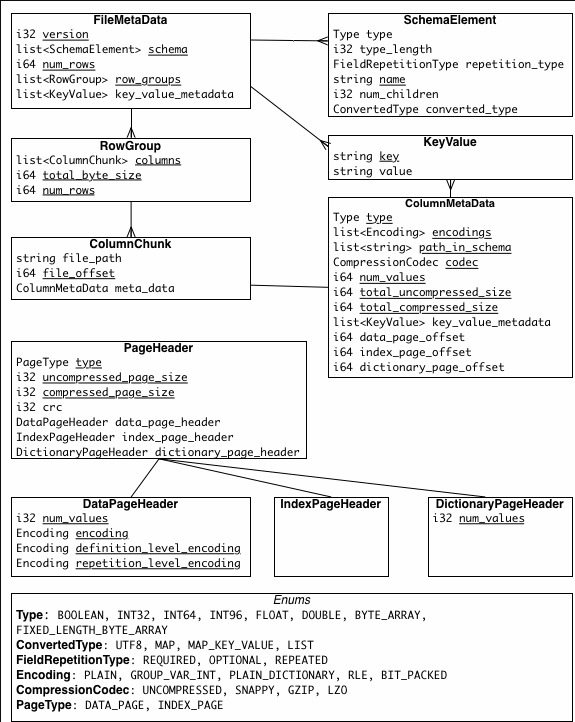
数据模型
message AddressBook {

 required string owner;  //required(出现1次)

 repeated string ownerPhoneNumbers; //repeated(出现0次或者多次)

 repeated group contacts {  //Parquet格式没有复杂的Map, List,Set等而是使用repeated fields和groups来表示

   required string name;

   optional string phoneNumber; //optional(出现0次或者1次)

 }

}
type可以是一个group或者一个primitive类型
一个schema有几个叶子节点就有多少列
			[  AddressBook  ]

			/       |        \

		   /        |          \

	required     repeated      repeated

	 owner  ownerPhoneNumbers   contacts

								/		\

							required    optional

							  name     phoneNumber
此处有4列
owner:string
ownerPhoneNumbers:string
contacts.name:string
contacts.phoneNumber:string
分段/组装算法
Definition Level
从根节点开始遍历,当某一个field的路径上的节点为空的时候,我们记录下当前深度作为这个field的Definition Level
最大Definition level:根据schema推算出来的,field路径都不为空时的Definition level
如果current definition level == max definition level ,则表示这个field是有数据的
Repetition level
记录该field的值是在哪一个深度上重复的。只有repeated类型的field需要Repetition Level,optional 和 required类型的不需要。Repetition Level = 0 表示开始一个新的record
如何存储
Parquet文件
所有数据水平切分成Row group:包含对应区间内的所有列的column chunk
column chunk:负责存储某一列的数据,由1个或多个Page组成
Page:压缩和编码的单元,对数据模型是透明的
Parquet文件尾部:Footer:文件的元数据信息和统计信息
推荐
row group size:一般情况下推荐配置一个Row group大小1G,一个HDFS块大小1G,一个HDFS文件只含有一个块,最大化顺序IO的性能优势
data page size:recommend 8KB for page sizes.小的page size有更好的读取性能,如单行查找时;大的page size带来少的空间成本和潜在的解析成本降低,因为page header变少了。Note:顺序扫描,不要去希望一次读完整个page,这不是IO意义上的数据块
疑问
多个列如何对应到同一行的
hbase存在列数据分布不均问题,即1列数据非常多,另一列数据非常少,导致有很多无用的block,推测parquet也存在这个问题,如果存在,那么会有很多空数据列来标识不存在的数据
org.apache.hadoop.hive.ql.io.parquet.MapredParquetOutputFormat
MapredParquetOutputFormat将对象写入parquet文件,通过它,我们来追踪这些疑问,方法getHiveRecordWriter返回一个写入记录的对象用于最终将对象的多个fields写到文件中
  /**

   *

   * Create the parquet schema from the hive schema, and return the RecordWriterWrapper which

   * contains the real output format

   */

  @Override

  public org.apache.hadoop.hive.ql.exec.FileSinkOperator.RecordWriter getHiveRecordWriter(

	  final JobConf jobConf,

	  final Path finalOutPath,

	  final Class<? extends Writable> valueClass,

	  final boolean isCompressed,

	  final Properties tableProperties,

	  final Progressable progress) throws IOException {

	LOG.info("creating new record writer..." + this);

	final String columnNameProperty = tableProperties.getProperty(IOConstants.COLUMNS);

	final String columnTypeProperty = tableProperties.getProperty(IOConstants.COLUMNS_TYPES);

	List<String> columnNames;

	List<TypeInfo> columnTypes;

	if (columnNameProperty.length() == 0) {

	  columnNames = new ArrayList<String>();

	} else {

	  columnNames = Arrays.asList(columnNameProperty.split(","));

	}

	if (columnTypeProperty.length() == 0) {

	  columnTypes = new ArrayList<TypeInfo>();

	} else {

	  columnTypes = TypeInfoUtils.getTypeInfosFromTypeString(columnTypeProperty);

	}

	//根据列名和类型,生成schema

	DataWritableWriteSupport.setSchema(HiveSchemaConverter.convert(columnNames, columnTypes), jobConf);

	//类的构造方法生成 realOutputFormat = new ParquetOutputFormat<ParquetHiveRecord>(new DataWritableWriteSupport());

	return getParquerRecordWriterWrapper(realOutputFormat, jobConf, finalOutPath.toString(),

			progress,tableProperties);

  }

  protected ParquetRecordWriterWrapper getParquerRecordWriterWrapper(

	  ParquetOutputFormat<ParquetHiveRecord> realOutputFormat,

	  JobConf jobConf,

	  String finalOutPath,

	  Progressable progress,

	  Properties tableProperties

	  ) throws IOException {

	return new ParquetRecordWriterWrapper(realOutputFormat, jobConf, finalOutPath.toString(),

			progress,tableProperties);

  }
ParquetRecordWriterWrapper是RecordWriter包装类
  public ParquetRecordWriterWrapper(

	  final OutputFormat<Void, ParquetHiveRecord> realOutputFormat,

	  final JobConf jobConf,

	  final String name,  //finalOutPath

	  final Progressable progress, Properties tableProperties) throws

		  IOException {

	try {

	  // create a TaskInputOutputContext

	  TaskAttemptID taskAttemptID = TaskAttemptID.forName(jobConf.get("mapred.task.id"));

	  if (taskAttemptID == null) {

		taskAttemptID = new TaskAttemptID();

	  }

	  taskContext = ContextUtil.newTaskAttemptContext(jobConf, taskAttemptID);

	  //从tableProperties初始化blockSize,ENABLE_DICTIONARY,COMPRESSION,如果tableProperties没有对应属性,则什么都不做

	  LOG.info("initialize serde with table properties.");

	  initializeSerProperties(taskContext, tableProperties);

	  LOG.info("creating real writer to write at " + name);

	  //真正的writer

	  realWriter =

			  ((ParquetOutputFormat) realOutputFormat).getRecordWriter(taskContext, new Path(name));

	  LOG.info("real writer: " + realWriter);

	} catch (final InterruptedException e) {

	  throw new IOException(e);

	}

  }
疑问
blockSize是什么
进入ParquetRecordWriterWrapper.getRecordWriter来看realWriter生成方式
public RecordWriter<Void, T> getRecordWriter(Configuration conf, Path file, CompressionCodecName codec) throws IOException, InterruptedException {

    WriteSupport<T> writeSupport = this.getWriteSupport(conf);  //writeSupport是一个关键的东西 ,读取配置中的parquet.write.support.class,反射生成实例

    CodecFactory codecFactory = new CodecFactory(conf);

    long blockSize = getLongBlockSize(conf);

    int pageSize = getPageSize(conf);

    int dictionaryPageSize = getDictionaryPageSize(conf);

    boolean enableDictionary = getEnableDictionary(conf);

    boolean validating = getValidation(conf);

    WriterVersion writerVersion = getWriterVersion(conf);

    //通过conf.schema生成写入上下文

    WriteContext init = writeSupport.init(conf);

	//使用finalOutPath

    ParquetFileWriter w = new ParquetFileWriter(conf, init.getSchema(), file);

    w.start();

    float maxLoad = conf.getFloat("parquet.memory.pool.ratio", 0.95F);

    long minAllocation = conf.getLong("parquet.memory.min.chunk.size", 1048576L);

    if (memoryManager == null) {

        memoryManager = new MemoryManager(maxLoad, minAllocation);

    } else if (memoryManager.getMemoryPoolRatio() != maxLoad) {

        LOG.warn("The configuration parquet.memory.pool.ratio has been set. It should not be reset by the new value: " + maxLoad);

    }

	//realWriter

    return new ParquetRecordWriter(w, writeSupport, init.getSchema(), init.getExtraMetaData(), blockSize, pageSize, codecFactory.getCompressor(codec, pageSize), dictionaryPageSize, enableDictionary, validating, writerVersion, memoryManager);

}
ParquetFileWriter,执行FS中的file
public ParquetFileWriter(Configuration configuration, MessageType schema, Path file, ParquetFileWriter.Mode mode) throws IOException {

    this.blocks = new ArrayList();

    this.state = ParquetFileWriter.STATE.NOT_STARTED;  //writer初始状态

    this.schema = schema;

    FileSystem fs = file.getFileSystem(configuration);

    boolean overwriteFlag = mode == ParquetFileWriter.Mode.OVERWRITE;

    this.out = fs.create(file, overwriteFlag);  //生成FSDataOutputStream,指定文件为file

}
真,最终 ParquetRecordWriter
public ParquetRecordWriter(ParquetFileWriter w, WriteSupport<T> writeSupport, MessageType schema, Map<String, String> extraMetaData, long blockSize, int pageSize, BytesCompressor compressor, int dictionaryPageSize, boolean enableDictionary, boolean validating, WriterVersion writerVersion, MemoryManager memoryManager) {

    this.internalWriter = new InternalParquetRecordWriter(w, writeSupport, schema, extraMetaData, blockSize, pageSize, compressor, dictionaryPageSize, enableDictionary, validating, writerVersion);

    this.memoryManager = (MemoryManager)Preconditions.checkNotNull(memoryManager, "memoryManager");

    memoryManager.addWriter(this.internalWriter, blockSize);

}
ParquetRecordWriterWrapper写入一条记录,对应row级别
  @Override

  public void write(final Void key, final ParquetHiveRecord value) throws IOException {

	try {

	  realWriter.write(key, value);

	} catch (final InterruptedException e) {

	  throw new IOException(e);

	}

  }
调用到ParquetRecordWriter.write方法,最终指向InternalParquetRecordWriter.write
public void write(Void key, T value) throws IOException, InterruptedException {

    this.internalWriter.write(value);

}

public void write(T value) throws IOException, InterruptedException {

    this.writeSupport.write(value);

    ++this.recordCount;

    this.checkBlockSizeReached();

}
既然writeSuppot是反射生成的,我们使用 GroupWriteSupport 来继续走完代码(spark自己写了一个WriteSupport:ParquetWriteSupport)
public void prepareForWrite(RecordConsumer recordConsumer) {

    this.groupWriter = new GroupWriter(recordConsumer, this.schema);

}

public void write(Group record) {

    this.groupWriter.write(record);

}

public class GroupWriter {

	private final RecordConsumer recordConsumer;

	private final GroupType schema;

	public GroupWriter(RecordConsumer recordConsumer, GroupType schema) {

		this.recordConsumer = recordConsumer;  //MessageColumnIORecordConsumer类

		this.schema = schema;

	}

	public void write(Group group) {

		//标记record开始,预准备一些标识

		this.recordConsumer.startMessage();

		//写入row

		this.writeGroup(group, this.schema);

		//标记record结束,处理写完数据后的标识操作

		this.recordConsumer.endMessage();

	}

	private void writeGroup(Group group, GroupType type) {

		int fieldCount = type.getFieldCount();

		//遍历所有field,对应column

		for(int field = 0; field < fieldCount; ++field) {

			int valueCount = group.getFieldRepetitionCount(field);

			//有效数量,如果为0,则表示null,不需要此时写入

			if (valueCount > 0) {

				Type fieldType = type.getType(field);

				String fieldName = fieldType.getName();

				//标记field开始

				this.recordConsumer.startField(fieldName, field);

				for(int index = 0; index < valueCount; ++index) {

					if (fieldType.isPrimitive()) {

						//写入原始类型的值

						group.writeValue(field, index, this.recordConsumer);

					} else {

					    //复杂结构,递归调用

						this.recordConsumer.startGroup();

						this.writeGroup(group.getGroup(field, index), fieldType.asGroupType());

						this.recordConsumer.endGroup();

					}

				}

				//标记field结束

				this.recordConsumer.endField(fieldName, field);

			}

		}

	}

}
当所有列中有数据的列插入完毕后,执行this.recordConsumer.endMessage() ,
public void endMessage() {
//空值处理,writer中仅写入了非空值,这里把空值也写进去占位
this.writeNullForMissingFieldsAtCurrentLevel();
this.columns.endRecord();
if (MessageColumnIO.DEBUG) {
this.log("< MESSAGE END >");
}
        if (MessageColumnIO.DEBUG) {

            this.printState();

        }

    }

    private void writeNullForMissingFieldsAtCurrentLevel() {

        int currentFieldsCount = ((GroupColumnIO)this.currentColumnIO).getChildrenCount();

        for(int i = 0; i < currentFieldsCount; ++i) {

            if (!this.fieldsWritten[this.currentLevel].isWritten(i)) {

                try {

                    ColumnIO undefinedField = ((GroupColumnIO)this.currentColumnIO).getChild(i);

                    int d = this.currentColumnIO.getDefinitionLevel();

                    if (MessageColumnIO.DEBUG) {

                        this.log(Arrays.toString(undefinedField.getFieldPath()) + ".writeNull(" + this.r[this.currentLevel] + "," + d + ")");

                    }

                    this.writeNull(undefinedField, this.r[this.currentLevel], d);

                } catch (RuntimeException var5) {

                    throw new ParquetEncodingException("error while writing nulls for fields of indexes " + i + " . current index: " + this.fieldsWritten[this.currentLevel], var5);

                }

            }

        }

    }
ColumnWriterV1类定义了写空值,写非空值的方法。两个方法不同点是this.dataColumn.writeInteger(value);空值不为写入到dataColumn中,也没有写入null,因此不能认为存入的是规则的矩阵,因此解析时,需要根据repetition,definition来对应具体的data,
public void writeNull(int repetitionLevel, int definitionLevel) {

	//写入列的repetitionLevel

    this.repetitionLevelColumn.writeInteger(repetitionLevel);

    this.definitionLevelColumn.writeInteger(definitionLevel);

	//记录列的空数据个数

    this.updateStatisticsNumNulls();

	//

    this.accountForValueWritten();

}

public void write(int value, int repetitionLevel, int definitionLevel) {

    this.repetitionLevelColumn.writeInteger(repetitionLevel);

    this.definitionLevelColumn.writeInteger(definitionLevel);

	//写非空值时,多了一个dataColumn写操作

    this.dataColumn.writeInteger(value);

    this.updateStatistics(value);

    this.accountForValueWritten();

}

//repetitionLevelColumn,definitionLevelColumn的生成方法如下,它依赖了共同的this.allocator:ByteBufferAllocator,作为写文件缓存

private ValuesWriter newColumnDescriptorValuesWriter(int maxLevel) {

	//如果maxLevel为0,则返回一个DevNullValuesWriter,当执行write操作时,DevNullValuesWriter内部什么都不做

    return (ValuesWriter)(maxLevel == 0 ? new DevNullValuesWriter() : new RunLengthBitPackingHybridValuesWriter(BytesUtils.getWidthFromMaxInt(maxLevel), 64, this.pageSizeThreshold, this.allocator));

}
当definitionLevel的maxLevel=0时,列为require节点
当repetitionLevel的maxLevel=0时,列没有涉及repeated字段
接下来再看看accountForValueWritten方法
private void accountForValueWritten() {

    ++this.valueCount; //值个数+1,如果个数超过了单个page的阈值,则触发大小判断

    if (this.valueCount > this.valueCountForNextSizeCheck) {

        long memSize = this.repetitionLevelColumn.getBufferedSize() + this.definitionLevelColumn.getBufferedSize() + this.dataColumn.getBufferedSize();

		//计算列中repetitionLevel、definitionLevel、datas在内存缓冲区中的大小,如果大于pageSize阈值

        if (memSize > (long)this.props.getPageSizeThreshold()) {

            if (this.props.estimateNextSizeCheck()) {

                this.valueCountForNextSizeCheck = this.valueCount / 2;

            } else {

                this.valueCountForNextSizeCheck = this.props.getMinRowCountForPageSizeCheck();

            }

			//将buffer写入文件

            this.writePage();

        } else if (this.props.estimateNextSizeCheck()) {

            this.valueCountForNextSizeCheck = (int)((float)this.valueCount + (float)this.valueCount * (float)this.props.getPageSizeThreshold() / (float)memSize) / 2 + 1;

        } else {

            this.valueCountForNextSizeCheck += this.props.getMinRowCountForPageSizeCheck();

        }

    }

}

private void writePage() {

    try {

		//concat将repetitionLevel,definitionLevel,dataColumn顺序组装

        this.pageWriter.writePage(BytesInput.concat(new BytesInput[]{this.repetitionLevelColumn.getBytes(), this.definitionLevelColumn.getBytes(), this.dataColumn.getBytes()}), this.valueCount, this.statistics, this.repetitionLevelColumn.getEncoding(), this.definitionLevelColumn.getEncoding(), this.dataColumn.getEncoding());

    } catch (IOException var2) {

        throw new ParquetEncodingException("could not write page for " + this.path, var2);

    }

	//重置内存,缓冲区

    this.repetitionLevelColumn.reset();

    this.definitionLevelColumn.reset();

    this.dataColumn.reset();

    this.valueCount = 0;

    this.resetStatistics();

}
concat将 repetitionLevel,definitionLevel,dataColumn顺序组装,也就是说保存时他们是3个部分,而不是每一列一个组合。这里所有的repetitionLevel被组织在一起了,definitionLevel,dataColumn亦如是
    public void writePage(BytesInput bytes, int valueCount, Statistics statistics, Encoding rlEncoding, Encoding dlEncoding, Encoding valuesEncoding) throws IOException {

        long uncompressedSize = bytes.size();

        if (uncompressedSize > 2147483647L) {

            throw new ParquetEncodingException("Cannot write page larger than Integer.MAX_VALUE bytes: " + uncompressedSize);

        } else {

			//压缩

            BytesInput compressedBytes = this.compressor.compress(bytes);

            long compressedSize = compressedBytes.size();

            if (compressedSize > 2147483647L) {

                throw new ParquetEncodingException("Cannot write compressed page larger than Integer.MAX_VALUE bytes: " + compressedSize);

            } else {

                this.tempOutputStream.reset();

				//写入pageMetadata

                ColumnChunkPageWriteStore.parquetMetadataConverter.writeDataPageHeader((int)uncompressedSize, (int)compressedSize, valueCount, statistics, rlEncoding, dlEncoding, valuesEncoding, this.tempOutputStream);

                this.uncompressedLength += uncompressedSize;

                this.compressedLength += compressedSize;

                this.totalValueCount += (long)valueCount;

                ++this.pageCount;

                if (this.totalStatistics == null) {

                    this.totalStatistics = statistics.copy();

                } else {

                    this.totalStatistics.mergeStatistics(statistics);

                }

                this.buf.collect(BytesInput.concat(new BytesInput[]{BytesInput.from(this.tempOutputStream), compressedBytes}));

                this.rlEncodings.add(rlEncoding);

                this.dlEncodings.add(dlEncoding);

                this.dataEncodings.add(valuesEncoding);

            }

        }

    }
Parquet 列式存储格式的更多相关文章
- 【转】深入分析 Parquet 列式存储格式
Parquet 是面向分析型业务的列式存储格式,由 Twitter 和 Cloudera 合作开发,2015 年 5 月从 Apache 的孵化器里毕业成为 Apache 顶级项目,最新的版本是 1. ...
- 深入分析Parquet列式存储格式【转】
Parquet是面向分析型业务的列式存储格式,由Twitter和Cloudera合作开发,2015年5月从Apache的孵化器里毕业成为Apache顶级项目,最新的版本是1.8.0. 列式存储 列式存 ...
- Parquet列式存储格式
Parquet是面向分析型业务的列式存储格式,由Twitter和Cloudera合作开发,2015年5月从Apache的孵化器里毕业成为Apache顶级项目,最新的版本是1.8.0. 列式存储 列式存 ...
- 深入分析Parquet列式存储格式
Parquet是面向分析型业务的列式存储格式,由Twitter和Cloudera合作开发,2015年5月从Apache的孵化器里毕业成为Apache顶级项目,最新的版本是1.8.0. 列式存储 列式存 ...
- parquet列式文件实战(未完,待续)
parquet列式文件实战 parquet code demo http://www.programcreek.com/java-api-examples/index.php?source_dir=h ...
- Parquet与ORC:高性能列式存储格式(收藏)
背景 随着大数据时代的到来,越来越多的数据流向了Hadoop生态圈,同时对于能够快速的从TB甚至PB级别的数据中获取有价值的数据对于一个产品和公司来说更加重要,在Hadoop生态圈的快速发展过程中,涌 ...
- Hadoop-No.4之列式存储格式
列式系统可提供的优势 对于查询内容之外的列,不必执行I/O和解压(若适用)操作 非常适合仅访问小部分列的查询.如果访问的列很多,则行存格式更为合适 相比由多行构成的数据块,列内的信息熵更低,所以从压缩 ...
- parquet列式文件实战
前言 列式文件,顾名思义就是按列存储到文件,和行式存储文件对应.保证了一列在一个文件中是连续的.下面从parquet常见术语,核心schema和文件结构来深入理解.最后通过java api完成writ ...
- Hadoop IO基于文件的数据结构详解【列式和行式数据结构的存储策略】
Charles所有关于hadoop的文章参考自hadoop权威指南第四版预览版 大家可以去safari免费阅读其英文预览版.本人也上传了PDF版本在我的资源中可以免费下载,不需要C币,点击这里下载. ...
随机推荐
- ava实现时钟小程序【代码】
其实这个程序并不难,主要是用Java 2D画图,弄一个线程,每隔一秒,依照时针分针秒针各自的速度重新计算它们走过的角度(相对12点方向顺时针偏离的角度),利用这个角度算出它们各自端点的坐标,重绘一次表 ...
- Spring Boot 第一弹,问候一下世界!!!
持续原创输出,点击上方蓝字关注我吧 目录 前言 什么是Spring Boot? 如何搭建一个Spring Boot项目? 第一个程序 Hello World 依赖解读 什么是配置文件? 什么是启动类? ...
- 30种SQL语句优化
1.'对查询进行优化,应尽量避免全表扫描,首先应考虑在 where 及 order by 涉及的列上建立索引. 2.应尽量避免在 where 子句中使用!=或<>操作符,否则将引擎放弃使用 ...
- 什么是 Opcache,如何使用 Opcache
Opcode 是啥? 我们先看一下 PHP 的执行过程: PHP 初始化执行环节,启动 Zend 引擎,加载注册的扩展模块. 初始化后读取 PHP 脚本文件,Zend 引擎对 PHP 文件进行词法分析 ...
- 基础篇:详解JAVA对象实例化过程
目录 1 对象的实例化过程 2 类的加载过程 3 触发类加载的条件 4 对象的实例化过程 5 类加载器和双亲委派规则,如何打破双亲委派规则 欢迎指正文中错误 关注公众号,一起交流 参考文章 1 对象的 ...
- 04 sublime text 3在线安装package control插件,之后安装主题插件和ConvertToUTF8 插件
前提:需要@@科学@@上网 在线安装包通常都需要@@科学@@上网 安装package control插件 在线安装package control插件 按ctrl+shift+p 输入install,选 ...
- matlab中imfinfo 有关图形文件的信息
来源:https://ww2.mathworks.cn/help/matlab/ref/imfinfo.html?searchHighlight=imfinfo&s_tid=doc_srcht ...
- Java 读取文件中的每一行,并为每一行插入特定的字符串
工具 1:Eclipse Java EE IDE for Web Developers. Version: Photon Release (4.8.0). Build id: 20180619-120 ...
- RHSA-2017:1842-重要: 内核 安全和BUG修复更新(需要重启、存在EXP、本地提权、代码执行)
[root@localhost ~]# cat /etc/redhat-release CentOS Linux release 7.2.1511 (Core) 修复命令: 使用root账号登陆She ...
- Docker笔记4:在 CentOS 上安装 Docker
Docker 是一个开源的应用容器引擎,主要有两个分支,一个是社区免费版(Docker CE),一个是企业版(Docker EE). 第1步:系统环境要求 Docker 支持的 CentOS 版本: ...