
聊聊Mybatis的实现原理
使用示例
平时我们使用的一般是集成了Spring或是Spring Boot的Mybatis,封装了一层,看源码不直接;如下,看看原生的Mybatis使用示例
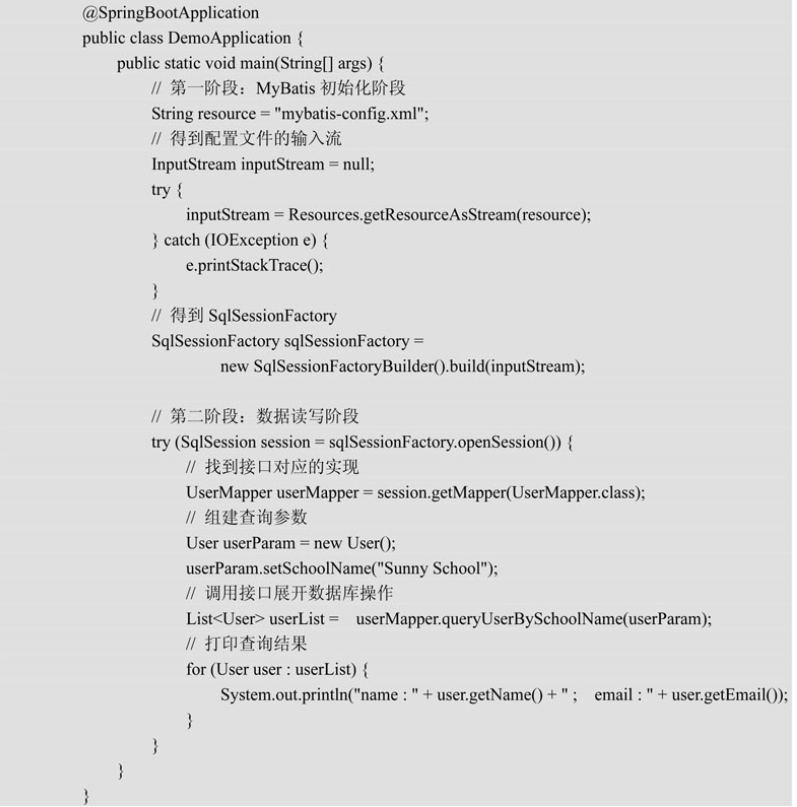
示例解析
通过代码可以清晰地看出,MyBatis的操作主要分为两大阶段:
- 第一阶段:MyBatis初始化阶段。该阶段用来完成MyBatis运行环境的准备工作,读取配置并初始化关键的对象,提供给后续使用,只在 MyBatis启动时运行一次。
- 第二阶段:数据读写阶段。该阶段由数据读写操作触发,将根据要求完成具体的增、删、改、查等数据库操作。
在第一阶段,最关键的就是SqlSessionFactory对象。在Spring集成Mybatis的源码中,SqlSessionFactoryBean也是做这个事情,读取配置并初始化构建SqlSessionFactory。
public class SqlSessionFactoryBean implements FactoryBean<SqlSessionFactory>, InitializingBean, ApplicationListener<ApplicationEvent> {

    // Spring Bean的生命周期会调用此方法

    public void afterPropertiesSet() throws Exception {

        this.sqlSessionFactory = this.buildSqlSessionFactory();

    }

    protected SqlSessionFactory buildSqlSessionFactory(){

        // 构建Configuration....

        Configuration configuration;

        if (this.configuration != null) {

            configuration = this.configuration;

            if (configuration.getVariables() == null) {

                configuration.setVariables(this.configurationProperties);

            } else if (this.configurationProperties != null) {

                configuration.getVariables().putAll(this.configurationProperties);

            }

        } else if (this.configLocation != null) {

            xmlConfigBuilder = new XMLConfigBuilder(this.configLocation.getInputStream(), (String)null, this.configurationProperties);

            configuration = xmlConfigBuilder.getConfiguration();

        } else {

            if (LOGGER.isDebugEnabled()) {

                LOGGER.debug("Property `configuration` or 'configLocation' not specified, using default MyBatis Configuration");

            }

            configuration = new Configuration();

            configuration.setVariables(this.configurationProperties);

        }

        /// 其它code...

        return this.sqlSessionFactoryBuilder.build(configuration);

    }

}
配置文件的解析,最终会生成一个Configuration对象。
private void parseConfiguration(XNode root) {

    try {

        Properties settings = this.settingsAsPropertiess(root.evalNode("settings"));

        this.propertiesElement(root.evalNode("properties"));

        this.loadCustomVfs(settings);

        this.typeAliasesElement(root.evalNode("typeAliases"));

        this.pluginElement(root.evalNode("plugins"));

        this.objectFactoryElement(root.evalNode("objectFactory"));

        this.objectWrapperFactoryElement(root.evalNode("objectWrapperFactory"));

        this.reflectionFactoryElement(root.evalNode("reflectionFactory"));

        this.settingsElement(settings);

        this.environmentsElement(root.evalNode("environments"));

        this.databaseIdProviderElement(root.evalNode("databaseIdProvider"));

        this.typeHandlerElement(root.evalNode("typeHandlers"));

        // 解析mappers节点

        this.mapperElement(root.evalNode("mappers"));

    } catch (Exception var3) {

        throw new BuilderException("Error parsing SQL Mapper Configuration. Cause: " + var3, var3);

    }

}
前期的准备已就绪,关键的配置已解析且构建并初始化了SqlSessionFactory了。接下来就是创建数据库连接并执行业务的CRUD。在第二阶段的OpenSession方法负责创建并打开数据库链接。
public SqlSession openSession(Connection connection) {

    return this.openSessionFromConnection(this.configuration.getDefaultExecutorType(), connection);

}

private SqlSession openSessionFromDataSource(ExecutorType execType, TransactionIsolationLevel level, boolean autoCommit) {

    Transaction tx = null;

    DefaultSqlSession var8;

    try {

        Environment environment = this.configuration.getEnvironment();

        TransactionFactory transactionFactory = this.getTransactionFactoryFromEnvironment(environment);

        tx = transactionFactory.newTransaction(environment.getDataSource(), level, autoCommit);

        Executor executor = this.configuration.newExecutor(tx, execType);

        var8 = new DefaultSqlSession(this.configuration, executor, autoCommit);

    } catch (Exception var12) {

        this.closeTransaction(tx);

        throw ExceptionFactory.wrapException("Error opening session.  Cause: " + var12, var12);

    } finally {

        ErrorContext.instance().reset();

    }

    return var8;

}
最后就是调用Mapper接口的业务方法,返回业务数据。
//SqlSession.getMapper()

public <T> T getMapper(Class<T> type) {

    return this.configuration.getMapper(type, this);

}

// configuration.getMapper()

public <T> T getMapper(Class<T> type, SqlSession sqlSession) {

    return this.mapperRegistry.getMapper(type, sqlSession);

}

// mapperRegistry.getMapper()

public <T> T getMapper(Class<T> type, SqlSession sqlSession) {

    MapperProxyFactory<T> mapperProxyFactory = (MapperProxyFactory)this.knownMappers.get(type);

    if (mapperProxyFactory == null) {

        throw new BindingException("Type " + type + " is not known to the MapperRegistry.");

    } else {

        try {

            return mapperProxyFactory.newInstance(sqlSession);

        } catch (Exception var5) {

            throw new BindingException("Error getting mapper instance. Cause: " + var5, var5);

        }

    }

}

// mapperProxyFactory.newInstance()

protected T newInstance(MapperProxy<T> mapperProxy) {

    return Proxy.newProxyInstance(this.mapperInterface.getClassLoader(), new Class[]{this.mapperInterface}, mapperProxy);

}

public T newInstance(SqlSession sqlSession) {

    MapperProxy<T> mapperProxy = new MapperProxy(sqlSession, this.mapperInterface, this.methodCache);

    return this.newInstance(mapperProxy);

}
最后,打完收工,示例代码所涉及到的关键代码就这些。
反思
上面的示例是比较简单的,那么其实现思路到底是什么样的?首先就有几个问题:
- Mapper接口中的方法没有实现,那客户端调用接口的方法时,返回的数据是从哪来的?
- Mapper文件与Mapper接口是怎么关联绑定上的?
第一个问题,绝对离不开动态代理,因为只有接口的时候,那么一定会有动态代理生成代理类同时有拦截处理器(InvocationHandler)来增强其执行逻辑。
第二个问题,Mapper文件中有一个<mapper>节点,其namespace就是接口的全限定名称,而其下节点<select>|<update>|..都有一个id值,该值与接口的方法是一致的。因此从这里就可以看出来,业务的crud操作节点是通过namespace+id来对应mapper接口及其方法的。那么我们就可以考虑到,在第一个问题中的拦截处理器执行方法method时,我们就可以通过此关联关系找到要执行的SQL。
如上,这么一分析来看,其实大概的实现思路已经出来了。就是动态代理+<mapper>节点解析实现了接口方法的调用与业务SQL的执行。
因此在第一阶段的解析时,Mapper文件里的<Mapper>节点解析出来的对象就起到了关键的作用。如下,有几个关键的抽象:
MapperRegistry类的knownMappers属性保存着接口及其代理对象的关系。
// type = interface

knownMappers.put(type, new MapperProxyFactory(type));
MappedStatement类对应着<mapper>节点下的CRUD节点。
public void parseStatementNode() {

    String id = this.context.getStringAttribute("id");

    if (this.databaseIdMatchesCurrent(id, databaseId, this.requiredDatabaseId)) {

        Integer fetchSize = this.context.getIntAttribute("fetchSize");

        Integer timeout = this.context.getIntAttribute("timeout");

        String parameterMap = this.context.getStringAttribute("parameterMap");

        String parameterType = this.context.getStringAttribute("parameterType");

        Class<?> parameterTypeClass = this.resolveClass(parameterType);

        String resultMap = this.context.getStringAttribute("resultMap");

        String resultType = this.context.getStringAttribute("resultType");

        // 解析其他属性...

        this.builderAssistant.addMappedStatement(id, sqlSource, statementType, sqlCommandType, fetchSize, timeout, parameterMap, parameterTypeClass, resultMap, resultTypeClass, resultSetTypeEnum, flushCache, useCache, resultOrdered, (KeyGenerator)keyGenerator, keyProperty, keyColumn, databaseId, langDriver, resultSets);

    }

}
如上是抽象出来整个执行过程的简单流程。实际上还有动态参数绑定与事务等,这些都是在动态代理的拦截处理器中的增强逻辑;下篇再阐述。
聊聊Mybatis的实现原理的更多相关文章
- 图解 | 聊聊 MyBatis 缓存
首发公众号-悟空聊架构:图解 | 聊聊 MyBatis 缓存 你好,我是悟空. 本文主要内容如下: 一.MyBatis 缓存中的常用概念 MyBatis 缓存:它用来优化 SQL 数据库查询的,但是可 ...
- Mybatis接口编程原理分析(三)
前面两篇博客Mybatis接口编程原理分析(一)和Mybatis接口编程原理分析(二)我们介绍了MapperProxyFactory.MapperProxy和MapperMethod的操作及源码分析, ...
- Mybatis接口编程原理分析(二)
在上一篇博客中 Mybatis接口编程原理分析(一)中我们介绍了MapperProxyFactory和MapperProxy,接下来我们要介绍的是MapperMethod MapperMethod:它 ...
- 深入理解Mybatis技术与原理
目录 第1章 Mybatis简介 1.1 传统的JDBC编程 1.2 ORM模型 1.4 MyBatis 1.5 什么时候用MyBatis 第2章 MyBatis入门 2.2 MyBatis构成 2. ...
- mybatis(一、原理,一对多,多对一查询)
MyBatis框架及原理分析 MyBatis 是支持定制化 SQL.存储过程以及高级映射的优秀的持久层框架,其主要就完成2件事情: 封装JDBC操作 利用反射打通Java类与SQL语句之间的相互转换 ...
- Mybatis之工作原理
1.Mybatis的架构 1.1 Mybatis的框架分层 1.2 MyBatis的实现原理 mybatis底层还是采用原生jdbc来对数据库进行操作的,它支持定制化 SQL.存储过程以及高级映射的优 ...
- 聊聊MyBatis缓存机制【美团-推荐】
聊聊MyBatis缓存机制 2018年01月19日 作者: 凯伦 文章链接 18778字 38分钟阅读 前言 MyBatis是常见的Java数据库访问层框架.在日常工作中,开发人员多数情况下是使用My ...
- mybatis 插件的原理-责任链和动态代理的体现
目录 1 拦截哪些方法 2 如何代理 3 代理对象 4 责任链设计模式 @ 如果没有自定义过拦截器, 可以看我前面的文章.如果不知道 JDK 动态代理怎么使用的, 可以看我这文章. 责任链设计模式理解 ...
- Mybatis简介与原理
经常面试别人或者被面试,对Mybatis简介与原理这个问题的回答千差万别,为了更好的服务与以后,来个原理介绍. 什么是Mybatis MyBatis 本是apache的一个开源项目iBatis, 20 ...
- MyBatis整合Spring原理分析
目录 MyBatis整合Spring原理分析 MapperScan的秘密 简单总结 假如不结合Spring框架,我们使用MyBatis时的一个典型使用方式如下: public class UserDa ...
随机推荐
- Java执行带空格的语句命令,cmd无法识别带空格路径的问题
带空格的会识别不了 先说解决方法: 1:用cmd中的start: 在JAVA中可以如此使用: Runtime.getRuntime().exec("cmd /c start \"\ ...
- 熹乐科技范维肖CC:基于开源 YoMo 框架构建“全球同服”的 Realtime Metaverse Application
前言 在「RTE2022 实时互联网大会」中,熹乐科技创始人 & CEO @范维肖CC 以<基于开源 YoMo 框架构建"全球同服"的 Realtime Metave ...
- 重学c#系列—— explicit、implicit与operator[三十四]
前言 我们都知道operator 可以对我们的操作符进行重写,那么explicit 和 implicit 就是对转换的重写. 正文 explicit 就是强制转换,然后implicit 就是隐式转换. ...
- IntelliJ IDEA 下载安装及配置使用教程(图文步骤详解)
前言 壹哥在前面的文章中,带大家下载.安装.配置了Eclipse这个更好用的IDE开发工具,并教会了大家如何在Eclipse中进行项目的创建和代码编写.运行.但是实际上,在各种IDE开发工具中,Ecl ...
- XCode汇编调试
开启Xcode汇编调试 选中Always Show Disassembly项. XCode -> Debug -> Debug Workflow -> Always Show Dis ...
- 第一推动|2023年VSCode插件最新推荐(54款)
本文介绍前端开发领域常用的一些VSCode插件,插件是VSCode最重要的组成部分之一,本文列出了我自己在以往工作经验中积累的54款插件,个人觉得这些插件是有用或有趣的,根据它们的作用,我粗略的把它们 ...
- [小迪安全]笔记 day12、13 MySQL注入
1. 简单案例 1.1 简易代码分析SQL注入原理 http://localhost:8085/sqli-labs/Less-2/index.php?id=2 id=2 正常查询 http://loc ...
- Flask框架使用蓝图划分目录、g对象、使用数据库连接池链接数据库
目录 一.使用蓝图划分项目目录 1.蓝图的介绍 2.蓝图的使用 二.介绍flask框架的g对象 1. g对象是什么? 2. 使用代码再次解释g对象 三.使用数据库连接池链接数据库 1. 引入数据库连接 ...
- lua快速入门~在js基础上,知道Lua 和 Js 的不同即可
lua 和 javaScript 差不多的,就是一些语法的细节不同,学过js,再注意一下下面的细节,就能上手了~ 快速入门,可以直接看一下菜鸟教程的lua:https://www.runoob.com ...
- Defi开发简介
Defi开发简介 介绍 Defi是去中心化金融的缩写, 是一项旨在利用区块链技术和智能合约创建更加开放,可访问和透明的金融体系的运动. 这与传统金融形成鲜明对比,传统金融通常由少数大型银行和金融机构控 ...