
Brainman(规律题)【数学思想】
Brainman
| Time Limit: 1000MS | Memory Limit: 30000K | |
| Total Submissions: 12942 | Accepted: 6504 |
Description
Background
Raymond Babbitt drives his brother Charlie mad. Recently Raymond counted 246 toothpicks spilled all over the floor in an instant just by glancing at them. And he can even count Poker cards. Charlie would love to be able to do cool things like that, too. He wants to beat his brother in a similar task.
Problem
Here's what Charlie thinks of. Imagine you get a sequence of N numbers. The goal is to move the numbers around so that at the end the sequence is ordered. The only operation allowed is to swap two adjacent numbers. Let us try an example:
Start with: 2 8 0 3
swap (2 8) 8 2 0 3
swap (2 0) 8 0 2 3
swap (2 3) 8 0 3 2
swap (8 0) 0 8 3 2
swap (8 3) 0 3 8 2
swap (8 2) 0 3 2 8
swap (3 2) 0 2 3 8
swap (3 8) 0 2 8 3
swap (8 3) 0 2 3 8
So the sequence (2 8 0 3) can be sorted with nine swaps of adjacent numbers. However, it is even possible to sort it with three such swaps:
Start with: 2 8 0 3
swap (8 0) 2 0 8 3
swap (2 0) 0 2 8 3
swap (8 3) 0 2 3 8
The question is: What is the minimum number of swaps of adjacent numbers to sort a given sequence?Since Charlie does not have Raymond's mental capabilities, he decides to cheat. Here is where you come into play. He asks you to write a computer program for him that answers the question. Rest assured he will pay a very good prize for it.
Input
The first line contains the number of scenarios.
For every scenario, you are given a line containing first the length N (1 <= N <= 1000) of the sequence,followed by the N elements of the sequence (each element is an integer in [-1000000, 1000000]). All numbers in this line are separated by single blanks.
Output
Start the output for every scenario with a line containing "Scenario #i:", where i is the number of the scenario starting at 1. Then print a single line containing the minimal number of swaps of adjacent numbers that are necessary to sort the given sequence. Terminate the output for the scenario with a blank line.
Sample Input
4

4 2 8 0 3

10 0 1 2 3 4 5 6 7 8 9

6 -42 23 6 28 -100 65537

5 0 0 0 0 0
Sample Output
Scenario #1:

3

Scenario #2:

0

Scenario #3:

5

Scenario #4:

0
思路:
目的:给出序列让计算出 通过 相邻数字的移位 实现序列 从小到大排列 所需要的总移动次数
在给出的序列中 没有可以更多可以利用的条件 既然是要排序 就试着找排序后位次和现在的位次的关系:
例: 2 8 0 3 是已知的序列
排序后: 0 2 3 8
其中 2的位次变化: 1→2 差值: 1
8: 2→4 2
0: 3→1 -2
3: 4→3 -1
差值相加为零可以理解,但同号之间的关系是不是直接相加就可以?
用题目示例3:可以证明不对
仔细想了想是因为:(下面是模拟的过程)
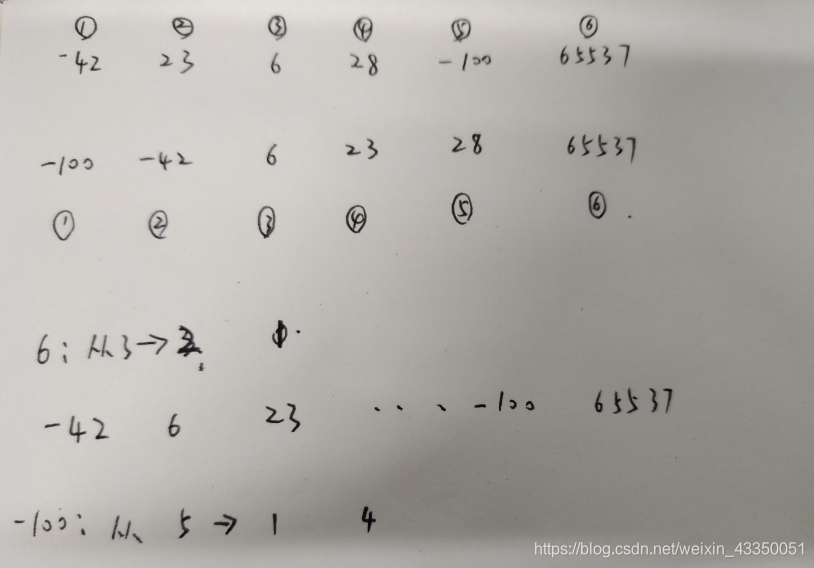
如果用开始的方法直接相加结果是0+4
但其实是0+1+4:
因为-100 最终在6 的前面 所以6 的位置就会由3 变成4 然后4再变成3 这样是1 而不是0(看不懂直接看规律)
所以规律是:从前往后移动计算前后序号差之和再加上在该位置后面比它小或相等值的个数
例如: -42 23 6 28 -100 65537
4+0+1(在6后面有1个-100比它小)
AC代码:
#include<stdio.h>

#include<algorithm>

using namespace std;

typedef long long LL;

const int MAX=1e3;

struct node{

    LL count;

    LL num1;

    LL num2;

}edge[MAX+5];

int main()

{

    LL b[MAX+5],T;

    scanf("%lld",&T);

    for(LL k=1;k<=T;k++){

        LL n;

        scanf("%lld",&n);

        for(LL i=1;i<=n;i++){

            scanf("%lld",&edge[i].count);

            edge[i].num1=i;

            b[i]=edge[i].count;

        }

        sort(b+1,b+n+1);

        for(LL i=1;i<=n;i++){

            for(LL j=1;j<=n;j++){

                if(b[i]==edge[j].count){

                    edge[j].num2=i;

                }

            }

        }

        LL sum=0;

        printf("Scenario #%lld:\n",k);

        for(LL i=2;i<=n;i++){

            if(edge[i].count<edge[i-1].count){

                LL count1=0;

                for(LL j=i+1;j<=n;j++){

                    if(edge[i].count>=edge[j].count){

                       count1++;

                    }

                }

                sum+=(edge[i].num1+count1-edge[i].num2);

                edge[i].count=edge[i-1].count;

            }

        }

        printf("%lld\n\n",sum);

    }

    return 0;

}
Brainman(规律题)【数学思想】的更多相关文章
- Codeforces - 规律题 [占坑]
发现自己容易被卡水题,需要强行苟一下规律题 CF上并没有对应的tag,所以本题集大部分对应百毒搜索按顺序刷 本题集侧重于找规律的过程(不然做这些垃圾题有什么用) Codeforces - 1008C ...
- 数学思想:为何我们把 x²读作x平方
要弄清楚这个问题,我们得先认识一个人.古希腊大数学家 欧多克索斯,其在整个古代仅次于阿基米德,是一位天文学家.医生.几何学家.立法家和地理学家. 为何我们把 x²读作x平方呢? 古希腊时代,越来越多的 ...
- LightOJ1010---Knights in Chessboard (规律题)
Given an m x n chessboard where you want to place chess knights. You have to find the number of maxi ...
- ACM_送气球(规律题)
送气球 Time Limit: 2000/1000ms (Java/Others) Problem Description: 为了奖励近段时间辛苦刷题的ACMer,会长决定给正在机房刷题的他们送气球. ...
- hdoj--1005--Number Sequence(规律题)
Number Sequence Time Limit: 2000/1000 MS (Java/Others) Memory Limit: 65536/32768 K (Java/Others) ...
- Visible Lattice Points(规律题)【数学规律】
Visible Lattice Points 题目链接(点击) Time Limit: 1000MS Memory Limit: 65536K Total Submissions: 9031 ...
- 1005:Number Sequence(hdu,数学规律题)
Problem Description A number sequence is defined as follows: f(1) = 1, f(2) = 1, f(n) = (A * f(n - 1 ...
- 2017 Multi-University Training Contest - Team 1 1011&&HDU 6043 KazaQ's Socks【规律题,数学,水】
KazaQ's Socks Time Limit: 2000/1000 MS (Java/Others) Memory Limit: 131072/131072 K (Java/Others)T ...
- codeforces round#524 D - Olya and magical square /// 大概算是数学规律题?
题目大意: t 个测试用例 (1≤t≤103) 给定n k (1≤n≤10^9,1≤k≤10^18) 表示有一个边长为2^n的正方形格子 每次操作只能将一个格子切割为左上左下右上右下的四等分格子 ...
随机推荐
- Canvas 画圆
原文地址:http://hi.baidu.com/lj2tj/item/557d8d1a65adfa721009b58b --------------------------------------- ...
- COCO数据集提取特定多个类并在YOLO-V3上训练
先占个地方,有空再写 ` import os Dir = './coco_class_6/Annotations/val2014' ImageDir = './coco_class_6/images/ ...
- 王艳 201771010127《面向对象程序设计(java)》第十周学习总结
一:理论部分. 1.泛型程序设计意味着编写的代码可以被很多不同类型的对象所重用. 1)泛型(参数化类型):在定义类.接口和方法时,通过类型参数指示将要处理的对象类型.如ArrayList类是一个泛型程 ...
- poj2226更改行列匹配建图
Muddy Fields Time Limit: 1000MS Memory Limit: 65536K Total Submissions: 10961 Accepted: 4071 Des ...
- C语言经典笔试题目
1.bool,float,指针变量 与 “零值” 比较的if语句 注意点:c语言中bool类型采用整数存储,0为false,非0均为true; float类型采用IEEE754标准,第一位符号位,中间 ...
- Java——DOS命令窗口用命令编译文件夹下所有.java文件
1.进入指定目录 cd 进入用户主目录 cd ~ 进入用户主目录 cd - 返回进入此目录之前所在的目录 cd .. 返回上级目录 cd\ 直接退回到当前盘根目录2. ...
- Map,HashMap五种遍历方法
假设有数组 HashMap<Integer, String> h=new HashMap<Integer,String>(); h.put( ...
- unicode 的中文字符串,调用 isalnum()返回的是 True ?
描述 Python isalnum() 方法检测字符串是否由字母和数字组成. 语法 isalnum()方法语法: str.isalnum() 返回值 如果 string 至少有一个字符并且所有字符都是 ...
- akka-typed(1) - actor生命周期管理
akka-typed的actor从创建.启用.状态转换.停用.监视等生命周期管理方式和akka-classic还是有一定的不同之处.这篇我们就介绍一下akka-typed的actor生命周期管理. 每 ...
- Android启动过程_大致流程
Android大致启动过程如图(基于O版本 使用draw.io画的). 注:这是通过查询结合自己了解的,还有不少不明确的,后续有进展完善,欢迎指正. 说明:绿色是主要几个的阶段.其他围绕这几个阶段的 ...