
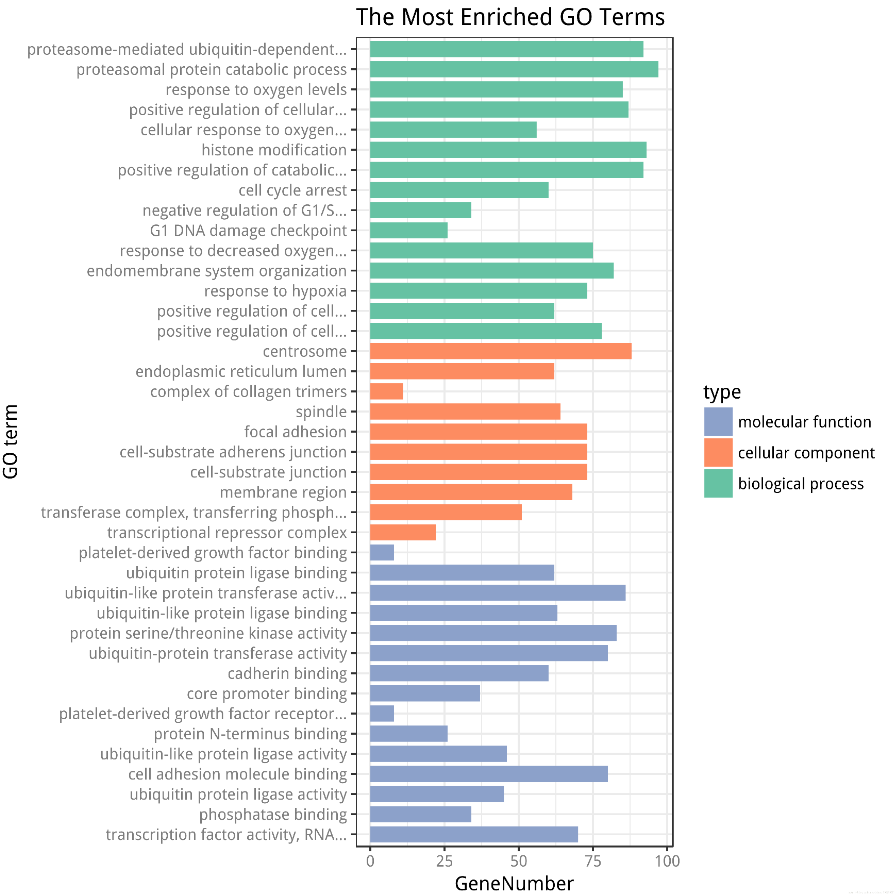
GO富集分析柱状图
 target_gene_id <- unique(read.delim("miRNA-gene interactions.txt")$EntrezID)

 # BiocInstaller::biocLite("clusterProfiler")

 # BiocInstaller::biocLite("org.Hs.eg.db")

 display_number = c(, , )

 ## GO enrichment with clusterProfiler

 library(clusterProfiler)

 ego_MF <- enrichGO(OrgDb="org.Hs.eg.db",

              gene = target_gene_id,

              pvalueCutoff = 0.05,

              ont = "MF",

              readable=TRUE)

 ego_result_MF <- as.data.frame(ego_MF)[:display_number[], ]

 # ego_result_MF <- ego_result_MF[order(ego_result_MF$Count),]

 ego_CC <- enrichGO(OrgDb="org.Hs.eg.db",

                    gene = target_gene_id,

                    pvalueCutoff = 0.05,

                    ont = "CC",

                    readable=TRUE)

 ego_result_CC <- as.data.frame(ego_CC)[:display_number[], ]

 # ego_result_CC <- ego_result_CC[order(ego_result_CC$Count),]

 ego_BP <- enrichGO(OrgDb="org.Hs.eg.db",

                    gene = target_gene_id,

                    pvalueCutoff = 0.05,

                    ont = "BP",

                    readable=TRUE)

 ego_result_BP <- na.omit(as.data.frame(ego_BP)[:display_number[], ])

 # ego_result_BP <- ego_result_BP[order(ego_result_BP$Count),]

 go_enrich_df <- data.frame(ID=c(ego_result_BP$ID, ego_result_CC$ID, ego_result_MF$ID),

                                    Description=c(ego_result_BP$Description, ego_result_CC$Description, ego_result_MF$Description),

                                    GeneNumber=c(ego_result_BP$Count, ego_result_CC$Count, ego_result_MF$Count),

                                    type=factor(c(rep("biological process", display_number[]), rep("cellular component", display_number[]),

                                           rep("molecular function", display_number[])), levels=c("molecular function", "cellular component", "biological process")))

 ## numbers as data on x axis

 go_enrich_df$number <- factor(rev(:nrow(go_enrich_df)))

 ## shorten the names of GO terms

 shorten_names <- function(x, n_word=, n_char=){

   if (length(strsplit(x, " ")[[]]) > n_word || (nchar(x) > ))

   {

     if (nchar(x) > ) x <- substr(x, , )

     x <- paste(paste(strsplit(x, " ")[[]][:min(length(strsplit(x," ")[[]]), n_word)],

                        collapse=" "), "...", sep="")

     return(x)

   }

   else

   {

     return(x)

   }

 }

 labels=(sapply(

   levels(go_enrich_df$Description)[as.numeric(go_enrich_df$Description)],

   shorten_names))

 names(labels) = rev(:nrow(go_enrich_df))

 ## colors for bar // green, blue, orange

 CPCOLS <- c("#8DA1CB", "#FD8D62", "#66C3A5")

 library(ggplot2)

 p <- ggplot(data=go_enrich_df, aes(x=number, y=GeneNumber, fill=type)) +

   geom_bar(stat="identity", width=0.8) + coord_flip() +

   scale_fill_manual(values = CPCOLS) + theme_bw() +

   scale_x_discrete(labels=labels) +

   xlab("GO term") +

   theme(axis.text=element_text(face = "bold", color="gray50")) +

   labs(title = "The Most Enriched GO Terms")

 p

 pdf("go_enrichment_of_miRNA_targets.pdf")

 p

 dev.off()

 svg("go_enrichment_of_miRNA_targets.svg")

 p

 dev.off()
GO富集分析柱状图的更多相关文章
- 基因探针富集分析(GSEA)& GO & pathway
http://blog.sina.com.cn/s/blog_4c1f21000100utyx.html GO是Gene Ontology的简称,是生物学家为了衡量基因的功能而而发起的一个项目,从分子 ...
- GO富集分析示例【华为云技术分享】
版权声明:本文为博主原创文章,遵循CC 4.0 BY-SA版权协议,转载请附上原文出处链接和本声明. 本文链接:https://blog.csdn.net/devcloud/article/detai ...
- DAVID 进行 GO/KEGG 功能富集分析
何为功能富集分析? 功能富集分析是将基因或者蛋白列表分成多个部分,即将一堆基因进行分类,而这里的分类标准往往是按照基因的功能来限定的.换句话说,就是把一个基因列表中,具有相似功能的基因放到一起,并和生 ...
- 利用GSEA对基因表达数据做富集分析
image Gene Set Enrichment Analysis (GSEA) is a computational method that determines whether an a p ...
- R: 修改镜像、bioconductor安装及go基因富集分析
1.安装bioconductor及go分析涉及的相关包 source("http://bioconductor.org/biocLite.R") options(BioC_mirr ...
- GO富集分析
GO的主要用途之一是对基因组进行富集分析.例如,给定一组在特定条件下上调的基因,富集分析将使用该基因组的注释发现哪些GO术语被过度表示(或未充分表示). 富集分析工具 用户可以直接从GOC网站的 ...
- OS Tools-GO富集分析工具的使用与解读详细教程
我们的云平台上的GO富集分析工具,需要输入的文件表格和参数很简单,但很多同学都不明白其中的原理与结果解读,这个帖子就跟大家详细解释~ 一.GO富集介绍: Gene Ontology(简称G ...
- webgestalt 通路富集分析
http://www.webgestalt.org/ 通路富集分析 参考 http://www.sci666.com.cn/9596.html
- GSEA 基因集富集分析
http://software.broadinstitute.org/gsea/index.jsp GSEA(Gene Set Enrichment Analysis)是一种生物信息学的计算方法,用于 ...
随机推荐
- Java学习---多线程的学习
基础知识 每个正在系统上运行的程序都是一个进程(process).每个进程包含一到多个线程(thread).进程也可能是整个程序或者是部分程序的动态执行. 线程是一组指令的集合,或者是程序的特殊段,它 ...
- 等待事件P1 P2 P3含义
从以下两个视图中查到的session中,有P1,P2,P3参数select * from v$sessionselect * from v$session_waitselect * from v$se ...
- December 26th 2016 Week 53rd Monday
Better to light one candle than to curse the darkness. 与其诅咒黑暗,不如燃起蜡烛. If the world is so cruel, I wo ...
- apt安装mysql
使用 APT 安装 MySQL 参考官方文档 apt-get install mysql-server 这将安装MySQL服务器的包,以及客户端和数据库公共文件的包. 在安装过程中,系统会要求您为ro ...
- 3、NPM使用
内容:NPM介绍,安装web框架模块,一些基本命令 #####介绍NPM是随同NodeJS一起安装的包管理工具,能解决NodeJS代码部署上的很多问题,常见的使用场景有以下几种: • 允许用户从 ...
- Functional Reactive Programming
Functional Reactive Programming (FRP) integrates time flow and compositional events into functional ...
- 1、Dubbo-分布式系统定义
1.分布式基础理论 1.1).什么是分布式系统? <分布式系统原理与范型>定义: “分布式系统是若干独立计算机的集合,这些计算机对于用户来说就像单个相关系统” 分布式系统(distribu ...
- 查看mysql中所有表的数据记录
select table_name,table_rows from tables where TABLE_SCHEMA = 'database name' order by table_rows de ...
- js尾巴
js中根据id获取标签: /** * 根据id获取标签 * @param {string}id * @returns {object} */ function $(id) { return typeo ...
- CSS网页布局:盒子模型
一.盒子模型 标准盒子模型(W3C盒子) 不论是标准盒模型还是IE盒子模型,都有content.padding.border.margin四个部分组成,但从上图也可以看出W3C盒子和IE盒子主要区别在 ...