
iOS边练边学--自定义等高的cell
一、storyboard自定义cell
<1>创建一个继承自UITableViewCell的子类,比如ChaosDealCell

<2>在storyboard中
<2.1>往cell里面增加需要用到的子控件

<2.2>设置cell的重用标识
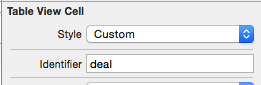
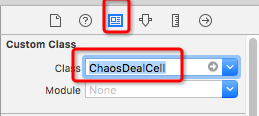
<2.3>设置cell的class为ChaosDealCell
<3>在控制器中
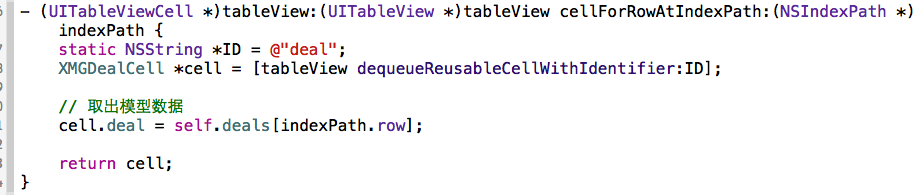
<3.1>利用重用标识找到cell并且给cell传递模型数据
<4>在ChaosDealCell中
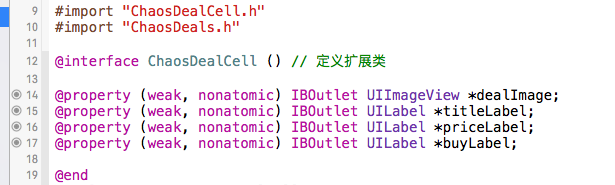
<4.1>将storyboard中的子控件连线到类扩展中
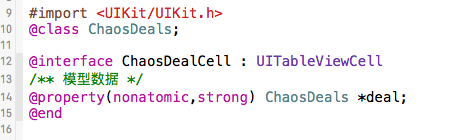
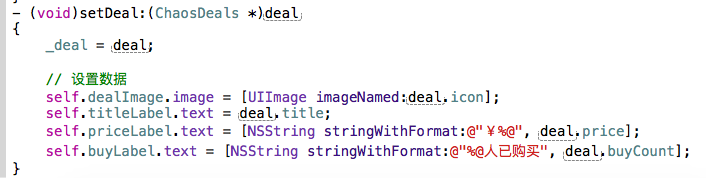
<4.2>需要提供一个模型属性,重写模型的set方法,在这个方法中设置模型数据到子控件上
二、Xib自定义cell
<1>创建一个继承自UITableViewCell的子类,比如ChaosDealCell
<2>创建一个xib文件(文件名建议跟cell的类名一样),比如ChaosDealCell.xib
<2.1>拖拽一个UITableViewCell出来
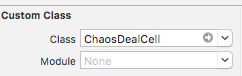
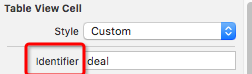
<2.2>修改cell的class为ChaosDealCell,,设置cell的重用标识
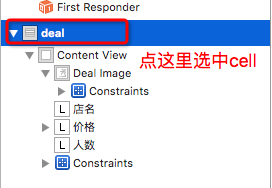
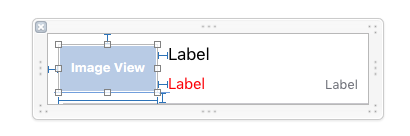
<2.3>往cell中添加需要用到的子控件
<3>在控制器中,别忘了给cell传递模型数数据
<方法一:>利用registerNib...方法注册xib文件
 - (void)viewDidLoad {

     [super viewDidLoad];

 //    [self.tableView registerNib:[UINib nibWithNibName:NSStringFromClass([ChaosDealCell class]) bundle:nil] forCellReuseIdentifier:@"deal"];

     // 分成两步写

     // 1.加载Nib

     UINib *nib = [UINib nibWithNibName:NSStringFromClass([ChaosDealCell class]) bundle:[NSBundle mainBundle]];

     // 注册cell

     [self.tableView registerNib:nib forCellReuseIdentifier:@"deal"];

 }
<方法二:>利用重用标识找到cell(如果没有注册xib文件,就需要手动加载xib文件)
 // 告诉tableView返回什么样的cell

 - (UITableViewCell *)tableView:(UITableView *)tableView cellForRowAtIndexPath:(NSIndexPath *)indexPath

 {

     // 获取对应行的数据

 //    ChaosDeals *deal = self.deals[indexPath.row];

     // 根据tableView从缓存池中拿cell

     ChaosDealCell *cell = [tableView dequeueReusableCellWithIdentifier:@"deal"];

     if (cell == nil) {

         cell = [[[NSBundle mainBundle] loadNibNamed:NSStringFromClass([ChaosDealCell class]) owner:nil options:nil] lastObject];

     }

     cell.deal = self.deals[indexPath.row];

     return cell;

 }
<4>在ChaosDealCell中
<4.1>将xib中的子控件连线到类扩展中
<4.2>需要提供一个模型属性,重写模型的set方法,在这个方法中设置模型数据到子控件上
<4.3>也可以将创建获得cell的代码封装起来(比如cellWithTableView:方法)
 + (instancetype)cellWithTableView:(UITableView *)tableView

 {

     ChaosDealCell *cell = [tableView dequeueReusableCellWithIdentifier:@"deal"];

     if (cell == nil) {

         cell = [[[NSBundle mainBundle] loadNibNamed:NSStringFromClass([ChaosDealCell class]) owner:nil options:nil] lastObject];

     }

     return cell;

 }
三、代码自定义cell(使用frame)
<1>创建一个集成自UITableViewCell的子类,比如ChaosDealCell
<1.1>在initWithStyle:reuseIdentifier:方法中
*添加子控件
*设置子空间的初始化属性(比如文字颜色、字体)
<1.2>在layoutSubviews方法中设置子控件的frame
<1.3>需要提供一个模型属性,重写模型的set方法,在这个方法中设置模型数据到子控件
<2>在控制器中
<2.1>利用registerClass...方法注册ChaosDealCell类
<2.2>利用重用标识找到cell(如果没有注册类,就需要手动创建cell)
<2.3>给cell传递模型数据
<2.4>也可以将创建获得cell的代码封装起来(比如cellWithTableView:方法)
 #import "XMGDealCell.h"

 #import "XMGDeal.h"

 @interface XMGDealCell()

 @property (weak, nonatomic) UIImageView *iconView;

 @property (weak, nonatomic) UILabel *titleLabel;

 @property (weak, nonatomic) UILabel *priceLabel;

 @property (weak, nonatomic) UILabel *buyCountLabel;

 @end

 @implementation XMGDealCell

 + (instancetype)cellWithTableView:(UITableView *)tableView

 {

     static NSString *ID = @"deal";

     // 创建cell

     XMGDealCell *cell = [tableView dequeueReusableCellWithIdentifier:ID];

 //    if (cell == nil) {

 //        cell = [[XMGDealCell alloc] initWithStyle:UITableViewCellStyleDefault reuseIdentifier:ID];

 //    }

     return cell;

 }

 // 1.在initWithStyle:reuseIdentifier:方法中添加子控件

 - (instancetype)initWithStyle:(UITableViewCellStyle)style reuseIdentifier:(NSString *)reuseIdentifier

 {

     if (self = [super initWithStyle:style reuseIdentifier:reuseIdentifier]) {

         UIImageView *iconView = [[UIImageView alloc] init];

         [self.contentView addSubview:iconView];

         self.iconView = iconView;

         UILabel *titleLabel = [[UILabel alloc] init];

         [self.contentView addSubview:titleLabel];

         self.titleLabel = titleLabel;

         UILabel *priceLabel = [[UILabel alloc] init];

         priceLabel.textColor = [UIColor orangeColor];

         [self.contentView addSubview:priceLabel];

         self.priceLabel = priceLabel;

         UILabel *buyCountLabel = [[UILabel alloc] init];

         buyCountLabel.textAlignment = NSTextAlignmentRight;

         buyCountLabel.font = [UIFont systemFontOfSize:];

         buyCountLabel.textColor = [UIColor lightGrayColor];

         [self.contentView addSubview:buyCountLabel];

         self.buyCountLabel = buyCountLabel;

     }

     return self;

 }

 // 2.在layoutSubviews方法中设置子控件的frame

 - (void)layoutSubviews

 {

     [super layoutSubviews];

     CGFloat contentH = self.contentView.frame.size.height;

     CGFloat contentW = self.contentView.frame.size.width;

     CGFloat margin = ;

     CGFloat iconX = margin;

     CGFloat iconY = margin;

     CGFloat iconW = ;

     CGFloat iconH = contentH -  * iconY;

     self.iconView.frame = CGRectMake(iconX, iconY, iconW, iconH);

     // titleLabel

     CGFloat titleX = CGRectGetMaxX(self.iconView.frame) + margin;

     CGFloat titleY = iconY;

     CGFloat titleW = contentW - titleX - margin;

     CGFloat titleH = ;

     self.titleLabel.frame = CGRectMake(titleX, titleY, titleW, titleH);

 //    CGRectMake(titleX, titleY, titleW, titleH);

     // priceLabel

     CGFloat priceX = titleX;

     CGFloat priceH = ;

     CGFloat priceY = contentH - margin - priceH;

     CGFloat priceW = ;

     self.priceLabel.frame = CGRectMake(priceX, priceY, priceW, priceH);

     // buyCountLabel

     CGFloat buyCountH = priceH;

     CGFloat buyCountY = priceY;

     CGFloat buyCountX = CGRectGetMaxX(self.priceLabel.frame) + margin;

     CGFloat buyCountW = contentW - buyCountX - margin;

     self.buyCountLabel.frame = CGRectMake(buyCountX, buyCountY, buyCountW, buyCountH);

 }

 // 3.重写模型的set方法

 - (void)setDeal:(XMGDeal *)deal

 {

     _deal = deal;

     // 设置数据

     self.iconView.image = [UIImage imageNamed:deal.icon];

     self.titleLabel.text = deal.title;

     self.priceLabel.text = [NSString stringWithFormat:@"¥%@", deal.price];

     self.buyCountLabel.text = [NSString stringWithFormat:@"%@人已购买", deal.buyCount];

 }

 @end
四、代码自定义cell(使用autolayout)
<1>创建一个集成自UITableViewCell的子类,比如ChaosDealCell
<1.1>在initWithStyle:reuseIdentifier:方法中
*添加子控件
*添加子控件的约束(建议使用Masonry)
*设置子空间的初始化属性(比如文字颜色、字体)
<1.2>在layoutSubviews方法中设置子控件的frame
<1.3>需要提供一个模型属性,重写模型的set方法,在这个方法中设置模型数据到子控件
<2>在控制器中
<2.1>利用registerClass...方法注册ChaosDealCell类
<2.2>利用重用标识找到cell(如果没有注册类,就需要手动创建cell)
<2.3>给cell传递模型数据
<2.4>也可以将创建获得cell的代码封装起来(比如cellWithTableView:方法)
 // 1.在initWithStyle:reuseIdentifier:方法中添加子控件

 - (instancetype)initWithStyle:(UITableViewCellStyle)style reuseIdentifier:(NSString *)reuseIdentifier

 {

     if (self = [super initWithStyle:style reuseIdentifier:reuseIdentifier]) {

         CGFloat margin = ;

         UIImageView *iconView = [[UIImageView alloc] init];

         [self.contentView addSubview:iconView];

         self.iconView = iconView;

         [iconView makeConstraints:^(MASConstraintMaker *make) {

             make.width.equalTo();

             make.left.top.offset(margin);

             make.bottom.offset(-margin);

         }];

         UILabel *titleLabel = [[UILabel alloc] init];

         [self.contentView addSubview:titleLabel];

         self.titleLabel = titleLabel;

         [titleLabel makeConstraints:^(MASConstraintMaker *make) {

             make.top.equalTo(iconView);

             make.left.equalTo(iconView.right).offset(margin);

             make.right.offset(-margin);

         }];

         UILabel *priceLabel = [[UILabel alloc] init];

         priceLabel.textColor = [UIColor orangeColor];

         [self.contentView addSubview:priceLabel];

         self.priceLabel = priceLabel;

         [priceLabel makeConstraints:^(MASConstraintMaker *make) {

             make.left.equalTo(titleLabel);

             make.bottom.equalTo(iconView);

             make.width.equalTo();

         }];

         UILabel *buyCountLabel = [[UILabel alloc] init];

         buyCountLabel.textAlignment = NSTextAlignmentRight;

         buyCountLabel.font = [UIFont systemFontOfSize:];

         buyCountLabel.textColor = [UIColor lightGrayColor];

         [self.contentView addSubview:buyCountLabel];

         self.buyCountLabel = buyCountLabel;

         [buyCountLabel makeConstraints:^(MASConstraintMaker *make) {

             make.bottom.equalTo(priceLabel);

             make.right.equalTo(titleLabel);

             make.left.equalTo(priceLabel.right).offset(margin);

         }];

     }

     return self;

 }
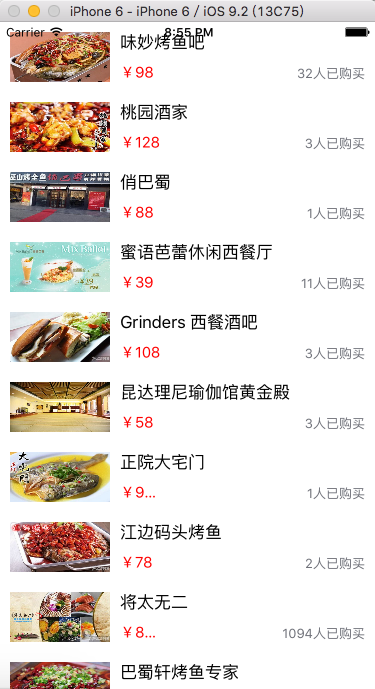
练习效果图
iOS边练边学--自定义等高的cell的更多相关文章
- iOS边练边学--自定义非等高的cell
一.使用xib或者storyboard自定义非等高的cell实现方式差不多,这里简单介绍一下通过xib文件实现的方法 <1.1>创建一个继承自UITableViewCell的子类,比如Ch ...
- iOS开发——UI进阶篇(二)自定义等高cell,xib自定义等高的cell,Autolayout布局子控件,团购案例
一.纯代码自定义等高cell 首先创建一个继承UITableViewCell的类@interface XMGTgCell : UITableViewCell在该类中依次做一下操作1.添加子控件 - ( ...
- iOS-UI控件之UITableView(三)- 自定义不等高的cell
Storyboard_不等高 对比自定义等高cell,需要几个额外的步骤(iOS8开始才支持) 添加子控件和contentView之间的间距约束 设置tableViewCell的真实行高和估算行高 / ...
- iOS-UI控件之UITableView(二)- 自定义不等高的cell
不等高的cell 给模型增加frame数据 所有子控件的frame cell的高度 @interface XMGStatus : NSObject /**** 文字\图片数据 ****/ // ... ...
- iOS边练边学--(Quartz2D)基本图形的绘制#附加自定义进度控件的练习
一.Quartz2D使用须知 Quartz2D的API是纯C语言的 Quartz2D的API来自于Core Graphics框架 二.<1>通过原始的方法(C语言)绘制简单图形--了解 & ...
- iOS边练边学--父子控制器之自定义控制器的切换
一.如图所示的界面,按钮One.Two.Three分别对应三个控制器的view,点击实现切换.个人感觉父子控制器的重点在于,控制器的view们之间建立了父子关系,控制器不建立的话,发生在view上面的 ...
- iOS边练边学--CALayer,非根层隐式动画,钟表练习
一.CALayer UIView之所以能显示在屏幕上,完全是因为他内部的一个图层 在创建UIView对象时,UIView内部会自动创建一个图层(即CALayer对象),通过UIView的layer属性 ...
- iOS边练边学--应用数据存储的常用方式(plist,Preference,NSKeyedArchiver)其中的三种
iOS应用数据存储的常用方式: XML属性列表(plist)归档 Preference(偏好设置) NSKeyedArchiver归档(NSCoding) SQLite3--这里暂且不讲 Core D ...
- iOS边练边学--Http网络再学习,简单介绍
一.URL 什么是URL URL中常见的协议 二.Http Http的基本通信过程 发送Http请求的方法 GET 和 POST 对比 GET 和 POST 的选择 三.iOS中的Http学习 iOS ...
随机推荐
- 【LeetCode】46. Permutations (2 solutions)
Permutations Given a collection of numbers, return all possible permutations. For example,[1,2,3] ha ...
- 2014年15款新评定的最佳PHP框架
通常,框架都会被认为是帮助开发者快速设计和开发动态网站的软件应用.每个月都有极大数量的新发布的 PHP 框架,使网站开发更简单更高效. 如果你是位 PHP 开发者,正在寻找当前最好的一些 PHP 框架 ...
- 'Provide value on 'System.Windows.StaticResourceExtension' threw an exception.'
产生这个错误的原因是,StaticResource必须先定义再引用,但是DynamicResource就没有这个限制,为避免这个错误出现,可将StaticResource的定义放在Window.xam ...
- SQL SERVER SELECT语句中加锁选项的详细说明 [转]
SQL Server提供了强大而完备的锁机制来帮助实现数据库系统的并发性和高性能.用户既能使用SQL Server的缺省设置也可以在select 语句中使用“加锁选项”来实现预期的效果. 本文介绍了S ...
- 转inux Shell编程入门
http://www.cnblogs.com/suyang/archive/2008/05/18/1201990.html 从程序员的角度来看, Shell本身是一种用C语言编写的程序,从用户的角度来 ...
- Form_如何通过标准功能查找数据源(概念)
2014-06-01 Created By BaoXinjian
- [Android开发那点破事]解决android.os.NetworkOnMainThreadException
[Android开发那点破事]解决android.os.NetworkOnMainThreadException 昨天和女朋友换了手机,我的iPhone 4S 换了她得三星I9003.第一感觉就是好卡 ...
- System V 共享内存 和 系列函数
跟消息队列一样,共享内存也有自己的数据结构,如下: struct shmid_ds { struct ipc_perm shm_perm; /* Ownership and permission ...
- osX显示隐藏文件
终端输入: defaults write com.apple.finder AppleShowAllFiles -bool YES
- mysql 5.6.23的源码安装
http://634871.blog.51cto.com/624871/1325914 首先删除系统自带的mysql rpm -qa | grep mysql rpm -e mysql //普 ...