
Python定制类(进阶6)
转载请标明出处:
http://www.cnblogs.com/why168888/p/6411919.html本文出自:【Edwin博客园】
Python定制类(进阶6)
1. python中什么是特殊方法
任何数据类型的实例都有一个特殊方法:__str__()
- 用于print的
__str__ - 用于len的
__len__ - 用于cmp的
__cmp__ - 特殊方法定义在class中
- 不需要直接调用
- Python的某些函数或操作符会调用对应的特殊方法
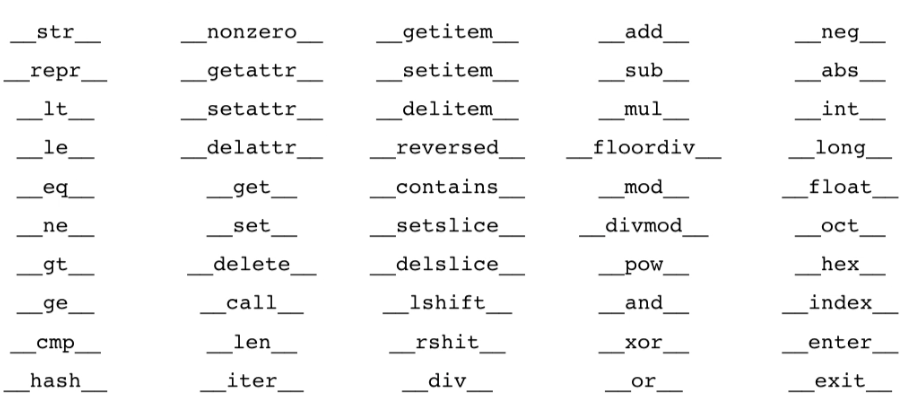
正确实现特殊方法
- 只需要编写用到的特殊方法
- 有关联性的特殊方法都必须实现
__getattr__,__setattr__,__delattr__
2. python中 __str__和__repr__
class Person(object):

    def __init__(self, name, gender):

        self.name = name

        self.gender = gender

class Student(Person):

    def __init__(self, name, gender, score):

        super(Student, self).__init__(name, gender)

        self.score = score

    def __str__(self):

        return '(Student: %s, %s, %s)' % (self.name, self.gender, self.score)

    __repr__ = __str__

s = Student('Bob', 'male', 88)

print s
3. python中 __cmp__
对 int、str 等内置数据类型排序时,Python的 sorted() 按照默认的比较函数 cmp 排序,但是,如果对一组 Student 类的实例排序时,就必须提供我们自己的特殊方法 __cmp__()
class Student(object):

    def __init__(self, name, score):

        self.name = name

        self.score = score

    def __str__(self):

        return '(%s: %s)' % (self.name, self.score)

    __repr__ = __str__

    def __cmp__(self, s):

        if self.name < s.name:

            return -1

        elif self.name > s.name:

            return 1

        else:

            return 0

class Student(object):

    def __init__(self, name, score):

        self.name = name

        self.score = score

    def __str__(self):

        return '(%s: %s)' % (self.name, self.score)

    __repr__ = __str__

    def __cmp__(self, s):

        if self.score == s.score:

            return cmp(self.name, s.name)

        return -cmp(self.score, s.score)

L = [Student('Tim', 99), Student('Bob', 88), Student('Alice', 99)]

print sorted(L)
4. python中 __len__
如果一个类表现得像一个list,要获取有多少个元素,就得用 len() 函数.
要让 len() 函数工作正常,类必须提供一个特殊方法__len__(),它返回元素的个数。
class Students(object):

    def __init__(self, *args):

        self.names = args

    def __len__(self):

        return len(self.names)

ss = Students('Bob', 'Alice', 'Tim')

print len(ss) # 3

class Fib(object):

    def __init__(self, num):

        a, b, L = 0, 1, []

        for n in range(num):

            L.append(a)

            a, b = b, a + b

        self.num = L

    def __len__(self):

        return len(self.num)

f = Fib(10)

print f.num # [0, 1, 1, 2, 3, 5, 8, 13, 21, 34]

print len(f) # 10
5. python中数学运算
Python 提供的基本数据类型 int、float 可以做整数和浮点的四则运算以及乘方等运算。
def gcd(a, b):

    if b == 0:

        return a

    return gcd(b, a % b)

class Rational(object):

    def __init__(self, p, q):

        self.p = p

        self.q = q

    def __add__(self, r):

        return Rational(self.p * r.q + self.q * r.p, self.q * r.q)

    def __sub__(self, r):

        return Rational(self.p * r.q - self.q * r.p, self.q * r.q)

    def __mul__(self, r):

        return Rational(self.p * r.p, self.q * r.q)

    def __div__(self, r):

        return Rational(self.p * r.q, self.q * r.p)

    def __str__(self):

        g = gcd(self.p, self.q)

        return '%s/%s' % (self.p / g, self.q / g)

    __repr__ = __str__

r1 = Rational(1, 2)

r2 = Rational(1, 4)

print r1 + r2

print r1 - r2

print r1 * r2

print r1 / r2
6. python中类型转换
print int(12.34) # 12

print float(12) # 12.0

class Rational(object):

    def __init__(self, p, q):

        self.p = p

        self.q = q

    def __int__(self):

        return self.p // self.q

    def __float__(self):

        return float(self.p) / self.q

print float(Rational(7, 2)) # 3.5

print float(Rational(1, 3)) # 0.333333333333
7. python中 @property
class Student(object):

    def __init__(self, name, score):

        self.name = name

        self.__score = score

    @property

    def score(self):

        return self.__score

    @score.setter

    def score(self, score):

        if score < 0 or score > 100:

            raise ValueError('invalid score')

        self.__score = score

    @property

    def grade(self):

        if self.score < 60:

            return 'C'

        if self.score < 80:

            return 'B'

        return 'A'

s = Student('Bob', 59)

print s.grade

s.score = 60

print s.grade

s.score = 99

print s.grade
8. python中 __slots__
slots 的目的是限制当前类所能拥有的属性,如果不需要添加任意动态的属性,使用__slots__也能节省内存。
class Student(object):

    __slots__ = ('name', 'gender', 'score')

    def __init__(self, name, gender, score):

        self.name = name

        self.gender = gender

        self.score = score

s = Student('Bob', 'male', 59)

s.name = 'Tim' # OK

s.score = 99 # OK

s.grade = 'A' # Error

class Person(object):

    __slots__ = ('name', 'gender')

    def __init__(self, name, gender):

        self.name = name

        self.gender = gender

class Student(Person):

    __slots__ = {'score'}

    def __init__(self, name, gender, score):

        super(Student, self).__init__(name, gender)

        self.score = score

s = Student('Bob', 'male', 59)

s.name = 'Tim'

s.score = 99

print s.score
9. python中__call__
一个类实例也可以变成一个可调用对象,只需要实现一个特殊方法__call__()
class Person(object):

    def __init__(self, name, gender):

        self.name = name

        self.gender = gender

    def __call__(self, friend):

        print 'My name is %s...' % self.name

        print 'My friend is %s...' % friend

p = Person('Bob', 'male')

p('Tim') # My name is Bob... My friend is Tim...

class Fib(object):

    def __call__(self, num):

        a, b, L = 0, 1, []

        for n in range(num):

            L.append(a)

            a, b = b, a + b

        return L

f = Fib()

print f(10) # [0, 1, 1, 2, 3, 5, 8, 13, 21, 34]
10.下一步学习内容
- IO:文件和Socket
- 多线程:进程和线程
- 数据库
- Web开发
Python定制类(进阶6)的更多相关文章
- python定制类(1):__getitem__和slice切片
python定制类(1):__getitem__和slice切片 1.__getitem__的简单用法: 当一个类中定义了__getitem__方法,那么它的实例对象便拥有了通过下标来索引的能力. c ...
- python 定制类
看到类似__slots__这种形如__xxx__的变量或者函数名就要注意,这些在Python中是有特殊用途的. __slots__我们已经知道怎么用了,__len__()方法我们也知道是为了能让cla ...
- python定制类详解
1.什么是定制类python中包含很多内置的(Built-in)函数,异常,对象.分别有不同的作用,我们可以重写这些功能. 2.__str__输出对象 class Language(object): ...
- Python 定制类与其对象的创建和应用
1.创建新类Athlete,创建两个唯一的对象实例sarah james,他们会继承Athlete类的特性 >>> class Athlete: def __init__(self, ...
- python定制类(以Fib类为例)
class Fib(object): def __init__(self): self.a, self.b = 0, 1 def __iter__(self): return self def __n ...
- Python 定制类 特殊方法
1.特殊方法 定义在class中 不需要直接调用,python的某些函数或操作符会自动的调用对应的特殊方法. 如定义了person类,使用print p 语句打印person类的实例时,就调用了特殊方 ...
- Python定制类
https://docs.python.org/3/reference/datamodel.html#special-method-names
- python基础——定制类
python基础——定制类 看到类似__slots__这种形如__xxx__的变量或者函数名就要注意,这些在Python中是有特殊用途的. __slots__我们已经知道怎么用了,__len__()方 ...
- python学习(八)定制类和枚举
`python`定制类主要是实现特定功能,通过在类中定义特定的函数完成特定的功能. class Student(object): def __init__(self, name): self.name ...
随机推荐
- 问题集录--新手入门深度学习,选择TensorFlow 好吗?
新手入门深度学习,选择 TensorFlow 有哪些益处? 佟达:首先,对于新手来说,TensorFlow的环境配置包装得真心非常好.相较之下,安装Caffe要痛苦的多,如果还要再CUDA环境下配合O ...
- iOS开源项目周报0309
由OpenDigg 出品的iOS开源项目周报第十期来啦.我们的iOS开源周报集合了OpenDigg一周来新收录的优质的iOS开源项目,方便iOS开发人员便捷的找到自己需要的项目工具等.LazyScro ...
- 关于C#的强制转换和尝试转换的方法
将String[]类型的Object类型,转换为String[]类型: public string ObjectToString(object ob) { string str = string.Em ...
- 如何在 Azure 中创建 ASP.NET Web 应用
Azure Web 应用提供高度可缩放.自修补的 Web 托管服务. 本快速入门演示如何将第一个 ASP.NET Web 应用部署到 Azure Web 应用中. 完成后,便拥有了一个资源组,该资源组 ...
- mysql:名次排名 (并列与不并列)
http://www.cnblogs.com/zengguowang/p/5541431.html sql语句查询排名 思路:有点类似循环里面的自增一样,设置一个变量并赋予初始值,循环一次自增加1,从 ...
- [javaSE] IO流(装饰设计模式)
装饰设计模式:当想要对已有的对象进行功能增强时,可以自定义类将已有的对象传入,并提供加强功能,自定义的该类称为装饰类 典型的: Reader--FileReader --BufferedReader ...
- NSURLSession和NSURLConnection
iOS9.0之后NSURLConnection被注销,采用NSURLSession,先介绍NSURLSession,然后介绍NSURLConnection 1.NSURLSession: post请求 ...
- 撩课-Java每天10道面试题第7天
撩课Java+系统架构 视频 点击开始学习 61.什么是并发修改异常? 什么是并发修改异常: 当我们在遍历实现了collection接口 与iterator接口的集合时(List.Set.Map), ...
- xshell 中解决中文乱码问题
点击菜单栏 文件 -> 属性 在属性对话框内点击终端, 选择 编码为 UTF-8 即可.
- redis使用及配置之缓存详解
redis使用及配置之缓存详解 1.Redis的介绍 Redis是一个Key-Value存储系统.它支持存储的value类型有:string(字符串),list(链表), set(无序集合),zset ...