
C/C++实现Perigram属性
C/C++实现Perigram属性
通常描述信号瞬时特征的物理量有:瞬时振幅、瞬时相位、及瞬时频率(“三瞬参数”),地震波的瞬时参数不仅可以直接用来研究岩性、构造等,而且也能够反演介质的品质因数等参数。在研究非平稳信号时,瞬时参数尤为重要。
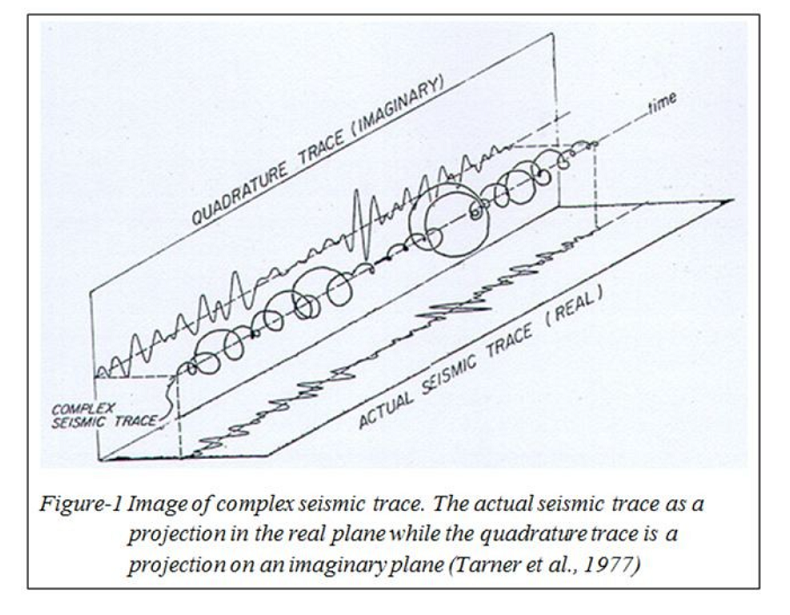
假设原始信号为\(x(t)\),通过Hilbert变换,将实信号转变为复信号\(S(t)=x(t)+iy(t)\),并提取瞬时振幅、瞬时相位、瞬时频率三个参数。本文档将介绍使用C/C++代码,由三瞬属性得到Perigram以及Perigram×Cosine of Phase这两种属性的过程。
1 地震属性、意义及计算方法
(1)瞬时振幅 Instaneous Amplitude
(/振幅包络Amplitude Envelope/反射强度Reflection Strength)
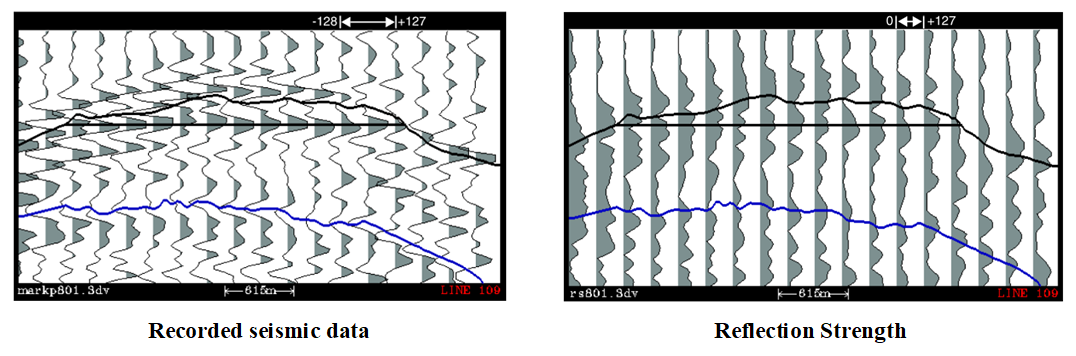
瞬时振幅或反射强度是地震信号在某一时刻的总能量的平方根,它是地震轨迹的包络线。利用Hilbert变换提取复信号的虚部\(y(t)\),瞬时振幅根据下式计算:
\]
瞬时振幅代表了声阻抗(或反射系数)的差别,因此能够识别亮点、气藏聚集位置、层序边界、不整合面、大的岩性和沉积相变化、孔隙度或其它岩性参数的空间变化、断层的侧向变化等。其值总为正。
(2)瞬时相位 Instaneous Phase
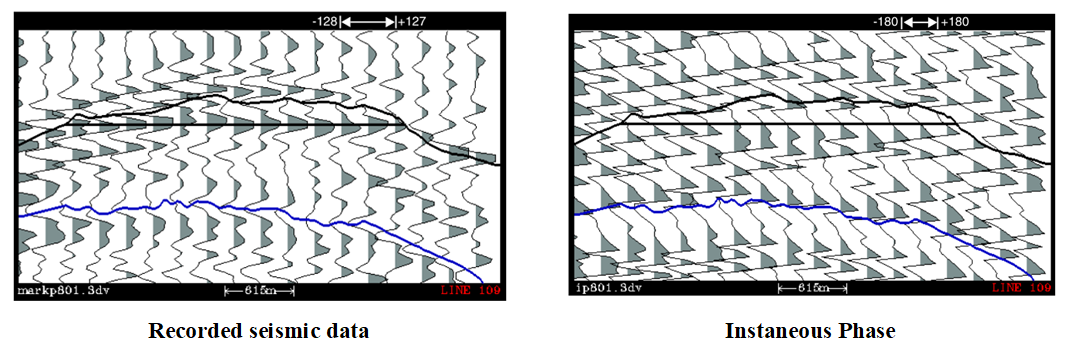
瞬时相位是地震剖面上同相轴连续性的量度,无论能量的强弱,它的相位都能显示出来。其计算式为:
\]
当波在各向异性的均匀介质中传播时,其相位是连续的;当波在有异常存在的介质中传播时,其相位将在异常位置发生显著变化,在剖面图中明显不连续。因此,利用瞬时相位能够较好地对地下分层和地下异常进行辨别,能够用来识别断层、尖灭、层序边界等。 瞬时相位数据呈现不连续的锯齿状,其值域范围为\(-180°\sim180°\)。
(3)瞬时频率 Instaneous Frequency
瞬时频率表示瞬时相位随时间的变化率:
\]
瞬时频率能够在横向上有效判别地震资料的相关性,薄层的岩性和厚度的变化能够引起瞬时频率的变化。一般高瞬时频率反映了薄的泥岩沉积,低的瞬时频率反映富砂沉积,因此可以应用瞬时频率反映碎屑岩的沉积环境 。

(4) 反射强度交流分量 Perigram
Perigram是去除了直流分量的反射强度,反射强度低频(直流)分量定义为给定时间窗口\(\Delta T\)内反射强度的平均值:
\]
当取一个极大的窗口时,\(A(t)\)接近直流分量,然后将其从反射强度中减去低频分量,得到Perigram:
\]
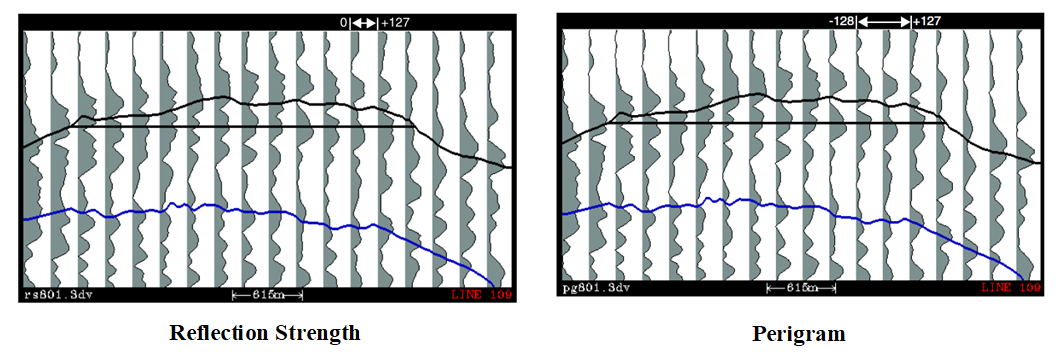
Perigram 与反射强度的用途基本相同。其能够加强反射强度峰值异常,并且更适合分析和处理,因为其有正负。
(5)反射强度交流分量与相位余弦之积
公式表示为:
=[A(t)-\bar{A}(t)]\cos \theta(t)
=x(t)[1-\frac{\bar{A}(t)}{{A}(t)}],\quad if\quad g(t)>0\\
G(t)=0,\quad if\quad g(t)\le 0\\
\]
当Perigram>0时,该属性为反射强度交流分量与相位余弦的乘积,否则为0。换言之,当Perigram值为正时,Perigram×相位余弦的值等于输入数据\(x(t)\)乘以一个小于1的比例;而当Perigram值为负时,值为0,对应低反射强度。该属性可用于突出强振幅与连续相位,同反射强度的用途相似。例如,当周围低能反射体被减弱至0时,与含气砂有关的部分将被明显点亮。
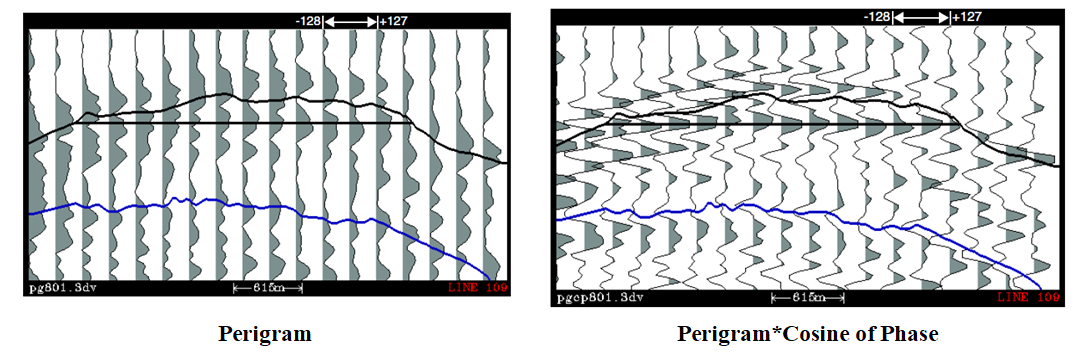
2 代码实现
(1) Perigram
void Compute_perigram(float* dataInput, int nt, float* Perigram){

	float *Imaginary = NULL;	//定义变换后得到的虚部

	float *Amplitude_envelope = NULL;	//振幅包络

	float *DC_component = NULL;	//直流分量

	float sum = 0.0f;

	Imaginary = (float*)calloc(nt, sizeof(float));

	Amplitude_envelope = (float*)calloc(nt, sizeof(float));

	DC_component = (float*)calloc(nt, sizeof(float));

	hilbert(nt, dataInput, Imaginary);	//希尔伯特变换

	for (int i = 0; i < nt; i++)

	{

		Amplitude_envelope[i] = sqrt(pow(dataInput[i], 2) + pow(Imaginary[i], 2));	//实部、虚部平方和开根号求瞬时振幅

		sum += Amplitude_envelope[i];

	}

	float Avg = sum/nt;

	for (int i = 0; i < nt; i++)

	{

		DC_component[i] = Avg;	//直流分量为全局平均

		Perigram[i]=Amplitude_envelope[i]- DC_component[i];	//Perigram

	}

	free(Imaginary);

	free(Amplitude_envelope);

	free(DC_component);

}
(2) Perigram*Cosine of Phase
void Compute_perigramXcosine(float* dataInput, int nt, float* PerigramXcos) {

	float *Imaginary = NULL;	//定义变换后得到的虚部

	float *Amplitude_envelope = NULL;	//振幅包络

	float *DC_component = NULL;	//直流分量

	float sum = 0.0f;

	Imaginary = (float*)calloc(nt, sizeof(float));

	Amplitude_envelope = (float*)calloc(nt, sizeof(float));

	DC_component = (float*)calloc(nt, sizeof(float));

	hilbert(nt, dataInput, Imaginary);	//希尔伯特变换

	for (int i = 0; i < nt; i++)

	{

		Amplitude_envelope[i] = sqrt(pow(dataInput[i], 2) + pow(Imaginary[i], 2));

		sum += Amplitude_envelope[i];

	}

	float Avg = sum / nt;

	for (int i = 0; i < nt; i++)

	{

		DC_component[i] = Avg;

		if ((Amplitude_envelope[i] - DC_component[i]) > 0) {	//如果g(t)大于0

			PerigramXcos[i] = dataInput[i] * (1 - DC_component[i] / Amplitude_envelope[i]);

		}

		else {	//g(t)小于0,那乘积余弦就赋为0

			PerigramXcos[i] = 0;

		}

	}

	free(Imaginary);

	free(Amplitude_envelope);

	free(DC_component);

}
主函数
int compute_type = 1;	//选择计算属性类别,当前为Perigram

//遍历每一道

for (int itrace = 0; itrace < ncdp; itrace++)

{

    fread(&traceheader, sizetraceheader, 1, fpinput);

    fread(dataInput, nt * sizeof(float), 1, fpinput);

    if (compute_type==1)	//Perigram

    {

        float* Perigram = NULL;

        Perigram = (float*)calloc(nt, sizeof(float));

        Compute_perigram(dataInput, nt, Perigram);

        fwrite(&traceheader, sizetraceheader, 1, fpoutput);

        fwrite(Perigram, nt * sizeof(float), 1, fpoutput);

        free(Perigram);

    }

    else {		//Perigram*cos of phase

        float* Perigram_cos = NULL;

        Perigram_cos = (float*)calloc(nt, sizeof(float));

        Compute_perigramXcosine(dataInput, nt, Perigram_cos);

        fwrite(&traceheader, sizetraceheader, 1, fpoutput);

        fwrite(Perigram_cos, nt * sizeof(float), 1, fpoutput);

        free(Perigram_cos);

    }

}
完整代码
I hilbert.h
#include "convolution.h"

void hilbert(int n, float x[], float y[]);
II hilbert.cpp
#include "hilbert.h"

#define PI 3.14159265358

#define LHHALF 30	/* half-length of Hilbert transform filter*/

#define LH 2*LHHALF+1	/* filter length must be odd */

void hilbert(int n, float x[], float y[])

/*****************************************************************************

Compute Hilbert transform y of x

******************************************************************************

Input:

n		length of x and y

x		array[n] to be Hilbert transformed

Output:

y		array[n] containing Hilbert transform of x

*****************************************************************************/

{

	static int madeh = 0;

	static float h[LH];

	int i;

	float taper;

	/* if not made, make Hilbert transform filter; use Hamming window */

	if (!madeh) {

		h[LHHALF] = 0.0;

		for (i = 1; i <= LHHALF; i++) {

			taper = 0.54 + 0.46*cos(PI*(float)i / (float)(LHHALF));

			h[LHHALF + i] = taper * (-(float)(i % 2)*2.0 /

				(PI*(float)(i)));

			h[LHHALF - i] = -h[LHHALF + i];

		}

		madeh = 1;

	}

	/* convolve Hilbert transform with input array */

	convolve_cwp(LH, -LHHALF, h, n, 0, x, n, 0, y);

    //需要用到卷积函数,见https://www.cnblogs.com/GeophysicsWorker/p/16399209.html

    //convolution.cpp

}
III Perigram_Attributes.h
#include<stdio.h>

#include<stdlib.h>

#include<math.h>

#include<string.h>

#include"hilbert.h"

void Compute_perigram(float* dataInput, int nt, float* Perigram);

void Compute_perigramXcosine(float* dataInput, int nt, float* PerigramXcos);
IV Perigram_Attributes.cpp
#include "Perigram_Attributes.h"

void Compute_perigram(float* dataInput, int nt, float* Perigram){

	float *Imaginary = NULL;	//定义变换后得到的虚部

	float *Amplitude_envelope = NULL;	//振幅包络

	float *DC_component = NULL;	//直流分量

	float sum = 0.0f;

	Imaginary = (float*)calloc(nt, sizeof(float));

	Amplitude_envelope = (float*)calloc(nt, sizeof(float));

	DC_component = (float*)calloc(nt, sizeof(float));

	hilbert(nt, dataInput, Imaginary);	//希尔伯特变换

	for (int i = 0; i < nt; i++)

	{

		Amplitude_envelope[i] = sqrt(pow(dataInput[i], 2) + pow(Imaginary[i], 2));	//实部、虚部平方和开根号求瞬时振幅

		sum += Amplitude_envelope[i];

	}

	float Avg = sum/nt;

	for (int i = 0; i < nt; i++)

	{

		DC_component[i] = Avg;	//直流分量为全局平均

		Perigram[i]=Amplitude_envelope[i]- DC_component[i];	//Perigram

	}

	free(Imaginary);

	free(Amplitude_envelope);

	free(DC_component);

}

void Compute_perigramXcosine(float* dataInput, int nt, float* PerigramXcos) {

	float *Imaginary = NULL;	//定义变换后得到的虚部

	float *Amplitude_envelope = NULL;	//振幅包络

	float *DC_component = NULL;	//直流分量

	float sum = 0.0f;

	Imaginary = (float*)calloc(nt, sizeof(float));

	Amplitude_envelope = (float*)calloc(nt, sizeof(float));

	DC_component = (float*)calloc(nt, sizeof(float));

	hilbert(nt, dataInput, Imaginary);	//希尔伯特变换

	for (int i = 0; i < nt; i++)

	{

		Amplitude_envelope[i] = sqrt(pow(dataInput[i], 2) + pow(Imaginary[i], 2));

		sum += Amplitude_envelope[i];

	}

	float Avg = sum / nt;

	for (int i = 0; i < nt; i++)

	{

		DC_component[i] = Avg;

		if ((Amplitude_envelope[i] - DC_component[i]) > 0) {	//如果相减后仍大于0

			PerigramXcos[i] = dataInput[i] * (1 - DC_component[i] / Amplitude_envelope[i]);

		}

		else {	//相减后小于0,那乘积余弦也就赋为0

			PerigramXcos[i] = 0;

		}

	}

	free(Imaginary);

	free(Amplitude_envelope);

	free(DC_component);

}
V main.cpp
#include<stdio.h>

#include<stdlib.h>

#include<math.h>

#include<string.h>

#include<iostream>

#include<vector>

#include<algorithm>

#include"hilbert.h"

#include"segy.h"

#include"Perigram_Attributes.h"

int main() {

	const char *filenameInput = "test.sgy";

	const char *filenameOutput = "Output66.sgy";

	bhed fileheader;

	segy traceheader;

	unsigned int nt = 0;

	unsigned int sizefileheader = sizeof(fileheader);

	unsigned int sizetraceheader = sizeof(traceheader);

	unsigned int ncdp = 0;

	long long size_file = 0;

	long long size_trace = 0;

	FILE *fpinput = NULL;

	FILE *fpoutput = NULL;

	float *dataInput = NULL;

	float *dataOutput = NULL;

	fpinput = fopen(filenameInput, "rb");

	fpoutput = fopen(filenameOutput, "wb");

	if (fpinput == NULL) {

		printf("can not open %s file\n", filenameInput);

		return false;

	}

	if (fpoutput == NULL) {

		printf("can not open %s file\n", filenameOutput);

		return false;

	}

	fread(&fileheader, sizefileheader, 1, fpinput);

	nt = fileheader.hns;

	_fseeki64(fpinput, 0, SEEK_END);

	size_file = _ftelli64(fpinput);

	size_trace = nt * sizeof(float) + sizetraceheader;

	ncdp = (size_file - (long long)sizefileheader) / size_trace;

	_fseeki64(fpinput, sizefileheader, SEEK_SET);

	fwrite(&fileheader, sizefileheader, 1, fpoutput);

	dataInput = (float*)calloc(nt, sizeof(float));

	dataOutput = (float*)calloc(nt, sizeof(float));

    /************以上为segy读写,不再赘述***********/

	int compute_type = 2;

	//遍历每一道

	for (int itrace = 0; itrace < ncdp; itrace++)

	{

		fread(&traceheader, sizetraceheader, 1, fpinput);

		fread(dataInput, nt * sizeof(float), 1, fpinput);

		if (compute_type==1)	//Perigram

		{

			float* Perigram = NULL;

			Perigram = (float*)calloc(nt, sizeof(float));

			Compute_perigram(dataInput, nt, Perigram);

			fwrite(&traceheader, sizetraceheader, 1, fpoutput);

			fwrite(Perigram, nt * sizeof(float), 1, fpoutput);

			free(Perigram);

		}

		else {		//Perigram*cos

			float* Perigram_cos = NULL;

			Perigram_cos = (float*)calloc(nt, sizeof(float));

			Compute_perigramXcosine(dataInput, nt, Perigram_cos);

			fwrite(&traceheader, sizetraceheader, 1, fpoutput);

			fwrite(Perigram_cos, nt * sizeof(float), 1, fpoutput);

			free(Perigram_cos);

		}

	}

	free(dataInput);

	free(dataOutput);

	fclose(fpinput);

	fclose(fpoutput);

	return 0;

}
参考:
1 唐金炎. 基于地震属性参数的地震相识别方法研究[D].成都理工大学,2011.
2 高静怀,汪文秉,朱光明.小波变换与信号瞬时特征分析[J].地球物理学报,1997(06):821-832.
3 BASIC THEORY AND GEOLOGICAL MEANING OF SEISMIC ATTRIBUTES (linkedin.com)
4 B. Gelchinsky, E. Landa, and V. Shtivelman, (1985), "Algorithms of phase and group correlation," GEOPHYSICS 50: 596-608.https://doi.org/10.1190/1.1441935
5 SHTIVELMAN, V., LANDA, E. and GELCHINSKY, B. (1986), PHASE AND GROUP TIME SECTIONS AND POSSIBILITIES FOR THEIR USE IN SEISMIC INTERPRETATION OF COMPLEX MEDIA. Geophysical Prospecting, 34: 508-536.https://doi.org/10.1111/j.1365-2478.1986.tb00479.x
6 PostStack Family Software Reference Manual.Landmark Software & Services.
C/C++实现Perigram属性的更多相关文章
- jqu
1 /*2 * 说明:3 * 本源代码的中文注释乃Auscarlin呕心沥血所作.旨在促进jQuery的传播以及向广大jQuery爱好者提供一个进阶4 *的途径,以让各位更加深入地了解jQuery,学 ...
- js-静态、原型、实例属性
本篇来说一下js中的属性: 1.静态属性 2.原型属性 3.实例属性 静态属性: function klass(){} var obj=new klass(); klass.count=0; klas ...
- 探究@property申明对象属性时copy与strong的区别
一.问题来源 一直没有搞清楚NSString.NSArray.NSDictionary--属性描述关键字copy和strong的区别,看别人的项目中属性定义有的用copy,有的用strong.自己在开 ...
- CSS HTML元素布局及Display属性
本篇文章主要介绍HTML的内联元素.块级元素的分类与布局,以及dispaly属性对布局的影响. 目录 1. HTML 元素分类:介绍内联元素.块级元素的分类. 2. HTML 元素布局:介绍内联元素. ...
- CSS float 浮动属性
本篇主要介绍float属性:定义元素朝哪个方向浮动. 目录: 1. 页面布局方式:介绍文档流.浮动层以及float属性. 2. float:left :介绍float为 left 时的布局方式. 3. ...
- CSS Position 定位属性
本篇文章主要介绍元素的Position属性,此属性可以设置元素在页面的定位方式. 目录 1. 介绍 position:介绍position的值以及辅助属性. 2. position 定位方式:介绍po ...
- npm package.json属性详解
概述 本文档是自己看官方文档的理解+翻译,内容是package.json配置里边的属性含义.package.json必须是一个严格的json文件,而不仅仅是js里边的一个对象.其中很多属性可以通过np ...
- JavaScript特性(attribute)、属性(property)和样式(style)
最近在研读一本巨著<JavaScript忍者秘籍>,里面有一篇文章提到了这3个概念. 书中的源码可以在此下载.我将源码放到了线上,如果不想下载,可以直接访问在线网址,修改页面名就能访问到相 ...
- 【用户交互】APP没有退出前台但改变系统属性如何实时更新UI?监听系统广播,让用户交互更舒心~
前日,一小伙伴问我一个问题,说它解决了半天都没解决这个问题,截图如下: 大概楼主理解如下: 如果在应用中有一个判断wifi的开关和一个当前音量大小的seekbar以及一个获取当前电量多少的按钮,想知道 ...
- jQuery的属性
The Write Less , Do More ! jQuery的属性 1. attr(name|properties|key,value|fn) : 设置或返回被选元素的属性值 ①获取属性 < ...
随机推荐
- 【Node.js】npm配置国内镜像源
[服务器]npm配置国内镜像源 零.问题 配置Node.js的HTTPS的时候,下载不了 一.解决 这里使用的是淘宝的镜像: npm config set registry https://regis ...
- Tengine-rpm 基于Tengine 3.1深度定制优化
Tengine RPM Tengine是亚洲最大的电子商务网站淘宝网推出的高性能的HTTP和反向代理web服务器.它基于 Nginx HTTP 服务器,拥有许多高级功能.事实证明,Tengine 在淘 ...
- KGDB调试Linux内核与模块
前言 内核 5.10 版本 openEuler 使用 yum install 下载了源码,并且通过两个 VMware 虚拟机进行调试 ubuntu 直接使用 git 拉取了https://kernel ...
- ESP32+Arduino入门(一):开发环境搭建
前言 作为一名硬件小白,在动手组装了一下小智AI之后,感觉还挺有意思的,也想开始学习ESP32了. ESP32介绍 ESP32 是乐鑫科技(Espressif Systems)推出的一款高性能.低功耗 ...
- Jenkins持续集成 docker、gitlab、sonar
Jenkins是一个功能强大的应用程序,允许持续集成和持续交付项目,无论用的是什么平台.这是一个免费的源代码,可以处理任何类型的构建或持续集成.集成Jenkins可以用于一些测试和部署技术.Jenki ...
- 详细介绍Java的SPI机制
一.什么是SPI机制 SPI(Service Provider Interface),是JDK内置的一种 服务提供发现机制,可以用来启用框架扩展和替换组件,主要是被框架的开发人员使用,比如java.s ...
- 基于注解的 AOP 配置
第一步:在 spring 配置文件中开启 spring 对注解 AOP 的支持 <!-- 开启 spring 对注解 AOP 的支持 --> <aop:aspectj-autopro ...
- symfony里实现resfull api并实现权限控制
---------------------------------------------------------- 1.restfull api部分 注:笔记,自己摸索出来的,路子野,仅供参考. - ...
- 记一次移动光猫(GM219-S)安全测试
前言 过个年,WiFi密码忘记了-光猫管理密码也忘记了(这个光猫也不支持物理按钮重置设置),但是手机还连着WiFi,正规操作找回不了密码,那就用咱们测试的思维来试试PWN掉这个路由器. 过程 未授权获 ...
- git-fame实战操作
参考网址:https://pydigger.com/pypi/git-fame,https://github.com/casperdcl/git-fame Git-fame 简介: Pretty-pr ...