
python自带性能强悍的标准库 itertools

可迭代对象就像密闭容器里的水,有货倒不出
itertools是python内置的标准模块,提供了很多简洁又高效的专用功能,使用得当能够极大的简化代码行数,同时所有方法都是实现了生成器函数,这就意味着极大的节省内存。
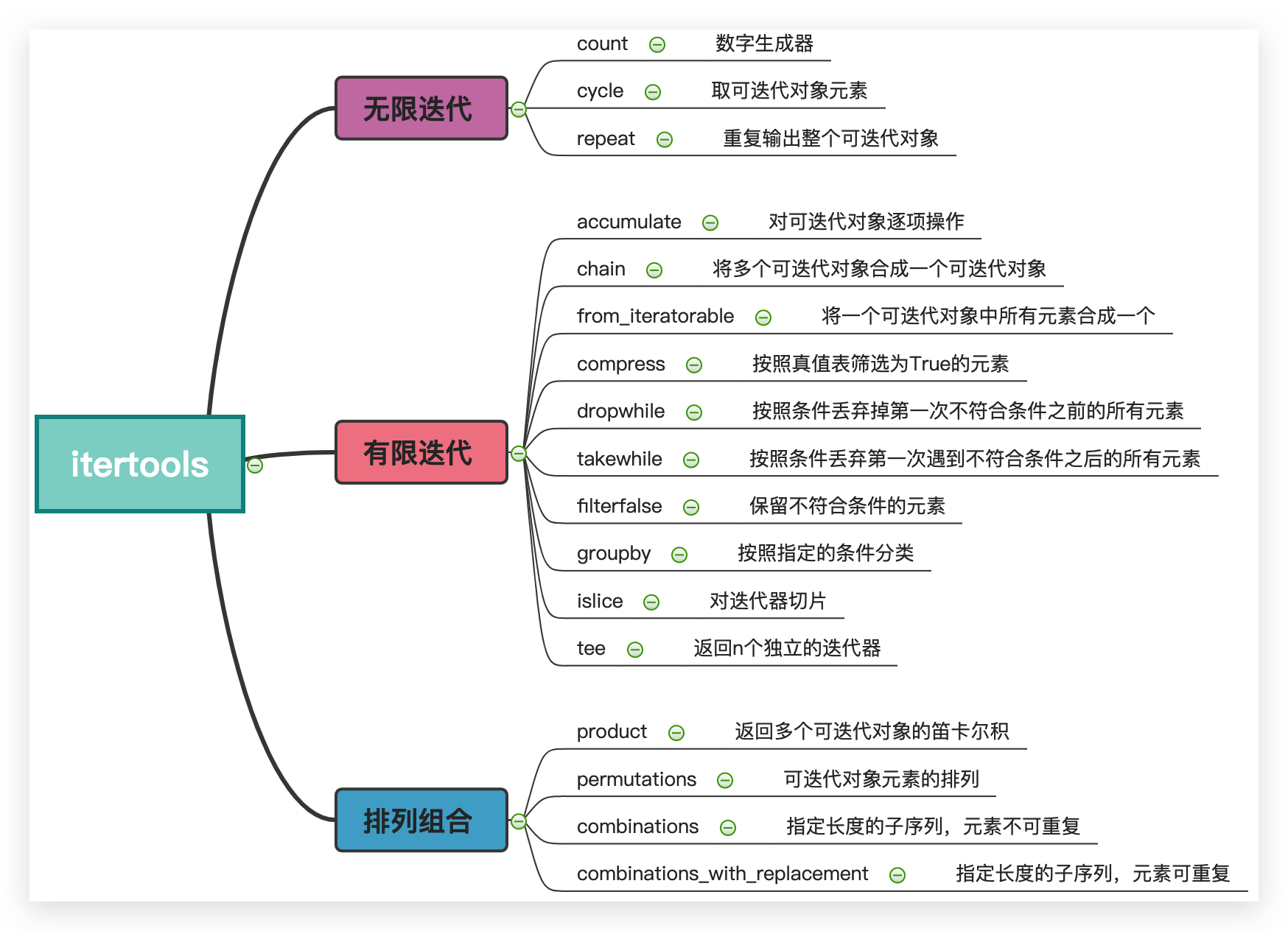
itertools提供的功能主要分为三大块,以最新版本的3.10为例:
- 对可迭代对象无限迭代,无限输出
- 对可迭代对象有限迭代
- 对可迭代对象排列组合
方法如下:
导入包
>>> from iteratortools import *
无限迭代
iteratortools.count(start=0, step=1)
数值生成器,可以指定起始位置和步长,并且步长可以为浮点数。无限输出,一直累加,在例子中需要边睡眠1s边输出。
>>> import time

>>> iterator = count(4, 0.5)

>>> for i in iterator:

...     print(i)

...     time.sleep(1)

...

4

4.5

5.0

5.5

6.0

6.5

7.0

7.5
iteratortools.cycle(iteratorable)
无限循环取出可迭代对象里的元素
>>> a = cycle("ABCD")

>>> import time

>>> for i in a:

...     print(i)

...     time.sleep(1)

...

A

B

C

D

A

B

C

D
iteratortools.repeat(object[, times])
不断重复输出整个object,如果指定了重复次数,则输出指定次数,否则将无限重复。
>>> iterator = repeat('hello world', 10)

>>>

>>> for i in iterator:

...     print(i)

...

hello world

hello world

hello world

hello world

hello world

hello world

hello world

hello world

hello world

hello world

有了这个神器,对输出10次hello world这种问题又有一种新解法
有限迭代
iteratortools.accumulate(iteratorable[, func, *, initial=None])
返回对列表中元素逐项的操作,操作有:
- 累加,返回累加到每一项的列表
- 累乘,返回累乘到每一项的列表
- 最小值,返回到当前项的最小值
- 最大值,返回到当前项的最大值
>>> [2, 4, 8, 1, 3, 5]

[2, 4, 8, 1, 3, 5]

>>> arr = [2, 4, 8, 1, 3, 5]

>>>

>>> add = accumulate(arr)

>>>

>>> list(add)

[2, 6, 14, 15, 18, 23]

>>>

>>> max = accumulate(arr, max)

>>> list(max)

[2, 4, 8, 8, 8, 8]

>>>

>>> import operator

>>> mul = accumulate(arr, operator.mul)

>>> list(mul)

[2, 8, 64, 64, 192, 960]

>>>

>>> min = accumulate(arr, min)

>>> list(min)

[2, 2, 2, 1, 1, 1]
iteratortools.chain(*iteratorables)
将多个可迭代对象构建成一个新的可迭代对象,统一返回。类似于将多个对象链成一条串
>>> iterator = chain([1,2,3],['a','b','c'],(5,6,7))

>>> list(iterator)

[1, 2, 3, 'a', 'b', 'c', 5, 6, 7]
优点:可以将多个可迭代对象整合成一个,避免逐个取值
chain.from_iteratorable(iteratorable)
将一个迭代对象中将所有元素类似于chain一样,统一返回。
>>> chain.from_iteratorable(['abc','def'])

<iteratortools.chain object at 0x1083ae460>

>>> iterator = chain.from_iteratorable(['abc','def'])

>>> list(iterator)

['a', 'b', 'c', 'd', 'e', 'f']
iteratortools.compress(data, selectors)
按照真值表筛选元素
>>> arr = [1,2,3,4]

>>> selectors = [1,0,1,0]

>>>

>>> iterator = compress(arr, selectors)

>>>

>>> list(iterator)

[1, 3]
iteratortools.dropwhile(predicate, iteratorable)
按照条件筛选,丢弃掉第一次不符合条件时之前的所有元素
>>> arr = [1,2,3,2,1,2,1]

>>> iterator = dropwhile(lambda x: x<3, arr)

>>> list(iterator)

[3, 2, 1, 2, 1]
iteratortools.takewhile(predicate, iteratorable)
根据predicate条件筛选可迭代对象中的元素,只要元素为真就返回,第一次遇到不符合的条件就退出。
按照条件筛选,丢弃第一次遇到不符合条件之后的元素。行为类似于上一个dropwhile,区别在于丢弃的选择不同。
iteratortools.filterfalse(predicate, iteratorable)
保留不符合条件的元素,返回迭代器
>>> arr = [1,2,3,4,5]

>>> iterator = filterfalse(lambda x:x<3, arr)

>>> list(iterator)

[3, 4, 5]
iteratortools.groupby(iteratorable, key=None)
按照指定的条件分类。输出条件和符合条件的元素
>>> iterator = groupby(arr, lambda x: x>3)

>>> for condition ,numbers in iterator:

...     print(condition, list(numbers))

...

False [1, 2, 3]

True [4, 5]
iteratortools.islice(iteratorable, start, stop[, step])
对迭代器进行切片,老版本中不能指定start和stop以及步长,新版本可以。
>>> iterator = count()

>>> slice_iterator = islice(iterator, 10, 20, 2)

>>> list(slice_iterator)

[10, 12, 14, 16, 18]
iteratortools.starmap(function, iteratorable)
将function作用于可迭代对象上,类似于map函数
iteratortools.tee(iteratorable, n=2)
从一个可迭代对象中返回 n 个独立的迭代器
>>> iterator = tee(arr)

>>> for i in iterator:

...     print(type(i), list(i))

...

<class 'iteratortools._tee'> [1, 2, 3, 4, 5]

<class 'iteratortools._tee'> [1, 2, 3, 4, 5]
iteratortools.zip_longest(*iteratorables, fillvalue=None)
创建一个迭代器,从每个可迭代对象中收集元素。如果可迭代对象的长度未对齐,将根据 fillvalue 填充缺失值。
迭代持续到耗光最长的可迭代对象。大致相当于:
>>> iterator = zip_longest("ABCD", "xy", fillvalue="-")

>>> list(iterator)

[('A', 'x'), ('B', 'y'), ('C', '-'), ('D', '-')]
排列组合迭代
iteratortools.product(*iteratorables, repeat=1)
生成多个可迭代对象的笛卡尔积
大致相当于生成器表达式中的嵌套循环。例如, product(A, B) 和 ((x,y) for x in A for y in B) 返回结果一样。
>>> iterator = product("123", "abc")

>>> list(iterator)

[('1', 'a'), ('1', 'b'), ('1', 'c'), ('2', 'a'), ('2', 'b'), ('2', 'c'), ('3', 'a'), ('3', 'b'), ('3', 'c')]
将可选参数 repeat 设定为要重复的次数。例如,product(A, repeat=4) 和 product(A, A, A, A) 是一样的
iteratortools.permutations(iteratorable, r=None)
由 iteratorable 元素生成长度为 r 的排列。元素的排列,类似于给一个[1,2,3],选取其中两个元素,一共有多少种组合方法?不要求元素排列之后的位置。
>>> iter = permutations([1,2,3], r=3)

>>> list(iterator)

[(1, 2, 3), (1, 3, 2), (2, 1, 3), (2, 3, 1), (3, 1, 2), (3, 2, 1)]
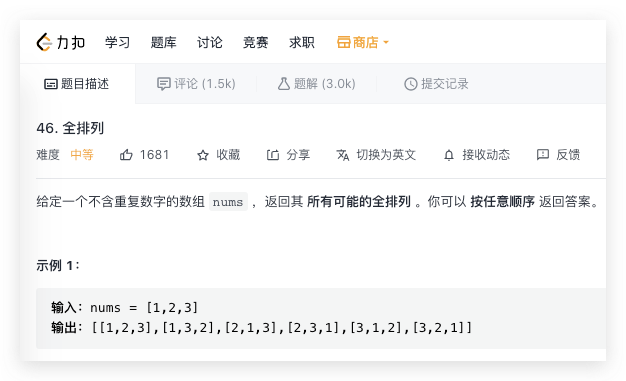
这个方法能够完美解决算法中的全排列问题,简直是量身定做。如果早知道这么简单,当年考算法也不会。。,哎
可参见leetcode46题:https://leetcode-cn.com/problems/permutations/
iteratortools.combinations(iteratorable, r)
返回由输入 iteratorable 中元素组成长度为 r 的子序列。元素不可重复使用。子序列是要求元素在排列之后和之前的相对位置不变的。1,2,3中3在1的后面,子序列中3也一定在1的后面。
>>> iterator = combinations([1,2,3,4], r = 3)

>>> list(iterator)

[(1, 2, 3), (1, 2, 4), (1, 3, 4), (2, 3, 4)]

>>> iterator = combinations([1], r = 3)

>>> list(iterator)

[]
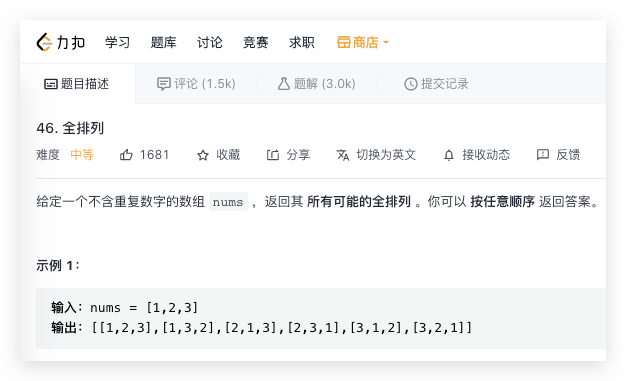
这个方法可以曲线解决组合总数问题
https://leetcode-cn.com/problems/combination-sum/
iteratortools.combinations_with_replacement(iteratorable, r)
返回由输入 iteratorable 中元素组成的长度为 r 的子序列,允许每个元素可重复出现
>>> iter = combinations_with_replacement([1,2,3,4], r=2)

>>> list(iter)

[(1, 1), (1, 2), (1, 3), (1, 4), (2, 2), (2, 3), (2, 4), (3, 3), (3, 4), (4, 4)]

>>> iterator = combinations_with_replacement([1], r=3)

>>> list(iterator)

[(1, 1, 1)]
python自带性能强悍的标准库 itertools的更多相关文章
- python协程(yield、asyncio标准库、gevent第三方)、异步的实现
引言 同步:不同程序单元为了完成某个任务,在执行过程中需靠某种通信方式以协调一致,称这些程序单元是同步执行的. 例如购物系统中更新商品库存,需要用"行锁"作为通信信号,让不同的更新 ...
- Python学习笔记011_模块_标准库_第三方库的安装
容器 -> 数据的封装 函数 -> 语句的封装 类 -> 方法和属性的封装 模块 -> 模块就是程序 , 保存每个.py文件 # 创建了一个hello.py的文件,它的内容如下 ...
- python进阶(26)collections标准库
前言 这个模块实现了特定目标的容器,以提供Python标准内建容器dict ,list ,set , 和tuple 的替代选择. 这个模块提供了以下几个函数 函数 作用 namedtuple() 创建 ...
- Python入门(六):标准库
操作系统接口 os模块提供了不少与操作系统相关联的函数. import os os.getcwd() # 返回当前的工作目录 os.chdir('d:/') # 修改当前的工作目录 os.system ...
- Python标准库——走马观花
作者:Vamei 出处:http://www.cnblogs.com/vamei 欢迎转载,也请保留这段声明.谢谢! Python有一套很有用的标准库(standard library).标准库会随着 ...
- Python 标准库一览(Python进阶学习)
转自:http://blog.csdn.net/jurbo/article/details/52334345 写这个的起因是,还是因为在做Python challenge的时候,有的时候想解决问题,连 ...
- 第十三篇:带缓冲的IO( 标准IO库 )
前言 在之前,学习了 read write 这样的不带缓冲IO函数. 而本文将讲解标准IO库中,带缓冲的IO函数. 为什么要有带缓冲IO函数 标准库提供的带缓冲IO函数是为了减少 read 和 wri ...
- Python模块进阶、标准库、扩展库
模块进阶 Python有一套很有用的标准库(standard library).标准库会随着Python解释器,一起安装在你的电脑中的. 它是Python的一个组成部分.这些标准库是Python为你准 ...
- C++解析(18):C++标准库与字符串类
0.目录 1.C++标准库 2.字符串类 3.数组操作符的重载 4.小结 1.C++标准库 有趣的重载--操作符 << 的原生意义是按位左移,例:1 << 2;,其意义是将整数 ...
随机推荐
- C#与dotNET项目想要另存为一个新项目sln文件丢了怎么办
如下图所示,我想要另存一个工程,把 V4.4整个的项目另存为V4.5,我可以把解决方案文件(.sln)改名字,但是我没法把文件夹改名字,改了打开sln就说找不到. 很简单的一个思路是反正sln是多余的 ...
- 教你用SQL进行数据分析
摘要:采用 SQL 作为数据查询和分析的入口是一种数据全栈的思路. 本文分享自华为云社区<如何使用 SQL 对数据进行分析?>,作者:zuozewei . 前言 我们通过 OLTP(联机事 ...
- Centos8 部署 ElasticSearch 集群并搭建 ELK,基于Logstash同步MySQL数据到ElasticSearch
Centos8安装Docker 1.更新一下yum [root@VM-24-9-centos ~]# yum -y update 2.安装containerd.io # centos8默认使用podm ...
- [bzoj4557]侦察守卫
令g[i][j]表示覆盖了i的子树中距离i大于等于j的所有点,f[i][j]表示覆盖了i的子树和子树外距离i小于等于j的所有点,有递推式$f[i][j]=min(f[i][j]+g[son][j],f ...
- [bzoj1084]最大子矩阵
用f[i][j][k]表示第一行前i个数,第二行前j个数选k个子矩形的答案,考虑转移:1.在第一行/第二行选择一个矩形2.当i=j时,可以选择一个两行的矩形注意要特判m=1的情况 1 #include ...
- [loj3302]信号传递
由于n较大,可以将n个数中的关系对数量记录在$m*m$的矩阵中,记作$a[i][j]$ 考虑朴素的状压dp枚举排列,即$f[i]$表示以i中的数的一种排列为整个序列的前缀的最小代价,然后转移枚举下一个 ...
- 洛谷 P4887 -【模板】莫队二次离线(第十四分块(前体))(莫队二次离线)
题面传送门 莫队二次离线 mol ban tea,大概是这道题让我第一次听说有这东西? 首先看到这类数数对的问题可以考虑莫队,记 \(S\) 为二进制下有 \(k\) 个 \(1\) 的数集,我们实时 ...
- 文件/目录对比:diff命令
命令格式 diff [参数] [文件1或目录1] [文件2或目录2] Linux diff命令用于比较文件的差异. diff以逐行的方式,比较文本文件的异同处. 如果指定要比较目录,diff会比较目录 ...
- 【机器学习与R语言】9- 支持向量机
目录 1.理解支持向量机(SVM) 1)SVM特点 2)用超平面分类 3)对非线性空间使用核函数 2. 支持向量机应用示例 1)收集数据 2)探索和准备数据 3)训练数据 4)评估模型 5)提高性能 ...
- R语言与医学统计图形-【12】ggplot2几何对象之条图
ggplot2绘图系统--几何对象之条图(包括误差条图) 1.条图 格式: geom_bar(mapping = , data = , stat = 'count', #统计变换默认计数 positi ...