
Andrew Ng机器学习 五:Regularized Linear Regression and Bias v.s. Variance
背景:实现一个线性回归模型,根据这个模型去预测一个水库的水位变化而流出的水量。
加载数据集ex5.data1后,数据集分为三部分:
1,训练集(training set)X与y;
2,交叉验证集(cross validation)Xval, yval;
3,测试集(test set): Xtest, ytest。
一:正则化线性回归(Regularized Linear Regression)
1,可视化训练集,如下图所示:
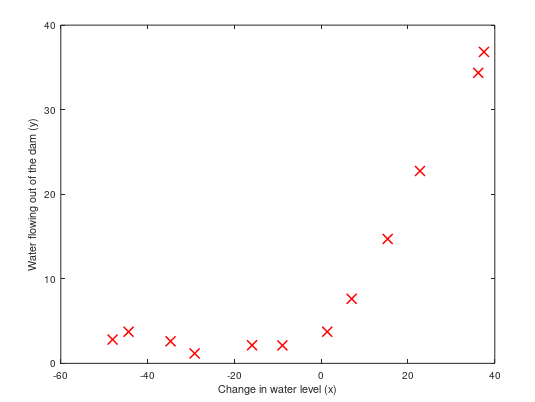
通过可视化数据,接下来我们使用线性回归去拟合这些数据集。
2,正则化线性回归代价函数:
$J(\theta)=\frac{1}{2m}(\sum_{i=1}^{m}(h_{\theta}(x^{(i)})-y^{(i)})^2)+\frac{\lambda }{2m}\sum_{j=1}^{n}\theta_{j}^{2}$,忽略偏差项$\theta_0$的正则化
3,正则化线性回归梯度:
$\frac{\partial J(\theta)}{\partial \theta_0}=\frac{1}{m}\sum_{i=1}^{m}[(h_\theta(x^{(i)})-y^{(i)})x^{(i)}_j]$ for $j=0$
$\frac{\partial J(\theta)}{\partial \theta_j}=(\frac{1}{m}\sum_{i=1}^{m}[(h_\theta(x^{(i)})-y^{(i)})x^{(i)}_j])+\frac{\lambda }{m}\theta_j $ for $j\geq 1$
function [J, grad] = linearRegCostFunction(X, y, theta, lambda)

%LINEARREGCOSTFUNCTION Compute cost and gradient for regularized linear

%regression with multiple variables

%   [J, grad] = LINEARREGCOSTFUNCTION(X, y, theta, lambda) computes the

%   cost of using theta as the parameter for linear regression to fit the

%   data points in X and y. Returns the cost in J and the gradient in grad

% Initialize some useful values

m = length(y); % number of training examples

% You need to return the following variables correctly

J = ;

grad = zeros(size(theta));

% ====================== YOUR CODE HERE ======================

% Instructions: Compute the cost and gradient of regularized linear

%               regression for a particular choice of theta.

%

%               You should set J to the cost and grad to the gradient.

%

  h=X*theta;

  theta(,)=;

  %线性回归代价函数

  J=(sum(power((h-y),))+lambda*sum(power(theta,)))/(*m);

 %梯度下降

  grad=((h-y)'*X).*(1/m)+(theta').*(lambda/m);

% =========================================================================

grad = grad(:);

end
linearRegCostFunction.m
4,拟合线性回归(Fitting linear regression):
在这我们不正则化,拟合如下图所示:
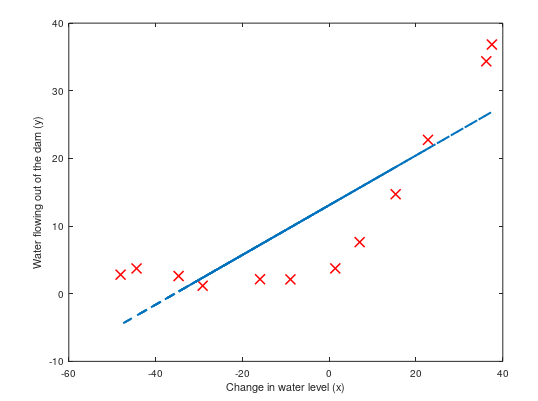
观察图可以拟合的直线为高偏差,因为数据集不是一条直线,而我们现在的数据集X只有一维,不足以拟合成一条曲线。
二:偏差与方差(Bias-variance)
1,学习曲线(Learning curves)
学习曲线将训练和交叉验证误差绘制为训练集大小的函数。
训练集误差(Training error): $J_{train}(\theta)=\frac{1}{2m}\sum_{i=1}^{m}(h_{\theta}(x^{(i)})-y^{(i)})^2$
在计算训练集误差时,在训练子集上进行计算(即$X(1:n,:)$和$y(1:n)$)(而不是整个训练集),
但是,对于交叉验证错误,在整个交叉验证集上对其进行计算。
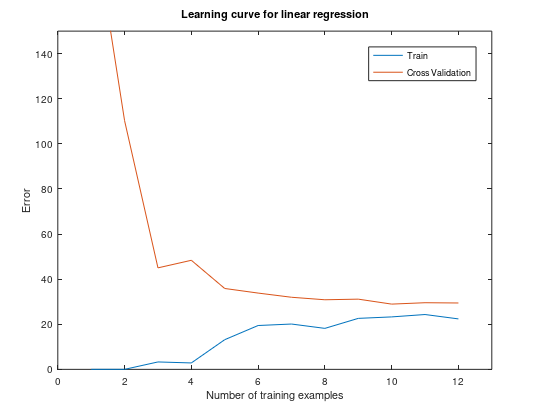
忽略正则化,我们可视化这个训练集的学习曲线,如下图所示:
function [error_train, error_val] = ...

    learningCurve(X, y, Xval, yval, lambda)

%LEARNINGCURVE Generates the train and cross validation set errors needed

%to plot a learning curve

%   [error_train, error_val] = ...

%       LEARNINGCURVE(X, y, Xval, yval, lambda) returns the train and

%       cross validation set errors for a learning curve. In particular,

%       it returns two vectors of the same length - error_train and

%       error_val. Then, error_train(i) contains the training error for

%       i examples (and similarly for error_val(i)).

%

%   In this function, you will compute the train and test errors for

%   dataset sizes from  up to m. In practice, when working with larger

%   datasets, you might want to do this in larger intervals.

%

% Number of training examples

m = size(X, );

% You need to return these values correctly

error_train = zeros(m, );

error_val   = zeros(m, );

% ====================== YOUR CODE HERE ======================

% Instructions: Fill in this function to return training errors in

%               error_train and the cross validation errors in error_val.

%               i.e., error_train(i) and

%               error_val(i) should give you the errors

%               obtained after training on i examples.

%

% Note: You should evaluate the training error on the first i training

%       examples (i.e., X(:i, :) and y(:i)).

%

%       For the cross-validation error, you should instead evaluate on

%       the _entire_ cross validation set (Xval and yval).

%

% Note: If you are using your cost function (linearRegCostFunction)

%       to compute the training and cross validation error, you should

%       call the function with the lambda argument set to .

%       Do note that you will still need to use lambda when running

%       the training to obtain the theta parameters.

%

% Hint: You can loop over the examples with the following:

%

%       for i = :m

%           % Compute train/cross validation errors using training examples

%           % X(:i, :) and y(:i), storing the result in

%           % error_train(i) and error_val(i)

%           ....

%

%       end

%

% ---------------------- Sample Solution ----------------------

  for i=:m

    %给前i个样例拟合参数θ

    theta = trainLinearReg(X(:i,:), y(:i,:), lambda);

    %计算前i个样例的训练误差

    [J, grad] = linearRegCostFunction(X(:i,:), y(:i,:), theta, );

    error_train(i)=J;

    %计算交叉验证集误差

    [J, grad] = linearRegCostFunction(Xval, yval, theta, );

    error_val(i)=J;

  end

% -------------------------------------------------------------

% =========================================================================

end
learningCurve.m
观察此图,可以看到训练集数量增大时,误差还是很大,不会有太大改观,这是属于高偏差/欠拟合(High bias)问题--模型太过于简单,接下来我们将会增加更多的特征去拟合训练集。
2,多项式回归(Polynomial regression)
我们在上一步对于训练集的模型太过于简单,导致出现了欠拟合(高偏差)问题,接下来我们通过原有的特征增加更多新的特征,我们增加p维,每一维为原来特征的i次幂。
回归函数:$h_{\theta}(x)=\theta_0+\theta_1(waterLevel)+\theta_2(waterLevel)^{2}+...++\theta_p(waterLevel)^{p}$
$=h_{\theta}(x)=\theta_0+\theta_1(x_1)+\theta_2(x_2)^{2}+...++\theta_p(x_p)^{p}$
function [X_poly] = polyFeatures(X, p)

%POLYFEATURES Maps X (1D vector) into the p-th power

%   [X_poly] = POLYFEATURES(X, p) takes a data matrix X (size m x ) and

%   maps each example into its polynomial features where

%   X_poly(i, :) = [X(i) X(i).^ X(i).^ ...  X(i).^p];

%

% You need to return the following variables correctly.

X_poly = zeros(numel(X), p);

% ====================== YOUR CODE HERE ======================

% Instructions: Given a vector X, return a matrix X_poly where the p-th

%               column of X contains the values of X to the p-th power.

%

%

##  for i=:p

##    X_poly(:,i)=X .^ i;

##  end

for i=:p

    X_poly(:,i)=X .^ i;

end

% =========================================================================

end
polyFeatures.m
我们增加了新特征之后,要先进行特征缩放。然后我们使用新的训练集去拟合参数$\theta$(忽略正则化)。
此训练集模型的曲线:

将训练集和交叉验证集的代价函数误差与样本数绘制在同一张图表
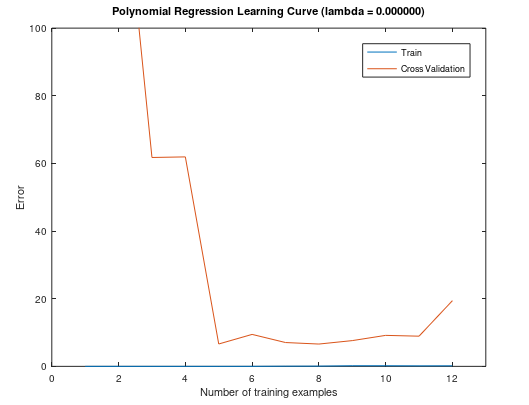
通过以上两图,我们可以看到,该模型完全适合于训练集,但对于交叉验证集,就不能很好的泛化了,此时出现了高方差/过拟合问题。那么接下来我们使用正则化来解决过拟合问题。
3,选择一个合适的正则化参数$\lambda$
我们尝试不同的$lambda$值来去选择一个较优的值,例如[0.001,0.003,0.01,0.03,0.1,0.3,1,3,10]
function [lambda_vec, error_train, error_val] = ...

    validationCurve(X, y, Xval, yval)

%VALIDATIONCURVE Generate the train and validation errors needed to

%plot a validation curve that we can use to select lambda

%   [lambda_vec, error_train, error_val] = ...

%       VALIDATIONCURVE(X, y, Xval, yval) returns the train

%       and validation errors (in error_train, error_val)

%       for different values of lambda. You are given the training set (X,

%       y) and validation set (Xval, yval).

%

% Selected values of lambda (you should not change this)

lambda_vec = [ 0.001 0.003 0.01 0.03 0.1 0.3   ]';

% You need to return these variables correctly.

error_train = zeros(length(lambda_vec), );

error_val = zeros(length(lambda_vec), );

% ====================== YOUR CODE HERE ======================

% Instructions: Fill in this function to return training errors in

%               error_train and the validation errors in error_val. The

%               vector lambda_vec contains the different lambda parameters

%               to use for each calculation of the errors, i.e,

%               error_train(i), and error_val(i) should give

%               you the errors obtained after training with

%               lambda = lambda_vec(i)

%

% Note: You can loop over lambda_vec with the following:

%

%       for i = :length(lambda_vec)

%           lambda = lambda_vec(i);

%           % Compute train / val errors when training linear

%           % regression with regularization parameter lambda

%           % You should store the result in error_train(i)

%           % and error_val(i)

%           ....

%

%       end

%

%

  for i=:length(lambda_vec)

      lambda=lambda_vec(i);

      [theta] = trainLinearReg(X, y, lambda)

      error_train(i)=linearRegCostFunction(X, y, theta, ); %计算训练集的误差,忽略正则化的影响

      error_val(i)=linearRegCostFunction(Xval, yval, theta, );

  end

% =========================================================================

end
validationCurve.m
可视化图如下所示:
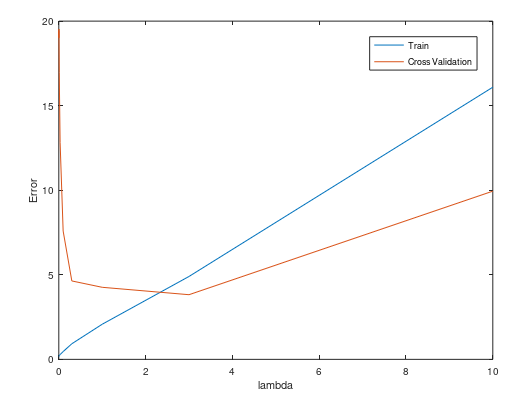
观察图,我们可以选择$lambda=3$。
总结:
1,获得更多的训练实例: 解决高偏差
2,尝试减少特征的数量:解决高方差
3,尝试获得更多的特征: 解决高偏差
4,尝试增加多项式的特征:解决高偏差
5,尝试减少正则化的程度$\lambda$:解决高偏差
6,尝试增加正则化的程度$\lambda$:解决高方差
Andrew Ng机器学习 五:Regularized Linear Regression and Bias v.s. Variance的更多相关文章
- 第五次编程作业-Regularized Linear Regression and Bias v.s. Variance
1.正规化的线性回归 (1)代价函数 (2)梯度 linearRegCostFunction.m function [J, grad] = linearRegCostFunction(X, y, th ...
- CheeseZH: Stanford University: Machine Learning Ex5:Regularized Linear Regression and Bias v.s. Variance
源码:https://github.com/cheesezhe/Coursera-Machine-Learning-Exercise/tree/master/ex5 Introduction: In ...
- Andrew Ng机器学习编程作业: Linear Regression
编程作业有两个文件 1.machine-learning-live-scripts(此为脚本文件方便作业) 2.machine-learning-ex1(此为作业文件) 将这两个文件解压拖入matla ...
- Andrew Ng机器学习 一: Linear Regression
一:单变量线性回归(Linear regression with one variable) 背景:在某城市开办饭馆,我们有这样的数据集ex1data1.txt,第一列代表某个城市的人口,第二列代表在 ...
- Andrew Ng机器学习编程作业:Logistic Regression
编程作业文件: machine-learning-ex2 1. Logistic Regression (逻辑回归) 有之前学生的数据,建立逻辑回归模型预测,根据两次考试结果预测一个学生是否有资格被大 ...
- Andrew Ng机器学习 二: Logistic Regression
一:逻辑回归(Logistic Regression) 背景:假设你是一所大学招生办的领导,你依据学生的成绩,给与他入学的资格.现在有这样一组以前的数据集ex2data1.txt,第一列表示第一次测验 ...
- Andrew Ng机器学习编程作业:Regularized Linear Regression and Bias/Variance
作业文件: machine-learning-ex5 1. 正则化线性回归 在本次练习的前半部分,我们将会正则化的线性回归模型来利用水库中水位的变化预测流出大坝的水量,后半部分我们对调试的学习算法进行 ...
- Andrew Ng机器学习课程笔记--汇总
笔记总结,各章节主要内容已总结在标题之中 Andrew Ng机器学习课程笔记–week1(机器学习简介&线性回归模型) Andrew Ng机器学习课程笔记--week2(多元线性回归& ...
- Andrew Ng机器学习课程笔记(五)之应用机器学习的建议
Andrew Ng机器学习课程笔记(五)之 应用机器学习的建议 版权声明:本文为博主原创文章,转载请指明转载地址 http://www.cnblogs.com/fydeblog/p/7368472.h ...
随机推荐
- [LeetCode] 79. Word Search 单词搜索
Given a 2D board and a word, find if the word exists in the grid. The word can be constructed from l ...
- openstack-keystone外组件命令行
摘自openstack文档 镜像(glance) 列出您可以访问的镜像 $ openstack image list 删除指定的镜像 $ openstack image delete IMAGE 描述 ...
- 开源之路2--SSH
SSH 为 Secure Shell (安全外壳协议)的缩写,由 IETF 的网络小组(Network Working Group)所制定:SSH是每一台Linux电脑的标准配置. SSH 是建立在应 ...
- Selenium自动化获取WebSocket信息
性能日志 ChromeDriver支持性能日志记录,您可以从中获取域“时间轴”,“网络”和“页面”的事件,以及指定跟踪类别的跟踪数据. 启用性能日志 默认情况下不启用性能日志记录.因此,在创建新会话时 ...
- 《TCP/IP - TCP/UDP》
一:概述 - 由于 IP 的传输是无状态的,IP 提供尽力服务,但并不保证数据可以到达主机. - 所以,数据的完整性需要更上层的 传输层来保证.TCP和UDP 均属于 传输层. 二:UDP - 特点 ...
- Django之拾遗
一.设计模式 1.1 MVC 模型(M)是数据的表述,非真正数据,而是数据接口. 视图(V)是你看到的界面,是模型的表现层,此外还提供了收集用户输入的接口. 控制器(C)控制模型和视图之间的信息流动. ...
- CharacterEncodingFilter cannot be cast to javax.servlet.Filter
java.lang.ClassCastException: org.springframework.web.filter.CharacterEncodingFilter cannot be cast ...
- 10分钟用scratch写一个大鱼吃小鱼的小游戏
第一次给张江小朋友教Scratch课程之前,还在担心一些概念能不能向小朋友解释清楚,可上完课发现,我严重低估了小朋友的聪明程度,发现现在的孩子相比较自己8.9岁的时候,简直聪明太多倍了. 所以总结了半 ...
- Web.sitemap网站导航
全文注释: Web.sitemap导航XML文件,站点地图,功能实现菜单 1.xml的版本1.0 和编码utf-8 2.Url链接 Title显示的标题 Description描述(ToolTip) ...
- Matlab 多项式及其函数
多项式及其函数 多项式及其函数 Matlab用一维向量表示多项式 例:创建一个通用的一维向量转化为字符串格式的表达式 function s = pprintf(p) %pprintf 该函数可将一维向 ...