
poj3440--Coin Toss(几何上的概率)
| Time Limit: 5000MS | Memory Limit: 65536K | |
| Total Submissions: 3946 | Accepted: 1076 |
Description
In a popular carnival game, a coin is tossed onto a table with an area that is covered with square tiles in a grid. The prizes are determined by the number of tiles covered by the coin when it comes to rest: the more tiles it covers, the better the prize. In the following diagram, the results from five coin tosses are shown:
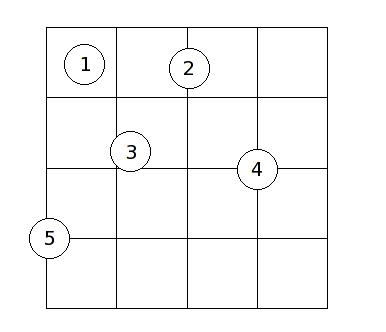
In this example:
- coin 1 covers 1 tile
- coin 2 covers 2 tiles
- coin 3 covers 3 tiles
- coin 4 covers 4 tiles
- coin 5 covers 2 tiles
Notice that it is acceptable for a coin to land on the boundary of the playing area (coin 5). In order for a coin to cover a tile, the coin must cover up a positive area of the tile. In other words, it is not enough to simply touch the boundary of the tile. The center of the coin may be at any point of the playing area with uniform probability. You may assume that (1) the coin always comes to a rest lying flat, and (2) the player is good enough to guarantee that the center of the coin will always come to rest on the playing area (or the boundary).
The probability of a coin covering a certain number of tiles depends on the tile and coin sizes, as well as the number of rows and columns of tiles in the playing area. In this problem, you will be required to write a program which computes the probabilities of a coin covering a certain number of tiles.
Input
Output
Separate the output of consecutive cases by a blank line.
Sample Input
3

5 5 10 3

7 4 25 20

10 10 10 4
Sample Output
Case 1:

Probability of covering 1 tile  = 57.7600%

Probability of covering 2 tiles = 36.4800%

Probability of covering 3 tiles = 1.2361%

Probability of covering 4 tiles = 4.5239%

Case 2:

Probability of covering 1 tile  = 12.5714%

Probability of covering 2 tiles = 46.2857%

Probability of covering 3 tiles = 8.8293%

Probability of covering 4 tiles = 32.3135%

Case 3:

Probability of covering 1 tile  = 40.9600%

Probability of covering 2 tiles = 46.0800%

Probability of covering 3 tiles = 2.7812%

Probability of covering 4 tiles = 10.1788%
Source
题意:
就是问一个半径为r的硬币扔在r*c由t*t正方形组成的格子,
问覆盖一个格子,两个格子,三个格子,四个格子的概率,要求圆心必须在矩形上
题解:
发现1,2,3,4组成的概率为1,然后发现3这种情况最难计算,所以计算出1,2,4,然后1去减就可以了。
 #include<cstdio>

 #include<cstring>

 #include<algorithm>

 #include<cmath>

 #include<iostream>

 using namespace std;

 const double PI=acos(-1.0),eps=1e-;

 int main()

 {

     int T,ca=;

     for(scanf("%d",&T);T;T--)

     {

         double n,m,t,c,A[];

         scanf("%lf%lf%lf%lf",&n,&m,&t,&c);

         A[]=t*t*n*m;

         A[]=(t-c)*(t-c)*n*m+(c*(t-c)+c*c/4.0)*+c*(t-c)*(n+m-);

         A[]=*c*(t-c)*n*m-c*(t-c)*(n+m)+c*c*(n+m-);

         A[]=PI*c*c/*(n-)*(m-);

         A[]=A[]-A[]-A[]-A[];

         printf("Case %d:\n",++ca);

         for(int i=;i<=;i++)

             printf("Probability of covering %d tile%s = %.4lf%%\n",i,(i==)?" ":"s",A[i]/A[]*100.0+eps);

         printf("\n");

     }

 }
poj3440--Coin Toss(几何上的概率)的更多相关文章
- UVA 10328 - Coin Toss dp+大数
题目链接: https://uva.onlinejudge.org/index.php?option=com_onlinejudge&Itemid=8&page=show_proble ...
- UVA 10328 Coin Toss
Coin Toss Time Limit: 3000ms Memory Limit: 131072KB This problem will be judged on UVA. Original ID: ...
- POJ 3440 Coin Toss(概率)
题目链接 概率问题,像是概率论上学的均匀分布,是不是呢,忘了... 概率同面积有关系,我写的各种搓,然后此题格式十分变态,=前有的时候俩空格,有的时候一个空格.代码各种搓. #include < ...
- POJ 3440 Coin Toss(求概率)
题目链接 题意 :把硬币往棋盘上扔,分别求出硬币占1,2,3,4个格子的时候的概率. 思路 : 求出公式输出,不过要注意输出格式,我还因为输入的时候用了int类型错了好几次..... #include ...
- poj 3440 Coin Toss 概率问题
这题主要是推导数学公式!!! 将概率问题转化为圆心所在的面积! 代码如下: #include<iostream> #include<stdio.h> #include<a ...
- Coin Toss(uva 10328,动态规划递推,限制条件,至少转至多,高精度)
有n张牌,求出至少有k张牌连续是正面的排列的种数.(1=<k<=n<=100) Toss is an important part of any event. When everyt ...
- UVa 10328 - Coin Toss (递推)
题意:给你一个硬币,抛掷n次,问出现连续至少k个正面向上的情况有多少种. 原题中问出现连续至少k个H的情况,很难下手.我们可以试着将问题转化一下. 设dp[i][j]表示抛掷i个硬币出现连续至多j个H ...
- [USACO Hol10] 臭气弹 图上期望概率dp 高斯
记住一开始和后来的经过是两个事件因此概率可以大于一 #include<cstdio> #include<iostream> #include<cstdlib> #i ...
- 题解 UVA10328 【Coin Toss】
这道题目其实就是说有N张纸牌,问至少连续K张正面朝上的可能性是多少. 可以用递推做.首先我们将题目所求从 至少K张 转化为 总数 - 至多K张 (为什么要这样自己想) 设F[i][j]为前i个纸牌至多 ...
随机推荐
- *关于TCP长连接,NAT超时,心跳包
参考: http://www.jianshu.com/p/584707554ed7 1.TCP长连接 TCP连接建立后只要不明确关闭,逻辑上连接一直存在. TCP是有保活定时器的,可以打开保活定时器来 ...
- Linux命令(009) -- tar
tar命令可以为Linux的文件和目录创建档案(备份).利用该命令,可以为某一特定文件创建备份,也可以在档案中改变文件或向档案中加入新的文件:可以把一大堆的文件和目录全部打包成一个文件,这对于备份文件 ...
- 转】[MySQL优化]为MySQL数据文件ibdata1瘦身
原博文出自于: http://blog.fens.me/category/%E6%95%B0%E6%8D%AE%E5%BA%93/page/2/ 感谢! [MySQL优化]为MySQL数据文件ibda ...
- Android开发学习——开发调试工具-DDMS应用,ADB进程,Logcat,Eclipse Debug调试
DDMS -- Dalvik debug monitor service 调试监控服务 对模拟器进行相关配置. ADB进程 Android debug bridge 建立eclipse和 ...
- Java 线程是什么-渐入佳境
线程:(一)什么是线程 管哥说:程序中有多个执行流就叫多线程.多线程是多任务的一种特别的形式.好处:单个程序可以创建多个并发执行的程序来完成各自的任务.多线程能满足程序员编写高效率的程序来达到充分利用 ...
- 轻松搞懂Java中的自旋锁
前言 在之前的文章<一文彻底搞懂面试中常问的各种“锁”>中介绍了Java中的各种“锁”,可能对于不是很了解这些概念的同学来说会觉得有点绕,所以我决定拆分出来,逐步详细的介绍一下这些锁的来龙 ...
- 搞定redis面试--Redis的过期策略?手写一个LRU?
1 面试题 Redis的过期策略都有哪些?内存淘汰机制都有哪些?手写一下LRU代码实现? 2 考点分析 1)我往redis里写的数据怎么没了? 我们生产环境的redis怎么经常会丢掉一些数据?写进去了 ...
- 简洁大方的wordpress主题,不容错过的主题,附带主题源码下载
cu主题是由疯狂的大叔设计,界面简洁大方是它最大的特点之一. 手残君也比较喜爱这款主题,在使用的过程中,根据手残君的个人习惯,对其进行了优化. 标题优化 标题居中显示 增加标题div背景色 标题div ...
- idea 2018 解决 双击shift 弹出 search everywhere 搜索框的方法
https://youtrack.jetbrains.com/issue/IDEA-161094
- H.264学习笔记4——变换量化
A.变换量化过程总体介绍 经过帧内(16x16和4x4亮度.8x8色度)和帧间(4x4~16x16亮度.4x4~8x8色度)像素块预测之后,得到预测块的残差,为了压缩残差信息的统计冗余,需要对残差数据 ...