
详细解读DiskLruCache
DiskLruCache这个类我记忆中是来自Google的一个开源项目,叫做BitmapFun,目的是更方便的加载bitmap。项目的源码:https://developer.android.com/training/displaying-bitmaps/index.html,这个项目中就有一个DiskLruCache类,用来做图片的磁盘缓存。了解缓存机制的朋友应该知道缓存应该做内存和磁盘两个,这个类提供的磁盘缓存用的是Lru(最近最少使用)算法。这个算法保证了经常使用的数据会被缓存,如果经常没用的数据就被清理。这就和人类的大脑一样,最近经常看过的知识就能记得很牢,如果长时间没看了,就可能记不得了。好了,说了这么多了,开始正文。
一、源码分析
1.1 源码
刚上来就开始源码分析不是我的风格,所以仅仅是贴一下,然后通过感性的认识进行总结。首先需要说明的是这个类在android的SDK中是没有的,需要自己下载导入。
/*
* Copyright (C) 2011 The Android Open Source Project
*
* Licensed under the Apache License, Version 2.0 (the "License");
* you may not use this file except in compliance with the License.
* You may obtain a copy of the License at
*
* http://www.apache.org/licenses/LICENSE-2.0
*
* Unless required by applicable law or agreed to in writing, software
* distributed under the License is distributed on an "AS IS" BASIS,
* WITHOUT WARRANTIES OR CONDITIONS OF ANY KIND, either express or implied.
* See the License for the specific language governing permissions and
* limitations under the License.
*/
package libcore.io;
import java.io.BufferedWriter;
import java.io.Closeable;
import java.io.EOFException;
import java.io.File;
import java.io.FileInputStream;
import java.io.FileNotFoundException;
import java.io.FileOutputStream;
import java.io.FileWriter;
import java.io.FilterOutputStream;
import java.io.IOException;
import java.io.InputStream;
import java.io.InputStreamReader;
import java.io.OutputStream;
import java.io.OutputStreamWriter;
import java.io.Writer;
import java.nio.charset.Charsets;
import java.util.ArrayList;
import java.util.Arrays;
import java.util.Iterator;
import java.util.LinkedHashMap;
import java.util.Map;
import java.util.concurrent.Callable;
import java.util.concurrent.ExecutorService;
import java.util.concurrent.LinkedBlockingQueue;
import java.util.concurrent.ThreadPoolExecutor;
import java.util.concurrent.TimeUnit;
/**
* A cache that uses a bounded amount of space on a filesystem. Each cache
* entry has a string key and a fixed number of values. Values are byte
* sequences, accessible as streams or files. Each value must be between {@code
* 0} and {@code Integer.MAX_VALUE} bytes in length.
*
* <p>The cache stores its data in a directory on the filesystem. This
* directory must be exclusive to the cache; the cache may delete or overwrite
* files from its directory. It is an error for multiple processes to use the
* same cache directory at the same time.
*
* <p>This cache limits the number of bytes that it will store on the
* filesystem. When the number of stored bytes exceeds the limit, the cache will
* remove entries in the background until the limit is satisfied. The limit is
* not strict: the cache may temporarily exceed it while waiting for files to be
* deleted. The limit does not include filesystem overhead or the cache
* journal so space-sensitive applications should set a conservative limit.
*
* <p>Clients call {@link #edit} to create or update the values of an entry. An
* entry may have only one editor at one time; if a value is not available to be
* edited then {@link #edit} will return null.
* <ul>
* <li>When an entry is being <strong>created</strong> it is necessary to
* supply a full set of values; the empty value should be used as a
* placeholder if necessary.
* <li>When an entry is being <strong>edited</strong>, it is not necessary
* to supply data for every value; values default to their previous
* value.
* </ul>
* Every {@link #edit} call must be matched by a call to {@link Editor#commit}
* or {@link Editor#abort}. Committing is atomic: a read observes the full set
* of values as they were before or after the commit, but never a mix of values.
*
* <p>Clients call {@link #get} to read a snapshot of an entry. The read will
* observe the value at the time that {@link #get} was called. Updates and
* removals after the call do not impact ongoing reads.
*
* <p>This class is tolerant of some I/O errors. If files are missing from the
* filesystem, the corresponding entries will be dropped from the cache. If
* an error occurs while writing a cache value, the edit will fail silently.
* Callers should handle other problems by catching {@code IOException} and
* responding appropriately.
*/
public final class DiskLruCache implements Closeable {
static final String JOURNAL_FILE = "journal";
static final String JOURNAL_FILE_TMP = "journal.tmp";
static final String MAGIC = "libcore.io.DiskLruCache";
static final String VERSION_1 = "1";
static final long ANY_SEQUENCE_NUMBER = -1;
private static final String CLEAN = "CLEAN";
private static final String DIRTY = "DIRTY";
private static final String REMOVE = "REMOVE";
private static final String READ = "READ";
/*
* This cache uses a journal file named "journal". A typical journal file
* looks like this:
* libcore.io.DiskLruCache
* 1
* 100
* 2
*
* CLEAN 3400330d1dfc7f3f7f4b8d4d803dfcf6 832 21054
* DIRTY 335c4c6028171cfddfbaae1a9c313c52
* CLEAN 335c4c6028171cfddfbaae1a9c313c52 3934 2342
* REMOVE 335c4c6028171cfddfbaae1a9c313c52
* DIRTY 1ab96a171faeeee38496d8b330771a7a
* CLEAN 1ab96a171faeeee38496d8b330771a7a 1600 234
* READ 335c4c6028171cfddfbaae1a9c313c52
* READ 3400330d1dfc7f3f7f4b8d4d803dfcf6
*
* The first five lines of the journal form its header. They are the
* constant string "libcore.io.DiskLruCache", the disk cache's version,
* the application's version, the value count, and a blank line.
*
* Each of the subsequent lines in the file is a record of the state of a
* cache entry. Each line contains space-separated values: a state, a key,
* and optional state-specific values.
* o DIRTY lines track that an entry is actively being created or updated.
* Every successful DIRTY action should be followed by a CLEAN or REMOVE
* action. DIRTY lines without a matching CLEAN or REMOVE indicate that
* temporary files may need to be deleted.
* o CLEAN lines track a cache entry that has been successfully published
* and may be read. A publish line is followed by the lengths of each of
* its values.
* o READ lines track accesses for LRU.
* o REMOVE lines track entries that have been deleted.
*
* The journal file is appended to as cache operations occur. The journal may
* occasionally be compacted by dropping redundant lines. A temporary file named
* "journal.tmp" will be used during compaction; that file should be deleted if
* it exists when the cache is opened.
*/
private final File directory;
private final File journalFile;
private final File journalFileTmp;
private final int appVersion;
private final long maxSize;
private final int valueCount;
private long size = 0;
private Writer journalWriter;
private final LinkedHashMap<String, Entry> lruEntries
= new LinkedHashMap<String, Entry>(0, 0.75f, true);
private int redundantOpCount;
/**
* To differentiate between old and current snapshots, each entry is given
* a sequence number each time an edit is committed. A snapshot is stale if
* its sequence number is not equal to its entry's sequence number.
*/
private long nextSequenceNumber = 0;
/** This cache uses a single background thread to evict entries. */
private final ExecutorService executorService = new ThreadPoolExecutor(0, 1,
60L, TimeUnit.SECONDS, new LinkedBlockingQueue<Runnable>());
private final Callable<Void> cleanupCallable = new Callable<Void>() {
@Override public Void call() throws Exception {
synchronized (DiskLruCache.this) {
if (journalWriter == null) {
return null; // closed
}
trimToSize();
if (journalRebuildRequired()) {
rebuildJournal();
redundantOpCount = 0;
}
}
return null;
}
};
private DiskLruCache(File directory, int appVersion, int valueCount, long maxSize) {
this.directory = directory;
this.appVersion = appVersion;
this.journalFile = new File(directory, JOURNAL_FILE);
this.journalFileTmp = new File(directory, JOURNAL_FILE_TMP);
this.valueCount = valueCount;
this.maxSize = maxSize;
}
/**
* Opens the cache in {@code directory}, creating a cache if none exists
* there.
*
* @param directory a writable directory
* @param appVersion
* @param valueCount the number of values per cache entry. Must be positive.
* @param maxSize the maximum number of bytes this cache should use to store
* @throws IOException if reading or writing the cache directory fails
*/
public static DiskLruCache open(File directory, int appVersion, int valueCount, long maxSize)
throws IOException {
if (maxSize <= 0) {
throw new IllegalArgumentException("maxSize <= 0");
}
if (valueCount <= 0) {
throw new IllegalArgumentException("valueCount <= 0");
}
// prefer to pick up where we left off
DiskLruCache cache = new DiskLruCache(directory, appVersion, valueCount, maxSize);
if (cache.journalFile.exists()) {
try {
cache.readJournal();
cache.processJournal();
cache.journalWriter = new BufferedWriter(new FileWriter(cache.journalFile, true));
return cache;
} catch (IOException journalIsCorrupt) {
System.logW("DiskLruCache " + directory + " is corrupt: "
+ journalIsCorrupt.getMessage() + ", removing");
cache.delete();
}
}
// create a new empty cache
directory.mkdirs();
cache = new DiskLruCache(directory, appVersion, valueCount, maxSize);
cache.rebuildJournal();
return cache;
}
private void readJournal() throws IOException {
StrictLineReader reader = new StrictLineReader(new FileInputStream(journalFile),
Charsets.US_ASCII);
try {
String magic = reader.readLine();
String version = reader.readLine();
String appVersionString = reader.readLine();
String valueCountString = reader.readLine();
String blank = reader.readLine();
if (!MAGIC.equals(magic)
|| !VERSION_1.equals(version)
|| !Integer.toString(appVersion).equals(appVersionString)
|| !Integer.toString(valueCount).equals(valueCountString)
|| !"".equals(blank)) {
throw new IOException("unexpected journal header: ["
+ magic + ", " + version + ", " + valueCountString + ", " + blank + "]");
}
int lineCount = 0;
while (true) {
try {
readJournalLine(reader.readLine());
lineCount++;
} catch (EOFException endOfJournal) {
break;
}
}
redundantOpCount = lineCount - lruEntries.size();
} finally {
IoUtils.closeQuietly(reader);
}
}
private void readJournalLine(String line) throws IOException {
int firstSpace = line.indexOf(' ');
if (firstSpace == -1) {
throw new IOException("unexpected journal line: " + line);
}
int keyBegin = firstSpace + 1;
int secondSpace = line.indexOf(' ', keyBegin);
final String key;
if (secondSpace == -1) {
key = line.substring(keyBegin);
if (firstSpace == REMOVE.length() && line.startsWith(REMOVE)) {
lruEntries.remove(key);
return;
}
} else {
key = line.substring(keyBegin, secondSpace);
}
Entry entry = lruEntries.get(key);
if (entry == null) {
entry = new Entry(key);
lruEntries.put(key, entry);
}
if (secondSpace != -1 && firstSpace == CLEAN.length() && line.startsWith(CLEAN)) {
String[] parts = line.substring(secondSpace + 1).split(" ");
entry.readable = true;
entry.currentEditor = null;
entry.setLengths(parts);
} else if (secondSpace == -1 && firstSpace == DIRTY.length() && line.startsWith(DIRTY)) {
entry.currentEditor = new Editor(entry);
} else if (secondSpace == -1 && firstSpace == READ.length() && line.startsWith(READ)) {
// this work was already done by calling lruEntries.get()
} else {
throw new IOException("unexpected journal line: " + line);
}
}
/**
* Computes the initial size and collects garbage as a part of opening the
* cache. Dirty entries are assumed to be inconsistent and will be deleted.
*/
private void processJournal() throws IOException {
deleteIfExists(journalFileTmp);
for (Iterator<Entry> i = lruEntries.values().iterator(); i.hasNext(); ) {
Entry entry = i.next();
if (entry.currentEditor == null) {
for (int t = 0; t < valueCount; t++) {
size += entry.lengths[t];
}
} else {
entry.currentEditor = null;
for (int t = 0; t < valueCount; t++) {
deleteIfExists(entry.getCleanFile(t));
deleteIfExists(entry.getDirtyFile(t));
}
i.remove();
}
}
}
/**
* Creates a new journal that omits redundant information. This replaces the
* current journal if it exists.
*/
private synchronized void rebuildJournal() throws IOException {
if (journalWriter != null) {
journalWriter.close();
}
Writer writer = new BufferedWriter(new FileWriter(journalFileTmp));
writer.write(MAGIC);
writer.write("\n");
writer.write(VERSION_1);
writer.write("\n");
writer.write(Integer.toString(appVersion));
writer.write("\n");
writer.write(Integer.toString(valueCount));
writer.write("\n");
writer.write("\n");
for (Entry entry : lruEntries.values()) {
if (entry.currentEditor != null) {
writer.write(DIRTY + ' ' + entry.key + '\n');
} else {
writer.write(CLEAN + ' ' + entry.key + entry.getLengths() + '\n');
}
}
writer.close();
journalFileTmp.renameTo(journalFile);
journalWriter = new BufferedWriter(new FileWriter(journalFile, true));
}
private static void deleteIfExists(File file) throws IOException {
try {
Libcore.os.remove(file.getPath());
} catch (ErrnoException errnoException) {
if (errnoException.errno != OsConstants.ENOENT) {
throw errnoException.rethrowAsIOException();
}
}
}
/**
* Returns a snapshot of the entry named {@code key}, or null if it doesn't
* exist is not currently readable. If a value is returned, it is moved to
* the head of the LRU queue.
*/
public synchronized Snapshot get(String key) throws IOException {
checkNotClosed();
validateKey(key);
Entry entry = lruEntries.get(key);
if (entry == null) {
return null;
}
if (!entry.readable) {
return null;
}
/*
* Open all streams eagerly to guarantee that we see a single published
* snapshot. If we opened streams lazily then the streams could come
* from different edits.
*/
InputStream[] ins = new InputStream[valueCount];
try {
for (int i = 0; i < valueCount; i++) {
ins[i] = new FileInputStream(entry.getCleanFile(i));
}
} catch (FileNotFoundException e) {
// a file must have been deleted manually!
return null;
}
redundantOpCount++;
journalWriter.append(READ + ' ' + key + '\n');
if (journalRebuildRequired()) {
executorService.submit(cleanupCallable);
}
return new Snapshot(key, entry.sequenceNumber, ins);
}
/**
* Returns an editor for the entry named {@code key}, or null if another
* edit is in progress.
*/
public Editor edit(String key) throws IOException {
return edit(key, ANY_SEQUENCE_NUMBER);
}
private synchronized Editor edit(String key, long expectedSequenceNumber) throws IOException {
checkNotClosed();
validateKey(key);
Entry entry = lruEntries.get(key);
if (expectedSequenceNumber != ANY_SEQUENCE_NUMBER
&& (entry == null || entry.sequenceNumber != expectedSequenceNumber)) {
return null; // snapshot is stale
}
if (entry == null) {
entry = new Entry(key);
lruEntries.put(key, entry);
} else if (entry.currentEditor != null) {
return null; // another edit is in progress
}
Editor editor = new Editor(entry);
entry.currentEditor = editor;
// flush the journal before creating files to prevent file leaks
journalWriter.write(DIRTY + ' ' + key + '\n');
journalWriter.flush();
return editor;
}
/**
* Returns the directory where this cache stores its data.
*/
public File getDirectory() {
return directory;
}
/**
* Returns the maximum number of bytes that this cache should use to store
* its data.
*/
public long maxSize() {
return maxSize;
}
/**
* Returns the number of bytes currently being used to store the values in
* this cache. This may be greater than the max size if a background
* deletion is pending.
*/
public synchronized long size() {
return size;
}
private synchronized void completeEdit(Editor editor, boolean success) throws IOException {
Entry entry = editor.entry;
if (entry.currentEditor != editor) {
throw new IllegalStateException();
}
// if this edit is creating the entry for the first time, every index must have a value
if (success && !entry.readable) {
for (int i = 0; i < valueCount; i++) {
if (!editor.written[i]) {
editor.abort();
throw new IllegalStateException("Newly created entry didn't create value for index " + i);
}
if (!entry.getDirtyFile(i).exists()) {
editor.abort();
System.logW("DiskLruCache: Newly created entry doesn't have file for index " + i);
return;
}
}
}
for (int i = 0; i < valueCount; i++) {
File dirty = entry.getDirtyFile(i);
if (success) {
if (dirty.exists()) {
File clean = entry.getCleanFile(i);
dirty.renameTo(clean);
long oldLength = entry.lengths[i];
long newLength = clean.length();
entry.lengths[i] = newLength;
size = size - oldLength + newLength;
}
} else {
deleteIfExists(dirty);
}
}
redundantOpCount++;
entry.currentEditor = null;
if (entry.readable | success) {
entry.readable = true;
journalWriter.write(CLEAN + ' ' + entry.key + entry.getLengths() + '\n');
if (success) {
entry.sequenceNumber = nextSequenceNumber++;
}
} else {
lruEntries.remove(entry.key);
journalWriter.write(REMOVE + ' ' + entry.key + '\n');
}
if (size > maxSize || journalRebuildRequired()) {
executorService.submit(cleanupCallable);
}
}
/**
* We only rebuild the journal when it will halve the size of the journal
* and eliminate at least 2000 ops.
*/
private boolean journalRebuildRequired() {
final int REDUNDANT_OP_COMPACT_THRESHOLD = 2000;
return redundantOpCount >= REDUNDANT_OP_COMPACT_THRESHOLD
&& redundantOpCount >= lruEntries.size();
}
/**
* Drops the entry for {@code key} if it exists and can be removed. Entries
* actively being edited cannot be removed.
*
* @return true if an entry was removed.
*/
public synchronized boolean remove(String key) throws IOException {
checkNotClosed();
validateKey(key);
Entry entry = lruEntries.get(key);
if (entry == null || entry.currentEditor != null) {
return false;
}
for (int i = 0; i < valueCount; i++) {
File file = entry.getCleanFile(i);
if (!file.delete()) {
throw new IOException("failed to delete " + file);
}
size -= entry.lengths[i];
entry.lengths[i] = 0;
}
redundantOpCount++;
journalWriter.append(REMOVE + ' ' + key + '\n');
lruEntries.remove(key);
if (journalRebuildRequired()) {
executorService.submit(cleanupCallable);
}
return true;
}
/**
* Returns true if this cache has been closed.
*/
public boolean isClosed() {
return journalWriter == null;
}
private void checkNotClosed() {
if (journalWriter == null) {
throw new IllegalStateException("cache is closed");
}
}
/**
* Force buffered operations to the filesystem.
*/
public synchronized void flush() throws IOException {
checkNotClosed();
trimToSize();
journalWriter.flush();
}
/**
* Closes this cache. Stored values will remain on the filesystem.
*/
public synchronized void close() throws IOException {
if (journalWriter == null) {
return; // already closed
}
for (Entry entry : new ArrayList<Entry>(lruEntries.values())) {
if (entry.currentEditor != null) {
entry.currentEditor.abort();
}
}
trimToSize();
journalWriter.close();
journalWriter = null;
}
private void trimToSize() throws IOException {
while (size > maxSize) {
Map.Entry<String, Entry> toEvict = lruEntries.eldest();
remove(toEvict.getKey());
}
}
/**
* Closes the cache and deletes all of its stored values. This will delete
* all files in the cache directory including files that weren't created by
* the cache.
*/
public void delete() throws IOException {
close();
IoUtils.deleteContents(directory);
}
private void validateKey(String key) {
if (key.contains(" ") || key.contains("\n") || key.contains("\r")) {
throw new IllegalArgumentException(
"keys must not contain spaces or newlines: \"" + key + "\"");
}
}
private static String inputStreamToString(InputStream in) throws IOException {
return Streams.readFully(new InputStreamReader(in, Charsets.UTF_8));
}
/**
* A snapshot of the values for an entry.
*/
public final class Snapshot implements Closeable {
private final String key;
private final long sequenceNumber;
private final InputStream[] ins;
private Snapshot(String key, long sequenceNumber, InputStream[] ins) {
this.key = key;
this.sequenceNumber = sequenceNumber;
this.ins = ins;
}
/**
* Returns an editor for this snapshot's entry, or null if either the
* entry has changed since this snapshot was created or if another edit
* is in progress.
*/
public Editor edit() throws IOException {
return DiskLruCache.this.edit(key, sequenceNumber);
}
/**
* Returns the unbuffered stream with the value for {@code index}.
*/
public InputStream getInputStream(int index) {
return ins[index];
}
/**
* Returns the string value for {@code index}.
*/
public String getString(int index) throws IOException {
return inputStreamToString(getInputStream(index));
}
@Override public void close() {
for (InputStream in : ins) {
IoUtils.closeQuietly(in);
}
}
}
/**
* Edits the values for an entry.
*/
public final class Editor {
private final Entry entry;
private final boolean[] written;
private boolean hasErrors;
private Editor(Entry entry) {
this.entry = entry;
this.written = (entry.readable) ? null : new boolean[valueCount];
}
/**
* Returns an unbuffered input stream to read the last committed value,
* or null if no value has been committed.
*/
public InputStream newInputStream(int index) throws IOException {
synchronized (DiskLruCache.this) {
if (entry.currentEditor != this) {
throw new IllegalStateException();
}
if (!entry.readable) {
return null;
}
return new FileInputStream(entry.getCleanFile(index));
}
}
/**
* Returns the last committed value as a string, or null if no value
* has been committed.
*/
public String getString(int index) throws IOException {
InputStream in = newInputStream(index);
return in != null ? inputStreamToString(in) : null;
}
/**
* Returns a new unbuffered output stream to write the value at
* {@code index}. If the underlying output stream encounters errors
* when writing to the filesystem, this edit will be aborted when
* {@link #commit} is called. The returned output stream does not throw
* IOExceptions.
*/
public OutputStream newOutputStream(int index) throws IOException {
synchronized (DiskLruCache.this) {
if (entry.currentEditor != this) {
throw new IllegalStateException();
}
if (!entry.readable) {
written[index] = true;
}
return new FaultHidingOutputStream(new FileOutputStream(entry.getDirtyFile(index)));
}
}
/**
* Sets the value at {@code index} to {@code value}.
*/
public void set(int index, String value) throws IOException {
Writer writer = null;
try {
writer = new OutputStreamWriter(newOutputStream(index), Charsets.UTF_8);
writer.write(value);
} finally {
IoUtils.closeQuietly(writer);
}
}
/**
* Commits this edit so it is visible to readers. This releases the
* edit lock so another edit may be started on the same key.
*/
public void commit() throws IOException {
if (hasErrors) {
completeEdit(this, false);
remove(entry.key); // the previous entry is stale
} else {
completeEdit(this, true);
}
}
/**
* Aborts this edit. This releases the edit lock so another edit may be
* started on the same key.
*/
public void abort() throws IOException {
completeEdit(this, false);
}
private class FaultHidingOutputStream extends FilterOutputStream {
private FaultHidingOutputStream(OutputStream out) {
super(out);
}
@Override public void write(int oneByte) {
try {
out.write(oneByte);
} catch (IOException e) {
hasErrors = true;
}
}
@Override public void write(byte[] buffer, int offset, int length) {
try {
out.write(buffer, offset, length);
} catch (IOException e) {
hasErrors = true;
}
}
@Override public void close() {
try {
out.close();
} catch (IOException e) {
hasErrors = true;
}
}
@Override public void flush() {
try {
out.flush();
} catch (IOException e) {
hasErrors = true;
}
}
}
}
private final class Entry {
private final String key;
/** Lengths of this entry's files. */
private final long[] lengths;
/** True if this entry has ever been published */
private boolean readable;
/** The ongoing edit or null if this entry is not being edited. */
private Editor currentEditor;
/** The sequence number of the most recently committed edit to this entry. */
private long sequenceNumber;
private Entry(String key) {
this.key = key;
this.lengths = new long[valueCount];
}
public String getLengths() throws IOException {
StringBuilder result = new StringBuilder();
for (long size : lengths) {
result.append(' ').append(size);
}
return result.toString();
}
/**
* Set lengths using decimal numbers like "10123".
*/
private void setLengths(String[] strings) throws IOException {
if (strings.length != valueCount) {
throw invalidLengths(strings);
}
try {
for (int i = 0; i < strings.length; i++) {
lengths[i] = Long.parseLong(strings[i]);
}
} catch (NumberFormatException e) {
throw invalidLengths(strings);
}
}
private IOException invalidLengths(String[] strings) throws IOException {
throw new IOException("unexpected journal line: " + Arrays.toString(strings));
}
public File getCleanFile(int i) {
return new File(directory, key + "." + i);
}
public File getDirtyFile(int i) {
return new File(directory, key + "." + i + ".tmp");
}
}
}
BitmapFun新版本的源码:
/*
* Copyright (C) 2011 The Android Open Source Project
*
* Licensed under the Apache License, Version 2.0 (the "License");
* you may not use this file except in compliance with the License.
* You may obtain a copy of the License at
*
* http://www.apache.org/licenses/LICENSE-2.0
*
* Unless required by applicable law or agreed to in writing, software
* distributed under the License is distributed on an "AS IS" BASIS,
* WITHOUT WARRANTIES OR CONDITIONS OF ANY KIND, either express or implied.
* See the License for the specific language governing permissions and
* limitations under the License.
*/ package com.example.android.displayingbitmaps.util; import java.io.BufferedInputStream;
import java.io.BufferedWriter;
import java.io.Closeable;
import java.io.EOFException;
import java.io.File;
import java.io.FileInputStream;
import java.io.FileNotFoundException;
import java.io.FileOutputStream;
import java.io.FileWriter;
import java.io.FilterOutputStream;
import java.io.IOException;
import java.io.InputStream;
import java.io.InputStreamReader;
import java.io.OutputStream;
import java.io.OutputStreamWriter;
import java.io.Reader;
import java.io.StringWriter;
import java.io.Writer;
import java.lang.reflect.Array;
import java.nio.charset.Charset;
import java.util.ArrayList;
import java.util.Arrays;
import java.util.Iterator;
import java.util.LinkedHashMap;
import java.util.Map;
import java.util.concurrent.Callable;
import java.util.concurrent.ExecutorService;
import java.util.concurrent.LinkedBlockingQueue;
import java.util.concurrent.ThreadPoolExecutor;
import java.util.concurrent.TimeUnit; /**
******************************************************************************
* Taken from the JB source code, can be found in:
* libcore/luni/src/main/java/libcore/io/DiskLruCache.java
* or direct link:
* https://android.googlesource.com/platform/libcore/+/android-4.1.1_r1/luni/src/main/java/libcore/io/DiskLruCache.java
******************************************************************************
*
* A cache that uses a bounded amount of space on a filesystem. Each cache
* entry has a string key and a fixed number of values. Values are byte
* sequences, accessible as streams or files. Each value must be between {@code
* 0} and {@code Integer.MAX_VALUE} bytes in length.
*
* <p>The cache stores its data in a directory on the filesystem. This
* directory must be exclusive to the cache; the cache may delete or overwrite
* files from its directory. It is an error for multiple processes to use the
* same cache directory at the same time.
*
* <p>This cache limits the number of bytes that it will store on the
* filesystem. When the number of stored bytes exceeds the limit, the cache will
* remove entries in the background until the limit is satisfied. The limit is
* not strict: the cache may temporarily exceed it while waiting for files to be
* deleted. The limit does not include filesystem overhead or the cache
* journal so space-sensitive applications should set a conservative limit.
*
* <p>Clients call {@link #edit} to create or update the values of an entry. An
* entry may have only one editor at one time; if a value is not available to be
* edited then {@link #edit} will return null.
* <ul>
* <li>When an entry is being <strong>created</strong> it is necessary to
* supply a full set of values; the empty value should be used as a
* placeholder if necessary.
* <li>When an entry is being <strong>edited</strong>, it is not necessary
* to supply data for every value; values default to their previous
* value.
* </ul>
* Every {@link #edit} call must be matched by a call to {@link Editor#commit}
* or {@link Editor#abort}. Committing is atomic: a read observes the full set
* of values as they were before or after the commit, but never a mix of values.
*
* <p>Clients call {@link #get} to read a snapshot of an entry. The read will
* observe the value at the time that {@link #get} was called. Updates and
* removals after the call do not impact ongoing reads.
*
* <p>This class is tolerant of some I/O errors. If files are missing from the
* filesystem, the corresponding entries will be dropped from the cache. If
* an error occurs while writing a cache value, the edit will fail silently.
* Callers should handle other problems by catching {@code IOException} and
* responding appropriately.
*/
public final class DiskLruCache implements Closeable {
static final String JOURNAL_FILE = "journal";
static final String JOURNAL_FILE_TMP = "journal.tmp";
static final String MAGIC = "libcore.io.DiskLruCache";
static final String VERSION_1 = "1";
static final long ANY_SEQUENCE_NUMBER = -1;
private static final String CLEAN = "CLEAN";
private static final String DIRTY = "DIRTY";
private static final String REMOVE = "REMOVE";
private static final String READ = "READ"; private static final Charset UTF_8 = Charset.forName("UTF-8");
private static final int IO_BUFFER_SIZE = 8 * 1024; /*
* This cache uses a journal file named "journal". A typical journal file
* looks like this:
* libcore.io.DiskLruCache
* 1
* 100
* 2
*
* CLEAN 3400330d1dfc7f3f7f4b8d4d803dfcf6 832 21054
* DIRTY 335c4c6028171cfddfbaae1a9c313c52
* CLEAN 335c4c6028171cfddfbaae1a9c313c52 3934 2342
* REMOVE 335c4c6028171cfddfbaae1a9c313c52
* DIRTY 1ab96a171faeeee38496d8b330771a7a
* CLEAN 1ab96a171faeeee38496d8b330771a7a 1600 234
* READ 335c4c6028171cfddfbaae1a9c313c52
* READ 3400330d1dfc7f3f7f4b8d4d803dfcf6
*
* The first five lines of the journal form its header. They are the
* constant string "libcore.io.DiskLruCache", the disk cache's version,
* the application's version, the value count, and a blank line.
*
* Each of the subsequent lines in the file is a record of the state of a
* cache entry. Each line contains space-separated values: a state, a key,
* and optional state-specific values.
* o DIRTY lines track that an entry is actively being created or updated.
* Every successful DIRTY action should be followed by a CLEAN or REMOVE
* action. DIRTY lines without a matching CLEAN or REMOVE indicate that
* temporary files may need to be deleted.
* o CLEAN lines track a cache entry that has been successfully published
* and may be read. A publish line is followed by the lengths of each of
* its values.
* o READ lines track accesses for LRU.
* o REMOVE lines track entries that have been deleted.
*
* The journal file is appended to as cache operations occur. The journal may
* occasionally be compacted by dropping redundant lines. A temporary file named
* "journal.tmp" will be used during compaction; that file should be deleted if
* it exists when the cache is opened.
*/ private final File directory;
private final File journalFile;
private final File journalFileTmp;
private final int appVersion;
private final long maxSize;
private final int valueCount;
private long size = 0;
private Writer journalWriter;
private final LinkedHashMap<String, Entry> lruEntries
= new LinkedHashMap<String, Entry>(0, 0.75f, true);
private int redundantOpCount; /**
* To differentiate between old and current snapshots, each entry is given
* a sequence number each time an edit is committed. A snapshot is stale if
* its sequence number is not equal to its entry's sequence number.
*/
private long nextSequenceNumber = 0; /* From java.util.Arrays */
@SuppressWarnings("unchecked")
private static <T> T[] copyOfRange(T[] original, int start, int end) {
final int originalLength = original.length; // For exception priority compatibility.
if (start > end) {
throw new IllegalArgumentException();
}
if (start < 0 || start > originalLength) {
throw new ArrayIndexOutOfBoundsException();
}
final int resultLength = end - start;
final int copyLength = Math.min(resultLength, originalLength - start);
final T[] result = (T[]) Array
.newInstance(original.getClass().getComponentType(), resultLength);
System.arraycopy(original, start, result, 0, copyLength);
return result;
} /**
* Returns the remainder of 'reader' as a string, closing it when done.
*/
public static String readFully(Reader reader) throws IOException {
try {
StringWriter writer = new StringWriter();
char[] buffer = new char[1024];
int count;
while ((count = reader.read(buffer)) != -1) {
writer.write(buffer, 0, count);
}
return writer.toString();
} finally {
reader.close();
}
} /**
* Returns the ASCII characters up to but not including the next "\r\n", or
* "\n".
*
* @throws java.io.EOFException if the stream is exhausted before the next newline
* character.
*/
public static String readAsciiLine(InputStream in) throws IOException {
// TODO: support UTF-8 here instead StringBuilder result = new StringBuilder(80);
while (true) {
int c = in.read();
if (c == -1) {
throw new EOFException();
} else if (c == '\n') {
break;
} result.append((char) c);
}
int length = result.length();
if (length > 0 && result.charAt(length - 1) == '\r') {
result.setLength(length - 1);
}
return result.toString();
} /**
* Closes 'closeable', ignoring any checked exceptions. Does nothing if 'closeable' is null.
*/
public static void closeQuietly(Closeable closeable) {
if (closeable != null) {
try {
closeable.close();
} catch (RuntimeException rethrown) {
throw rethrown;
} catch (Exception ignored) {
}
}
} /**
* Recursively delete everything in {@code dir}.
*/
// TODO: this should specify paths as Strings rather than as Files
public static void deleteContents(File dir) throws IOException {
File[] files = dir.listFiles();
if (files == null) {
throw new IllegalArgumentException("not a directory: " + dir);
}
for (File file : files) {
if (file.isDirectory()) {
deleteContents(file);
}
if (!file.delete()) {
throw new IOException("failed to delete file: " + file);
}
}
} /** This cache uses a single background thread to evict entries. */
private final ExecutorService executorService = new ThreadPoolExecutor(0, 1,
60L, TimeUnit.SECONDS, new LinkedBlockingQueue<Runnable>());
private final Callable<Void> cleanupCallable = new Callable<Void>() {
@Override public Void call() throws Exception {
synchronized (DiskLruCache.this) {
if (journalWriter == null) {
return null; // closed
}
trimToSize();
if (journalRebuildRequired()) {
rebuildJournal();
redundantOpCount = 0;
}
}
return null;
}
}; private DiskLruCache(File directory, int appVersion, int valueCount, long maxSize) {
this.directory = directory;
this.appVersion = appVersion;
this.journalFile = new File(directory, JOURNAL_FILE);
this.journalFileTmp = new File(directory, JOURNAL_FILE_TMP);
this.valueCount = valueCount;
this.maxSize = maxSize;
} /**
* Opens the cache in {@code directory}, creating a cache if none exists
* there.
*
* @param directory a writable directory
* @param appVersion
* @param valueCount the number of values per cache entry. Must be positive.
* @param maxSize the maximum number of bytes this cache should use to store
* @throws java.io.IOException if reading or writing the cache directory fails
*/
public static DiskLruCache open(File directory, int appVersion, int valueCount, long maxSize)
throws IOException {
if (maxSize <= 0) {
throw new IllegalArgumentException("maxSize <= 0");
}
if (valueCount <= 0) {
throw new IllegalArgumentException("valueCount <= 0");
} // prefer to pick up where we left off
DiskLruCache cache = new DiskLruCache(directory, appVersion, valueCount, maxSize);
if (cache.journalFile.exists()) {
try {
cache.readJournal();
cache.processJournal();
cache.journalWriter = new BufferedWriter(new FileWriter(cache.journalFile, true),
IO_BUFFER_SIZE);
return cache;
} catch (IOException journalIsCorrupt) {
// System.logW("DiskLruCache " + directory + " is corrupt: "
// + journalIsCorrupt.getMessage() + ", removing");
cache.delete();
}
} // create a new empty cache
directory.mkdirs();
cache = new DiskLruCache(directory, appVersion, valueCount, maxSize);
cache.rebuildJournal();
return cache;
} private void readJournal() throws IOException {
InputStream in = new BufferedInputStream(new FileInputStream(journalFile), IO_BUFFER_SIZE);
try {
String magic = readAsciiLine(in);
String version = readAsciiLine(in);
String appVersionString = readAsciiLine(in);
String valueCountString = readAsciiLine(in);
String blank = readAsciiLine(in);
if (!MAGIC.equals(magic)
|| !VERSION_1.equals(version)
|| !Integer.toString(appVersion).equals(appVersionString)
|| !Integer.toString(valueCount).equals(valueCountString)
|| !"".equals(blank)) {
throw new IOException("unexpected journal header: ["
+ magic + ", " + version + ", " + valueCountString + ", " + blank + "]");
} while (true) {
try {
readJournalLine(readAsciiLine(in));
} catch (EOFException endOfJournal) {
break;
}
}
} finally {
closeQuietly(in);
}
} private void readJournalLine(String line) throws IOException {
String[] parts = line.split(" ");
if (parts.length < 2) {
throw new IOException("unexpected journal line: " + line);
} String key = parts[1];
if (parts[0].equals(REMOVE) && parts.length == 2) {
lruEntries.remove(key);
return;
} Entry entry = lruEntries.get(key);
if (entry == null) {
entry = new Entry(key);
lruEntries.put(key, entry);
} if (parts[0].equals(CLEAN) && parts.length == 2 + valueCount) {
entry.readable = true;
entry.currentEditor = null;
entry.setLengths(copyOfRange(parts, 2, parts.length));
} else if (parts[0].equals(DIRTY) && parts.length == 2) {
entry.currentEditor = new Editor(entry);
} else if (parts[0].equals(READ) && parts.length == 2) {
// this work was already done by calling lruEntries.get()
} else {
throw new IOException("unexpected journal line: " + line);
}
} /**
* Computes the initial size and collects garbage as a part of opening the
* cache. Dirty entries are assumed to be inconsistent and will be deleted.
*/
private void processJournal() throws IOException {
deleteIfExists(journalFileTmp);
for (Iterator<Entry> i = lruEntries.values().iterator(); i.hasNext(); ) {
Entry entry = i.next();
if (entry.currentEditor == null) {
for (int t = 0; t < valueCount; t++) {
size += entry.lengths[t];
}
} else {
entry.currentEditor = null;
for (int t = 0; t < valueCount; t++) {
deleteIfExists(entry.getCleanFile(t));
deleteIfExists(entry.getDirtyFile(t));
}
i.remove();
}
}
} /**
* Creates a new journal that omits redundant information. This replaces the
* current journal if it exists.
*/
private synchronized void rebuildJournal() throws IOException {
if (journalWriter != null) {
journalWriter.close();
} Writer writer = new BufferedWriter(new FileWriter(journalFileTmp), IO_BUFFER_SIZE);
writer.write(MAGIC);
writer.write("\n");
writer.write(VERSION_1);
writer.write("\n");
writer.write(Integer.toString(appVersion));
writer.write("\n");
writer.write(Integer.toString(valueCount));
writer.write("\n");
writer.write("\n"); for (Entry entry : lruEntries.values()) {
if (entry.currentEditor != null) {
writer.write(DIRTY + ' ' + entry.key + '\n');
} else {
writer.write(CLEAN + ' ' + entry.key + entry.getLengths() + '\n');
}
} writer.close();
journalFileTmp.renameTo(journalFile);
journalWriter = new BufferedWriter(new FileWriter(journalFile, true), IO_BUFFER_SIZE);
} private static void deleteIfExists(File file) throws IOException {
// try {
// Libcore.os.remove(file.getPath());
// } catch (ErrnoException errnoException) {
// if (errnoException.errno != OsConstants.ENOENT) {
// throw errnoException.rethrowAsIOException();
// }
// }
if (file.exists() && !file.delete()) {
throw new IOException();
}
} /**
* Returns a snapshot of the entry named {@code key}, or null if it doesn't
* exist is not currently readable. If a value is returned, it is moved to
* the head of the LRU queue.
*/
public synchronized Snapshot get(String key) throws IOException {
checkNotClosed();
validateKey(key);
Entry entry = lruEntries.get(key);
if (entry == null) {
return null;
} if (!entry.readable) {
return null;
} /*
* Open all streams eagerly to guarantee that we see a single published
* snapshot. If we opened streams lazily then the streams could come
* from different edits.
*/
InputStream[] ins = new InputStream[valueCount];
try {
for (int i = 0; i < valueCount; i++) {
ins[i] = new FileInputStream(entry.getCleanFile(i));
}
} catch (FileNotFoundException e) {
// a file must have been deleted manually!
return null;
} redundantOpCount++;
journalWriter.append(READ + ' ' + key + '\n');
if (journalRebuildRequired()) {
executorService.submit(cleanupCallable);
} return new Snapshot(key, entry.sequenceNumber, ins);
} /**
* Returns an editor for the entry named {@code key}, or null if another
* edit is in progress.
*/
public Editor edit(String key) throws IOException {
return edit(key, ANY_SEQUENCE_NUMBER);
} private synchronized Editor edit(String key, long expectedSequenceNumber) throws IOException {
checkNotClosed();
validateKey(key);
Entry entry = lruEntries.get(key);
if (expectedSequenceNumber != ANY_SEQUENCE_NUMBER
&& (entry == null || entry.sequenceNumber != expectedSequenceNumber)) {
return null; // snapshot is stale
}
if (entry == null) {
entry = new Entry(key);
lruEntries.put(key, entry);
} else if (entry.currentEditor != null) {
return null; // another edit is in progress
} Editor editor = new Editor(entry);
entry.currentEditor = editor; // flush the journal before creating files to prevent file leaks
journalWriter.write(DIRTY + ' ' + key + '\n');
journalWriter.flush();
return editor;
} /**
* Returns the directory where this cache stores its data.
*/
public File getDirectory() {
return directory;
} /**
* Returns the maximum number of bytes that this cache should use to store
* its data.
*/
public long maxSize() {
return maxSize;
} /**
* Returns the number of bytes currently being used to store the values in
* this cache. This may be greater than the max size if a background
* deletion is pending.
*/
public synchronized long size() {
return size;
} private synchronized void completeEdit(Editor editor, boolean success) throws IOException {
Entry entry = editor.entry;
if (entry.currentEditor != editor) {
throw new IllegalStateException();
} // if this edit is creating the entry for the first time, every index must have a value
if (success && !entry.readable) {
for (int i = 0; i < valueCount; i++) {
if (!entry.getDirtyFile(i).exists()) {
editor.abort();
throw new IllegalStateException("edit didn't create file " + i);
}
}
} for (int i = 0; i < valueCount; i++) {
File dirty = entry.getDirtyFile(i);
if (success) {
if (dirty.exists()) {
File clean = entry.getCleanFile(i);
dirty.renameTo(clean);
long oldLength = entry.lengths[i];
long newLength = clean.length();
entry.lengths[i] = newLength;
size = size - oldLength + newLength;
}
} else {
deleteIfExists(dirty);
}
} redundantOpCount++;
entry.currentEditor = null;
if (entry.readable | success) {
entry.readable = true;
journalWriter.write(CLEAN + ' ' + entry.key + entry.getLengths() + '\n');
if (success) {
entry.sequenceNumber = nextSequenceNumber++;
}
} else {
lruEntries.remove(entry.key);
journalWriter.write(REMOVE + ' ' + entry.key + '\n');
} if (size > maxSize || journalRebuildRequired()) {
executorService.submit(cleanupCallable);
}
} /**
* We only rebuild the journal when it will halve the size of the journal
* and eliminate at least 2000 ops.
*/
private boolean journalRebuildRequired() {
final int REDUNDANT_OP_COMPACT_THRESHOLD = 2000;
return redundantOpCount >= REDUNDANT_OP_COMPACT_THRESHOLD
&& redundantOpCount >= lruEntries.size();
} /**
* Drops the entry for {@code key} if it exists and can be removed. Entries
* actively being edited cannot be removed.
*
* @return true if an entry was removed.
*/
public synchronized boolean remove(String key) throws IOException {
checkNotClosed();
validateKey(key);
Entry entry = lruEntries.get(key);
if (entry == null || entry.currentEditor != null) {
return false;
} for (int i = 0; i < valueCount; i++) {
File file = entry.getCleanFile(i);
if (!file.delete()) {
throw new IOException("failed to delete " + file);
}
size -= entry.lengths[i];
entry.lengths[i] = 0;
} redundantOpCount++;
journalWriter.append(REMOVE + ' ' + key + '\n');
lruEntries.remove(key); if (journalRebuildRequired()) {
executorService.submit(cleanupCallable);
} return true;
} /**
* Returns true if this cache has been closed.
*/
public boolean isClosed() {
return journalWriter == null;
} private void checkNotClosed() {
if (journalWriter == null) {
throw new IllegalStateException("cache is closed");
}
} /**
* Force buffered operations to the filesystem.
*/
public synchronized void flush() throws IOException {
checkNotClosed();
trimToSize();
journalWriter.flush();
} /**
* Closes this cache. Stored values will remain on the filesystem.
*/
public synchronized void close() throws IOException {
if (journalWriter == null) {
return; // already closed
}
for (Entry entry : new ArrayList<Entry>(lruEntries.values())) {
if (entry.currentEditor != null) {
entry.currentEditor.abort();
}
}
trimToSize();
journalWriter.close();
journalWriter = null;
} private void trimToSize() throws IOException {
while (size > maxSize) {
// Map.Entry<String, Entry> toEvict = lruEntries.eldest();
final Map.Entry<String, Entry> toEvict = lruEntries.entrySet().iterator().next();
remove(toEvict.getKey());
}
} /**
* Closes the cache and deletes all of its stored values. This will delete
* all files in the cache directory including files that weren't created by
* the cache.
*/
public void delete() throws IOException {
close();
deleteContents(directory);
} private void validateKey(String key) {
if (key.contains(" ") || key.contains("\n") || key.contains("\r")) {
throw new IllegalArgumentException(
"keys must not contain spaces or newlines: \"" + key + "\"");
}
} private static String inputStreamToString(InputStream in) throws IOException {
return readFully(new InputStreamReader(in, UTF_8));
} /**
* A snapshot of the values for an entry.
*/
public final class Snapshot implements Closeable {
private final String key;
private final long sequenceNumber;
private final InputStream[] ins; private Snapshot(String key, long sequenceNumber, InputStream[] ins) {
this.key = key;
this.sequenceNumber = sequenceNumber;
this.ins = ins;
} /**
* Returns an editor for this snapshot's entry, or null if either the
* entry has changed since this snapshot was created or if another edit
* is in progress.
*/
public Editor edit() throws IOException {
return DiskLruCache.this.edit(key, sequenceNumber);
} /**
* Returns the unbuffered stream with the value for {@code index}.
*/
public InputStream getInputStream(int index) {
return ins[index];
} /**
* Returns the string value for {@code index}.
*/
public String getString(int index) throws IOException {
return inputStreamToString(getInputStream(index));
} @Override public void close() {
for (InputStream in : ins) {
closeQuietly(in);
}
}
} /**
* Edits the values for an entry.
*/
public final class Editor {
private final Entry entry;
private boolean hasErrors; private Editor(Entry entry) {
this.entry = entry;
} /**
* Returns an unbuffered input stream to read the last committed value,
* or null if no value has been committed.
*/
public InputStream newInputStream(int index) throws IOException {
synchronized (DiskLruCache.this) {
if (entry.currentEditor != this) {
throw new IllegalStateException();
}
if (!entry.readable) {
return null;
}
return new FileInputStream(entry.getCleanFile(index));
}
} /**
* Returns the last committed value as a string, or null if no value
* has been committed.
*/
public String getString(int index) throws IOException {
InputStream in = newInputStream(index);
return in != null ? inputStreamToString(in) : null;
} /**
* Returns a new unbuffered output stream to write the value at
* {@code index}. If the underlying output stream encounters errors
* when writing to the filesystem, this edit will be aborted when
* {@link #commit} is called. The returned output stream does not throw
* IOExceptions.
*/
public OutputStream newOutputStream(int index) throws IOException {
synchronized (DiskLruCache.this) {
if (entry.currentEditor != this) {
throw new IllegalStateException();
}
return new FaultHidingOutputStream(new FileOutputStream(entry.getDirtyFile(index)));
}
} /**
* Sets the value at {@code index} to {@code value}.
*/
public void set(int index, String value) throws IOException {
Writer writer = null;
try {
writer = new OutputStreamWriter(newOutputStream(index), UTF_8);
writer.write(value);
} finally {
closeQuietly(writer);
}
} /**
* Commits this edit so it is visible to readers. This releases the
* edit lock so another edit may be started on the same key.
*/
public void commit() throws IOException {
if (hasErrors) {
completeEdit(this, false);
remove(entry.key); // the previous entry is stale
} else {
completeEdit(this, true);
}
} /**
* Aborts this edit. This releases the edit lock so another edit may be
* started on the same key.
*/
public void abort() throws IOException {
completeEdit(this, false);
} private class FaultHidingOutputStream extends FilterOutputStream {
private FaultHidingOutputStream(OutputStream out) {
super(out);
} @Override public void write(int oneByte) {
try {
out.write(oneByte);
} catch (IOException e) {
hasErrors = true;
}
} @Override public void write(byte[] buffer, int offset, int length) {
try {
out.write(buffer, offset, length);
} catch (IOException e) {
hasErrors = true;
}
} @Override public void close() {
try {
out.close();
} catch (IOException e) {
hasErrors = true;
}
} @Override public void flush() {
try {
out.flush();
} catch (IOException e) {
hasErrors = true;
}
}
}
} private final class Entry {
private final String key; /** Lengths of this entry's files. */
private final long[] lengths; /** True if this entry has ever been published */
private boolean readable; /** The ongoing edit or null if this entry is not being edited. */
private Editor currentEditor; /** The sequence number of the most recently committed edit to this entry. */
private long sequenceNumber; private Entry(String key) {
this.key = key;
this.lengths = new long[valueCount];
} public String getLengths() throws IOException {
StringBuilder result = new StringBuilder();
for (long size : lengths) {
result.append(' ').append(size);
}
return result.toString();
} /**
* Set lengths using decimal numbers like "10123".
*/
private void setLengths(String[] strings) throws IOException {
if (strings.length != valueCount) {
throw invalidLengths(strings);
} try {
for (int i = 0; i < strings.length; i++) {
lengths[i] = Long.parseLong(strings[i]);
}
} catch (NumberFormatException e) {
throw invalidLengths(strings);
}
} private IOException invalidLengths(String[] strings) throws IOException {
throw new IOException("unexpected journal line: " + Arrays.toString(strings));
} public File getCleanFile(int i) {
return new File(directory, key + "." + i);
} public File getDirtyFile(int i) {
return new File(directory, key + "." + i + ".tmp");
}
}
}
BitmapFun老版本的源码:http://files.cnblogs.com/xiaoQLu/bitmapfun_old.rar
/*

 * Copyright (C) 2012 The Android Open Source Project

 *

 * Licensed under the Apache License, Version 2.0 (the "License");

 * you may not use this file except in compliance with the License.

 * You may obtain a copy of the License at

 *

 *      http://www.apache.org/licenses/LICENSE-2.0

 *

 * Unless required by applicable law or agreed to in writing, software

 * distributed under the License is distributed on an "AS IS" BASIS,

 * WITHOUT WARRANTIES OR CONDITIONS OF ANY KIND, either express or implied.

 * See the License for the specific language governing permissions and

 * limitations under the License.

 */

package com.example.android.bitmapfun.util;

import android.content.Context;

import android.graphics.Bitmap;

import android.graphics.Bitmap.CompressFormat;

import android.graphics.BitmapFactory;

import android.os.Environment;

import android.util.Log;

import com.example.android.bitmapfun.BuildConfig;

import java.io.BufferedOutputStream;

import java.io.File;

import java.io.FileNotFoundException;

import java.io.FileOutputStream;

import java.io.FilenameFilter;

import java.io.IOException;

import java.io.OutputStream;

import java.io.UnsupportedEncodingException;

import java.net.URLEncoder;

import java.util.Collections;

import java.util.LinkedHashMap;

import java.util.Map;

import java.util.Map.Entry;

/**

 * A simple disk LRU bitmap cache to illustrate how a disk cache would be used for bitmap caching. A

 * much more robust and efficient disk LRU cache solution can be found in the ICS source code

 * (libcore/luni/src/main/java/libcore/io/DiskLruCache.java) and is preferable to this simple

 * implementation.

 */

public class DiskLruCache {

    private static final String TAG = "DiskLruCache";

    private static final String CACHE_FILENAME_PREFIX = "cache_";

    private static final int MAX_REMOVALS = 4;

    private static final int INITIAL_CAPACITY = 32;

    private static final float LOAD_FACTOR = 0.75f;

    private final File mCacheDir;

    private int cacheSize = 0;

    private int cacheByteSize = 0;

    private final int maxCacheItemSize = 64; // 64 item default

    private long maxCacheByteSize = 1024 * 1024 * 5; // 5MB default

    private CompressFormat mCompressFormat = CompressFormat.JPEG;

    private int mCompressQuality = 70;

    private final Map<String, String> mLinkedHashMap =

            Collections.synchronizedMap(new LinkedHashMap<String, String>(

                    INITIAL_CAPACITY, LOAD_FACTOR, true));

    /**

     * A filename filter to use to identify the cache filenames which have CACHE_FILENAME_PREFIX

     * prepended.

     */

    private static final FilenameFilter cacheFileFilter = new FilenameFilter() {

        @Override

        public boolean accept(File dir, String filename) {

            return filename.startsWith(CACHE_FILENAME_PREFIX);

        }

    };

    /**

     * Used to fetch an instance of DiskLruCache.

     *

     * @param context

     * @param cacheDir

     * @param maxByteSize

     * @return

     */

    public static DiskLruCache openCache(Context context, File cacheDir, long maxByteSize) {

        if (!cacheDir.exists()) {

            cacheDir.mkdir();

        }

        if (cacheDir.isDirectory() && cacheDir.canWrite()

                && Utils.getUsableSpace(cacheDir) > maxByteSize) {

            return new DiskLruCache(cacheDir, maxByteSize);

        }

        return null;

    }

    /**

     * Constructor that should not be called directly, instead use

     * {@link DiskLruCache#openCache(Context, File, long)} which runs some extra checks before

     * creating a DiskLruCache instance.

     *

     * @param cacheDir

     * @param maxByteSize

     */

    private DiskLruCache(File cacheDir, long maxByteSize) {

        mCacheDir = cacheDir;

        maxCacheByteSize = maxByteSize;

    }

    /**

     * Add a bitmap to the disk cache.

     *

     * @param key A unique identifier for the bitmap.

     * @param data The bitmap to store.

     */

    public void put(String key, Bitmap data) {

        synchronized (mLinkedHashMap) {

            if (mLinkedHashMap.get(key) == null) {

                try {

                    final String file = createFilePath(mCacheDir, key);

                    if (writeBitmapToFile(data, file)) {

                        put(key, file);

                        flushCache();

                    }

                } catch (final FileNotFoundException e) {

                    Log.e(TAG, "Error in put: " + e.getMessage());

                } catch (final IOException e) {

                    Log.e(TAG, "Error in put: " + e.getMessage());

                }

            }

        }

    }

    private void put(String key, String file) {

        mLinkedHashMap.put(key, file);

        cacheSize = mLinkedHashMap.size();

        cacheByteSize += new File(file).length();

    }

    /**

     * Flush the cache, removing oldest entries if the total size is over the specified cache size.

     * Note that this isn't keeping track of stale files in the cache directory that aren't in the

     * HashMap. If the images and keys in the disk cache change often then they probably won't ever

     * be removed.

     */

    private void flushCache() {

        Entry<String, String> eldestEntry;

        File eldestFile;

        long eldestFileSize;

        int count = 0;

        while (count < MAX_REMOVALS &&

                (cacheSize > maxCacheItemSize || cacheByteSize > maxCacheByteSize)) {

            eldestEntry = mLinkedHashMap.entrySet().iterator().next();

            eldestFile = new File(eldestEntry.getValue());

            eldestFileSize = eldestFile.length();

            mLinkedHashMap.remove(eldestEntry.getKey());

            eldestFile.delete();

            cacheSize = mLinkedHashMap.size();

            cacheByteSize -= eldestFileSize;

            count++;

            if (BuildConfig.DEBUG) {

                Log.d(TAG, "flushCache - Removed cache file, " + eldestFile + ", "

                        + eldestFileSize);

            }

        }

    }

    /**

     * Get an image from the disk cache.

     *

     * @param key The unique identifier for the bitmap

     * @return The bitmap or null if not found

     */

    public Bitmap get(String key) {

        synchronized (mLinkedHashMap) {

            final String file = mLinkedHashMap.get(key);

            if (file != null) {

                if (BuildConfig.DEBUG) {

                    Log.d(TAG, "Disk cache hit");

                }

                return BitmapFactory.decodeFile(file);

            } else {

                final String existingFile = createFilePath(mCacheDir, key);

                if (new File(existingFile).exists()) {

                    put(key, existingFile);

                    if (BuildConfig.DEBUG) {

                        Log.d(TAG, "Disk cache hit (existing file)");

                    }

                    return BitmapFactory.decodeFile(existingFile);

                }

            }

            return null;

        }

    }

    /**

     * Checks if a specific key exist in the cache.

     *

     * @param key The unique identifier for the bitmap

     * @return true if found, false otherwise

     */

    public boolean containsKey(String key) {

        // See if the key is in our HashMap

        if (mLinkedHashMap.containsKey(key)) {

            return true;

        }

        // Now check if there's an actual file that exists based on the key

        final String existingFile = createFilePath(mCacheDir, key);

        if (new File(existingFile).exists()) {

            // File found, add it to the HashMap for future use

            put(key, existingFile);

            return true;

        }

        return false;

    }

    /**

     * Removes all disk cache entries from this instance cache dir

     */

    public void clearCache() {

        DiskLruCache.clearCache(mCacheDir);

    }

    /**

     * Removes all disk cache entries from the application cache directory in the uniqueName

     * sub-directory.

     *

     * @param context The context to use

     * @param uniqueName A unique cache directory name to append to the app cache directory

     */

    public static void clearCache(Context context, String uniqueName) {

        File cacheDir = getDiskCacheDir(context, uniqueName);

        clearCache(cacheDir);

    }

    /**

     * Removes all disk cache entries from the given directory. This should not be called directly,

     * call {@link DiskLruCache#clearCache(Context, String)} or {@link DiskLruCache#clearCache()}

     * instead.

     *

     * @param cacheDir The directory to remove the cache files from

     */

    private static void clearCache(File cacheDir) {

        final File[] files = cacheDir.listFiles(cacheFileFilter);

        for (int i=0; i<files.length; i++) {

            files[i].delete();

        }

    }

    /**

     * Get a usable cache directory (external if available, internal otherwise).

     *

     * @param context The context to use

     * @param uniqueName A unique directory name to append to the cache dir

     * @return The cache dir

     */

    public static File getDiskCacheDir(Context context, String uniqueName) {

        // Check if media is mounted or storage is built-in, if so, try and use external cache dir

        // otherwise use internal cache dir

        final String cachePath =

                Environment.getExternalStorageState() == Environment.MEDIA_MOUNTED ||

                        !Utils.isExternalStorageRemovable() ?

                        Utils.getExternalCacheDir(context).getPath() :

                        context.getCacheDir().getPath();

        return new File(cachePath + File.separator + uniqueName);

    }

    /**

     * Creates a constant cache file path given a target cache directory and an image key.

     *

     * @param cacheDir

     * @param key

     * @return

     */

    public static String createFilePath(File cacheDir, String key) {

        try {

            // Use URLEncoder to ensure we have a valid filename, a tad hacky but it will do for

            // this example

            return cacheDir.getAbsolutePath() + File.separator +

                    CACHE_FILENAME_PREFIX + URLEncoder.encode(key.replace("*", ""), "UTF-8");

        } catch (final UnsupportedEncodingException e) {

            Log.e(TAG, "createFilePath - " + e);

        }

        return null;

    }

    /**

     * Create a constant cache file path using the current cache directory and an image key.

     *

     * @param key

     * @return

     */

    public String createFilePath(String key) {

        return createFilePath(mCacheDir, key);

    }

    /**

     * Sets the target compression format and quality for images written to the disk cache.

     *

     * @param compressFormat

     * @param quality

     */

    public void setCompressParams(CompressFormat compressFormat, int quality) {

        mCompressFormat = compressFormat;

        mCompressQuality = quality;

    }

    /**

     * Writes a bitmap to a file. Call {@link DiskLruCache#setCompressParams(CompressFormat, int)}

     * first to set the target bitmap compression and format.

     *

     * @param bitmap

     * @param file

     * @return

     */

    private boolean writeBitmapToFile(Bitmap bitmap, String file)

            throws IOException, FileNotFoundException {

        OutputStream out = null;

        try {

            out = new BufferedOutputStream(new FileOutputStream(file), Utils.IO_BUFFER_SIZE);

            return bitmap.compress(mCompressFormat, mCompressQuality, out);

        } finally {

            if (out != null) {

                out.close();

            }

        }

    }

}
很奇怪,为啥我要把同一个类贴出三个源码呢?因为它们各有不同之处。
最新版本的源码来源网址也又很多,这个咱们不管。关键是它代码中用到了很多别的类对象,用这个代码的话就需要导入关联的对象,而那些和它有关的类对象又相互依赖,十分麻烦。所以不是很推荐用第一个源码,如果你非要用的话,可以下载我在文章最后放的源码,在那里面我已经导入了与DiskLruCache有关的类对象。
BitmapFun的新版本源码是完全独立的,算是第一个源码的精简版,只有一个类,你直接复制到工程中就行,但这里有个不算问题的问题。这个缓存类的重点就是日志记录,实现LruCache算法的关键是通过操作日志来看哪个对象经常被访问,哪个对象没怎么用过,这样就可以有选择性的删除了。但问题就出在这个日志记录上,要知道这个日志是写在磁盘上的,要读写就必须要进行IO操作,IO操作又是众所周知的慢,频繁的IO操作必然会引起性能的下降。如果深入分析的话,你会发现读取磁盘上的图片(这里用图片来举例,可以是其他文件类型)应该是多线程的,但我们必须确保同一时间只能有一个线程操作日志,因此就必须加同步锁。好了,加了同步锁来进行IO操作固然安全多了,但效率又开始下降了。
BitmapFun老版本的源码是不用日志文件的,直接从程序访问sdcard缓存开始计算访问时间,这样就避免了频繁的IO操作,算是一个简单可行的办法。这个代码是从BitmapFun中提取的,所以它缓存的对象是bitmap,通用性不强,如果要用话请自行修改吧。
总结:第一个源码和第二个源码内部实现是完全一样的,第二个源码做代码的整合,方便导入到项目中,所以请优先考虑用第二个源码。如果你在用这个类的时候发现加载图片的速度很慢,效率低,可以用第三个源码来替换,以提高效率。实现图片加载不建议用BitmapFun,效率不高。
1.2 分析
来源网址:http://blog.csdn.net/linghu_java/article/details/8600053
有注释的源码:
/*
* Copyright (C) 2011 The Android Open Source Project
*
* Licensed under the Apache License, Version 2.0 (the "License");
* you may not use this file except in compliance with the License.
* You may obtain a copy of the License at
*
* http://www.apache.org/licenses/LICENSE-2.0
*
* Unless required by applicable law or agreed to in writing, software
* distributed under the License is distributed on an "AS IS" BASIS,
* WITHOUT WARRANTIES OR CONDITIONS OF ANY KIND, either express or implied.
* See the License for the specific language governing permissions and
* limitations under the License.
*/ package com.example.android.bitmapfun.util; import java.io.BufferedInputStream;
import java.io.BufferedWriter;
import java.io.Closeable;
import java.io.EOFException;
import java.io.File;
import java.io.FileInputStream;
import java.io.FileNotFoundException;
import java.io.FileOutputStream;
import java.io.FileWriter;
import java.io.FilterOutputStream;
import java.io.IOException;
import java.io.InputStream;
import java.io.InputStreamReader;
import java.io.OutputStream;
import java.io.OutputStreamWriter;
import java.io.Reader;
import java.io.StringWriter;
import java.io.Writer;
import java.lang.reflect.Array;
import java.nio.charset.Charset;
import java.util.ArrayList;
import java.util.Arrays;
import java.util.Iterator;
import java.util.LinkedHashMap;
import java.util.Map;
import java.util.concurrent.Callable;
import java.util.concurrent.ExecutorService;
import java.util.concurrent.LinkedBlockingQueue;
import java.util.concurrent.ThreadPoolExecutor;
import java.util.concurrent.TimeUnit; /**
******************************************************************************
* Taken from the JB source code, can be found in:
* libcore/luni/src/main/java/libcore/io/DiskLruCache.java
* or direct link:
* https://android.googlesource.com/platform/libcore/+/android-4.1.1_r1/luni/src/main/java/libcore/io/DiskLruCache.java
******************************************************************************
*
* A cache that uses a bounded amount of space on a filesystem. Each cache
* entry has a string key and a fixed number of values. Values are byte
* sequences, accessible as streams or files. Each value must be between {@code
* 0} and {@code Integer.MAX_VALUE} bytes in length.
* 一个使用空间大小有边界的文件cache,每一个entry包含一个key和values。values是byte序列,按文件或者流来访问的。
* 每一个value的长度在0---Integer.MAX_VALUE之间。
*
* <p>The cache stores its data in a directory on the filesystem. This
* directory must be exclusive to the cache; the cache may delete or overwrite
* files from its directory. It is an error for multiple processes to use the
* same cache directory at the same time.
* cache使用目录文件存储数据。文件路径必须是唯一的,可以删除和重写目录文件。多个进程同时使用同样的文件目录是不正确的
*
* <p>This cache limits the number of bytes that it will store on the
* filesystem. When the number of stored bytes exceeds the limit, the cache will
* remove entries in the background until the limit is satisfied. The limit is
* not strict: the cache may temporarily exceed it while waiting for files to be
* deleted. The limit does not include filesystem overhead or the cache
* journal so space-sensitive applications should set a conservative limit.
* cache限制了大小,当超出空间大小时,cache就会后台删除entry直到空间没有达到上限为止。空间大小限制不是严格的,
* cache可能会暂时超过limit在等待文件删除的过程中。cache的limit不包括文件系统的头部和日志,
* 所以空间大小敏感的应用应当设置一个保守的limit大小
*
* <p>Clients call {@link #edit} to create or update the values of an entry. An
* entry may have only one editor at one time; if a value is not available to be
* edited then {@link #edit} will return null.
* <ul>
* <li>When an entry is being <strong>created</strong> it is necessary to
* supply a full set of values; the empty value should be used as a
* placeholder if necessary.
* <li>When an entry is being <strong>edited</strong>, it is not necessary
* to supply data for every value; values default to their previous
* value.
* </ul>
* Every {@link #edit} call must be matched by a call to {@link Editor#commit}
* or {@link Editor#abort}. Committing is atomic: a read observes the full set
* of values as they were before or after the commit, but never a mix of values.
*调用edit()来创建或者更新entry的值,一个entry同时只能有一个editor;如果值不可被编辑就返回null。
*当entry被创建时必须提供一个value。空的value应当用占位符表示。当entry被编辑的时候,必须提供value。
*每次调用必须有匹配Editor commit或abort,commit是原子操作,读必须在commit前或者后,不会造成值混乱。
*
* <p>Clients call {@link #get} to read a snapshot of an entry. The read will
* observe the value at the time that {@link #get} was called. Updates and
* removals after the call do not impact ongoing reads.
* 调用get来读entry的快照。当get调用时读者读其值,更新或者删除不会影响先前的读
*
* <p>This class is tolerant of some I/O errors. If files are missing from the
* filesystem, the corresponding entries will be dropped from the cache. If
* an error occurs while writing a cache value, the edit will fail silently.
* Callers should handle other problems by catching {@code IOException} and
* responding appropriately.
* 该类可以容忍一些I/O errors。如果文件丢失啦,相应的entry就会被drop。写cache时如果error发生,edit将失败。
* 调用者应当相应的处理其它问题
*/
public final class DiskLruCache implements Closeable {
static final String JOURNAL_FILE = "journal";
static final String JOURNAL_FILE_TMP = "journal.tmp";
static final String MAGIC = "libcore.io.DiskLruCache";
static final String VERSION_1 = "1";
static final long ANY_SEQUENCE_NUMBER = -1;
private static final String CLEAN = "CLEAN";
private static final String DIRTY = "DIRTY";
private static final String REMOVE = "REMOVE";
private static final String READ = "READ"; private static final Charset UTF_8 = Charset.forName("UTF-8");
private static final int IO_BUFFER_SIZE = 8 * 1024;//8K /*
* This cache uses a journal file named "journal". A typical journal file
* looks like this:
* libcore.io.DiskLruCache
* 1 //the disk cache's version
* 100 //the application's version
* 2 //value count
*
* //state key optional
* CLEAN 3400330d1dfc7f3f7f4b8d4d803dfcf6 832 21054
* DIRTY 335c4c6028171cfddfbaae1a9c313c52
* CLEAN 335c4c6028171cfddfbaae1a9c313c52 3934 2342
* REMOVE 335c4c6028171cfddfbaae1a9c313c52
* DIRTY 1ab96a171faeeee38496d8b330771a7a
* CLEAN 1ab96a171faeeee38496d8b330771a7a 1600 234
* READ 335c4c6028171cfddfbaae1a9c313c52
* READ 3400330d1dfc7f3f7f4b8d4d803dfcf6
*
* The first five lines of the journal form its header. They are the
* constant string "libcore.io.DiskLruCache", the disk cache's version,
* the application's version, the value count, and a blank line.
*
* Each of the subsequent lines in the file is a record of the state of a
* cache entry. Each line contains space-separated values: a state, a key,
* and optional state-specific values.
* o DIRTY lines track that an entry is actively being created or updated.
* Every successful DIRTY action should be followed by a CLEAN or REMOVE
* action. DIRTY lines without a matching CLEAN or REMOVE indicate that
* temporary files may need to be deleted.
* Dirty是entry被创建或者更新,每一个dirty应当被clean或remove action,如果有一行dirty没有
* 匹配的clean或Remove action,就表示临时文件需要被删除。
* o CLEAN lines track a cache entry that has been successfully published
* and may be read. A publish line is followed by the lengths of each of
* its values.
* Clean entry已经成功的发布并且可能会被读过。一个发布行
* o READ lines track accesses for LRU.
* Read表示LRU访问
* o REMOVE lines track entries that have been deleted.
* Remove表示entry已经被删除
*
* The journal file is appended to as cache operations occur. The journal may
* occasionally be compacted by dropping redundant lines. A temporary file named
* "journal.tmp" will be used during compaction; that file should be deleted if
* it exists when the cache is opened.
* 日志文件在cache操作发生时添加,日志可能O尔删除的冗余行来压缩。一个临时的名字为journal.tmp的文件将被使用
* 在压缩期间。当cache被opened的时候文件应当被删除。
*/ private final File directory;
private final File journalFile;//日志文件
private final File journalFileTmp;//日志文件临时文件
private final int appVersion;//应用ersion
private final long maxSize;//最大空间
private final int valueCount;//key对应的value的个数
private long size = 0;
private Writer journalWriter;
private final LinkedHashMap<String, Entry> lruEntries
= new LinkedHashMap<String, Entry>(0, 0.75f, true);
private int redundantOpCount; /**
* To differentiate between old and current snapshots, each entry is given
* a sequence number each time an edit is committed. A snapshot is stale if
* its sequence number is not equal to its entry's sequence number.
* 区分老的和当前的快照,每一个实体在每次编辑被committed时都被赋予一个序列号。
* 一个快照的序列号如果不等于entry的序列号那它就是废弃的。
*/
private long nextSequenceNumber = 0; //数组拷贝
/* From java.util.Arrays */
@SuppressWarnings("unchecked")
private static <T> T[] copyOfRange(T[] original, int start, int end) {
final int originalLength = original.length; // For exception priority compatibility.
if (start > end) {
throw new IllegalArgumentException();
}
if (start < 0 || start > originalLength) {
throw new ArrayIndexOutOfBoundsException();
}
final int resultLength = end - start;
final int copyLength = Math.min(resultLength, originalLength - start);
final T[] result = (T[]) Array
.newInstance(original.getClass().getComponentType(), resultLength);
System.arraycopy(original, start, result, 0, copyLength);
return result;
} /**
* Returns the remainder of 'reader' as a string, closing it when done.
* 返回String的值,然后close
*/
public static String readFully(Reader reader) throws IOException {
try {
StringWriter writer = new StringWriter();
char[] buffer = new char[1024];
int count;
while ((count = reader.read(buffer)) != -1) {
writer.write(buffer, 0, count);
}
return writer.toString();
} finally {
reader.close();
}
} /**
* Returns the ASCII characters up to but not including the next "\r\n", or
* "\n".
*
* @throws java.io.EOFException if the stream is exhausted before the next newline
* character.
* 读取输入流中返回的某行ASCII码字符
*/
public static String readAsciiLine(InputStream in) throws IOException {
// TODO: support UTF-8 here instead StringBuilder result = new StringBuilder(80);
while (true) {
int c = in.read();
if (c == -1) {
throw new EOFException();
} else if (c == '\n') {
break;
} result.append((char) c);
}
int length = result.length();
if (length > 0 && result.charAt(length - 1) == '\r') {
result.setLength(length - 1);
}
return result.toString();
} /**
* Closes 'closeable', ignoring any checked exceptions. Does nothing if 'closeable' is null.
* closeable关闭
*/
public static void closeQuietly(Closeable closeable) {
if (closeable != null) {
try {
closeable.close();
} catch (RuntimeException rethrown) {
throw rethrown;
} catch (Exception ignored) {
}
}
} /**
* Recursively delete everything in {@code dir}.
* 递归删除dir
*/
// TODO: this should specify paths as Strings rather than as Files
public static void deleteContents(File dir) throws IOException {
File[] files = dir.listFiles();
if (files == null) {
throw new IllegalArgumentException("not a directory: " + dir);
}
for (File file : files) {
if (file.isDirectory()) {
deleteContents(file);
}
if (!file.delete()) {
throw new IOException("failed to delete file: " + file);
}
}
} /** This cache uses a single background thread to evict entries.
* 后台单线程回收entry
*/
private final ExecutorService executorService = new ThreadPoolExecutor(0, 1,
60L, TimeUnit.SECONDS, new LinkedBlockingQueue<Runnable>());
private final Callable<Void> cleanupCallable = new Callable<Void>() {
@Override public Void call() throws Exception {
synchronized (DiskLruCache.this) {
if (journalWriter == null) {
return null; // closed
}
trimToSize();//回收到满足maxsize
if (journalRebuildRequired()) {
rebuildJournal();
redundantOpCount = 0;
}
}
return null;
}
}; //构造器
private DiskLruCache(File directory, int appVersion, int valueCount, long maxSize) {
this.directory = directory;
this.appVersion = appVersion;
this.journalFile = new File(directory, JOURNAL_FILE);
this.journalFileTmp = new File(directory, JOURNAL_FILE_TMP);
this.valueCount = valueCount;
this.maxSize = maxSize;
} /**
* Opens the cache in {@code directory}, creating a cache if none exists
* there.
* 创建cache
*
* @param directory a writable directory
* @param appVersion
* @param valueCount the number of values per cache entry. Must be positive.
* 每一个key相对应的value的数目
* @param maxSize the maximum number of bytes this cache should use to store
* @throws IOException if reading or writing the cache directory fails
*/
public static DiskLruCache open(File directory, int appVersion, int valueCount, long maxSize)
throws IOException {
if (maxSize <= 0) {//maxsize必须大于0
throw new IllegalArgumentException("maxSize <= 0");
}
if (valueCount <= 0) {//valuecount也必须大于0
throw new IllegalArgumentException("valueCount <= 0");
} // prefer to pick up where we left off优先处理先前的cache
DiskLruCache cache = new DiskLruCache(directory, appVersion, valueCount, maxSize);
if (cache.journalFile.exists()) {
try {
cache.readJournal();
cache.processJournal();
cache.journalWriter = new BufferedWriter(new FileWriter(cache.journalFile, true),
IO_BUFFER_SIZE);
return cache;
} catch (IOException journalIsCorrupt) {
// System.logW("DiskLruCache " + directory + " is corrupt: "
// + journalIsCorrupt.getMessage() + ", removing");
cache.delete();
}
} // create a new empty cache创建一个空新的cache
directory.mkdirs();
cache = new DiskLruCache(directory, appVersion, valueCount, maxSize);
cache.rebuildJournal();
return cache;
} //读取日志信息
private void readJournal() throws IOException {
InputStream in = new BufferedInputStream(new FileInputStream(journalFile), IO_BUFFER_SIZE);
try {
String magic = readAsciiLine(in);
String version = readAsciiLine(in);
String appVersionString = readAsciiLine(in);
String valueCountString = readAsciiLine(in);
String blank = readAsciiLine(in);
if (!MAGIC.equals(magic)
|| !VERSION_1.equals(version)
|| !Integer.toString(appVersion).equals(appVersionString)
|| !Integer.toString(valueCount).equals(valueCountString)
|| !"".equals(blank)) {
throw new IOException("unexpected journal header: ["
+ magic + ", " + version + ", " + valueCountString + ", " + blank + "]");
} while (true) {
try {
readJournalLine(readAsciiLine(in));//读取日志信息
} catch (EOFException endOfJournal) {
break;
}
}
} finally {
closeQuietly(in);//关闭输入流
}
} //读取日志中某行日志信息
private void readJournalLine(String line) throws IOException {
String[] parts = line.split(" ");
if (parts.length < 2) {
throw new IOException("unexpected journal line: " + line);
} String key = parts[1];
if (parts[0].equals(REMOVE) && parts.length == 2) {
lruEntries.remove(key);
return;
} Entry entry = lruEntries.get(key);
if (entry == null) {
entry = new Entry(key);
lruEntries.put(key, entry);
} if (parts[0].equals(CLEAN) && parts.length == 2 + valueCount) {
entry.readable = true;
entry.currentEditor = null;
entry.setLengths(copyOfRange(parts, 2, parts.length));
} else if (parts[0].equals(DIRTY) && parts.length == 2) {
entry.currentEditor = new Editor(entry);
} else if (parts[0].equals(READ) && parts.length == 2) {
// this work was already done by calling lruEntries.get()
} else {
throw new IOException("unexpected journal line: " + line);
}
} /**
* Computes the initial size and collects garbage as a part of opening the
* cache. Dirty entries are assumed to be inconsistent and will be deleted.
* 处理日志
* 计算初始化cache的初始化大小和收集垃圾。Dirty entry假定不一致将会被删掉。
*/
private void processJournal() throws IOException {
deleteIfExists(journalFileTmp);//删除日志文件
for (Iterator<Entry> i = lruEntries.values().iterator(); i.hasNext(); ) {
Entry entry = i.next();
if (entry.currentEditor == null) {
for (int t = 0; t < valueCount; t++) {
size += entry.lengths[t];
}
} else {
entry.currentEditor = null;
for (int t = 0; t < valueCount; t++) {
deleteIfExists(entry.getCleanFile(t));
deleteIfExists(entry.getDirtyFile(t));
}
i.remove();
}
}
} /**
* Creates a new journal that omits redundant information. This replaces the
* current journal if it exists.
* 创建一个新的删掉冗余信息的日志。替换当前的日志
*/
private synchronized void rebuildJournal() throws IOException {
if (journalWriter != null) {
journalWriter.close();
} Writer writer = new BufferedWriter(new FileWriter(journalFileTmp), IO_BUFFER_SIZE);
writer.write(MAGIC);
writer.write("\n");
writer.write(VERSION_1);
writer.write("\n");
writer.write(Integer.toString(appVersion));
writer.write("\n");
writer.write(Integer.toString(valueCount));
writer.write("\n");
writer.write("\n"); for (Entry entry : lruEntries.values()) {
if (entry.currentEditor != null) {
writer.write(DIRTY + ' ' + entry.key + '\n');
} else {
writer.write(CLEAN + ' ' + entry.key + entry.getLengths() + '\n');
}
} writer.close();
journalFileTmp.renameTo(journalFile);
journalWriter = new BufferedWriter(new FileWriter(journalFile, true), IO_BUFFER_SIZE);
} //文件若存在删除
private static void deleteIfExists(File file) throws IOException {
// try {
// Libcore.os.remove(file.getPath());
// } catch (ErrnoException errnoException) {
// if (errnoException.errno != OsConstants.ENOENT) {
// throw errnoException.rethrowAsIOException();
// }
// }
if (file.exists() && !file.delete()) {
throw new IOException();
}
} /**
* Returns a snapshot of the entry named {@code key}, or null if it doesn't
* exist is not currently readable. If a value is returned, it is moved to
* the head of the LRU queue.
* 返回key对应的entry的snapshot,当key相应的entry不存在或者当前不可读时返回null。
* 如果返回相应的值,它就会被移动到LRU队列的头部。
*/
public synchronized Snapshot get(String key) throws IOException {
checkNotClosed();//检查cache是否已关闭
validateKey(key);//验证key格式的正确性
Entry entry = lruEntries.get(key);
if (entry == null) {
return null;
} if (!entry.readable) {
return null;
} /*
* Open all streams eagerly to guarantee that we see a single published
* snapshot. If we opened streams lazily then the streams could come
* from different edits.
*/
InputStream[] ins = new InputStream[valueCount];
try {
for (int i = 0; i < valueCount; i++) {
ins[i] = new FileInputStream(entry.getCleanFile(i));
}
} catch (FileNotFoundException e) {
// a file must have been deleted manually!
return null;
} redundantOpCount++;
journalWriter.append(READ + ' ' + key + '\n');
if (journalRebuildRequired()) {
executorService.submit(cleanupCallable);
} return new Snapshot(key, entry.sequenceNumber, ins);
} /**
* Returns an editor for the entry named {@code key}, or null if another
* edit is in progress.
*/
public Editor edit(String key) throws IOException {
return edit(key, ANY_SEQUENCE_NUMBER);
} //有key和序列号生成一个editor
private synchronized Editor edit(String key, long expectedSequenceNumber) throws IOException {
checkNotClosed();//检查cache关闭与否
validateKey(key);//验证key格式正确性
Entry entry = lruEntries.get(key);
if (expectedSequenceNumber != ANY_SEQUENCE_NUMBER
&& (entry == null || entry.sequenceNumber != expectedSequenceNumber)) {
return null; // snapshot is stale
}
if (entry == null) {
entry = new Entry(key);
lruEntries.put(key, entry);
} else if (entry.currentEditor != null) {
return null; // another edit is in progress
} Editor editor = new Editor(entry);
entry.currentEditor = editor; // flush the journal before creating files to prevent file leaks
journalWriter.write(DIRTY + ' ' + key + '\n');
journalWriter.flush();
return editor;
} /**
* Returns the directory where this cache stores its data.
*/
public File getDirectory() {
return directory;
} /**
* Returns the maximum number of bytes that this cache should use to store
* its data.
*/
public long maxSize() {
return maxSize;
} /**
* Returns the number of bytes currently being used to store the values in
* this cache. This may be greater than the max size if a background
* deletion is pending.
*/
public synchronized long size() {
return size;
} //完成Edit动作
private synchronized void completeEdit(Editor editor, boolean success) throws IOException {
Entry entry = editor.entry;
if (entry.currentEditor != editor) {
throw new IllegalStateException();
} // if this edit is creating the entry for the first time, every index must have a value
if (success && !entry.readable) {
for (int i = 0; i < valueCount; i++) {
if (!entry.getDirtyFile(i).exists()) {
editor.abort();
throw new IllegalStateException("edit didn't create file " + i);
}
}
} for (int i = 0; i < valueCount; i++) {
File dirty = entry.getDirtyFile(i);
if (success) {
if (dirty.exists()) {
File clean = entry.getCleanFile(i);
dirty.renameTo(clean);
long oldLength = entry.lengths[i];
long newLength = clean.length();
entry.lengths[i] = newLength;
size = size - oldLength + newLength;
}
} else {
deleteIfExists(dirty);
}
} redundantOpCount++;
entry.currentEditor = null;
if (entry.readable | success) {
entry.readable = true;
journalWriter.write(CLEAN + ' ' + entry.key + entry.getLengths() + '\n');
if (success) {
entry.sequenceNumber = nextSequenceNumber++;
}
} else {
lruEntries.remove(entry.key);
journalWriter.write(REMOVE + ' ' + entry.key + '\n');
} if (size > maxSize || journalRebuildRequired()) {
executorService.submit(cleanupCallable);
}
} /**
* We only rebuild the journal when it will halve the size of the journal
* and eliminate at least 2000 ops.
* 当日志大小减半并且删掉至少2000项时重新构造日志
*/
private boolean journalRebuildRequired() {
final int REDUNDANT_OP_COMPACT_THRESHOLD = 2000;
return redundantOpCount >= REDUNDANT_OP_COMPACT_THRESHOLD
&& redundantOpCount >= lruEntries.size();
} /**
* Drops the entry for {@code key} if it exists and can be removed. Entries
* actively being edited cannot be removed.
* 删除key相应的entry,被编辑的Entry不能被remove
* @return true if an entry was removed.
*/
public synchronized boolean remove(String key) throws IOException {
checkNotClosed();//检查cache是否已经关闭
validateKey(key);//验证key格式的正确性
Entry entry = lruEntries.get(key);
if (entry == null || entry.currentEditor != null) {
return false;
} for (int i = 0; i < valueCount; i++) {
File file = entry.getCleanFile(i);
if (!file.delete()) {
throw new IOException("failed to delete " + file);
}
size -= entry.lengths[i];
entry.lengths[i] = 0;
} redundantOpCount++;
journalWriter.append(REMOVE + ' ' + key + '\n');
lruEntries.remove(key); if (journalRebuildRequired()) {
executorService.submit(cleanupCallable);
} return true;
} /**
* Returns true if this cache has been closed.
* 判断cache是否已经关闭
*/
public boolean isClosed() {
return journalWriter == null;
} //检查cache是否已经关闭
private void checkNotClosed() {
if (journalWriter == null) {
throw new IllegalStateException("cache is closed");
}
} /**
* Force buffered operations to the filesystem.
*/
public synchronized void flush() throws IOException {
checkNotClosed();//检查cache是否关闭
trimToSize();//满足最大空间limit
journalWriter.flush();
} /**
* Closes this cache. Stored values will remain on the filesystem.
* 关闭cache。
*/
public synchronized void close() throws IOException {
if (journalWriter == null) {
return; // already closed
}
for (Entry entry : new ArrayList<Entry>(lruEntries.values())) {
if (entry.currentEditor != null) {
entry.currentEditor.abort();
}
}
trimToSize();
journalWriter.close();
journalWriter = null;
} //回收删除某些entry到空间大小满足maxsize
private void trimToSize() throws IOException {
while (size > maxSize) {
// Map.Entry<String, Entry> toEvict = lruEntries.eldest();
final Map.Entry<String, Entry> toEvict = lruEntries.entrySet().iterator().next();
remove(toEvict.getKey());
}
} /**
* Closes the cache and deletes all of its stored values. This will delete
* all files in the cache directory including files that weren't created by
* the cache.
* 关闭删除cache
*/
public void delete() throws IOException {
close();
deleteContents(directory);
} //验证key格式的正确性
private void validateKey(String key) {
if (key.contains(" ") || key.contains("\n") || key.contains("\r")) {
throw new IllegalArgumentException(
"keys must not contain spaces or newlines: \"" + key + "\"");
}
} //字符串形式读出输入流的内容
private static String inputStreamToString(InputStream in) throws IOException {
return readFully(new InputStreamReader(in, UTF_8));
} /**
* A snapshot of the values for an entry.
* entry的快照
*/
public final class Snapshot implements Closeable {
private final String key;//key
private final long sequenceNumber;//序列号(同文件名称)
private final InputStream[] ins;//两个修改的文件输入流 private Snapshot(String key, long sequenceNumber, InputStream[] ins) {
this.key = key;
this.sequenceNumber = sequenceNumber;
this.ins = ins;
} /**
* Returns an editor for this snapshot's entry, or null if either the
* entry has changed since this snapshot was created or if another edit
* is in progress.
* 返回entry快照的editor,如果entry已经更新了或者另一个edit正在处理过程中返回null。
*/
public Editor edit() throws IOException {
return DiskLruCache.this.edit(key, sequenceNumber);
} /**
* Returns the unbuffered stream with the value for {@code index}.
*/
public InputStream getInputStream(int index) {
return ins[index];
} /**
* Returns the string value for {@code index}.
*/
public String getString(int index) throws IOException {
return inputStreamToString(getInputStream(index));
} @Override public void close() {
for (InputStream in : ins) {
closeQuietly(in);
}
}
} /**
* Edits the values for an entry.
* entry编辑器
*/
public final class Editor {
private final Entry entry;
private boolean hasErrors; private Editor(Entry entry) {
this.entry = entry;
} /**
* Returns an unbuffered input stream to read the last committed value,
* or null if no value has been committed.
* 返回一个最后提交的entry的不缓存输入流,如果没有值被提交过返回null
*/
public InputStream newInputStream(int index) throws IOException {
synchronized (DiskLruCache.this) {
if (entry.currentEditor != this) {
throw new IllegalStateException();
}
if (!entry.readable) {
return null;
}
return new FileInputStream(entry.getCleanFile(index));
}
} /**
* Returns the last committed value as a string, or null if no value
* has been committed.
* 返回最后提交的entry的文件内容,字符串形式
*/
public String getString(int index) throws IOException {
InputStream in = newInputStream(index);
return in != null ? inputStreamToString(in) : null;
} /**
* Returns a new unbuffered output stream to write the value at
* {@code index}. If the underlying output stream encounters errors
* when writing to the filesystem, this edit will be aborted when
* {@link #commit} is called. The returned output stream does not throw
* IOExceptions.
* 返回一个新的无缓冲的输出流,写文件时如果潜在的输出流存在错误,这个edit将被废弃。
*/
public OutputStream newOutputStream(int index) throws IOException {
synchronized (DiskLruCache.this) {
if (entry.currentEditor != this) {
throw new IllegalStateException();
}
return new FaultHidingOutputStream(new FileOutputStream(entry.getDirtyFile(index)));
}
} /**
* Sets the value at {@code index} to {@code value}.
* 设置entry的value的文件的内容
*/
public void set(int index, String value) throws IOException {
Writer writer = null;
try {
writer = new OutputStreamWriter(newOutputStream(index), UTF_8);
writer.write(value);
} finally {
closeQuietly(writer);
}
} /**
* Commits this edit so it is visible to readers. This releases the
* edit lock so another edit may be started on the same key.
* commit提交编辑的结果,释放edit锁然后其它edit可以启动
*/
public void commit() throws IOException {
if (hasErrors) {
completeEdit(this, false);
remove(entry.key); // the previous entry is stale
} else {
completeEdit(this, true);
}
} /**
* Aborts this edit. This releases the edit lock so another edit may be
* started on the same key.
* 废弃edit,释放edit锁然后其它edit可以启动
*/
public void abort() throws IOException {
completeEdit(this, false);
} //包装的输出流类
private class FaultHidingOutputStream extends FilterOutputStream {
private FaultHidingOutputStream(OutputStream out) {
super(out);
} @Override public void write(int oneByte) {
try {
out.write(oneByte);
} catch (IOException e) {
hasErrors = true;
}
} @Override public void write(byte[] buffer, int offset, int length) {
try {
out.write(buffer, offset, length);
} catch (IOException e) {
hasErrors = true;
}
} @Override public void close() {
try {
out.close();
} catch (IOException e) {
hasErrors = true;
}
} @Override public void flush() {
try {
out.flush();
} catch (IOException e) {
hasErrors = true;
}
}
}
} /*
* Entry 最终类
*/
private final class Entry {
private final String key; /** Lengths of this entry's files. */
private final long[] lengths;//每一个cache文件的长度 /** True if this entry has ever been published */
private boolean readable; /** The ongoing edit or null if this entry is not being edited. */
private Editor currentEditor; /** The sequence number of the most recently committed edit to this entry. */
private long sequenceNumber; private Entry(String key) {
this.key = key;
this.lengths = new long[valueCount];
} public String getLengths() throws IOException {
StringBuilder result = new StringBuilder();
for (long size : lengths) {
result.append(' ').append(size);
}
return result.toString();
} /**
* Set lengths using decimal numbers like "10123".
* 设置每一个cache文件的长度(即lengths[i]的长度)
*/
private void setLengths(String[] strings) throws IOException {
if (strings.length != valueCount) {
throw invalidLengths(strings);
} try {
for (int i = 0; i < strings.length; i++) {
lengths[i] = Long.parseLong(strings[i]);
}
} catch (NumberFormatException e) {
throw invalidLengths(strings);
}
} private IOException invalidLengths(String[] strings) throws IOException {
throw new IOException("unexpected journal line: " + Arrays.toString(strings));
} public File getCleanFile(int i) {
return new File(directory, key + "." + i);
} public File getDirtyFile(int i) {
return new File(directory, key + "." + i + ".tmp");
}
}
}
重点思路总结:
- 你作为一个缓存,你自然要有大小,这个大小应该是可以让用户(程序员)设定的。
- 缓存也应该有索引,这里的索引是通过key-value进行的,这个value是byte序列。也就是说我们可以存放任何可以转换为比特序列的对象,文本、bitmap自然都是可以的。存放的时候给每个对象设定一个独一无二的key就行。
- 读取数据的时候应该是用这个key来读取的,因为是磁盘操作,那么自然读出来的就是一个输入流(stream),我们对这个流进行处理,自然就能将其变为我们想要的对象了。
- 这个类是用日志来记录操作的,通过分析日志就知道什么对象经常被操作,所以这个日志至关重要,必须要保证同一时间仅仅能有一个线程进行访问。
- 这个类允许一些IO异常,IO出现异常是很正常的,所以我们在用这个类的时候应该在那些抛出异常的方法中进行适当的处理
- 虽然我们设定了缓存的大小,当缓存文件的大小稍稍大于这个设定大小后并不一定会被清理,也就说具体的缓存可能略大于你设定的缓存大小,如果你不是十分在意磁盘空间,可以不用管它。
- 我们用日志文件来记录操作,这个日志文件也应该会自动压缩,否则就会越来越大。当这个日志文件需要被压缩的时候,应该能自动删除一些冗余行,比如那些操作失败留下的记录。
- 我们读取文件的操作应该不影响文件的写操作,所以读取的文件可能是文件的快照。
- 进行IO操作时必须要考虑字符编码和关闭IO流的问题,所以这个类应该能提供编码格式和关闭流的操作。
二、初始化DiskLruCache
将上面第二个源码复制到你的项目中,然后完成各种导入即可。
2.1 设置缓存大小
    private DiskLruCache mDiskCache;

    private static final int DISK_CACHE_SIZE = 1024 * 1024 * 10; // 10MB 磁盘缓存的大小为10M

    private static final String DISK_CACHE_SUBDIR = "bitmap"; // 这里我们缓存的类型是bitmap
现在定义好了缓存的大小,例子中是10m,我们这个例子中想要缓存的是bitmap(图片),所以就给缓存文件叫这个名字了。如果你想要缓存txt之类的,可以用自定义别的名字,比如String。

2.2 设定缓存目录
    /**

     * @description 获得磁盘缓存的路径

     *              当SD卡存在或SD卡不可被移除的时,就用getExternalCacheDir()方法来获取缓存路径,否则就调用getCacheDir()方法来获取缓存路径。

     *              getExternalCacheDir()-> /sdcard/Android/data/<application

     *              package>/cache getCacheDir() -> /data/data/<application package>/cache

     * @param context

     * @param uniqueName 缓存文件夹名称,可以自定义。这里我们缓存的是bitmap,所以缓存文件夹名定义为:bitmap

     * @return

     */

    private File getDiskCacheDir(Context context, String uniqueName) {

        String cachePath;

        if (Environment.MEDIA_MOUNTED.equals(Environment.getExternalStorageState()) || !Environment.isExternalStorageRemovable()) {

            cachePath = context.getExternalCacheDir().getPath();

        } else {

            cachePath = context.getCacheDir().getPath();

        }

        return new File(cachePath + File.separator + uniqueName);

    }
这个方法设定了缓存的地址,设置地址也是有讲究的。DiskLruCache并没有限制数据的缓存位置,可以自由地进行设定,但是通常情况下应用程序都会将缓存的位置选择为 /sdcard/Android/data/<application package>/cache 这个路径。
选择在这个位置有两点好处:
第一,这是存储在SD卡上的,因此即使缓存再多的数据也不会对手机的内置存储空间有任何影响,只要SD卡空间足够就行。
第二,这个路径被Android系统认定为应用程序的缓存路径,当程序被卸载的时候,这里的数据也会一起被清除掉,这样就不会出现删除程序之后手机上还有很多残留数据的问题。
2.3 初始化
初始化前需要通过方法来得到当前应用的版本代码,当你应用升级时,这个缓存目录会被清空。
  /**

     * @description 得到程序的版本号

     * 注意:每当版本号改变,缓存路径下存储的所有数据都会被清除掉

     *

     * @param context

     * @return

     */

    private int getAppVersion(Context context) {

        try {

            PackageInfo info = context.getPackageManager().getPackageInfo(context.getPackageName(), 0);

            return info.versionCode;

        } catch (NameNotFoundException e) {

            e.printStackTrace();

        }

        return 1;

    }
DiskLruCache类需要用过open方法来获得实例
    /**

     * Opens the cache in {@code directory}, creating a cache if none exists

     * there.

     *

     * @param directory a writable directory

     * @param appVersion

     * @param valueCount the number of values per cache entry. Must be positive.

     * @param maxSize the maximum number of bytes this cache should use to store

     * @throws IOException if reading or writing the cache directory fails

     */

    public static DiskLruCache open(File directory, int appVersion, int valueCount, long maxSize) throws IOException
第一个参数是缓存的目录,第二个是应用程序的版本,第三个参数指定同一个key可以对应多少个缓存文件,基本都是传1(一对一,key-value),最后一个是缓存的大小,这个例子中我们定义的是10M。所以我们就有了下面这个初始化方法体。
    /**

     * @description 初始化磁盘缓存

     *

     */

    private void initCache() {

        try {

            File cacheDir = getDiskCacheDir(this, DISK_CACHE_SUBDIR);

            if (!cacheDir.exists()) {

                cacheDir.mkdirs();

            }

            mDiskCache = DiskLruCache.open(cacheDir, getAppVersion(this), 1, DISK_CACHE_SIZE);

        } catch (IOException e) {

            e.printStackTrace();

        }

    }
首先判断缓存根目录是否存在,如果不存在就创建。然后通过这个静态的open(…)方法来产生DiskLruCache实例。仅仅这样我还觉得不爽,为啥必须要用open方法才能创建呢?不能用构造函数么?下面去看源码:
构造方法
有人说这个不是有构造方法么?是的,但这个方法体被private标注了,所以我们没办法直接用。我们也能隐约感觉到open方法会调用这个构造方法。
    private DiskLruCache(File directory, int appVersion, int valueCount, long maxSize) {

        this.directory = directory;

        this.appVersion = appVersion;

        this.journalFile = new File(directory, JOURNAL_FILE);

        this.journalFileTmp = new File(directory, JOURNAL_FILE_TMP);

        this.valueCount = valueCount;

        this.maxSize = maxSize;

    }
open(…)
    /**

     * Opens the cache in {@code directory}, creating a cache if none exists

     * there.

     *

     * @param directory

     *            a writable directory

     * @param appVersion

     * @param valueCount

     *            the number of values per cache entry. Must be positive.

     * @param maxSize

     *            the maximum number of bytes this cache should use to store

     * @throws IOException

     *             if reading or writing the cache directory fails

     */

    public static DiskLruCache open(File directory, int appVersion, int valueCount, long maxSize) throws IOException {

        if (maxSize <= 0) {

            throw new IllegalArgumentException("maxSize <= 0");

        }

        if (valueCount <= 0) {

            throw new IllegalArgumentException("valueCount <= 0");

        }

        // prefer to pick up where we left off

        DiskLruCache cache = new DiskLruCache(directory, appVersion, valueCount, maxSize);

        if (cache.journalFile.exists()) {

            try {

                cache.readJournal();

                cache.processJournal();

                cache.journalWriter = new BufferedWriter(new FileWriter(cache.journalFile, true));

                return cache;

            } catch (IOException journalIsCorrupt) {

                Log.w(TAG, "DiskLruCache " + directory + " is corrupt: " + journalIsCorrupt.getMessage() + ", removing");

                cache.delete();

            }

        }

        // create a new empty cache

        directory.mkdirs();

        cache = new DiskLruCache(directory, appVersion, valueCount, maxSize);

        cache.rebuildJournal();

        return cache;

    }
哈哈,终于看到本质了。它用open的目的是进行各种检查,保证传入构造函数的参数是正确的,避免出错。这里的检查有判断版本号,判断缓存目录等。如果你的应用之前就已经采用了缓存,这个缓存就开始识别你之前的缓存文件,如果应用之前没进行缓存,那么就创立一个空的缓存。
三、写入磁盘缓存
3.1 从网络下载图片
我们既然要缓存网络图片,那自然就要下载一个,下载好的图片肯定是流。
package com.kale.cache;

import java.io.BufferedInputStream;

import java.io.BufferedOutputStream;

import java.io.IOException;

import java.io.OutputStream;

import java.net.HttpURLConnection;

import java.net.URL;

public class DownLoadPic {

    /**

     * @description 下载这个url的文件,并将图片放入输出流

     *

     * @param urlString

     * @param outputStream

     * @return

     */

    public static boolean downloadUrlToStream(String urlString, OutputStream outputStream) {

        HttpURLConnection urlConnection = null;

        BufferedOutputStream out = null;

        BufferedInputStream in = null;

        try {

            final URL url = new URL(urlString);

            urlConnection = (HttpURLConnection) url.openConnection();

            in = new BufferedInputStream(urlConnection.getInputStream(), 8 * 1024);

            out = new BufferedOutputStream(outputStream, 8 * 1024);

            int b;

            while ((b = in.read()) != -1) {

                out.write(b);

            }

            return true;

        } catch (final IOException e) {

            e.printStackTrace();

        } finally {

            if (urlConnection != null) {

                urlConnection.disconnect();

            }

            try {

                if (out != null) {

                    out.close();

                }

                if (in != null) {

                    in.close();

                }

            } catch (final IOException e) {

                e.printStackTrace();

            }

        }

        return false;

    }

}
通过传入url,调用urlConnection来进行下载处理;传入输出流,将处理的结果放入输出流。
3.2 处理缓存文件的key
现在我们有了数据流,开始思考如何存入磁盘。最上面我们分析了,存入数据必须要一个索引,这个索引应该是独一无二的,并且和数据一一对应。现在我们存放的是图片,自然会想到了图片独一无二的url,这个url(https://avatars2.githubusercontent.com/u/9552155?v=3&u=0d33d696e757f6f529674aeb3f532f6e20f28a4b&s=140)符合key的标准,但不符合文件名的标准。所以我们想到了给这个url进行编码,让其比较规整。用MD5进行编码是可行的,但如果你的key完全不需要加密,你可以选择其他的编码方式,让最终编码的结果没有需要转译的字符,这里我就用了MD5来进行编码。
package com.kale.cache;

import java.io.UnsupportedEncodingException;

import java.security.MessageDigest;

import java.security.NoSuchAlgorithmException;

public class MD5 {

    /*

     * MD5加密

     */

    public static String getMD5Str(String str) {

        MessageDigest messageDigest = null;

        try {

            messageDigest = MessageDigest.getInstance("MD5");

            messageDigest.reset();

            messageDigest.update(str.getBytes("UTF-8"));

        } catch (NoSuchAlgorithmException e) {

            System.out.println("NoSuchAlgorithmException caught!");

            System.exit(-1);

        } catch (UnsupportedEncodingException e) {

            e.printStackTrace();

        }

        byte[] byteArray = messageDigest.digest();

        StringBuffer md5StrBuff = new StringBuffer();

        for (int i = 0; i < byteArray.length; i++) {

            if (Integer.toHexString(0xFF & byteArray[i]).length() == 1)

                md5StrBuff.append("0").append(Integer.toHexString(0xFF & byteArray[i]));

            else

                md5StrBuff.append(Integer.toHexString(0xFF & byteArray[i]));

        }

        // 16位加密,从第9位到25位

        return md5StrBuff.substring(8, 24).toString().toUpperCase();

    }

}
现在我们就可以通过MD5算法来加密url,得到的字符串绝对是符合文件名规则的。要知道这里我们处理的key就是未来缓存文件的文件名。
String key = MD5.getMD5Str(url); // 通过md5加密了这个URL,生成一个key
3.3 写入缓存
写入缓存是用
    /**

     * Returns an editor for the entry named {@code key}, or null if another

     * edit is in progress.

     */

    public Editor edit(String key) throws IOException
这个edit来做的,传入key后会得到一个DiskLruCache.Editor对象。这个editor对象有newOutputStream()这个方法,是得到一个输出流。这里我们传如的参数是0
     /**

         * Returns a new unbuffered output stream to write the value at

         * {@code index}. If the underlying output stream encounters errors when

         * writing to the filesystem, this edit will be aborted when

         * {@link #commit} is called. The returned output stream does not throw

         * IOExceptions.

         */

        public OutputStream newOutputStream(int index) throws IOException
我们现在就可以把下载文件得到的输出流和这个editor产生的输出流进行对应,在下载时传入editor的输出流,下载的结果就保存在这个流中,最终就可以缓存到磁盘中了。
代码片段:
@Override

    protected Boolean doInBackground(String... urls) {

        String key = MD5.getMD5Str(urls[0]); // 通过md5加密了这个URL,生成一个key

        boolean result = false;

        try {

            DiskLruCache.Editor editor = mDiskLruCache.edit(key); // 产生一个editor对象

            if (editor != null) {

                OutputStream outputStream = editor.newOutputStream(0); // 产生一个输出流

                if (DownLoadPic.downloadUrlToStream(urls[0], outputStream)) { // 从这个url下载图片,将editor的输出流传入

                    editor.commit(); // 提交,写入磁盘中

                    result = true;

                } else {

                    editor.abort(); // 出错,撤销操作

                    result = false;

                }

            }

            // mDiskLruCache.flush();

        } catch (IOException e) {

            // TODO 自动生成的 catch 块

            e.printStackTrace();

        }

        return result;

    }
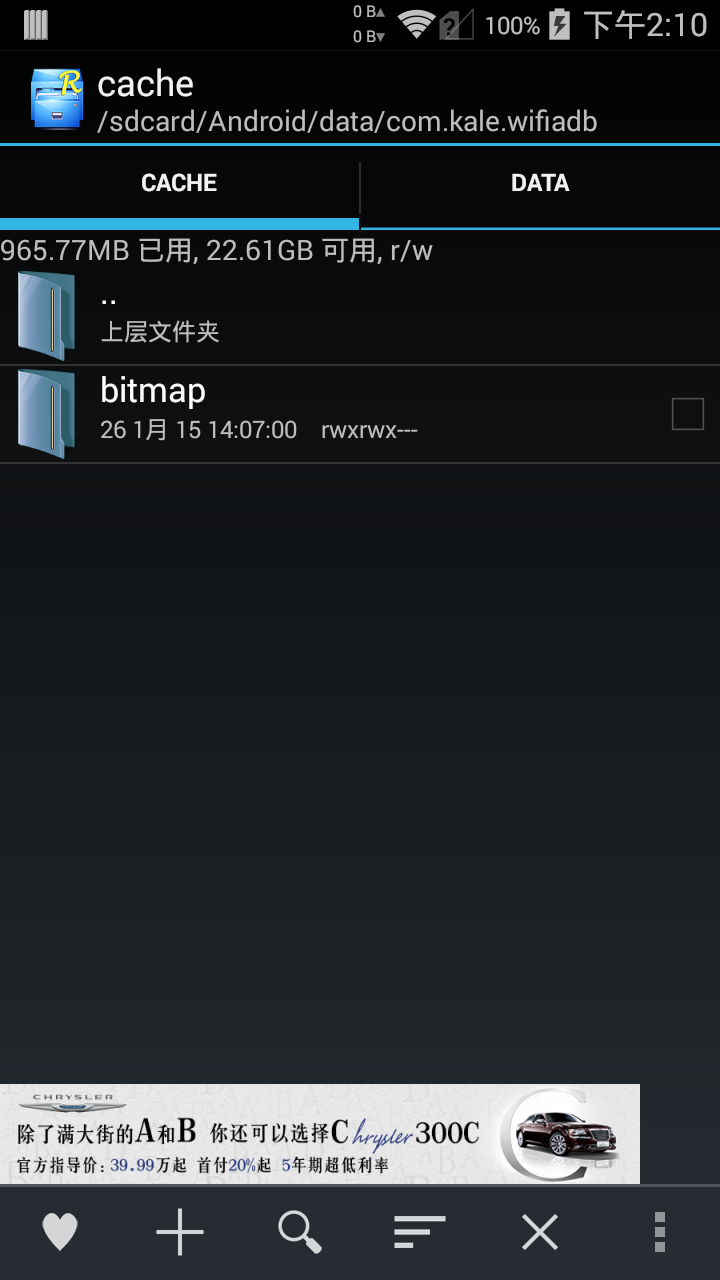
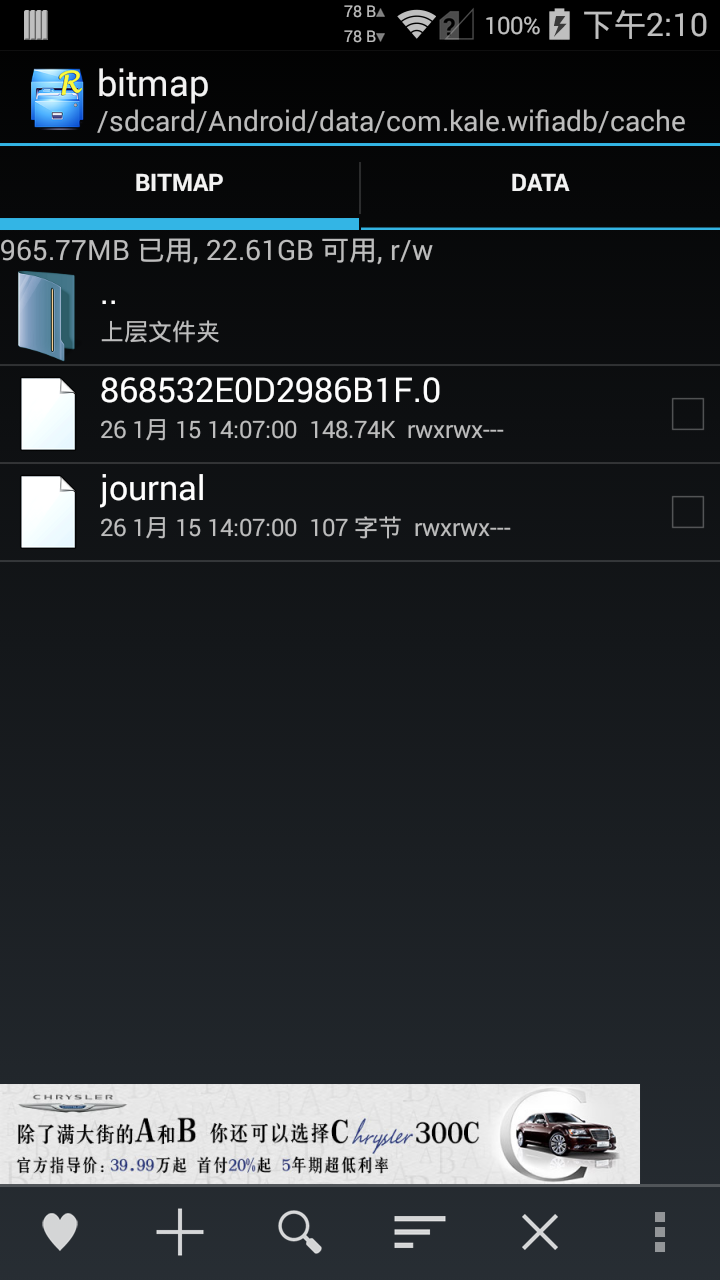 已经缓存到sd卡中了。文件夹称是bitmap,缓存文件名是MD5编码的结果,journal是日志文件。
3.4 完整代码
package com.kale.cache;

import java.io.IOException;

import java.io.OutputStream;

import libcore.io.DiskLruCache;

import android.app.Activity;

import android.content.Context;

import android.os.AsyncTask;

import android.widget.Toast;

public class SetTask extends AsyncTask<String, Integer, Boolean> {

    private DiskLruCache mDiskLruCache;

    private Context context;

    public SetTask(Activity activity, DiskLruCache cache) {

        context = activity;

        mDiskLruCache = cache;

    }

    @Override

    protected Boolean doInBackground(String... urls) {

        String key = MD5.getMD5Str(urls[0]); // 通过md5加密了这个URL,生成一个key

        boolean result = false;

        try {

            DiskLruCache.Editor editor = mDiskLruCache.edit(key); // 产生一个editor对象

            if (editor != null) {

                OutputStream outputStream = editor.newOutputStream(0); // 产生一个输出流

                if (DownLoadPic.downloadUrlToStream(urls[0], outputStream)) { // 从这个url下载图片,将editor的输出流传入

                    editor.commit(); // 提交,写入磁盘中

                    result = true;

                } else {

                    editor.abort(); // 出错,撤销操作

                    result = false;

                }

            }

            // mDiskLruCache.flush();

        } catch (IOException e) {

            // TODO 自动生成的 catch 块

            e.printStackTrace();

        }

        return result;

    }

    @Override

    protected void onPostExecute(Boolean result) {

        // TODO 自动生成的方法存根

        super.onPostExecute(result);

        if (result) {

            Toast.makeText(context, "已经写入磁盘", 0).show();

        }else {

            Toast.makeText(context, "出错!!!", 0).show();

        }

    }

}
四、读取磁盘缓存
取出磁盘缓存的方法是:
    /**

     * Returns a snapshot of the entry named {@code key}, or null if it doesn't

     * exist is not currently readable. If a value is returned, it is moved to

     * the head of the LRU queue.

     */

    public synchronized Snapshot get(String key) throws IOException
英文注释已经很清楚了,通过key来得到snapshot对象,如果是null,则说明当前没有这个key对应的文件,如果返回了结果,这个数据就被移动到最近最少使用队列的头部,也就表明是刚用过的,不会被清除掉。
然后,我们就可以用DiskLruCache.Snapshot的getInputStream()方法得到输入流了,这样就能把我们缓存的数据读进来。因为之前传入的参数是0,所以这里读出时传参数0
代码片段:
       DiskLruCache.Snapshot snapShot = mDiskLruCache.get(key);

            if (snapShot != null) {

                InputStream is = snapShot.getInputStream(0);

                bitmap = BitmapFactory.decodeStream(is);

            }
完整代码:
public class GetTask extends AsyncTask<String, Integer, Bitmap> {

    private DiskLruCache mDiskLruCache;

    private ImageView mImageView;

    public GetTask(ImageView imageView,  DiskLruCache cache) {

        mImageView = imageView;

        mDiskLruCache = cache;

    }

    @Override

    protected Bitmap doInBackground(String... urls) {

        String key = MD5.getMD5Str(urls[0]); // 通过md5加密了这个URL,生成一个key

        Bitmap bitmap = null;

        try {

            DiskLruCache.Snapshot snapShot = mDiskLruCache.get(key);

            if (snapShot != null) {

                InputStream is = snapShot.getInputStream(0);

                bitmap = BitmapFactory.decodeStream(is);

            }

        } catch (IOException e) {

            e.printStackTrace();

        }

        return bitmap;

    }

    @Override

    protected void onPostExecute(Bitmap result) {

        mImageView.setImageBitmap(result);

    }

}
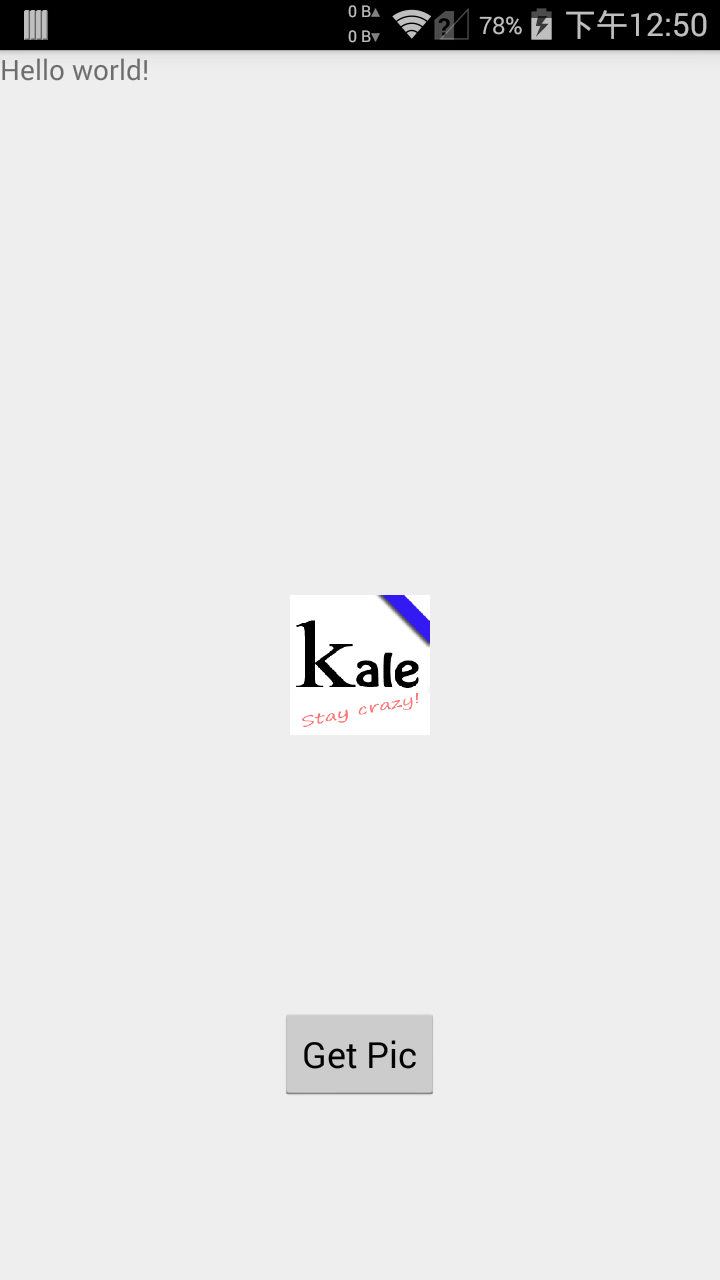 当点击get pic时从磁盘开始读取图片信息,最终展现在imageview中
五、其他API
5.1 size()
    /**

     * Returns the number of bytes currently being used to store the values in

     * this cache. This may be greater than the max size if a background

     * deletion is pending.

     */

    public synchronized long size() {

        return size;

    }
这个方法会返回当前缓存路径下所有缓存数据的总字节数,以byte为单位,如果应用程序中需要在界面上显示当前缓存数据的总大小,就可以通过调用这个方法计算出来。具体返回的大小可能略大于设置的cahce大小(在后台有数据操作的情况下)。你可以将这个数据显示在app的设置界面中,让用户知道应用占用的缓存大小。

5.2 flush()
这个方法用于将内存中的操作记录同步到日志文件(也就是journal文件)当中。这个方法非常重要,因为DiskLruCache能够正常工作的前提就是要依赖于journal文件中的内容。前面在讲解写入缓存操作的时候有调用过一次这个方法,但其实并不是每次写入缓存都要调用一次flush()方法的,频繁地调用并不会带来任何好处,只会额外增加同步journal文件的时间。比较标准的做法就是在Activity的onPause()方法中去调用一次flush()方法就可以了。
    /*

     * 并不是每次写入缓存都要调用一次flush()方法的,频繁地调用并不会带来任何好处,只会额外增加同步journal文件的时间,推荐在activity的onPause中调用

     */

    @Override

    protected void onPause() {

        // TODO 自动生成的方法存根

        super.onPause();

        try {

            mDiskCache.flush();

        } catch (IOException e) {

            // TODO 自动生成的 catch 块

            e.printStackTrace();

        }

    }
5.3 close()
    /**

     * Closes this cache. Stored values will remain on the filesystem.

     */

    public synchronized void close() throws IOException {

        if (journalWriter == null) {

            return; // already closed

        }

        for (Entry entry : new ArrayList<Entry>(lruEntries.values())) {

            if (entry.currentEditor != null) {

                entry.currentEditor.abort();

            }

        }

        trimToSize();

        journalWriter.close();

        journalWriter = null;

    }
这个方法用于将DiskLruCache关闭掉,是和open()方法对应的一个方法。关闭掉了之后就不能再调用DiskLruCache中任何操作缓存数据的方法,通常只应该在Activity的onDestroy()方法中去调用close()方法。
5.4 delete()
    /**

     * Closes the cache and deletes all of its stored values. This will delete

     * all files in the cache directory including files that weren't created by

     * the cache.

     */

    public void delete() throws IOException {

        close();

        IoUtils.deleteContents(directory);

    }
这个方法用于将所有的缓存数据全部删除,比如手动清理缓存功能,其实只需要调用一下DiskLruCache的delete()方法就可以实现了。
六、journal文件
journal文件是日志文件,里面记录了我们所有的操作。当我们写入一次时,文件内容如下方左图所示,如果写入多次就是右图了。
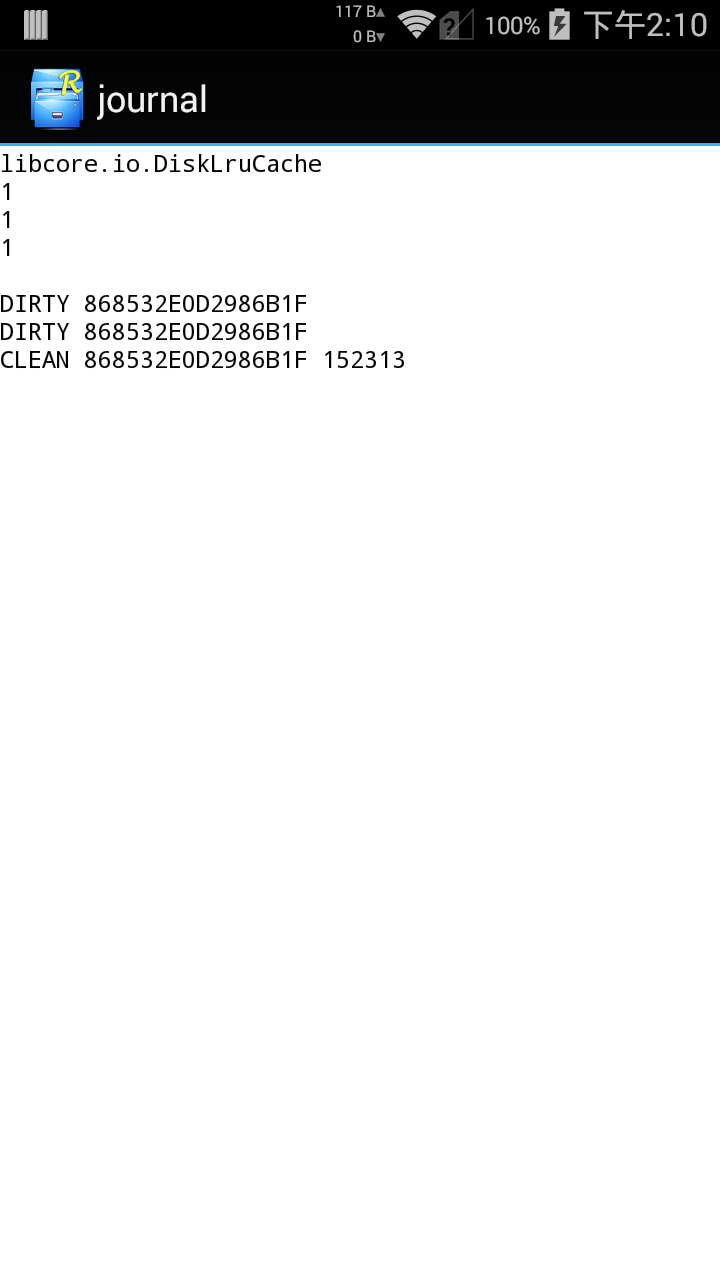

6.1 文件头
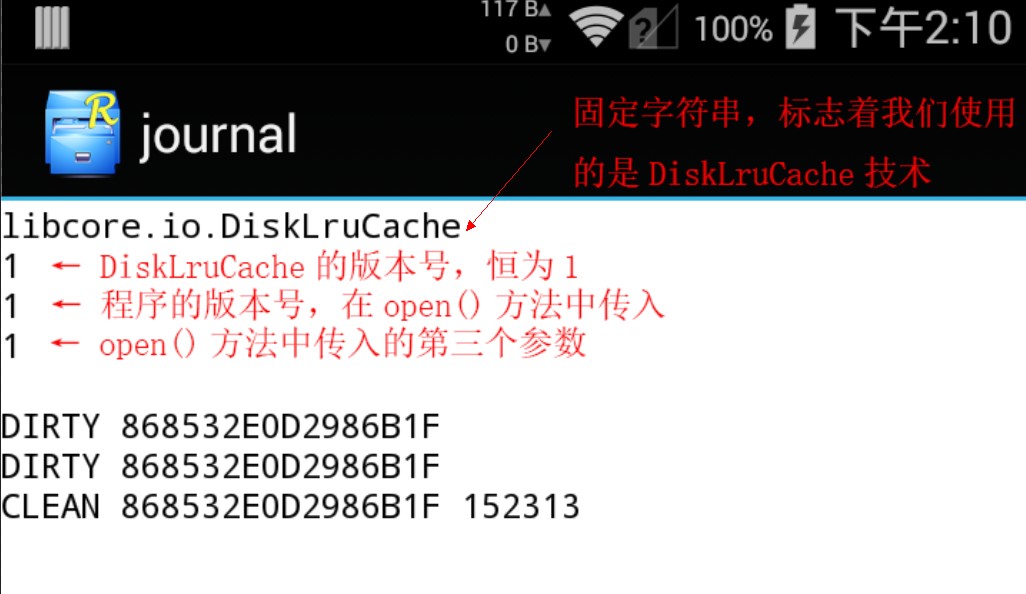
6.2 文件体
文件重要的操作记录是在文件体中的,里面有多个关键字。
DIRTY:表示这是一条脏数据。
每当我们调用一次DiskLruCache的edit()方法时,都会向journal文件中写入一条DIRTY记录,表示我们正准备写入一条缓存数据,但不知结果如何。然后,调用commit()方法表示写入缓存成功,这时会向journal中写入一条CLEAN记录,意味着这条“脏”数据被“洗干净了”,调用abort()方法表示写入缓存失败,这时会向journal中写入一条REMOVE记录。
也就是说,每一行DIRTY的key,后面都应该有一行对应的CLEAN或者REMOVE的记录,否则这条数据就是“脏”的,会被自动删除掉。
CLEAN:表示这条数据存入成功。
CLEAN数据前应该有对应的一个DIRTY数据,当存入成功了就会产生这条CLEAN的日志,这个日志后面都会有一串数字。比如这里的152313,这表示缓存数据的大小,以字节为单位。
REMOVE:缓存失败时产生的日志。
每个REMOVE日志之前应该都有一个DIRTY的日志,调用abort()方法,撤销缓存时就产生了REMOVE日志。
READ:读取文件的记录。
每当我们调用get()方法去读取一条缓存数据时,就会向journal文件中写入一条READ记录。

6.3 journal文件的大小
这个文件的大小可能会略大于你设置的最大缓存大小,这点在前面有说道。具体原因请自行查看源码。当这个文件的日志过多时,DiskLruCache会开始整理日志文件。
    /**

     * We only rebuild the journal when it will halve the size of the journal

     * and eliminate at least 2000 ops.

     */

    private boolean journalRebuildRequired() {

        final int REDUNDANT_OP_COMPACT_THRESHOLD = 2000;

        return redundantOpCount >= REDUNDANT_OP_COMPACT_THRESHOLD && redundantOpCount >= lruEntries.size();

    }
DiskLruCache中使用了一个redundantOpCount变量来记录用户操作的次数,每执行一次写入、读取或移除缓存的操作,这个变量值都会加1,当变量值达到2000的时候就会触发重构journal的事件,这时会自动把journal中一些多余的、不必要的记录全部清除掉,保证journal文件的大小始终保持在一个合理的范围内。
快速构建工具类:
package com.kale.photoswall.util;

import java.io.File;

import java.io.IOException;

import libcore.io.DiskLruCache;

import android.content.Context;

import android.content.pm.PackageInfo;

import android.content.pm.PackageManager.NameNotFoundException;

import android.graphics.Bitmap;

import android.os.Environment;

import com.android.volley.toolbox.NetworkImageView;

public abstract class LruDiskBaseCache {

    protected DiskLruCache mDiskLruCache;

    public abstract void putDiskToView(NetworkImageView view, String url);

    public abstract void putBitmapToDisk(String url, Bitmap bitmap);

    /**

     * @description 初始化磁盘缓存

     *

     */

    protected LruDiskBaseCache(Context context, String diskCacheDir, int diskSize) {

        try {

            File cacheDir = getDiskCacheDir(context, diskCacheDir);

            if (!cacheDir.exists()) {

                cacheDir.mkdirs();

            }

            mDiskLruCache = DiskLruCache.open(cacheDir, getAppVersion(context), 1, diskSize);

        } catch (IOException e) {

            e.printStackTrace();

        }

    }

    /**

     * @description 得到程序的版本号 注意:每当版本号改变,缓存路径下存储的所有数据都会被清除掉

     *

     * @param context

     * @return

     */

    protected int getAppVersion(Context context) {

        try {

            PackageInfo info = context.getPackageManager().getPackageInfo(context.getPackageName(), 0);

            return info.versionCode;

        } catch (NameNotFoundException e) {

            e.printStackTrace();

        }

        return 1;

    }

    /**

     * @description 获得磁盘缓存的路径

     *              当SD卡存在或SD卡不可被移除的时,就用getExternalCacheDir()方法来获取缓存路径,否则就调用getCacheDir()方法来获取缓存路径。

     *              getExternalCacheDir()-> /sdcard/Android/data/<application

     *              package>/cache getCacheDir() -> /data/data/<application package>/cache

     * @param context

     * @param uniqueName 缓存文件夹名称,可以自定义。这里我们缓存的是bitmap,所以缓存文件夹名定义为:bitmap

     * @return

     */

    private File getDiskCacheDir(Context context, String uniqueName) {

        String cachePath;

        if (Environment.MEDIA_MOUNTED.equals(Environment.getExternalStorageState()) || !Environment.isExternalStorageRemovable()) {

            cachePath = context.getExternalCacheDir().getPath();

        } else {

            cachePath = context.getCacheDir().getPath();

        }

        return new File(cachePath + File.separator + uniqueName);

    }

}
源码下载:http://download.csdn.net/detail/shark0017/8400459
参考自:
http://www.eoeandroid.com/thread-277474-104-1.html
http://blog.csdn.net/sun1021976312/article/details/38611281
http://blog.csdn.net/linghu_java/article/details/8600053
详细解读DiskLruCache的更多相关文章
- MemCache超详细解读
MemCache是什么 MemCache是一个自由.源码开放.高性能.分布式的分布式内存对象缓存系统,用于动态Web应用以减轻数据库的负载.它通过在内存中缓存数据和对象来减少读取数据库的次数,从而提高 ...
- MemCache超详细解读 图
http://www.cnblogs.com/xrq730/p/4948707.html MemCache是什么 MemCache是一个自由.源码开放.高性能.分布式的分布式内存对象缓存系统,用于 ...
- rpm软件包管理的详细解读
CentOS系统上使用rpm命令管理程序包:安装.卸载.升级.查询.校验.数据库维护 1.基本安装 rpm -ivh PackageFile 2.rpm选项 rpm -ivh --test Packa ...
- MemCache详细解读
MemCache是什么 MemCache是一个自由.源码开放.高性能.分布式的分布式内存对象缓存系统,用于动态Web应用以减轻数据库的负载.它通过在内存中缓存数据和对象来减少读取数据库的次数,从而提高 ...
- Android BLE蓝牙详细解读
代码地址如下:http://www.demodashi.com/demo/15062.html 随着物联网时代的到来,越来越多的智能硬件设备开始流行起来,比如智能手环.心率检测仪.以及各式各样的智能家 ...
- 为你详细解读HTTP请求头的具体含意
当我们打开一个网页时,浏览器要向网站服务器发送一个HTTP请求头,然后网站服务器根据HTTP请求头的内容生成当次请求的内容发送给浏览器.你明白HTTP请求头的具体含意吗?下面一条条的为你详细解读,先看 ...
- 详细解读Volley(三)—— ImageLoader & NetworkImageView
ImageLoader是一个加载网络图片的封装类,其内部还是由ImageRequest来实现的.但因为源码中没有提供磁盘缓存的设置,所以咱们还需要去源码中进行修改,让我们可以更加自如的设定是否进行磁盘 ...
- 【Python】【Web.py】详细解读Python的web.py框架下的application.py模块
详细解读Python的web.py框架下的application.py模块 这篇文章主要介绍了Python的web.py框架下的application.py模块,作者深入分析了web.py的源码, ...
- VINS-mono详细解读
VINS-mono详细解读 极品巧克力 前言 Vins-mono是香港科技大学开源的一个VIO算法,https://github.com/HKUST-Aerial-Robotics/VINS-Mono ...
随机推荐
- Navicat Premium 常用功能讲解
https://www.linuxidc.com/Linux/2016-04/130159.htm Navicat Premium 常用功能讲解 1.快捷键 1.1. F8 快速回到当前对象列表 1. ...
- 用Fiddler对Android应用进行抓包
前言 Fiddler是一款非常流行并且实用的http抓包工具,它的原理是在本机开启了一个http的代理服务器,然后它会转发所有的http请求和响应,因此,它比一般的firebug或者是chrome自带 ...
- 添加用户到LDAP服务器
1. 在浏览器中打开http://ldap.example.com/phpldapadmin 2. 点击[login]链接,输入管理员密码. 3. 点击[Create a new entry her ...
- 【LeetCode】287. Find the Duplicate Number
Difficulty:medium More:[目录]LeetCode Java实现 Description Given an array nums containing n + 1 integer ...
- codeM编程大赛E题 (暴力+字符串匹配(kmp))
题目大意:S(n,k)用k(2-16)进制表示1-n的数字所组成的字符串,例如S(16,16)=123456789ABCDEF10: 解题思路: n最大50000,k最大100000,以为暴力会超时. ...
- ctrl+c ctrl+d ctrl+z 的区别和使用场景
三者的区别 Ctrl+C :强制中断程序,程序无论运行哪里都停止. Ctrl+D :发送一个 exit 的信号,退出当前的用户或者是客户端. Ctrl+Z :暂停程序,在进程中维持挂起状态. 引用别人 ...
- ADSL
ADSL属于DSL技术的一种,全称Asymmetric Digital Subscriber Line( 非对称数字用户线路),亦可称作非对称数字用户环路.是一种新的数据传输方式. ADSL技术提供的 ...
- Windows密码破解工具ophcrack
Windows密码破解工具ophcrack Windows用户密码都采用哈希算法加密进行保存.Kali Linux内置了专用破解工具ophcrack.该工具是一个图形化界面工具,支持Windows ...
- Xamarin iOS教程之自定义视图
Xamarin iOS教程之自定义视图 Xamarin iOS自定义视图 工具栏中的视图在实际应用开发中用的很多,但是为了吸引用户的眼球,开发者可以做出一些自定义的视图. [示例2-33]以下将实现一 ...
- Jindent——让intellij idea 像eclipse一样生成模版化的javadoc注释
插件地址 http://plugins.jetbrains.com/plugin/2170?pr=idea 安装方法参考 http://www.cnblogs.com/nova-/p/3535636. ...