
Mesos源码分析(4) Mesos Master的启动之三
3. ModuleManager::load(flags.modules.get())如果有参数--modules或者--modules_dir=dirpath,则会将路径中的so文件load进来
代码中加载模块的代码如下

对应的命令行参数如下:

都可以写什么Module呢?
首先是Allocator
默认是内置的Hierarchical Dominant Resource Fairness allocator
要写一个自己的Allocator:
- 通过--modules加载so
- 通过--allocator参数指定
当然很少有人会重写这个Allocator,因为这是Mesos的精髓所在,但是可以对默认的Alllocator进行加强的。
参考文档http://mesos.apache.org/documentation/latest/allocation-module/
Mesos Allocation Modules
The logic that the Mesos master uses to determine which frameworks to make resource offers to is encapsulated in the master's allocator module. The allocator is a pluggable component that organizations can use to implement their own sharing policy, e.g. fair-sharing, priority, etc., or tune the default hierarchical Dominant Resource Fairness algorithm (see the DRF paper).
To use a custom allocator in Mesos, one must:
- Implement the Allocator interface as defined in mesos/allocator/allocator.hpp,
- Wrap the allocator implementation in a module and load it in the Mesos master.
Writing a custom allocator
Allocator modules are implemented in C++, the same language in which Mesos is written. They must subclass the Allocator interface defined in mesos/allocator/allocator.hpp. However, your implementation can be a C++ proxy, which delegates calls to an actual allocator written in a language of your choice.
The default allocator is HierarchicalDRFAllocatorProcess, which lives in$MESOS_HOME/src/master/allocator/mesos/hierarchical.hpp. Like most Mesos components, it is actor-based, which means all interface methods are non-blocking and return immediately after putting the corresponding action into the actor's queue. If you would like to design your custom allocator in a similar manner, subclass MesosAllocatorProcess from$MESOS_HOME/src/master/allocator/mesos/allocator.hpp and wrap your actor-based allocator inMesosAllocator. This dispatches calls to the underlying actor and controls its lifetime. You can refer to HierarchicalDRFAllocatorProcess as a starting place if you choose to write your own actor-based allocation module.
Additionally, the built-in hierarchical allocator can be extended without the need to reimplement the entirety of the allocation logic. This is possible through the use of the Sorter abstraction. Sorters define the order in which hierarchy layers (e.g. roles or frameworks) should be offered resources by taking "client" objects and some information about those clients and returning an ordered list of clients.
Sorters are implemented in C++ and inherit the Sorter class defined in$MESOS_HOME/src/master/allocator/sorter/sorter.hpp. The default sorter is DRFSorter, which implements fair sharing and can be found in$MESOS_HOME/src/master/allocator/sorter/drf/sorter.hpp. This sorter is capable of expressing priorities by specifying weights in Sorter::add(). Each client's share is divided by its weight. For example, a role that has a weight of 2 will be offered twice as many resources as a role with weight 1.
Wiring up a custom allocator
Once a custom allocator has been written, the next step is to override the built-in implementation with your own. This process consists of several steps:
- Wrap your allocator in a Mesos allocator module,
- Load this module in Mesos master.
An allocator module is a factory function and a module description, as defined inmesos/module/allocator.hpp. Assuming the allocation logic is implemented by theExternalAllocator class declared in external_allocator.hpp, the following snippet describes the implementation of an allocator module named ExternalAllocatorModule:
#include <mesos/allocator/allocator.hpp>
#include <mesos/module/allocator.hpp>
#include <stout/try.hpp>
#include "external_allocator.hpp"
using namespace mesos;
using mesos::allocator::Allocator;
using mesos::internal::master::allocator::HierarchicalDRFAllocator;
static Allocator* createExternalAllocator(const Parameters& parameters)
{
Try<Allocator*> allocator = ExternalAllocator::create();
if (allocator.isError()) {
return nullptr;
}
return allocator.get();
}
// Declares an ExternalAllocator module named 'ExternalAllocatorModule'.
mesos::modules::Module<Allocator> ExternalAllocatorModule(
MESOS_MODULE_API_VERSION,
MESOS_VERSION,
"Mesos Contributor",
"engineer@example.com",
"External Allocator module.",
nullptr,
createExternalAllocator);
Refer to the Mesos Modules documentation for instructions on how to compile and load a module in Mesos master.
Hook
你可以写hook模块,讲代码插在很多关键的步骤,从而改写整个Executor或者Docker或者Task的启动的整个过程。
可以干预的hook的地方定义在mesos/hook.hpp中。
Class hook定义如下:
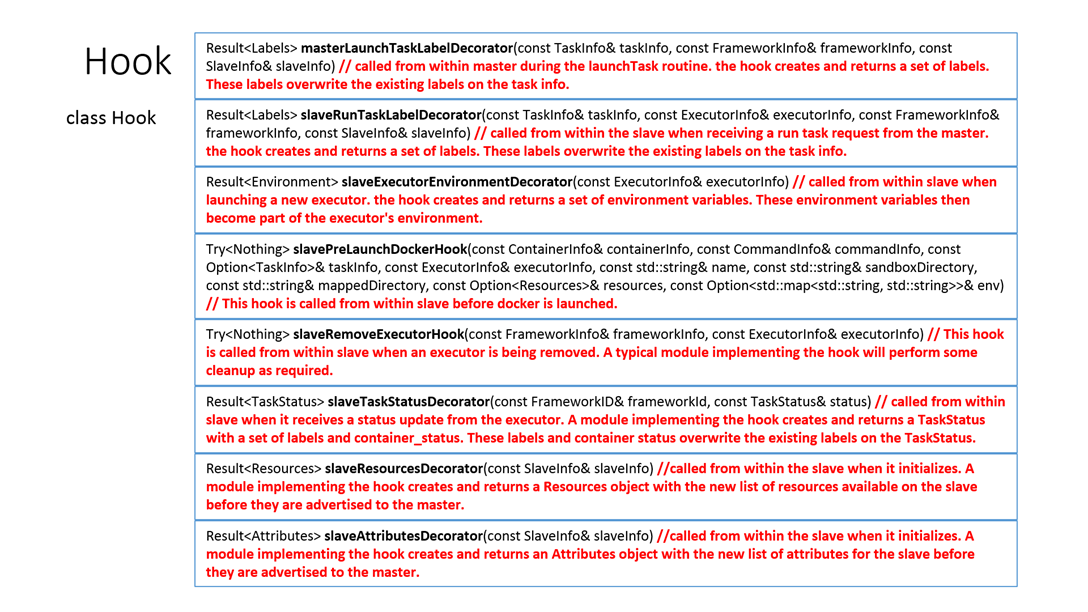
其中比较常用的是slavePrelaunchDockerHook,可以在Docker启动之前做一些事情,比如准备工作。
还有slaveRemoveExecutorHook,这个可以在executor结束的时候,做一些事情,比如清理工作。
要加载一个hook需要:
- 通过--modules加载so
- 通过--hooks加载hook
./bin/mesos-agent.sh --master=<IP>:<PORT> --modules="file://<path-to-modules-config>.json" --hooks=TestTaskHook
Isolator
可通过--isolation=VALUE指定,仅仅用于Mesos Containerizer。
在src/slave/containerizer/mesos/container.cpp里面

默认只会有cpu和memory
|
然后是创建Mesos Containerizer的Launcher
|
然后就是创建Isolator
|
所有的isolator会放在一个vector里面
|
最终创建MesosContainerizer
|
那isolator是如何起作用的呢?
当一个MesosContainerizer启动一个进程的时候,会调用如下的函数。
在src/slave/containerizer/mesos/containerizer.cpp中有

里面最重要的一步是fork一个进程
|
最后还会调用isolate不断的检验这个进程是否使用适当的资源。
|
Isolator定义了以下函数
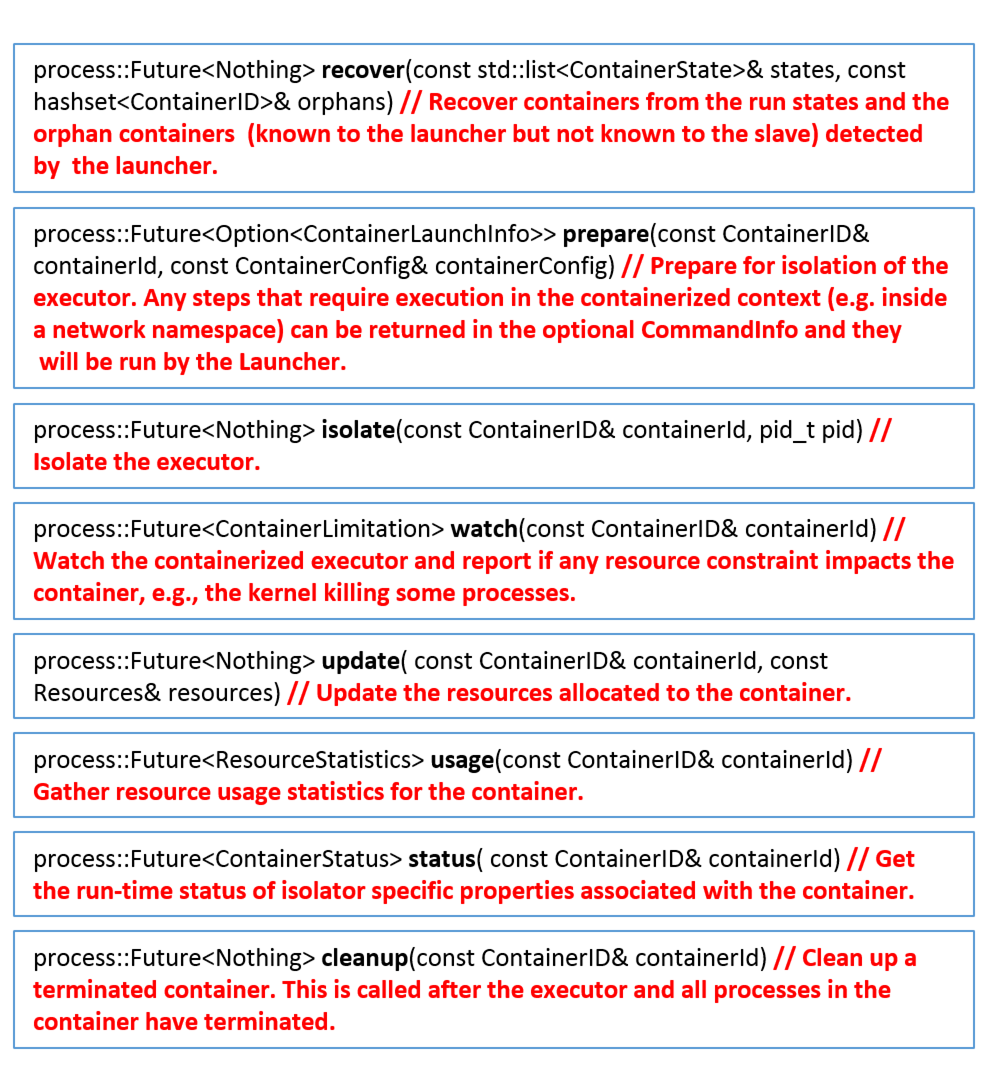

中会调用

Master Contender and Detector
Detector是检测哪个是Mesos-Master的Leader,Contender是自己竞争成为Mesos-Master的leader。默认使用zookeeper。
4. Mesos-Master启动的第四步是加载Hook, HookManager::initialize(flags.hooks.get())

Mesos源码分析(4) Mesos Master的启动之三的更多相关文章
- Mesos源码分析(5): Mesos Master的启动之四
5. Create an instance of allocator. 代码如下 Mesos源码中默认的Allocator,即HierarchicalDRFAllocator的位置在$ME ...
- Mesos源码分析(2): Mesos Master的启动之一
Mesos Master的启动参数如下: /usr/sbin/mesos-master --zk=zk://127.0.0.1:2181/mesos --port=5050 --log_dir=/va ...
- Mesos源码分析(6): Mesos Master的初始化
Mesos Master的初始化在src/master/master.cpp中 在Mesos Master的log中,是能看到这一行的. 1.初始化role,并设置weight权重 ...
- Mesos源码分析(3): Mesos Master的启动之二
2. process::firewall::install(move(rules));如果有参数--firewall_rules则会添加规则 对应的代码如下: // Initialize fire ...
- Mesos源码分析(1): Mesos的启动过程总论
- Mesos源码分析(9): Test Framework的启动
我们以Test Framework为例子解释Framework的启动方式. Test Framework的代码在src/examples/test_framework.cpp中的main函数 首先要指 ...
- Mesos源码分析
Mesos源码分析(1): Mesos的启动过程总论 Mesos源码分析(2): Mesos Master的启动之一 Mesos源码分析(3): Mesos Master的启动之二 Mesos源码分析 ...
- Mesos源码分析(11): Mesos-Master接收到launchTasks消息
根据Mesos源码分析(6): Mesos Master的初始化中的代码分析,当Mesos-Master接收到launchTask消息的时候,会调用Master::launchTasks函数. v ...
- Mesos源码分析(10): MesosSchedulerDriver的启动及运行一个Task
MesosSchedulerDriver的代码在src/sched/sched.cpp里面实现. Driver->run()调用start() 首先检测Mesos-Maste ...
随机推荐
- vs/windows程序找不到入口点cuvidGetDecodeStatus于AppDecGL.exe动态链接库上
解决方法:这个问题的原因是由于使用的英伟达显卡驱动版本不够新,更新显卡驱动即可. 找了一个多月的原因,终于知道起源了.最终问题还是出在了nvcuvid.lib/.dll上面.通过分析vs调试信息可以得 ...
- 【java】字节码操作技术
asm.javassist.cglib. 1.asm 比较底层,使用的visitor设计模式. 官网:https://asm.ow2.io/ 2.javassist 官网:http://www.jav ...
- VIM 编辑器
可视化模块 进入vi/vim编辑器,按CTRL+V进入可视化模式(VISUAL BLOCK) 2 移动光标上移或者下移,选中多行的开头,如下图所示 3 选择完毕后,按大写的的I键,此时下方会提示进入“ ...
- FreeRTOS 启动进程调度后,程序卡死的部分原因分析。
现象:1,RTOS 使用时 系统卡启动文件 B .处. 原因分析:该种情况是由于定义开启了中断,但是未开启中断处理服务.程序执行到中断响应式无对应的程序响应 ...
- 控制可编辑的Div 在添加图片,或者@某人的时候 光标移动到最后
this.$refs.editor.innerHTML += '<span style="color:yellowgreen;">@ 野猪佩奇</span> ...
- apache atlas源码编译打包 centos
参考:https://atlas.apache.org/InstallationSteps.html https://blog.csdn.net/lingbo229/article/details/8 ...
- dbus-launch
NAME dbus-launch - Utility to start a message bus from a shell script dbus-launch - 从shell脚本启动一个消息总线 ...
- UOJ#424. 【集训队作业2018】count 多项式,FFT,矩阵
原文链接https://www.cnblogs.com/zhouzhendong/p/UOJ424.html 题解 主席太神仙了! 首先我们把题意转化成:对所有挺好序列建 笛卡尔树,有多少笛卡尔树互不 ...
- MongoDB安装之window版本的安装
Windows 平台安装 MongoDB MongoDB 下载 MongoDB 提供了可用于 32 位和 64 位系统的预编译二进制包,你可以从MongoDB官网下载安装,MongoDB 预编译二进制 ...
- 相机标定问题-Matlab & Py-Opencv
一.相机标定基本理论 1.相机成像系统介绍 图中总共有4个坐标系: 图像坐标系:Op 坐标表示方法(u,v) Unit:Dots(个) 成像坐标系:Oi ...