
Django之session验证的三种姿势
一.什么是session
session是保存在服务端的键值对,Django默认支持Session,并且默认是将Session数据存储在数据库中,即:django_session 表中。
二.FVB中使用装饰器进行session验证
认证装饰器:
# 登陆验证

def auth(func):

 '''判断是否登录装饰器'''

    def inner(request, *args, **kwargs):

        ck = request.session.get("username")

		'''如果没有登陆返回到login.html'''

        if not ck:

            return redirect("/login.html")

        return func(request, *args, **kwargs)

    return inner
在需要认证的函数执行前加上装饰器认证即可,实际中应用如下:
def login(request):

    if request.method == "GET":

        return render(request, "login.html")

    else:

        username = request.POST.get("user")

        pwd = request.POST.get("pwd")

        pwd = md5(pwd)

        dic = {"flag":False}

        obj = User.objects.filter(username=username, pwd=pwd).first()

        if obj:

            request.session["username"] = username

            return redirect("/index.html")

        else:

            print(dic)

            return HttpResponse(json.dumps(dic))

@auth

def index(request):

    user = request.session.get("username")

    business = Business.objects.all().values("name")

    host_list = Host.objects.all().values("id","host","port","business__name")

    username = User.objects.all().values("username")

    return render(request, 'index.html', {'host_list':host_list,"business":business,"user":user,"username":username})

@auth

def addhost(request):

    business = Business.objects.all().values("name")

    if request.method == "POST":

        user = request.session.get("username")

        host = request.POST.get("host")

        port = request.POST.get("port")

        select_business = request.POST.get("business")

        business_id = Business.objects.filter(name=select_business).values("id")[0]

        host = Host.objects.create(host=host,

                                  port=port,

                                  business_id=business_id["id"])

        # host.business.add(*business)

        return render(request, "index.html")

    return render(request, "index.html", {"business":business})

@auth

def up_business(request):

    if request.method == "POST":

        user = request.session.get("username")

        host= request.POST.get("host")

        port= request.POST.get("port")

        business_name = request.POST.get("business")

        username = request.POST.get("username")

        print(host,port,business_name,username)

        return render(request,"保存成功")
三.CBV中使用类继承的方式进行session认证
- cbv是 class based view(基于类)
- cbv基于dispatch进行反射,get获取,post提交
- 应用场景:登录认证(继承dispatch,在dispatch里做session验证)
CBV第一种方式继承
1.单继承
扫盲:(继承的时候,一定要清楚self是哪个类实例化出来的对象,下例,self为B实例化的对象,任何属性优先从自己里面找,找不到在去父类里找)
class A(object):

    def aaa(self):

        print('from A')

    def bbb(self):

        self.aaa()

class B(A):

    def aaa(self):

        print('from B')

c = B()

c.aaa()
应用:
from django.views import View

class BaseView(View):

    def dispatch(self, request, *args, **kwargs):  # 继承父类的dispatch,因为父类里有返回值,所以也要有return

        if request.session.get('username'):

            response = super(BaseView, self).dispatch(request, *args, **kwargs)

            return response

        else:

            return redirect('/login.html')

class IndexView(BaseView):

    def get(self, request, *args, **kwargs):

        return HttpResponse(request.session['username'])
2.多继承(继承顺序从左到右)
class BaseView(object):

    def dispatch(self, request, *args, **kwargs):

        if request.session.get('username'):

            response = super(BaseView,self).dispatch(request, *args, **kwargs)

            return response

        else:

            return redirect('/login.html')

class IndexView(BaseView,View):#先去找BaseView,BaseView中未定义在去找View

    def get(self,request,*args,**kwargs):

        return HttpResponse(request.session['username'])
CBV第二种方式装饰器
from django.utils.decorators import method_decorator

def auth(func): #定义装饰器

    def inner(request,*args,**kwargs):

        if request.session.get('username'):

            obj = func(request,*args,**kwargs)

            return obj

        else:

            return redirect('/login.html')

    return inner

@method_decorator(auth,name='get')  #放在类顶部就需要method_decorator这个装饰器

class IndexView(View):

    @method_decorator(auth) #放在dispatch上就相当于全局都需要经过认证

    def dispatch(self, request, *args, **kwargs):

        if request.session.get('username'):

            response = super(IndexView,self).dispatch(request, *args, **kwargs)

            return response

        else:

            return redirect('/login.html')

    @method_decorator(auth)

    def get(self,request,*args,**kwargs):

        return HttpResponse(request.session['username'])

    @method_decorator(csrf_exempt)  # 无效 csrf 放到post函数上的装饰器,是无效的,需要放到dispath上或者类上

    def post(self,request,*args,**kwargs):

        return HttpResponse(request.session['username'])
四.中间件middleware
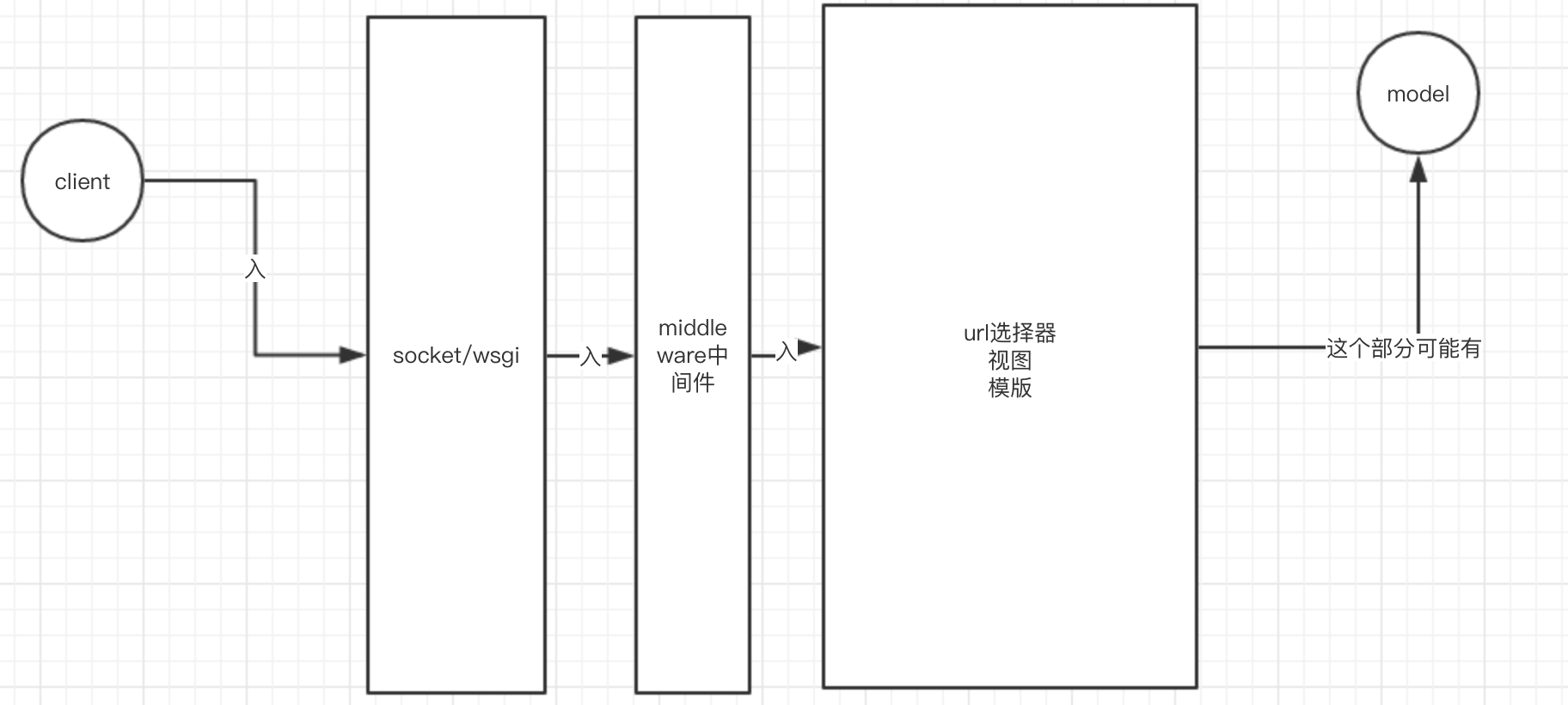
如下是django的生命周期
如下为中间件的执行顺序
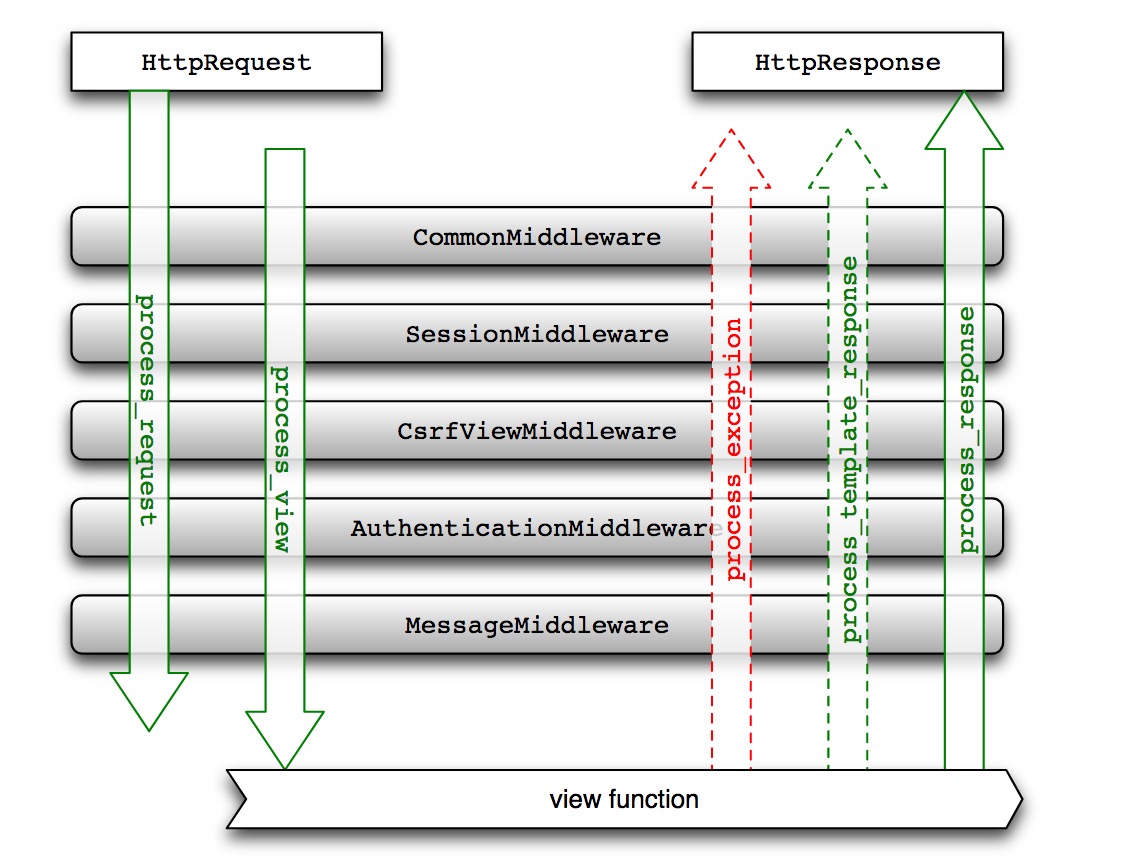
- 中间件执行时机:请求到来,请求返回时
- 中间件是一个类:
def process_request(self,request):
print('m2.process_request')
def process_response(self,request, response):
print('m2.prcess_response')
return response
- 应用:
- 请求日志
- 用户登录认证
Django根目录新建md文件夹,新建Middleware.py文件
from django.utils.deprecation import MiddlewareMixin

class M1(MiddlewareMixin):

    '''先执行request,然后到url路由,url之后返回到最上方,在执行view,如果出现错误就直接到response上,执行完,到真正到视图,如果有问题就

    执行exception,从下至上查找,如果找到exception就直接执行exception的return在走response返回用户

    每个中间件中,4个方法不需要都写.

    '''

    def process_request(self,request):

        if request.path_info == "/login.html":

            return None

        user_info = request.session.get("username")

        if not user_info:

            return redirect("/login.html")
注:新的django版本可能不存在MiddlewareMixin,需要手动写一下这个类进行继承
class MiddlewareMixin(object):

    def __init__(self, get_response=None):

        self.get_response = get_response

        super(MiddlewareMixin, self).__init__()

    def __call__(self, request):

        response = None

        if hasattr(self, 'process_request'):

            response = self.process_request(request)

        if not response:

            response = self.get_response(request)

        if hasattr(self, 'process_response'):

            response = self.process_response(request, response)

        return response

class M1(MiddlewareMixin):

    def process_request(self,request):

        if request.path_info == "/login.html":

            return None

        user_info = request.session.get("username")

        if not user_info:

            return redirect("/login.html")
settings里配置:
MIDDLEWARE = [

    'django.middleware.security.SecurityMiddleware',

    'django.contrib.sessions.middleware.SessionMiddleware',

    'django.middleware.common.CommonMiddleware',

    'django.middleware.csrf.CsrfViewMiddleware',

    'django.contrib.auth.middleware.AuthenticationMiddleware',

    'django.contrib.messages.middleware.MessageMiddleware',

    'django.middleware.clickjacking.XFrameOptionsMiddleware',

    'md.Middleware.M1',

]

WSGI_APPLICATION = 'BBS.wsgi.application'

SESSION_ENGINE = 'django.contrib.sessions.backends.db'  # 引擎(默认)

SESSION_COOKIE_NAME = "sessionid"  # Session的cookie保存在浏览器上时的key,即:sessionid=随机字符串(默认)

SESSION_COOKIE_PATH = "/"  # Session的cookie保存的路径(默认)

SESSION_COOKIE_DOMAIN = None  # Session的cookie保存的域名(默认)

SESSION_COOKIE_SECURE = False  # 是否Https传输cookie(默认)

SESSION_COOKIE_HTTPONLY = True  # 是否Session的cookie只支持http传输(默认)

SESSION_COOKIE_AGE = 1209600  # Session的cookie失效日期(2周)(默认)

SESSION_EXPIRE_AT_BROWSER_CLOSE = False  # 是否关闭浏览器使得Session过期(默认)

SESSION_SAVE_EVERY_REQUEST = True  # 是否每次请求都保存Session,默认修改之后才保存(默认)
Django之session验证的三种姿势的更多相关文章
- django之创建第7-6-第三种传值方式
1.创建bar.html文件 <!DOCTYPE html> <html lang="en"> <head> <meta charset= ...
- 设置session超时的三种方式
设置session超时的三种方式 1. 在容器中设置:如在tomcat-7\conf\web.xml中设置 Tomcat默认session超时时间为30分钟,可以根据需要修改,负数或0为不限制sess ...
- 一级缓存、二级缓存、延迟加载、hibernate session 域 pojo三种状态
1.一级缓存(session缓存 ).二级缓存 意义:提高hibernate查询效率. 缺点:可能会因并发,产生数据不一致. 本质:基于session 的缓存,利用hiber ...
- 让Session失效的三种方法
我们设置SESSION失效的时间,是为了确保在用户长时间不与服务器交互的情况下,可以自动退出登录.本文介绍了三种设置SESSION失效的方法,希望对你有帮助. Session对象是HttpSessio ...
- Django多对多表的三种创建方式,MTV与MVC概念
MTV与MVC MTV模型(django): M:模型层(models.py) T:templates V:views MVC模型: M:模型层(models.py) V:视图层(views.py) ...
- 关于 tomcat 集群中 session 共享的三种方法
前两种均需要使用 memcached 或redis 存储 session ,最后一种使用 terracotta 服务器共享. 建议使用 redis,不仅仅因为它可以将缓存的内容持久化,还因为它支持的单 ...
- Tomcat 集群中 实现session 共享的三种方法
前两种均需要使用 memcached 或 redis 存储 session ,最后一种使用 terracotta 服务器共享. 建议使用 redis ,不仅仅因为它可以将缓存的内容持久化,还因为它支持 ...
- Django 多对多表的三种创建方式
第一种: class Book(models.Model): name = models.CharField(max_length=32) # 第一种自动创建 authors = models.Man ...
- ASP.NET中身份验证的三种方法
Asp.net的身份验证有有三种,分别是"Windows | Forms | Passport",其中又以Forms验证用的最多,也最灵活.Forms 验证方式对基于用户的验证授权 ...
随机推荐
- C#问题记录-CallbackOnCollectedDelegate
做项目的时候遇到了这个问题: 检测到:CallbackOnCollectedDelegate 对“xx.HookProc::Invoke”类型的已垃圾回收委托进行了回调.这可能会导致应用程序崩溃.损坏 ...
- 多进程——waitpid()函数的小例子
本例中使用fork()创建一个子进程,然后让子进程暂停5s,接下来对原有的父进程使用waitpid()函数,利用WNOHANG使父进程不会阻塞每隔一秒判断子进程是否退出. #include" ...
- 【挖坑】2019年JAVA安全总结:SQL注入——新项目的开发与老项目的修复
如何在项目中有效的防止SQL注入 写给需要的人,所有的问题源自我们的不重视. 本章略过"什么是SQL注入","如何去利用SQL注入"的讲解,仅讲如何去防御 PS ...
- hdu1213-How Many Tables---基础并查集
题目链接: http://acm.hdu.edu.cn/showproblem.php?pid=1213 题目大意: 今天是Ignatius的生日,他邀请了许多朋友.现在是吃晚饭的时间,Ignatiu ...
- Wired Memory
https://developer.apple.com/library/content/documentation/Performance/Conceptual/ManagingMemory/Arti ...
- 浅谈KD-Tree
前言 \(KD-Tree\)是一个十分神奇的东西,其实本质上类似于一个\(K\)维的二叉搜索树. 核心思想 \(KD-Tree\)的核心思想与\(BST\)是差不多的(插入等操作也都基本上一样). 唯 ...
- mongodb索引 全文索引
全文索引,也叫文本索引,平时,我们百度的搜索,比如api文档的搜索,这种全局的索引就可以使用全文索引实现 全文索引:对字符串与字符串数组创建全文可搜索对索引 使用情况:比如有一个数据集合,存储了用户的 ...
- python剑指offer 合并两个排序的链表
题目描述 输入两个单调递增的链表,输出两个链表合成后的链表,当然我们需要合成后的链表满足单调不减规则. # -*- coding:utf-8 -*- # class ListNode: # def _ ...
- linux分区之ext2,ext3,ext4,gpt
linux分区之ext2,ext3,ext4,gpt 2013-07-10 12:00:24 标签:ext3 gpt 原创作品,允许转载,转载时请务必以超链接形式标明文章 原始出处 .作者信息和本声明 ...
- Vue之Vue-touch的使用
最近项目中,有的页面发现设置返回键看起来怪怪的,感觉与整体不协调,于是就考虑使用手势滑动事件来实现返回功能~ 开叉查阅资料~找到了vue-touch,使用起来可谓是简单粗暴啊,适合我这样的快速开发人员 ...