
李宏毅 Tensorflow解决Fizz Buzz问题
提出问题
一个网友的博客,记录他在一次面试时,碰到面试官要求他在白板上用TensorFlow写一个简单的网络实现异或(XOR)功能。这个本身并不难,单层感知器不能解决异或问题是学习神经网络中的一个常识,而简单的两层神经网络却能将其轻易解决。但这个问题的难处在于,我们接触TensorFlow通常直接拿来写CNN,或者其他的深度学习相关的网络了,而实现这种简单网络,基本上从未做过;更何况,要求在白板上写出来,如果想bug free,并不是容易的事儿啊。
数据
李宏毅老师对数据进行了如下分析
对数字101到1000做了labeling,即训练数据xtrain.shape=(900,10),每一个数字都是用二进位来表示,第一个数字是101,用二进位来表示即为[1,0,1,0,0,1,1,0,0,0],每一位表示2^{n-1},n表示左数第几位。现在一共有四个case,[一般,Fizz,Buzz,Fizz Buzz],所以y_train.shape=(900,10),对应的维度用1表示,其他都为0
数据分析
900个样本,每个样本代表一个数字,并且有二进制值数值表示。观察样本,第一个数字是101,则二进制的表示为1010011000

然后观察label
如果不是被3,5或者同时被整出,则保留原数。所以一共有四种情况。“原数,fizz,buzz,fizz&buzz”

inputlayer是10维度,为中间隐藏层输出100维,最终输出4维。激活函数用的是ReLU函数,compile配置中,是做分类,学习率优化函数是adam,再设置batchsize和epoch即可。
源代码
#!/usr/bin/env python

# -*- coding: utf-8 -*-

# @Time : 2019/9/13 11:12

# @Author : BaoBao

# @Mail : baobaotql@163.com

# @File : test6.py.py

# @Software: PyCharm

#fizz buzz问题

from keras.layers.normalization import BatchNormalization

from keras.models import Sequential

from keras.layers.core import Dense,Dropout,Activation

from keras.optimizers import SGD,Adam

import numpy as np

def fizzbuzz(start,end):

    x_train,y_train=[],[]

    for i in range(start,end+1):

        num = i

        tmp=[0]*10

        j=0

        while num :

            tmp[j] = num & 1

            num = num>>1

            j+=1

        x_train.append(tmp)

        if i % 3 == 0 and i % 5 ==0:

            y_train.append([0,0,0,1])

        elif i % 3 == 0:

            y_train.append([0,1,0,0])

        elif i % 5 == 0:

            y_train.append([0,0,1,0])

        else :

            y_train.append([1,0,0,0])

    return np.array(x_train),np.array(y_train)

x_train,y_train = fizzbuzz(101,1000) #打标记函数

x_test,y_test = fizzbuzz(1,100)

model = Sequential()

model.add(Dense(input_dim=10,output_dim=10))

model.add(Activation('relu'))

model.add(Dense(output_dim=4))

model.add(Activation('softmax'))

model.compile(loss='categorical_crossentropy',optimizer='adam',metrics=['accuracy'])

model.fit(x_train,y_train,batch_size=20,nb_epoch=100)

result = model.evaluate(x_test,y_test,batch_size=1000)

print('Acc:',result[1])
运行结果

可以看到accuray的结果不是很好,那么我们考虑多种方案来解决,比如修改Activation function,或者将hidden neure修改为1000后 可以看到accuracy的明显提高
运行结果

----------------------------------华丽的分割线------------------------------------------
从别的博主看到的一个方法写的很简单QAQ我好菜啊
1.import 模块
import numpy as np

import tensorflow as tf
2.输入数据的placeholder
具体来说,一个data,一个label
data = tf.placeholder(tf.float32, shape=(4, 2))

label = tf.placeholder(tf.float32, shape=(4, 1))
由于本例比较特殊,异或只有四种输入和对应的四个输出,所以根据需求定义固定的shape
3.基于输入数据的placeholder构建model
异或需要两层神经网络,每层分别需要一个weights和一个bias,所以定义如下:
with tf.variable_scope('layer1') as scope:

  weight = tf.get_variable(name='weight', shape=(2, 2))

  bias = tf.get_variable(name='bias', shape=(2,))

  x = tf.nn.sigmoid(tf.matmul(data, weight) + bias)

with tf.variable_scope('layer2') as scope:

  weight = tf.get_variable(name='weight', shape=(2, 1))

  bias = tf.get_variable(name='bias', shape=(1,))

  x = tf.matmul(x, weight) + bias
这里为了方便变量管理,以及在tensorboard上的条理性,使用了variable_scope,当然,也可以不使用。
此外,因为我们后面的loss要使用sigmoid_cross_entropy_with_logits函数,所以这里第二层网络的输出没有过sigmoid函数。如果loss使用其他函数,则可以做相应处理。
4.定义loss
其实这里可以灵活选用各种loss函数,比如MSE,等等。但我们还是选用了在CNN中广泛使用的cross entropy
preds = tf.nn.sigmoid(x)

loss = tf.reduce_mean(tf.nn.sigmoid_cross_entropy_with_logits(labels=label, logits=x))
我们这里把模型的输出x过了一下sigmoid函数,作为最终输出,以便在训练时对模型进行监视。
5.定义Optimizer
learning_rate = tf.placeholder(tf.float32)

optimizer = tf.train.GradientDescentOptimizer(learning_rate).minimize(loss)
6.构建并输入数据,开始训练
train_data = np.array([[0, 0], [0, 1], [1, 0], [1, 1]])

train_label = np.array([[0], [1], [1], [0]])

with tf.Session() as sess:

  sess.run(tf.global_variables_initializer())

  for step in range(10000):

    if step < 3000:

      lr = 1

    elif step < 6000:

      lr = 0.1

    else:

      lr = 0.01

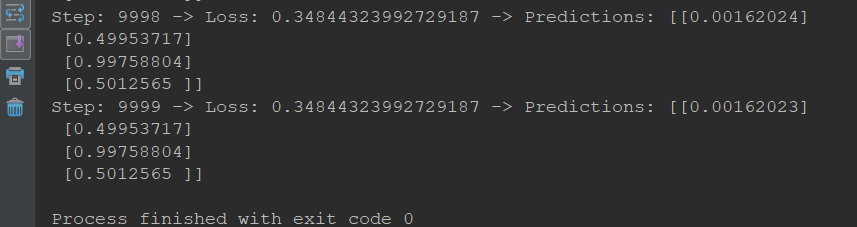
    _, l, pred = sess.run([optimizer, loss, preds], feed_dict={data: train_data, label: train_label, learning_rate: lr})

    if step % 500:

      print('Step: {} -> Loss: {} -> Predictions: {}'.format(step, l, pred)
完整代码:
#!/usr/bin/env python

# -*- coding: utf-8 -*-

# @Time : 2019/9/13 11:24

# @Author : BaoBao

# @Mail : baobaotql@163.com

# @File : test7.py

# @Software: PyCharm

#fizz buzz问题

import numpy as np

import tensorflow as tf

data = tf.placeholder(tf.float32, shape=(4, 2))

label = tf.placeholder(tf.float32, shape=(4, 1))

with tf.variable_scope('layer1') as scope:

  weight = tf.get_variable(name='weight', shape=(2, 2))

  bias = tf.get_variable(name='bias', shape=(2,))

  x = tf.nn.sigmoid(tf.matmul(data, weight) + bias)

with tf.variable_scope('layer2') as scope:

  weight = tf.get_variable(name='weight', shape=(2, 1))

  bias = tf.get_variable(name='bias', shape=(1,))

  x = tf.matmul(x, weight) + bias

preds = tf.nn.sigmoid(x)

loss = tf.reduce_mean(tf.nn.sigmoid_cross_entropy_with_logits(labels=label, logits=x))

learning_rate = tf.placeholder(tf.float32)

optimizer = tf.train.GradientDescentOptimizer(learning_rate).minimize(loss)

train_data = np.array([[0, 0], [0, 1], [1, 0], [1, 1]])

train_label = np.array([[0], [1], [1], [0]])

with tf.Session() as sess:

  sess.run(tf.global_variables_initializer())

  for step in range(10000):

    if step < 3000:

      lr = 1

    elif step < 6000:

      lr = 0.1

    else:

      lr = 0.01

    _, l, pred = sess.run([optimizer, loss, preds], feed_dict={data: train_data, label: train_label, learning_rate: lr})

    if step % 500:

      print('Step: {} -> Loss: {} -> Predictions: {}'.format(step, l, pred))
运行结果
李宏毅 Tensorflow解决Fizz Buzz问题的更多相关文章
- 【笔记】机器学习 - 李宏毅 - 11 - Keras Demo2 & Fizz Buzz
1. Keras Demo2 前节的Keras Demo代码: import numpy as np from keras.models import Sequential from keras.la ...
- [LeetCode] Fizz Buzz 嘶嘶嗡嗡
Write a program that outputs the string representation of numbers from 1 to n. But for multiples of ...
- Lintcode 9.Fizz Buzz 问题
------------------------ AC代码: class Solution { /** * param n: As description. * return: A list of s ...
- LeetCode 412. Fizz Buzz
Problem: Write a program that outputs the string representation of numbers from 1 to n. But for mult ...
- LeetCode Fizz Buzz
原题链接在这里:https://leetcode.com/problems/fizz-buzz/ 题目: Write a program that outputs the string represe ...
- Fizz Buzz
class Solution { public: /** * param n: As description. * return: A list of strings. */ vector<st ...
- LintCode (9)Fizz Buzz
下面是AC代码,C++风格: class Solution { public: vector<string> fizzBuzz(int N) { vector<string> ...
- [重构到模式-Chain of Responsibility Pattern]把Fizz Buzz招式重构到责任链模式
写一段程序从1打印到100,但是遇到3的倍数时打印Fizz,遇到5的倍数时打印Buzz,遇到即是3的倍数同时也是5的倍数时打印FizzBuzz.例如: 1 2 Fizz 4 Buzz Fizz 7 8 ...
- Swift完成fizz buzz test
看到一篇文章上说,很多貌似看过很多本编程书的童鞋连简单的fizz buzz测试都完不成. 不知道fizz buzz test为何物的,建议自行搜之. 测试要求是,编写满足以下条件的代码: Write ...
随机推荐
- Mapreduce案例之找共同好友
数据准备: A:B,C,D,F,E,OB:A,C,E,KC:F,A,D,ID:A,E,F,LE:B,C,D,M,LF:A,B,C,D,E,O,MG:A,C,D,E,FH:A,C,D,E,OI:A,OJ ...
- bzoj1711[USACO07OPEN]吃饭Dining
题意 有F种食物和D种饮料,每种食物或饮料只能供一头牛享用,且每头牛只享用一种食物和一种饮料.现在有n头牛,每头牛都有自己喜欢的食物种类列表和饮料种类列表,问最多能使几头牛同时享用到自己喜欢的食物和饮 ...
- python不换行输出
python默认的print是换行输出的.要想实现不换行输出,方法如下: python 2.X版本: print('要在print后面加个逗号-> , '), python 3.X版本: pri ...
- 响应json数据之发送ajax的请求
一.前端异步请求代码: <span style="font-size:14px;">$.ajax ({ type: "POST", //请求的方式 ...
- java实现上传文件夹
我们平时经常做的是上传文件,上传文件夹与上传文件类似,但也有一些不同之处,这次做了上传文件夹就记录下以备后用. 首先我们需要了解的是上传文件三要素: 1.表单提交方式:post (get方式提交有大小 ...
- [Luogu] 飞扬的小鸟
https://www.luogu.org/problemnew/show/P1941 Bfs or Dp #include <bits/stdc++.h> using namespace ...
- 在chrome开发者模式中查找你的js文件
在chrom开发者模式中按ctrl+o查找你的js文件
- vue项目更换目录后执行npm run dev 就报错(新手进)
在我们搭建好一个VUE项目的环境后,觉得这个项目存放的位置不好,想移动一下,但是移动后我们发现执行npm run dev就会报下面的错误: 明明只是移动了一下位置,就报错,实在是太恶心了. 但是只要我 ...
- codeforces708C
CF708C Centroids 题意翻译 给定一颗树,你有一次将树改造的机会,改造的意思是删去一条边,再加入一条边,保证改造后还是一棵树. 请问有多少点可以通过改造,成为这颗树的中心?(如果以某个点 ...
- Python地理信息数据可视化
地图 基础铺垫 定义 地图(map):是指按一定的比例运用符号.颜色.文字标记等描绘显示地球表面的自然地理.行政区域.社会经济状况的图形. 地图绘制步骤 绘制需要展示的地图,获取地图对象,获取每个区域 ...