
Android:日常学习笔记(8)———探究UI开发(3)
Android:日常学习笔记(8)———探究UI开发(3)
详解四种基本布局
前言
布局定义用户界面的视觉结构,如Activity或应用小部件的 UI。您可以通过两种方式声明布局:
- 在 XML 中声明 UI 元素。Android 提供了对应于 View 类及其子类的简明 XML 词汇,如用于小部件和布局的词汇;
- 运行时实例化布局元素。您的应用可以通过编程创建 View 对象和 ViewGroup 对象(并操纵其属性)。
编写XML
您可以利用 Android 的 XML 词汇,按照在 HTML 中创建包含一系列嵌套元素的网页的相同方式快速设计 UI 布局及其包含的屏幕元素。
每个布局文件都必须只包含一个根元素,并且该元素必须是视图对象或 ViewGroup 对象。定义根元素之后,即可再以子元素的形式添加其他布局对象或小部件,从而逐步构建定义布局的视图层次结构。例如,以下这个 XML 布局使用垂直 LinearLayout 来储存一个 TextView 和一个 Button:
<?xml version="1.0" encoding="utf-8"?>

<LinearLayout xmlns:android="http://schemas.android.com/apk/res/android"

              android:layout_width="match_parent"

              android:layout_height="match_parent"

              android:orientation="vertical" >

    <TextView android:id="@+id/text"

              android:layout_width="wrap_content"

              android:layout_height="wrap_content"

              android:text="Hello, I am a TextView" />

    <Button android:id="@+id/button"

            android:layout_width="wrap_content"

            android:layout_height="wrap_content"

            android:text="Hello, I am a Button" />

</LinearLayout>
重要:
在 XML 中声明布局后,请在您的 Android 项目
res/layout/目录中以.xml扩展名保存文件,以便其能够正确编译
加载 XML 资源
当您编译应用时,每个 XML 布局文件都会编译到一个 View 资源中。 您应该在 Activity.onCreate() 回调实现中从您的应用代码加载布局资源。请通过调用 setContentView()R.layout.layout_file_name 形式向其传递对布局资源的引用来执行此操作。例如,如果您的 XML 布局保存为main_layout.xml,则需要像下面这样为您的 Activity 加载该布局:
public void onCreate(Bundle savedInstanceState) {

    super.onCreate(savedInstanceState);

    setContentView(R.layout.main_layout);

}
线性布局
说明:
LinearLayout 是一个视图组,用于使所有子视图在单个方向(垂直或水平)保持对齐。 您可以使用 android:orientation 属性指定布局方向。

LinearLayout的所有子视图依次堆叠,因此无论子视图有多宽,垂直列表每行均只有一个子视图,水平列表将只有一行高(最高子视图的高度加上内边距)。
LinearLayout遵守子视图之间的“边距”以及每个子视图的“重力”(右对齐、居中对齐、左对齐)。
布局权重:
LinearLayout 还支持使用 android:layout_weight 属性为各个子视图分配权重。此属性根据视图应在屏幕上占据的空间量向视图分配“重要性”值。 权重值更大的视图可以填充父视图中任何剩余的空间。子视图可以指定权重值,然后系统会按照子视图声明的权重值的比例,将视图组中的任何剩余空间分配给子视图。 默认权重为零。
<?xml version="1.0" encoding="utf-8"?>

<LinearLayout xmlns:android="http://schemas.android.com/apk/res/android"

    android:layout_width="match_parent"

    android:layout_height="match_parent"

    android:paddingLeft="16dp"

    android:paddingRight="16dp"

    android:orientation="vertical" >

    <EditText

        android:layout_width="match_parent"

        android:layout_height="wrap_content"

        android:hint="@string/to" />

    <EditText

        android:layout_width="match_parent"

        android:layout_height="wrap_content"
android:layout_weight="1"
        android:hint="@string/subject" />

    <EditText

        android:layout_width="match_parent"

        android:layout_height="0dp"

        android:layout_weight="2"

        android:gravity="top"

        android:hint="@string/message" />

    <Button

        android:layout_width="100dp"

        android:layout_height="wrap_content"

        android:layout_gravity="right"

        android:text="@string/send" />

</LinearLayout>

相对布局
说明:
RelativeLayout是一种用于显示具有相对位置的子视图的视图组。每个视图的位置可以指定相对于兄弟元素(如左或低于另一个视图)或位置相对于父RelativeLayout区域(如底部对齐,左或中心)。

相对布局是一种非常有力的用户界面设计工具,它可以消除内嵌的视图组并且保持你的平面布局层次,这有助于提高性能。
如果你发现自己使用了数个内嵌的线性布局组,那么你 可以替代它们单单用一个相对布局。
相对布局允许子视图指定它们相对于父视图或者其他(指定ID的)视图的位置。所以你可以通过右边界对齐两个元素,或使一个低于另一个,集中在屏幕上,集中,等等。默认情况下,所有的子视图被绘制在左上角,所以你必须使用各种各样的来自于RelativeLayout.LayoutParams的布局属性来定义每个视图的位置)
一些可以被使用的布局属性如下:
在你的XML布局文件中,可以在任意位置声明对其他视图的依赖关系。比如你能声明view1定位在view2的下面,即使view2是最后一个声明的视图层次结构,也就是说这种定位不需要关心声明的先后顺序。每个布局属性是一个布尔值,使布局位置相对于父RelativeLayout或ID引用另一个视图在视图的布局应该定位。
代码:
<?xml version="1.0" encoding="utf-8"?>

<RelativeLayout xmlns:android="http://schemas.android.com/apk/res/android"

    android:layout_width="match_parent"

    android:layout_height="match_parent"

    android:paddingLeft="16dp"

    android:paddingRight="16dp" >

    <EditText

        android:id="@+id/name"

        android:layout_width="match_parent"

        android:layout_height="wrap_content"

        android:hint="键入文本信息" />

    <Spinner

        android:id="@+id/dates"

        android:layout_width="0dp"

        android:layout_height="wrap_content"

        android:layout_below="@id/name"

        android:layout_alignParentLeft="true"

        android:layout_toLeftOf="@+id/times" />

    <Spinner

        android:id="@id/times"

        android:layout_width="96dp"

        android:layout_height="wrap_content"

        android:layout_below="@id/name"

        android:layout_alignParentRight="true" />

    <Button

        android:layout_width="96dp"

        android:layout_height="wrap_content"

        android:layout_below="@id/times"

        android:layout_alignParentRight="true"

        android:text="按钮" />

</RelativeLayout>

说明:
注意代码中的加粗语句:使用布尔值如android:layout_alignParentLeft的是相对于整个RelativeLayout视图的,而标注ID的是相对于其他视图。
坐标布局(AbsoluteLayout)
坐标布局(AbsoluteLayout)
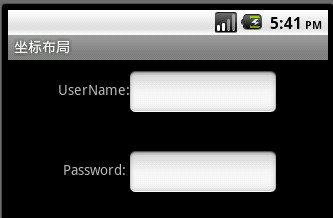
描述:对其控件进行直接定位,增加灵活性。
常用属性:android:layout_x,android:layout_y.
<?xml version="1.0" encoding="utf-8"?>

<AbsoluteLayout

  xmlns:android="http://schemas.android.com/apk/res/android"

  android:layout_width="wrap_content"

  android:layout_height="wrap_content">

  <TextView

       android:layout_width="wrap_content"

       android:text="UserName:"

       android:layout_height="wrap_content"

       android:id="@+id/tvName"

       android:layout_y="20dip"

       android:layout_x="50dip">

       </TextView>

   <TextView

       android:layout_width="wrap_content"

       android:text="Password:"

       android:layout_height="wrap_content"

       android:id="@+id/tvPassword"

       android:layout_y="100dip"

       android:layout_x="55dip">

       </TextView>

   <EditText

       android:layout_width="150px"

       android:layout_height="wrap_content"

       android:id="@+id/tvPassword"

       android:layout_y="10dip"

       android:layout_x="120dip">

       </EditText>

   <EditText

       android:layout_width="150px"

       android:layout_height="wrap_content"

       android:id="@+id/tvPassword"

       android:layout_y="90dip"

       android:layout_x="120dip">

       </EditText>

</AbsoluteLayout>
TableLayout布局
说明:
它遵循着以下结构:
<TableLayout>

    <TableRow>

    <!-在这里填充第一行的元素->

    </TableRow>

    <TableRow>

    <!-在这里填充第二行的元素->

    </TableRow>

</TableLayout>
还有几个重要属性:
- 写在TableLayout中的属性
- android:stretchColumns 设置第几列为伸展(0表示第一列)
- android:shrinkColumns 设置第几列为收缩
- android:collapseColumns 设置第几列为隐藏
- 写在TableRow里的控件里的属性
- android:layout_column 设置控件在第几列
- android:layout_span 设置控件能跨多少列
代码:
<?xml version="1.0" encoding="utf-8"?>

<TableLayout xmlns:android="http://schemas.android.com/apk/res/android"

    android:layout_width="match_parent"

    android:layout_height="match_parent"

    android:collapseColumns="2" //设置第3列为隐藏

    android:shrinkColumns="1"  //设置第2列为收缩

    android:stretchColumns="0">  //设置第1列为伸展

    <TableRow>

        <TextView android:text="我是伸展的第一列" />

        <TextView android:text="我是收缩的第二列" />

        <TextView android:text="我被隐藏了" />

    </TableRow>

    <TableRow>

        <TextView android:text="我可以伸展的很长很长很长长" />

        <TextView android:text="我可以收缩,我可以变的很深很深很深" />

        <TextView android:text="我被隐藏了T_T" />

    </TableRow>

    <TableRow>

        <TextView

            android:layout_column="1"

            android:text="我要在第2列" />

    </TableRow>

    <TableRow>

        <TextView

            android:layout_width="wrap_content"

            android:layout_height="wrap_content"

            android:layout_column="0"

            android:layout_span="2"

            android:text="我要               跨                  两                列" />

    </TableRow>

</TableLayout>
Android:日常学习笔记(8)———探究UI开发(3)的更多相关文章
- Android:日常学习笔记(8)———探究UI开发(5)
Android:日常学习笔记(8)———探究UI开发(5) ListView控件的使用 ListView概述 A view that shows items in a vertically scrol ...
- Android:日常学习笔记(7)———探究UI开发(4)
Android:日常学习笔记(7)———探究UI开发(4) UI概述 View 和 ViewGrou Android 应用中的所有用户界面元素都是使用 View 和 ViewGroup 对象构建而成 ...
- Android:日常学习笔记(8)———探究UI开发(2)
Android:日常学习笔记(8)———探究UI开发(2) 对话框 说明: 对话框是提示用户作出决定或输入额外信息的小窗口. 对话框不会填充屏幕,通常用于需要用户采取行动才能继续执行的模式事件. 提示 ...
- Android:日常学习笔记(7)———探究UI开发(1)
Android:日常学习笔记(7)———探究UI开发(1) 常用控件的使用方法 TextView 说明:TextView是安卓中最为简单的一个控件,常用来在界面上显示一段文本信息. 代码: <T ...
- Android:日常学习笔记(9)———探究持久化技术
Android:日常学习笔记(9)———探究持久化技术 引入持久化技术 什么是持久化技术 持久化技术就是指将那些内存中的瞬时数据保存到存储设备中,保证即使在手机或电脑关机的情况下,这些数据仍然不会丢失 ...
- Android:日常学习笔记(9)———探究广播机制
Android:日常学习笔记(9)———探究广播机制 引入广播机制 Andorid广播机制 广播是任何应用均可接收的消息.系统将针对系统事件(例如:系统启动或设备开始充电时)传递各种广播.通过将 In ...
- Android:日常学习笔记(6)——探究活动(4)
Android:日常学习笔记(6)——探究活动(4) 活动的启动模式 standard模式 standard是活动默认的启动模式,在不进行显示定义的情况下,所有活动都会自动使用这种启动模式. stan ...
- Android:日常学习笔记(6)——探究活动(3)
Android:日常学习笔记(6)——探究活动(3) 活动的生命周期 返回栈 Android中的活动是可以叠加的,我们每启动一个新活动,就会覆盖在原来的活动上,点击Back以后销毁最上面的活动,下面的 ...
- Android:日常学习笔记(5)——探究活动(2)
Android:日常学习笔记(5)——探究活动(2) 使用Intent在活动之间穿梭 什么是Intent Intent时Android程序中各组件之间进行交互的一种重要方式,他不仅可以指明当前组件想要 ...
随机推荐
- Goole Python 风格指南 中文版
http://zh-google-styleguide.readthedocs.io/en/latest/google-python-styleguide/
- c++ 宏 #val 在unicode下的使用。
#define CHECK(condition) cout<<check failed:<<#condition<<endl; 上面这句宏,当你 CHECK(myf ...
- IOS设计模式浅析之原型模式(Prototype)
原型模式的定义 “使用原型实例指定创建对象的种类,并通过复制这个原型创建新的对象”.最初的定义出现于<设计模式>(Addison-Wesley,1994). 简单来理解就是根据这个原型创建 ...
- Linux make语法
make是一种控制编译或者重复编译软件的工具. make可以自动关键软件的编译内容.方式和时机,从而使程序员把更多的精力集中在编写代码上. make主要的机制是在命令行键入make命令,make会自动 ...
- Eclipse 浏览(Navigate)菜单浏览 Eclipse 工作空间
Eclipse 浏览(Navigate)菜单 浏览 Eclipse 工作空间 浏览(Navigate)菜单提供了多个菜单可以让你快速定位到指定资源. 上图中 Open Type, Open Type ...
- char * const p和const char *p的区别
1. 前者定义P为常量,即只能单向赋值一次,P++展开为p=p+1,重复赋值给常量,出错,后者P为地址变量,地址变量是指向该变量的存储地址值如:4B3F6A,不能赋给一个字符值(字符相当于ascii表 ...
- 安装onlyoffice document server
1. 安装docker apt install docker.io 2. 安装和启动onlyoffice sudo docker run -i -t -d -p 80:80 onlyoffice/do ...
- shell 命令getopts用法
写shell脚本常见sh test.sh -m 2 -d 3的写法 事例脚本: #!/bin/bash while getopts ":a:b:c:" arg #选项后面的冒号表示 ...
- MVC action 执行两次 background url()
大年初七第一天上班就来解决问题,我也是醉了. 其实是历史遗留问题,今天看到后不能忍了,赶紧解决一下. 旧系统中以一个微信版本的列表页面没有问题,在新系统中重新开发一边后发现列表页面的action总是请 ...
- 【BZOJ4199】[Noi2015]品酒大会 后缀数组+并查集
[BZOJ4199][Noi2015]品酒大会 题面:http://www.lydsy.com/JudgeOnline/wttl/thread.php?tid=2144 题解:听说能用SAM?SA默默 ...