
单因素特征选择--Univariate Feature Selection
An example showing univariate feature selection.
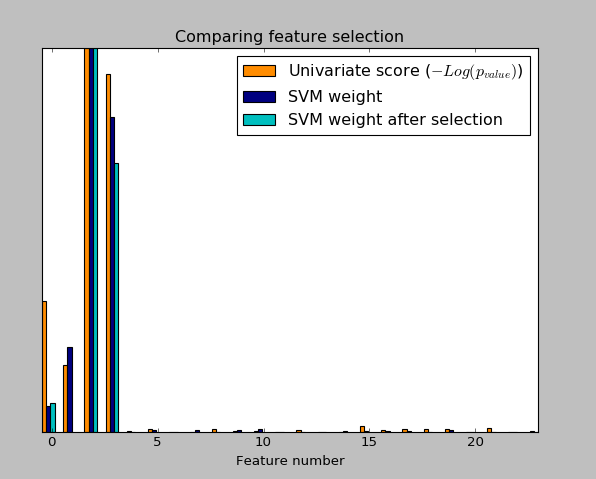
Noisy (non informative) features are added to the iris data and univariate feature selection(单因素特征选择) is applied. For each feature, we plot the p-values for the univariate feature selection and the corresponding weights of an SVM. We can see that univariate feature selection selects the informative features and that these have larger SVM weights.
In the total set of features, only the 4 first ones are significant. We can see that they have the highest score with univariate feature selection. The SVM assigns a large weight to one of these features, but also Selects many of the non-informative features. Applying univariate feature selection before the SVM increases the SVM weight attributed to the significant features, and will thus improve classification.
#encoding:utf-8

import numpy as np

import matplotlib.pyplot as plt

from sklearn import datasets,svm

from sklearn.feature_selection import SelectPercentile,f_classif

###load iris dateset

iris=datasets.load_iris()

###Some Noisy data not correlated

E=np.random.uniform(0,0.1,size=(len(iris.data),20)) ###uniform distribution   150*20

X=np.hstack((iris.data,E))

y=iris.target

plt.figure(1)

plt.clf()

X_indices=np.arange(X.shape[-1])   ###X.shape=(150,24)    X.shape([-1])=24

selector=SelectPercentile(f_classif,percentile=10)

selector.fit(X,y)

scores=-np.log10(selector.pvalues_)

scores/=scores.max()

plt.bar(X_indices-0.45,scores,width=0.2,label=r"Univariate score ($-Log(p_{value})$)",color='darkorange')

# plt.show()

####Compare to weight of an svm

clf=svm.SVC(kernel='linear')

clf.fit(X,y)

svm_weights=(clf.coef_**2).sum(axis=0)

svm_weights/=svm_weights.max()

plt.bar(X_indices - .25, svm_weights, width=.2, label='SVM weight',

        color='navy')

clf_selected=svm.SVC(kernel='linear')

# clf_selected.fit(selector.transform((X,y)))

clf_selected.fit(selector.transform(X),y)

svm_weights_selected=(clf_selected.coef_**2).sum(axis=0)

svm_weights_selected/=svm_weights_selected.max()

plt.bar(X_indices[selector.get_support()]-.05,svm_weights_selected,width=.2,label='SVM weight after selection',color='c')

plt.title("Comparing feature selection")

plt.xlabel('Feature number')

plt.yticks(())

plt.axis('tight')

plt.legend(loc='upper right')

plt.show()
实验结果:
单因素特征选择--Univariate Feature Selection的更多相关文章
- 机器学习概念之特征选择(Feature selection)之RFormula算法介绍
不多说,直接上干货! RFormula算法介绍: RFormula通过R模型公式来选择列.支持R操作中的部分操作,包括‘~’, ‘.’, ‘:’, ‘+’以及‘-‘,基本操作如下: 1. ~分隔目标和 ...
- 机器学习概念之特征选择(Feature selection)之VectorSlicer算法介绍
不多说,直接上干货! VectorSlicer 算法介绍: VectorSlicer是一个转换器,输入特征向量,输出原始特征向量子集.VectorSlicer接收带有特定索引的向量列,通过对这些索引的 ...
- 机器学习概念之特征选择(Feature selection)
不多说,直接上干货! .
- 特征选择与稀疏学习(Feature Selection and Sparse Learning)
本博客是针对周志华教授所著<机器学习>的"第11章 特征选择与稀疏学习"部分内容的学习笔记. 在实际使用机器学习算法的过程中,往往在特征选择这一块是一个比较让人模棱两可 ...
- [Feature] Feature selection
Ref: 1.13. Feature selection Ref: 1.13. 特征选择(Feature selection) 大纲列表 3.1 Filter 3.1.1 方差选择法 3.1.2 相关 ...
- 【转】[特征选择] An Introduction to Feature Selection 翻译
中文原文链接:http://www.cnblogs.com/AHappyCat/p/5318042.html 英文原文链接: An Introduction to Feature Selection ...
- 机器学习-特征选择 Feature Selection 研究报告
原文:http://www.cnblogs.com/xbinworld/archive/2012/11/27/2791504.html 机器学习-特征选择 Feature Selection 研究报告 ...
- highly variable gene | 高变异基因的选择 | feature selection | 特征选择
在做单细胞的时候,有很多基因属于noise,就是变化没有规律,或者无显著变化的基因.在后续分析之前,我们需要把它们去掉. 以下是一种找出highly variable gene的方法: The fea ...
- the steps that may be taken to solve a feature selection problem:特征选择的步骤
參考:JMLR的paper<an introduction to variable and feature selection> we summarize the steps that m ...
随机推荐
- html canvas 骰子1
<!DOCTYPE html PUBLIC "-//W3C//DTD XHTML 1.0 Transitional//EN" "http://www.w3.org/ ...
- 关于mybatis一对多关联时
一对多关联时注:collection标签,property属性名称,column参数字段, ofType查询返回类型,select查询方法,javaType方法的返回类型
- mysql 分组查询问题 group_concat
这几天在做购物车的时候.购物车内的商品为一个商品占一行,结果再从数据库读出的时候,没有分组,而是循环所有的内容出来,然后进行判断.如果一样的话就把他保存到一个变量中.但是自己逻辑没搞清楚.一直出bug ...
- 关于css的新思考
因为被派去协助别的组,有机会写了一下react,发现ICE做的那一个套件用来搭建后台系统真的太给力了(插一句必入table组件其实是可以把删除添加座位基础方法加进去的).因为看了demo的代码以及对于 ...
- 北大poj-2688
Cleaning Robot Time Limit: 1000MS Memory Limit: 65536K Total Submissions: 4395 Accepted: 1763 De ...
- Java Swing 第02记 标签和按钮
JLable的常用构造器 Public JLabel() 创建无图像且其标题为空字符串的JLabel对象 Public JLabel(String text) 使用指定的字符串text(也就是标签显示 ...
- 【转】Sqlite 混合模式程序集是针对“v2.0.50727”版的运行时生成的,在没有配置其他信息的情况下,无法在 4.0 运行时中加载该...
开发环境: vs2010+.net framework 4.0+ System.Data.SQLite.DLL (2.0)今天在做Sqlite数据库测试,一运行程序在一处方法调用时报出了一个异常 混合 ...
- js地区转盘抽奖插件
<script type="text/javascript"> var colors = ["#B8D430", "#3AB745&quo ...
- HDU 5379
题意:告诉你一棵树的结构,要求满足下三个条件,求满足的序列有多少种. 1.每个节点只有一个数字: 2.作为儿子节点的编号要连续 也就是兄弟节点间的麻将编号要连续: 3.每棵子树的麻将编号要连续: 首先 ...
- css性能优化
1.前端 1.1.减少http请求次数: 1.1.1先了解下HTTP对性能的影响,HTTP是浏览器和服务器通过Interet进行相互通信的协议.HTTP是一种客服端/服务器协议,有请求和响应构成. 浏 ...