
C++学习书籍推荐《Effective C++ 第三版(英文)》下载
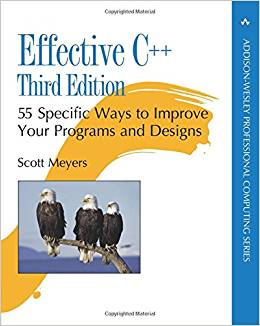
百度云及其他网盘下载地址:点我
作者简介
Scott Meyers is one of the world's foremost authorities on C++, providing training and consulting services to clients worldwide. He is the author of the best-selling Effective C++ series of books (Effective C++, More Effective C++, and Effective STL) and of the innovative Effective C++ CD. He is consulting editor for Addison Wesley's Effective Software Development Series and is a founding member of the Advisory Board for The C++ Source (http://www.artima.com/cppsource). He holds a Ph.D. in Computer Science from Brown University. His web site is http://www.aristeia.com.
目录
Preface xv
Acknowledgments xvii
Introduction 1
Chapter 1: Accustoming Yourself to C++ 11
Item 1: View C++ as a federation of languages. 11
Item 2: Prefer consts, enums, and inlines to #defines. 13
Item 3: Use const whenever possible. 17
Item 4: Make sure that objects are initialized before they’re used. 26
Chapter 2: Constructors, Destructors, and Assignment Operators 34
Item 5: Know what functions C++ silently writes and calls. 34
Item 6: Explicitly disallow the use of compiler-generated functions you do not want. 37
Item 7: Declare destructors virtual in polymorphic base classes. 40
Item 8: Prevent exceptions from leaving destructors. 44
Item 9: Never call virtual functions during construction or destruction. 48
Item 10: Have assignment operators return a reference to *this. 52
Item 11: Handle assignment to self in operator=. 53
Item 12: Copy all parts of an object. 57
Chapter 3: Resource Management 61
Item 13: Use objects to manage resources. 61
Item 14: Think carefully about copying behavior in resource-managing classes. 66
Item 15: Provide access to raw resources in resource-managing classes. 69
Item 16: Use the same form in corresponding uses of new and delete. 73
Item 17: Store newed objects in smart pointers in standalone statements. 75
Chapter 4: Designs and Declarations 78
Item 18: Make interfaces easy to use correctly and hard to use incorrectly. 78
Item 19: Treat class design as type design. 84
Item 20: Prefer pass-by-reference-to-const to pass-by-value. 86
Item 21: Don’t try to return a reference when you must return an object. 90
Item 22: Declare data members private. 94
Item 23: Prefer non-member non-friend functions to member functions. 98
Item 24: Declare non-member functions when type conversions should apply to all parameters. 102
Item 25: Consider support for a non-throwing swap. 106
Chapter 5: Implementations 113
Item 26: Postpone variable definitions as long as possible. 113
Item 27: Minimize casting. 116
Item 28: Avoid returning “handles” to object internals. 123
Item 29: Strive for exception-safe code. 127
Item 30: Understand the ins and outs of inlining. 134
Item 31: Minimize compilation dependencies between files. 140
Chapter 6: Inheritance and Object-Oriented Design 149
Item 32: Make sure public inheritance models “is-a.” 150
Item 33: Avoid hiding inherited names. 156
Item 34: Differentiate between inheritance of interface and inheritance of implementation. 161
Item 35: Consider alternatives to virtual functions. 169
Item 36: Never redefine an inherited non-virtual function. 178
Item 37: Never redefine a function’s inherited default parameter value. 180
Item 38: Model “has-a” or “is-implemented-in-terms-of” through composition. 184
Item 39: Use private inheritance judiciously. 187
Item 40: Use multiple inheritance judiciously. 192
Chapter 7: Templates and Generic Programming 199
Item 41: Understand implicit interfaces and compile-time polymorphism. 199
Item 42: Understand the two meanings of typename. 203
Item 43: Know how to access names in templatized base classes. 207
Item 44: Factor parameter-independent code out of templates. 212
Item 45: Use member function templates to accept “all compatible types.” 218
Item 46: Define non-member functions inside templates when type conversions are desired. 222
Item 47: Use traits classes for information about types. 226
Item 48: Be aware of template metaprogramming. 233
Chapter 8: Customizing new and delete 239
Item 49: Understand the behavior of the new-handler. 240
Item 50: Understand when it makes sense to replace new and delete. 247
Item 51: Adhere to convention when writing new and delete. 252
Item 52: Write placement delete if you write placement new. 256
Chapter 9: Miscellany 262
Item 53: Pay attention to compiler warnings. 262
Item 54: Familiarize yourself with the standard library, including TR1. 263
Item 55: Familiarize yourself with Boost. 269
Appendix A: Beyond Effective C++ 273
Appendix B: Item Mappings Between Second and Third Editions 277
Index 280
百度云及其他网盘下载地址:点我
C++学习书籍推荐《Effective C++ 第三版(英文)》下载的更多相关文章
- C语言学习书籍推荐《C Primer Plus(中文版)(第5版)》下载
普拉塔 (Prata S.) (作者), 云巅工作室 (译者) <C Primer Plus(中文版)(第5版)>共17章,介绍了C语言的基础知识,包括数据类型.格式化输入输出.运算符.表 ...
- java虚拟机的学习书籍推荐
javaEE开发已然是一个老生常谈的话题了,但经典之所以会成为经典,就是因为有可重复琢磨之处,每一次的反复推敲都会有不一样的收获.如果你不满足于做一个只会写if…else…的Java程序员,而是希望更 ...
- C++学习书籍推荐《Accelerated C++中文版》下载
百度云及其他网盘下载地址:点我 媒体推荐 书评 这是一本一流的C++入门书,它采用了一种和实践相结合的方式来解决具体的问题.相比我所见过的其他C++入门书来说,本书以令人惊奇的紧凑格式覆盖了更多的关于 ...
- C语言学习书籍推荐《C陷阱与缺陷》下载
下载地址:点我 凯尼格 (作者), 高巍 (译者) <C和C++经典著作:C陷阱与缺陷>适合有一定经验的C程序员阅读学习,即便你是C编程高手,<C和C++经典著作:C陷阱与缺陷> ...
- C语言学习书籍推荐《C和指针 Pointers On C》下载
<C和指针 POINTERS ON C>提供与C语言编程相关的全面资源和深入讨论.本书通过对指针的基础知识和高 级特性的探讨,帮助程序员把指针的强大功能融入到自己的程序中去. 全书共18 ...
- java学习书籍推荐
1. Java 语言基础 谈到Java 语言基础学习的书籍,大家肯定会推荐Bruce Eckel 的<Thinking in Java >.它是一本写的相当深刻的技术书籍,Java 语言基 ...
- linux学习书籍推荐linux学习书籍推荐
引用地址:http://www.cnblogs.com/notepi/archive/2013/06/15/3137103.html Linux 学习书目推荐 Linux基础 1.<Linux与 ...
- 19年最新 Python0基础学习书籍推荐(内涵PDF地址以及书籍源码)
去年看过一篇文章,是关于18年的最适合0基础学习的书籍,今年,最新的书籍也已经统计出来.书籍的PDF太过于难找,所以很多PDF都找不到. 仅仅只能找到英文版PDF 本文章统计了18.19并做过对比,在 ...
- c++学习书籍推荐《C++沉思录》下载
百度云及其他网盘下载地址:点我 编辑推荐 经典C++图书,应广大读者的强烈要求再版 目录 第0章 序幕第一篇 动机第1章 为什么我用C++第2章 为什么用C++工作第3章 生活在现实世界中 第二篇 类 ...
- c++学习书籍推荐《C++编程思想第一卷》下载
百度云及其他网盘下载地址:点我 编辑推荐 <C++编程思想>(第1卷)(第2版)第1版荣获"软件开发"杂志评选的1996年度 图书震撼大奖,中文版自2000年推出以来, ...
随机推荐
- AY写给国人的教程- VS2017 Live Unit Testing[1/2]-C#人爱学不学-aaronyang技术分享
原文:AY写给国人的教程- VS2017 Live Unit Testing[1/2]-C#人爱学不学-aaronyang技术分享 谢谢大家观看-AY的 VS2017推广系列 Live Unit Te ...
- Expression Blend学习动画基础
原文:Expression Blend学习动画基础 什么是动画(Animation)? 动画就是时间+换面的组合,画面跟着时间变化.最常见的是flash的动画,还有GIF动态图片. 动画的主要元素 时 ...
- github page的两种类型
1. 什么是Github ? Github 官方主页 简单说,Github是一个基于git的社会化代码分享社区. 你可以在Github上创建免费的远程仓库(remote repository),分享你 ...
- windows下的getopt/getoptlong函数(拷贝GNU C的库函数)
http://www.cnblogs.com/oloroso/p/4856104.html
- 【Gerrit】Performance Cheat Sheet
首先说下做这件事情的主因,组内有人说Project repo sync有点慢,废话不多说,直接上图. 相关官方文档参考链接: 我的数据: ~/review_site/logs# fgrep " ...
- 生成wsdl代理c#代码
C:\Program Files (x86)\Microsoft SDKs\Windows\v10.0A\bin\NETFX 4.6.1 Tools\wsdl.exe /l:CS /out:d:\ws ...
- QString转换为LPTSTR(使用了reinterpret_cast,真是叹为观止,但是也开阔了思路),三篇文章合起来的各种转换方法
醉了,windows下宏定义了很多char类型 LPTSTR .今天,直接使用,qt报错,真TM费事. 将“CPU”转化为wcha_t * QString str = "CPU"; ...
- WPF 鼠标在图片Image上悬停时切换更改设置图片源Source
// 无效的写法,图片不会被切换 <Image Margin="0,0,0,0" Width="50" Height="50" Sou ...
- imp dll时遇见的非常恶心的问题
我需要导入dll库中这样一个函数VM661JTCPDLL_API int admin_login(sel_admin_ret* sel_admins, int num, char* admin_nam ...
- C# ACCESS 修改表记录提示"UPDATE 语句语法错"问题
错误的sql 语句如下: sqlStr = "update tb_userInfo set passWord='" + pw + "' where userName=' ...