
Scrapy使用详细记录
这几天,又用到了scrapy框架写爬虫,感觉忘得差不多了,虽然保存了书签,但有些东西,还是多写写才好啊
首先,官方而经典的的开发手册那是需要的:
https://doc.scrapy.org/en/latest/intro/tutorial.html
一、创建项目
命令行cd到合适的目录:
scrapy startproject tutorial
就新建了一个tutorial的项目,项目的结构如下:
tutorial/

    scrapy.cfg            # deploy configuration file

    tutorial/             # project's Python module, you'll import your code from here

        __init__.py

        items.py          # project items definition file

        middlewares.py    # project middlewares file

        pipelines.py      # project pipelines file

        settings.py       # project settings file

        spiders/          # a directory where you'll later put your spiders

            __init__.py
这里还会提示需不需要帮你创建一个新的爬虫文件,随意了
初步使用官方教程 我就不详细说了
二、各种组件介绍
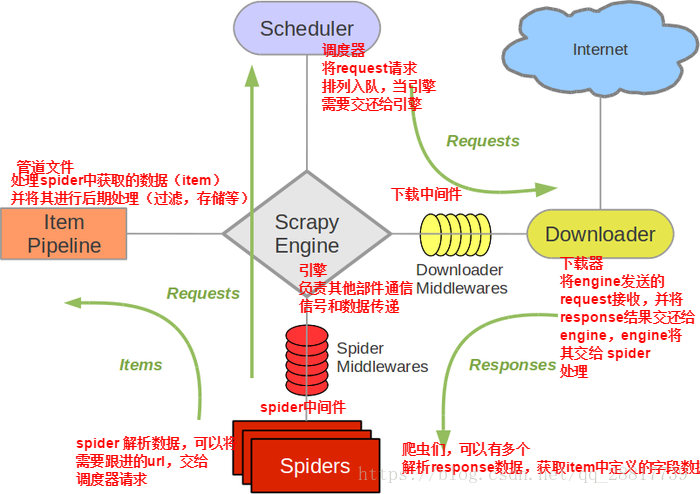
scrapy.sfg
以我现在理解是,部署项目发布相关的东西,比如在使用scrapyd发布时需要用到,其余时候不用动它
items.py
这里是用来计划你需要哪些数据的,比如爬虫需要保存4个值:
import scrapy

class Product(scrapy.Item):

    name = scrapy.Field()

    price = scrapy.Field()

    stock = scrapy.Field()

    last_updated = scrapy.Field(serializer=str)
middlerwares.py
爬虫中间件是使用非常多的,比如需要为每个请求设置随机User-Agent
代码如下,需要在settings.py中准备好ua数据,或者其他方式读取进来也行
USER_AGENTS = [

    "Mozilla/5.0 (Linux; U; Android 2.3.6; en-us; Nexus S Build/GRK39F) AppleWebKit/533.1 (KHTML, like Gecko) Version/4.0 Mobile Safari/533.1",

    "Avant Browser/1.2.789rel1 (http://www.avantbrowser.com)",

    "Mozilla/5.0 (Windows; U; Windows NT 6.1; en-US) AppleWebKit/532.5 (KHTML, like Gecko) Chrome/4.0.249.0 Safari/532.5",

    "Mozilla/5.0 (Windows; U; Windows NT 5.2; en-US) AppleWebKit/532.9 (KHTML, like Gecko) Chrome/5.0.310.0 Safari/532.9",

    "Mozilla/5.0 (Windows; U; Windows NT 5.1; en-US) AppleWebKit/534.7 (KHTML, like Gecko) Chrome/7.0.514.0 Safari/534.7",

    "Mozilla/5.0 (Windows; U; Windows NT 6.0; en-US) AppleWebKit/534.14 (KHTML, like Gecko) Chrome/9.0.601.0 Safari/534.14",

    "Mozilla/5.0 (Windows; U; Windows NT 6.1; en-US) AppleWebKit/534.14 (KHTML, like Gecko) Chrome/10.0.601.0 Safari/534.14",

    "Mozilla/5.0 (Windows; U; Windows NT 6.1; en-US) AppleWebKit/534.20 (KHTML, like Gecko) Chrome/11.0.672.2 Safari/534.20",

    "Mozilla/5.0 (Windows NT 6.1; WOW64) AppleWebKit/534.27 (KHTML, like Gecko) Chrome/12.0.712.0 Safari/534.27",

    "Mozilla/5.0 (Windows NT 6.1; WOW64) AppleWebKit/535.1 (KHTML, like Gecko) Chrome/13.0.782.24 Safari/535.1",

    "Mozilla/5.0 (Windows NT 6.0) AppleWebKit/535.2 (KHTML, like Gecko) Chrome/15.0.874.120 Safari/535.2",

    "Mozilla/5.0 (Windows NT 6.1; WOW64) AppleWebKit/535.7 (KHTML, like Gecko) Chrome/16.0.912.36 Safari/535.7",

    "Mozilla/5.0 (Windows; U; Windows NT 6.0 x64; en-US; rv:1.9pre) Gecko/2008072421 Minefield/3.0.2pre",

    "Mozilla/5.0 (Windows; U; Windows NT 5.1; en-US; rv:1.9.0.10) Gecko/2009042316 Firefox/3.0.10",

    "Mozilla/5.0 (Windows; U; Windows NT 6.0; en-GB; rv:1.9.0.11) Gecko/2009060215 Firefox/3.0.11 (.NET CLR 3.5.30729)",

    "Mozilla/5.0 (Windows; U; Windows NT 6.0; en-US; rv:1.9.1.6) Gecko/20091201 Firefox/3.5.6 GTB5",

    "Mozilla/5.0 (Windows; U; Windows NT 5.1; tr; rv:1.9.2.8) Gecko/20100722 Firefox/3.6.8 ( .NET CLR 3.5.30729; .NET4.0E)",

    "Mozilla/5.0 (Windows NT 6.1; rv:2.0.1) Gecko/20100101 Firefox/4.0.1",

    "Mozilla/5.0 (Windows NT 6.1; Win64; x64; rv:2.0.1) Gecko/20100101 Firefox/4.0.1",

    "Mozilla/5.0 (Windows NT 5.1; rv:5.0) Gecko/20100101 Firefox/5.0",

    "Mozilla/5.0 (Windows NT 6.1; WOW64; rv:6.0a2) Gecko/20110622 Firefox/6.0a2",

    "Mozilla/5.0 (Windows NT 6.1; WOW64; rv:7.0.1) Gecko/20100101 Firefox/7.0.1",

    "Mozilla/5.0 (Windows NT 6.1; WOW64; rv:2.0b4pre) Gecko/20100815 Minefield/4.0b4pre",

    "Mozilla/4.0 (compatible; MSIE 5.5; Windows NT 5.0 )",

    "Mozilla/4.0 (compatible; MSIE 5.5; Windows 98; Win 9x 4.90)",

    "Mozilla/5.0 (Windows; U; Windows XP) Gecko MultiZilla/1.6.1.0a",

    "Mozilla/2.02E (Win95; U)",

    "Mozilla/3.01Gold (Win95; I)",

    "Mozilla/4.8 [en] (Windows NT 5.1; U)",

    "Mozilla/5.0 (Windows; U; Win98; en-US; rv:1.4) Gecko Netscape/7.1 (ax)",

    "HTC_Dream Mozilla/5.0 (Linux; U; Android 1.5; en-ca; Build/CUPCAKE) AppleWebKit/528.5  (KHTML, like Gecko) Version/3.1.2 Mobile Safari/525.20.1",

    "Mozilla/5.0 (hp-tablet; Linux; hpwOS/3.0.2; U; de-DE) AppleWebKit/534.6 (KHTML, like Gecko) wOSBrowser/234.40.1 Safari/534.6 TouchPad/1.0",

    "Mozilla/5.0 (Linux; U; Android 1.5; en-us; sdk Build/CUPCAKE) AppleWebkit/528.5  (KHTML, like Gecko) Version/3.1.2 Mobile Safari/525.20.1",

    "Mozilla/5.0 (Linux; U; Android 2.1; en-us; Nexus One Build/ERD62) AppleWebKit/530.17 (KHTML, like Gecko) Version/4.0 Mobile Safari/530.17",

    "Mozilla/5.0 (Linux; U; Android 2.2; en-us; Nexus One Build/FRF91) AppleWebKit/533.1 (KHTML, like Gecko) Version/4.0 Mobile Safari/533.1",

    "Mozilla/5.0 (Linux; U; Android 1.5; en-us; htc_bahamas Build/CRB17) AppleWebKit/528.5  (KHTML, like Gecko) Version/3.1.2 Mobile Safari/525.20.1",

    "Mozilla/5.0 (Linux; U; Android 2.1-update1; de-de; HTC Desire 1.19.161.5 Build/ERE27) AppleWebKit/530.17 (KHTML, like Gecko) Version/4.0 Mobile Safari/530.17",

    "Mozilla/5.0 (Linux; U; Android 2.2; en-us; Sprint APA9292KT Build/FRF91) AppleWebKit/533.1 (KHTML, like Gecko) Version/4.0 Mobile Safari/533.1",

    "Mozilla/5.0 (Linux; U; Android 1.5; de-ch; HTC Hero Build/CUPCAKE) AppleWebKit/528.5  (KHTML, like Gecko) Version/3.1.2 Mobile Safari/525.20.1",

    "Mozilla/5.0 (Linux; U; Android 2.2; en-us; ADR6300 Build/FRF91) AppleWebKit/533.1 (KHTML, like Gecko) Version/4.0 Mobile Safari/533.1",

    "Mozilla/5.0 (Linux; U; Android 2.1; en-us; HTC Legend Build/cupcake) AppleWebKit/530.17 (KHTML, like Gecko) Version/4.0 Mobile Safari/530.17",

    "Mozilla/5.0 (Linux; U; Android 1.5; de-de; HTC Magic Build/PLAT-RC33) AppleWebKit/528.5  (KHTML, like Gecko) Version/3.1.2 Mobile Safari/525.20.1 FirePHP/0.3",

    "Mozilla/5.0 (Linux; U; Android 1.6; en-us; HTC_TATTOO_A3288 Build/DRC79) AppleWebKit/528.5  (KHTML, like Gecko) Version/3.1.2 Mobile Safari/525.20.1",

    "Mozilla/5.0 (Linux; U; Android 1.0; en-us; dream) AppleWebKit/525.10  (KHTML, like Gecko) Version/3.0.4 Mobile Safari/523.12.2",

    "Mozilla/5.0 (Linux; U; Android 1.5; en-us; T-Mobile G1 Build/CRB43) AppleWebKit/528.5  (KHTML, like Gecko) Version/3.1.2 Mobile Safari 525.20.1",

    "Mozilla/5.0 (Linux; U; Android 1.5; en-gb; T-Mobile_G2_Touch Build/CUPCAKE) AppleWebKit/528.5  (KHTML, like Gecko) Version/3.1.2 Mobile Safari/525.20.1",

    "Mozilla/5.0 (Linux; U; Android 2.0; en-us; Droid Build/ESD20) AppleWebKit/530.17 (KHTML, like Gecko) Version/4.0 Mobile Safari/530.17",

    "Mozilla/5.0 (Linux; U; Android 2.2; en-us; Droid Build/FRG22D) AppleWebKit/533.1 (KHTML, like Gecko) Version/4.0 Mobile Safari/533.1",

    "Mozilla/5.0 (Linux; U; Android 2.0; en-us; Milestone Build/ SHOLS_U2_01.03.1) AppleWebKit/530.17 (KHTML, like Gecko) Version/4.0 Mobile Safari/530.17",

    "Mozilla/5.0 (Linux; U; Android 2.0.1; de-de; Milestone Build/SHOLS_U2_01.14.0) AppleWebKit/530.17 (KHTML, like Gecko) Version/4.0 Mobile Safari/530.17",

    "Mozilla/5.0 (Linux; U; Android 3.0; en-us; Xoom Build/HRI39) AppleWebKit/525.10  (KHTML, like Gecko) Version/3.0.4 Mobile Safari/523.12.2",

    "Mozilla/5.0 (Linux; U; Android 0.5; en-us) AppleWebKit/522  (KHTML, like Gecko) Safari/419.3",

    "Mozilla/5.0 (Linux; U; Android 1.1; en-gb; dream) AppleWebKit/525.10  (KHTML, like Gecko) Version/3.0.4 Mobile Safari/523.12.2",

    "Mozilla/5.0 (Linux; U; Android 2.0; en-us; Droid Build/ESD20) AppleWebKit/530.17 (KHTML, like Gecko) Version/4.0 Mobile Safari/530.17",

    "Mozilla/5.0 (Linux; U; Android 2.1; en-us; Nexus One Build/ERD62) AppleWebKit/530.17 (KHTML, like Gecko) Version/4.0 Mobile Safari/530.17",

    "Mozilla/5.0 (Linux; U; Android 2.2; en-us; Sprint APA9292KT Build/FRF91) AppleWebKit/533.1 (KHTML, like Gecko) Version/4.0 Mobile Safari/533.1",

    "Mozilla/5.0 (Linux; U; Android 2.2; en-us; ADR6300 Build/FRF91) AppleWebKit/533.1 (KHTML, like Gecko) Version/4.0 Mobile Safari/533.1",

    "Mozilla/5.0 (Linux; U; Android 2.2; en-ca; GT-P1000M Build/FROYO) AppleWebKit/533.1 (KHTML, like Gecko) Version/4.0 Mobile Safari/533.1",

    "Mozilla/5.0 (Linux; U; Android 3.0.1; fr-fr; A500 Build/HRI66) AppleWebKit/534.13 (KHTML, like Gecko) Version/4.0 Safari/534.13",

    "Mozilla/5.0 (Linux; U; Android 3.0; en-us; Xoom Build/HRI39) AppleWebKit/525.10  (KHTML, like Gecko) Version/3.0.4 Mobile Safari/523.12.2",

    "Mozilla/5.0 (Linux; U; Android 1.6; es-es; SonyEricssonX10i Build/R1FA016) AppleWebKit/528.5  (KHTML, like Gecko) Version/3.1.2 Mobile Safari/525.20.1",

    "Mozilla/5.0 (Linux; U; Android 1.6; en-us; SonyEricssonX10i Build/R1AA056) AppleWebKit/528.5  (KHTML, like Gecko) Version/3.1.2 Mobile Safari/525.20.1",

]
# 随机User-Agent

class RandomUserAgentMiddleware(object):

    def __init__(self, agents):

        """接收从from_crawler传的List-agents"""

        self.agents = agents

    @classmethod

    def from_crawler(cls, crawler):

        """从settings读取USER_AGENTS,传参到构造函数"""

        return cls(crawler.settings.getlist('USER_AGENTS'))

    def process_request(self, request, spider):

        """修改每一个request的header"""

        request.headers.setdefault('User-Agent', random.choice(self.agents))
最后一定要在settings.py中配置,才会生效
DOWNLOADER_MIDDLEWARES = {

    'tutorial.middlewares.RandomUserAgentMiddleware': 1

}
设置动态代理,同样在这,只需要在meta中指定即可,scrapy会帮你调度,这里以设置固定代理为例
# 代理服务器

class ProxyMiddleware(object):

    def process_request(self, request, spider):

        """设置代理"""

        request.meta['proxy'] = 'http://115.226.140.24:44978'
同上,需要在settings.py中配置,才会生效
DOWNLOADER_MIDDLEWARES = {

    'tutorial.middlewares.RandomUserAgentMiddleware': 1,

    'tutorial.middlewares.ProxyMiddleware': 556

}
设置cookie,同样也可以在这配置,和设置请求头其实是一样的
# Cookies更新

class CookiesMiddleware(object):

    def get_cookies(self):

        # 1.从redis中获取

        # 2.http接口

        pass

    def process_request(self, request, spider):

        request.cookies = self.get_cookies()
同样,需要在settings.py中配置
pipelines.py
这里是写关于item类的处理方式的
比如,需要将item存放至mysql中,就可以在这里写,这里我写用文件追加形式保存数据
class WenshuPipeline(object):

    def process_item(self, item, spider):

        date = item['date']

        # 一个日期一个文件

        with open(date + '.txt', 'a', encoding='utf-8') as f:

            f.write(item['json_data'] + "\n")
同样,需要在settings.py中配置
ITEM_PIPELINES = {

   'tutorial.pipelines.WenshuPipeline': 300,

}
settings.py
这里配置了许多,非常重要的配置,记几个常用的,以后补充
名字:
一般自动生成,略
遵守爬虫协议:
# Obey robots.txt rules

ROBOTSTXT_OBEY = False  # 默认true
失败重试:
# 请求失败重试

RETRY_ENABLED = True # 默认true

RETRY_TIMES = 3  # 默认2

# RETRY_HTTP_CODECS  #遇到什么http code时需要重试,默认是500,502,503,504,408,其他的,网络连接超时等问题也会自动retry的
下载超时时间:
DOWNLOAD_TIMEOUT = 15  # 默认180秒

# 但是减小下载超时可能会引发错误:

# TimeoutError: User timeout caused connection failure: Getting http://xxx.com. took longer than 15.0 seconds.
是否启用cookie:
# Disable cookies (enabled by default)

COOKIES_ENABLED = True
是否启用httpcahe:
# Enable and configure HTTP caching (disabled by default)

# See https://doc.scrapy.org/en/latest/topics/downloader-middleware.html#httpcache-middleware-settings

#HTTPCACHE_ENABLED = True

#HTTPCACHE_EXPIRATION_SECS = 0

#HTTPCACHE_DIR = 'httpcache'

#HTTPCACHE_IGNORE_HTTP_CODES = []

#HTTPCACHE_STORAGE = 'scrapy.extensions.httpcache.FilesystemCacheStorage'
异步请求数(控制速度十分重要的设置):
# Configure maximum concurrent requests performed by Scrapy (default: 16)

CONCURRENT_REQUESTS = 16

# Configure a delay for requests for the same website (default: 0)

# See https://doc.scrapy.org/en/latest/topics/settings.html#download-delay

# See also autothrottle settings and docs

#DOWNLOAD_DELAY = 3

# The download delay setting will honor only one of:

#CONCURRENT_REQUESTS_PER_DOMAIN = 16

#CONCURRENT_REQUESTS_PER_IP = 16
中间件,前面提到过
日志:
# 设置日志

# 日志文件

LOG_FILE = BOT_NAME + '_' + time.strftime("%Y-%m-%d", time.localtime()) + '.log'

# 日志等级

LOG_LEVEL = 'INFO'

# 是否启用日志(创建日志后,不需开启,进行配置)

LOG_ENABLED = True  # (默认为True,启用日志)

# 日志编码

LOG_ENCODING = 'utf-8'

# 如果是True ,进程当中,所有标准输出(包括错误)将会被重定向到log中;例如:在爬虫代码中的 print()

LOG_STDOUT = False  # 默认为False
spiders
这里写爬虫,爬虫的起始url,怎么解析,和怎么处理,都是在这里完成
三、三个重要的类详解
scrapy.Request
scrapy框架提供的请求类,源码在scrapy.http.request.__init__文件中,这个类一般用来提交get请求,在spider中通过yield交给引擎
class Request(object_ref):

    def __init__(self, url, callback=None, method='GET', headers=None, body=None,

                 cookies=None, meta=None, encoding='utf-8', priority=0,

                 dont_filter=False, errback=None, flags=None):

        self._encoding = encoding  # this one has to be set first

        self.method = str(method).upper()

        self._set_url(url)

        self._set_body(body)

        assert isinstance(priority, int), "Request priority not an integer: %r" % priority

        self.priority = priority

        if callback is not None and not callable(callback):

            raise TypeError('callback must be a callable, got %s' % type(callback).__name__)

        if errback is not None and not callable(errback):

            raise TypeError('errback must be a callable, got %s' % type(errback).__name__)

        assert callback or not errback, "Cannot use errback without a callback"

        self.callback = callback

        self.errback = errback

        self.cookies = cookies or {}

        self.headers = Headers(headers or {}, encoding=encoding)

        self.dont_filter = dont_filter

        self._meta = dict(meta) if meta else None

        self.flags = [] if flags is None else list(flags)

    @property

    def meta(self):

        if self._meta is None:

            self._meta = {}

        return self._meta

    def _get_url(self):

        return self._url

    def _set_url(self, url):

        if not isinstance(url, six.string_types):

            raise TypeError('Request url must be str or unicode, got %s:' % type(url).__name__)

        s = safe_url_string(url, self.encoding)

        self._url = escape_ajax(s)

        if ':' not in self._url:

            raise ValueError('Missing scheme in request url: %s' % self._url)

    url = property(_get_url, obsolete_setter(_set_url, 'url'))

    def _get_body(self):

        return self._body

    def _set_body(self, body):

        if body is None:

            self._body = b''

        else:

            self._body = to_bytes(body, self.encoding)

    body = property(_get_body, obsolete_setter(_set_body, 'body'))

    @property

    def encoding(self):

        return self._encoding

    def __str__(self):

        return "<%s %s>" % (self.method, self.url)

    __repr__ = __str__

    def copy(self):

        """Return a copy of this Request"""

        return self.replace()

    def replace(self, *args, **kwargs):

        """Create a new Request with the same attributes except for those

        given new values.

        """

        for x in ['url', 'method', 'headers', 'body', 'cookies', 'meta',

                  'encoding', 'priority', 'dont_filter', 'callback', 'errback']:

            kwargs.setdefault(x, getattr(self, x))

        cls = kwargs.pop('cls', self.__class__)

        return cls(*args, **kwargs)
可以看到,它有我们了解的一般request所需要的内容,我们设置url,headers,cookies,callback等,都可以在构造函数中来设置
当然,还有两个重要的方法,是比较鼓励外部调用的,copy()和replace(),replace()将所有构造函数的属性浅拷贝,但你可以设置给定新值,
注意是浅拷贝,所以meta的拷贝只是引用改变。copy()就是浅拷贝request
当然还需要有post请求,也就是form表单提交,源文件在scrapy.http.request.form.FormRequest,这个类继承自scrapy.Request,确实有很多可以复用的
class FormRequest(Request):

    def __init__(self, *args, **kwargs):

        formdata = kwargs.pop('formdata', None)

        if formdata and kwargs.get('method') is None:

            kwargs['method'] = 'POST'

        super(FormRequest, self).__init__(*args, **kwargs)

        if formdata:

            items = formdata.items() if isinstance(formdata, dict) else formdata

            querystr = _urlencode(items, self.encoding)

            if self.method == 'POST':

                self.headers.setdefault(b'Content-Type', b'application/x-www-form-urlencoded')

                self._set_body(querystr)

            else:

                self._set_url(self.url + ('&' if '?' in self.url else '?') + querystr)

    @classmethod

    def from_response(cls, response, formname=None, formid=None, formnumber=0, formdata=None,

                      clickdata=None, dont_click=False, formxpath=None, formcss=None, **kwargs):

        kwargs.setdefault('encoding', response.encoding)

        if formcss is not None:

            from parsel.csstranslator import HTMLTranslator

            formxpath = HTMLTranslator().css_to_xpath(formcss)

        form = _get_form(response, formname, formid, formnumber, formxpath)

        formdata = _get_inputs(form, formdata, dont_click, clickdata, response)

        url = _get_form_url(form, kwargs.pop('url', None))

        method = kwargs.pop('method', form.method)

        return cls(url=url, method=method, formdata=formdata, **kwargs)

def _get_form_url(form, url):

    if url is None:

        action = form.get('action')

        if action is None:

            return form.base_url

        return urljoin(form.base_url, strip_html5_whitespace(action))

    return urljoin(form.base_url, url)

def _urlencode(seq, enc):

    values = [(to_bytes(k, enc), to_bytes(v, enc))

              for k, vs in seq

              for v in (vs if is_listlike(vs) else [vs])]

    return urlencode(values, doseq=1)

def _get_form(response, formname, formid, formnumber, formxpath):

    """Find the form element """

    root = create_root_node(response.text, lxml.html.HTMLParser,

                            base_url=get_base_url(response))

    forms = root.xpath('//form')

    if not forms:

        raise ValueError("No <form> element found in %s" % response)

    if formname is not None:

        f = root.xpath('//form[@name="%s"]' % formname)

        if f:

            return f[0]

    if formid is not None:

        f = root.xpath('//form[@id="%s"]' % formid)

        if f:

            return f[0]

    # Get form element from xpath, if not found, go up

    if formxpath is not None:

        nodes = root.xpath(formxpath)

        if nodes:

            el = nodes[0]

            while True:

                if el.tag == 'form':

                    return el

                el = el.getparent()

                if el is None:

                    break

        encoded = formxpath if six.PY3 else formxpath.encode('unicode_escape')

        raise ValueError('No <form> element found with %s' % encoded)

    # If we get here, it means that either formname was None

    # or invalid

    if formnumber is not None:

        try:

            form = forms[formnumber]

        except IndexError:

            raise IndexError("Form number %d not found in %s" %

                             (formnumber, response))

        else:

            return form

def _get_inputs(form, formdata, dont_click, clickdata, response):

    try:

        formdata = dict(formdata or ())

    except (ValueError, TypeError):

        raise ValueError('formdata should be a dict or iterable of tuples')

    inputs = form.xpath('descendant::textarea'

                        '|descendant::select'

                        '|descendant::input[not(@type) or @type['

                        ' not(re:test(., "^(?:submit|image|reset)$", "i"))'

                        ' and (../@checked or'

                        '  not(re:test(., "^(?:checkbox|radio)$", "i")))]]',

                        namespaces={

                            "re": "http://exslt.org/regular-expressions"})

    values = [(k, u'' if v is None else v)

              for k, v in (_value(e) for e in inputs)

              if k and k not in formdata]

    if not dont_click:

        clickable = _get_clickable(clickdata, form)

        if clickable and clickable[0] not in formdata and not clickable[0] is None:

            values.append(clickable)

    values.extend((k, v) for k, v in formdata.items() if v is not None)

    return values

def _value(ele):

    n = ele.name

    v = ele.value

    if ele.tag == 'select':

        return _select_value(ele, n, v)

    return n, v

def _select_value(ele, n, v):

    multiple = ele.multiple

    if v is None and not multiple:

        # Match browser behaviour on simple select tag without options selected

        # And for select tags wihout options

        o = ele.value_options

        return (n, o[0]) if o else (None, None)

    elif v is not None and multiple:

        # This is a workround to bug in lxml fixed 2.3.1

        # fix https://github.com/lxml/lxml/commit/57f49eed82068a20da3db8f1b18ae00c1bab8b12#L1L1139

        selected_options = ele.xpath('.//option[@selected]')

        v = [(o.get('value') or o.text or u'').strip() for o in selected_options]

    return n, v

def _get_clickable(clickdata, form):

    """

    Returns the clickable element specified in clickdata,

    if the latter is given. If not, it returns the first

    clickable element found

    """

    clickables = [

        el for el in form.xpath(

            'descendant::*[(self::input or self::button)'

            ' and re:test(@type, "^submit$", "i")]'

            '|descendant::button[not(@type)]',

            namespaces={"re": "http://exslt.org/regular-expressions"})

        ]

    if not clickables:

        return

    # If we don't have clickdata, we just use the first clickable element

    if clickdata is None:

        el = clickables[0]

        return (el.get('name'), el.get('value') or '')

    # If clickdata is given, we compare it to the clickable elements to find a

    # match. We first look to see if the number is specified in clickdata,

    # because that uniquely identifies the element

    nr = clickdata.get('nr', None)

    if nr is not None:

        try:

            el = list(form.inputs)[nr]

        except IndexError:

            pass

        else:

            return (el.get('name'), el.get('value') or '')

    # We didn't find it, so now we build an XPath expression out of the other

    # arguments, because they can be used as such

    xpath = u'.//*' + \

            u''.join(u'[@%s="%s"]' % c for c in six.iteritems(clickdata))

    el = form.xpath(xpath)

    if len(el) == 1:

        return (el[0].get('name'), el[0].get('value') or '')

    elif len(el) > 1:

        raise ValueError("Multiple elements found (%r) matching the criteria "

                         "in clickdata: %r" % (el, clickdata))

    else:

        raise ValueError('No clickable element matching clickdata: %r' % (clickdata,))
不过很显然几乎都是_私有方法,不建议调用,而且很多数据都是需要urlencode的
为什么要讲这些呢,因为在我使用过程中,需要使用中间件动态改变headers,cookies,formdata,让我查了很久才知道怎么改
因为比如cookie,也许spider中yield之后,经过很长时间才能抵达下载器,为了维护成最新的cookie,可以在中间件中进行修改
scrapy.Response
这是scrapy提供的响应类,源文件scrapy.http.response.Response
"""

This module implements the Response class which is used to represent HTTP

responses in Scrapy.

See documentation in docs/topics/request-response.rst

"""

from six.moves.urllib.parse import urljoin

from scrapy.http.request import Request

from scrapy.http.headers import Headers

from scrapy.link import Link

from scrapy.utils.trackref import object_ref

from scrapy.http.common import obsolete_setter

from scrapy.exceptions import NotSupported

class Response(object_ref):

    def __init__(self, url, status=200, headers=None, body=b'', flags=None, request=None):

        self.headers = Headers(headers or {})

        self.status = int(status)

        self._set_body(body)

        self._set_url(url)

        self.request = request

        self.flags = [] if flags is None else list(flags)

    @property

    def meta(self):

        try:

            return self.request.meta

        except AttributeError:

            raise AttributeError(

                "Response.meta not available, this response "

                "is not tied to any request"

            )

    def _get_url(self):

        return self._url

    def _set_url(self, url):

        if isinstance(url, str):

            self._url = url

        else:

            raise TypeError('%s url must be str, got %s:' % (type(self).__name__,

                type(url).__name__))

    url = property(_get_url, obsolete_setter(_set_url, 'url'))

    def _get_body(self):

        return self._body

    def _set_body(self, body):

        if body is None:

            self._body = b''

        elif not isinstance(body, bytes):

            raise TypeError(

                "Response body must be bytes. "

                "If you want to pass unicode body use TextResponse "

                "or HtmlResponse.")

        else:

            self._body = body

    body = property(_get_body, obsolete_setter(_set_body, 'body'))

    def __str__(self):

        return "<%d %s>" % (self.status, self.url)

    __repr__ = __str__

    def copy(self):

        """Return a copy of this Response"""

        return self.replace()

    def replace(self, *args, **kwargs):

        """Create a new Response with the same attributes except for those

        given new values.

        """

        for x in ['url', 'status', 'headers', 'body', 'request', 'flags']:

            kwargs.setdefault(x, getattr(self, x))

        cls = kwargs.pop('cls', self.__class__)

        return cls(*args, **kwargs)

    def urljoin(self, url):

        """Join this Response's url with a possible relative url to form an

        absolute interpretation of the latter."""

        return urljoin(self.url, url)

    @property

    def text(self):

        """For subclasses of TextResponse, this will return the body

        as text (unicode object in Python 2 and str in Python 3)

        """

        raise AttributeError("Response content isn't text")

    def css(self, *a, **kw):

        """Shortcut method implemented only by responses whose content

        is text (subclasses of TextResponse).

        """

        raise NotSupported("Response content isn't text")

    def xpath(self, *a, **kw):

        """Shortcut method implemented only by responses whose content

        is text (subclasses of TextResponse).

        """

        raise NotSupported("Response content isn't text")

    def follow(self, url, callback=None, method='GET', headers=None, body=None,

               cookies=None, meta=None, encoding='utf-8', priority=0,

               dont_filter=False, errback=None):

        # type: (...) -> Request

        """

        Return a :class:`~.Request` instance to follow a link ``url``.

        It accepts the same arguments as ``Request.__init__`` method,

        but ``url`` can be a relative URL or a ``scrapy.link.Link`` object,

        not only an absolute URL.

        :class:`~.TextResponse` provides a :meth:`~.TextResponse.follow`

        method which supports selectors in addition to absolute/relative URLs

        and Link objects.

        """

        if isinstance(url, Link):

            url = url.url

        url = self.urljoin(url)

        return Request(url, callback,

                       method=method,

                       headers=headers,

                       body=body,

                       cookies=cookies,

                       meta=meta,

                       encoding=encoding,

                       priority=priority,

                       dont_filter=dont_filter,

                       errback=errback)
显然,这里提供一些方法调用,从这里可以看出,response包含了request,并且共用一个meta字典,所以才能用于传参
还有就是各种常用的选择器使用,但是可以看出,这并不是我们一般使用的Resonse,我们使用的也是它的子类scrapy.http.response.text.TextResponse
子类才真正实现了那些选择器和text
Middlerware
这个并不是指一个类,泛指中间件,一般写在Middlerware.py文件中,主要讲一讲自定义的功能,定义格式:
class tutorialDownloaderMiddleware(object):

    # Not all methods need to be defined. If a method is not defined,

    # scrapy acts as if the downloader middleware does not modify the

    # passed objects.

    @classmethod

    def from_crawler(cls, crawler):

        # This method is used by Scrapy to create your spiders.

        s = cls()

        crawler.signals.connect(s.spider_opened, signal=signals.spider_opened)

        return s

    def process_request(self, request, spider):

        # Called for each request that goes through the downloader

        # middleware.

        # Must either:

        # - return None: continue processing this request

        # - or return a Response object

        # - or return a Request object

        # - or raise IgnoreRequest: process_exception() methods of

        #   installed downloader middleware will be called

        return None

    def process_response(self, request, response, spider):

        # Called with the response returned from the downloader.

        # Must either;

        # - return a Response object

        # - return a Request object

        # - or raise IgnoreRequest

        return response

    def process_exception(self, request, exception, spider):

        # Called when a download handler or a process_request()

        # (from other downloader middleware) raises an exception.

        # Must either:

        # - return None: continue processing this exception

        # - return a Response object: stops process_exception() chain

        # - return a Request object: stops process_exception() chain

        pass

    def spider_opened(self, spider):

        spider.logger.info('Spider opened: %s' % spider.name)
@classmethod
def from_crawler(cls, crawler):
这个方法主要用于给中间件构造函数传参,返回的就是实例
def process_request(self, request, spider):
这个方法会处理从引擎发往下载器的request
def process_response(self, request, response, spider):
这个方法会处理从下载器发往引擎的response
def process_exception(self, request, exception, spider):
这个方法会处理其他中间件抛出的异常和下载时候的异常
def spider_opened(self, spider):
这个没用过,哈哈,不过看得出是可以在爬虫打开时被调用
好了,上面笼统介绍了用处,其实是为了说我写中间件时候遇到的问题,因为scrapy有自带的很多中间件,所以方法的编写,优先级的设置,没搞好出bug都不知道哪出的,还千奇百怪
默认的中间件:DOWNLOADER_MIDDLEWARES_BASE 几乎都有重要的功能,了解这些,如果再深入一点源码,对理解http请求都很有辅助的帮助
所以记录一下最近用到的Middlerware和优先级,亲测是可行的
    def process_request(self, request, spider):

        """修改headers,优先级 1"""

        request.headers.setdefault('User-Agent', random.choice(self.agents))

    def process_request(self, request, spider):

        """修改cookies,优先级 50"""

        request.cookies = self.get_cookies()

    def process_request(self, request, spider):

        """设置代理,优先级60"""

        request.meta['proxy'] = 'http://' + self.proxys[self.num % PROXY_POOL_NUM]

    def process_response(self, request, response, spider):

        """检查response合法性, 优先级 560"""

        html = response.body.decode()

        if response.status != 200 or html is None:

            print('内容为空')

            return request.replace(dont_filter=True)

        elif 'VisitRemind' in html:

            print('出现验证码')

            return request.replace(dont_filter=True)

        else:

            return response

    def process_exception(self, request, exception, spider):

        """处理异常,优先级 560"""

        print(exception)

        meta = request.meta

        if 'req_error_times' in meta.keys():

            meta['req_error_times'] = meta['req_error_times'] + 1

        else:

            meta['req_error_times'] = 1

        print(meta['req_error_times'])

        if meta['req_error_times'] > MAX_ERROR_TIMES:

            raise IgnoreRequest

        return request.replace(dont_filter=True)
四、调试scrapy
这是非常重要的部分,我刚开始学的时候就完全摸不着头脑怎么去调试,有些错误由于框架封装的缘故,报得很奇怪,有时候不能定位具体的错误代码在哪,提示错误在scrapy源码中,总不可能去改源码吧。。。下面讲讲怎么调试
有许多命令行可以调试的命令,但是总感觉很简陋
如果你在使用IDE,可以在项目根目录,也就是scrapy.sfg同级目录下新建一个run.py文件
# !usr/bin/env python

# -*- coding:utf-8 _*-

"""

@author:happy_code

@email: happy_code@foxmail.com

@file:  run.py

@time:  2019/01/24

@desc:

"""

from scrapy import cmdline

if __name__ == '__main__':

    cmdline.execute('scrapy crawl tutorial'.split())
这样,右键运行项目可以很方便。打断点后,右键debug也和普通项目一样debug,很方便
五、运行和部署
运行,命令行cd到项目根目录
scrapy crawl tutorial
最近在使用scrapyd和scrapy-client部署,还在学习,感觉挺方便的,有时间更
六、心得
现在还有中间件的配置中,优先级的控制上有些疑惑,
还有在于源码,比如引擎,下载器,这方面有疑惑
还有关于异步也是不太明白原理
继续奋斗吧!
Scrapy使用详细记录的更多相关文章
- Maven 搭建SpringMvc+Spring+Mybatis详细记录
总觉得,看比人写的总是那么好,每次搭建框架时都会找博客,找教程来跟着一步一步走,虽然很快搭建成功了,但是经常情况是我并不知道我干了什么,也不记得具体步骤,到底为什么要这么做,今天我详细记录了一下自己搭 ...
- 基于stm32的水质监测系统项目基础部分详细记录
基于stm32的水质监测系统项目基础部分详细记录 软件环境:MDK5 硬件环境:STM32F103ZET6 开发板.颜色传感器.串口屏.串口打印机 搭建工程模板 在进行项目软件的撰写时,首先新建一个基 ...
- 一种历史详细记录表,完整实现:CommonOperateLog 详细记录某用户、某时间、对某表、某主键、某字段的修改(新旧值
一种历史详细记录表,完整实现:CommonOperateLog 详细记录某用户.某时间.对某表.某主键.某字段的修改(新旧值). 特别适用于订单历史记录.重要财务记录.审批流记录 表设计: names ...
- #实现详细记录登陆过系统的用户,IP地址,shell命令及详细操作的时间
//实现详细记录登陆过系统的用户,IP地址,shell命令及详细操作的时间 将下面代码加入/etc/profile //history USER_IP = who -u am i 2> /dev ...
- Response.ContentType 详细列表-请求的内容类型详细记录
Response.ContentType 详细列表-请求的内容类型详细记录 作者:王春天一.应用实例: Response.Clear(); Response.ContentType = "t ...
- 1 win10双系统安装ubuntu16.04和18.04(问题详细记录)
我从来不想在琐事上花功夫.就拿装系统来说,我感觉拿过来一个完全陌生的项目源码,看起来,都比装系统爽.我属于典型的逻辑思考男.喜欢畅游程序的海洋. 一直windows跑深度学习和tensorflow,有 ...
- python scrapy简单爬虫记录(实现简单爬取知乎)
之前写了个scrapy的学习记录,只是简单的介绍了下scrapy的一些内容,并没有实际的例子,现在开始记录例子 使用的环境是python2.7, scrapy1.2.0 首先创建项目 在要建立项目的目 ...
- 【Oracle RAC】Linux系统Oracle18c RAC安装配置详细记录过程(图文并茂)
本文Oracle 18c GI/RAC on Oracle Linux step-by-step 的安装配置步骤,同时也包含dbca 创建数据库的过程. 1. 关闭SELINUX,防火墙vi /etc ...
- K8ssandra入门-详细记录在Linux上部署K8ssandra到Kubernetes
1 什么是K8ssandra Cassandra是一款非常优秀的开源的分布式NoSQL数据库,被许多优秀的大公司采用,具有高可用.弹性扩展.性能好等特点. 正应Cassandra的优势,我们经常需要在 ...
随机推荐
- Java compiler level does not match the version of the installed Java project fac
Java compiler level does not match the version of the installed Java project fac 问题一: 问:项目图标报错,Probl ...
- Oracle10g 安装步骤
一.Oracle10g 安装预备步骤 取得 Oracle 10g 安装程序,或从 Oracle 技术网(OTN)下载光盘映像.在评估阶段您可以免费下载和使用无技术限制的全功能 Oracle,但在正式的 ...
- Android之ProGuard混淆器
ProGuard是一个压缩.优化和混淆Java字节码文件的免费的工具,它可以删除无用的类.字段.方法和属性.可以删除没用的注释,最大限度地优化字节码文件.它还可以使用简短的无意义的名称来重命名已经存在 ...
- MYSQL数据库的导出的几种方法
mysql的数据导出几种方法 从网上找到一些问题是关于如何从MySQL中导出数据,以便用在本地或其它的数据库系统之上:以及 将现有数据导入MySQL数据库中. 数据导出 数据导出主要有以下几种方法 ...
- 【C语言】21-结构体
C语言的核心部分都说得七七八八了,相信大家已经对C语言的基本数据类型(char\int\float).数组.指针都很熟悉了,今天来学习C语言中另外一种数据类型:结构体.在iOS开发中,结构体是经常用到 ...
- 06、Windows 10 技术预览
随着 Windows 10 发布的,未来 Windows 平台都是统一开发模型,可以只写一个 Appx 包,就可以同时部署到 Windows/ Windowsw Phone/ Tablet /xbox ...
- css 优先级的bug
对于前端而言,了解css样式的优先级,对开发或处理bug有着事半功倍的效果,今天在做项目的时候,突然碰到一个优先级的小问题,刚开始不知道所因,后来才发现这个问题是由优先级造成的.先描述下问题,鼠标悬停 ...
- jquery 对table的一些操作 怎么获取tr下的第二个td元素?
1.HTML结构 <table id = "test"> <tr><td>1</td><td>1</td>& ...
- API - 使用Default对象 - 基础篇
在编写Spider Studio脚本时, Default对象是最常用最重要的一个, 其类型定义如下: Webus3.Spider.Controls.JQueryBrowser Default; 下面介 ...
- Scala类中的get与set
在scala类中get和set使用有以下几种: 1. var foo: Scala自动合成一个getter和一个setter 2. val foo: Scala自动合成一个getter scala中v ...