
<Yarn> <Capacity Scheduler> <Source Code>
Yarn capacity scheduler
- 首先要知道, [Attention: RM有两个组件,其中Scheduler完全就只是负责资源的分配;ApplicationsManager则负责接受application,选取ApplicationMaster,监控重启AM。]
- CapacityScheduler的优点就是灵活,集群的利用率高;缺点也是由其灵活性造成的,因为CapacityScheduler不支持抢占式调度,必须等上一个任务主动释放资源。

- 可以看出,只要提交的app数没有达到上限,就能够一直提交app到集群,只是这些app会处于accepted的状态,一直pending,直到ResourceManager给它分配资源。
- 因此Scheduler实际上是会不断地schedule,然后分配资源给那些集群,在具体分配的时候,在queue内部可能会考虑优先级,然后结合FIFO。
AsyncScheduleThread
- 在CapacityScheduler内部有个AsyncScheduleThread 这个异步Scheduler线程会不断地调schedule(cs)方法。
schedule(cs)
- // Schedule on all nodes by starting at a random point.
- static void schedule(CapacityScheduler cs)
- // first randomize the start point
- Collection<FiCaSchedulerNode> nodes = cs.getAllNodes().values() // get all the nodes in the cluster
- for each node: cs.allocateContainersToNode(node)
- // assign new containers... 1. check for reserved apps(for reservation see here and here. ) 2. schedule if there are no reservations
- if reservedContainer != null
- get the reserved apps according to reservedContainers
- // try to fulfill the reservation
- LeafQueue queue = ((LeafQueue) reservedApplication.getQueue();
- CSAssignment assignment = queue.assignContainers(clusterResource, node, false); // assignContainers(Resource clusterResource, FiCaSchedulerNode node, boolean needToUnreserve);
- // if our queue cannot access this node, just return
- // check for reserved resources
- TBD...
- // try to schedule more if there are no reservations to fulfill
- if (node.getReservedContainer() == null)
- if (calculator.computeAvailableContainers(node.getAvailableResource(), minimumAllocation) > 0), then // computeAvailableContainers(Resource available, Resource required), as for DominantResourceCalculator, return the min ratio of mem & vcores.
- assignContainers(clusterResource, node, false) // assignContainers(Resource clusterResource, FiCaSchedulerNode node)
- // if our queue cannot access this node, just return
- // check for reserved resources // TBD...
- // try to assign containers to apps in order
- for (FoCaSchedulerApp application: activeApplications)
- if (SchedulerAppUtils.isBlacklisted(application, node, LOG) // check if this resource is on blacklist, i.e. cannot run the app in this node/rack
- // schedule in priority order, this is the priority of the resourceRequest of this app
- for (Priority priority : application.getPriorities())
- ResourceRequest anyRequest = application.getResourceRequest(priority, ResourceRequest.ANY)
- Resource required = anyRequest.getCapacity()
- Set<String> requestedNodeLabels = getRequestLabelSetByExpression(anyRequest.getNodeLabelExpression());
- // compute user-limit & set headroom.
- Resource userLimit = computeUserLimitAndSetHeadroom(application, clusterResource, required, requestedNodeLabels)
- // compute user limit respect requested labels
- // TODO: need consider headroom respect labels also
- Resource userLimit = computeUserLimit(application, clusterResource, required, queueUser, requestedLabels)
- // our current capacity: equal to the max(required, queue-capacity) if we're running below capacity, equal to (usedResources + required) if running over capacity.
- // if we have labels to request(choose to use the first one).
- // else if no label on request, just use absolute capacity as capacity for nodes without label.
- // TBD...
- // max avail capacity needs to take into account usage by ancestor-siblings which are greater than their base
- // calculate absoluteMaxAvailCapacity: my max avail is min(my max capacity, unused from my parent by my siblings if they are beyond their base capacity)
- // then calculate queueMaxCap using absoluteMaxAvailCapacity
- // check canAssignToThisQueue
- // consider the intersection of queue-canAccessLabels and node-labels, if any of the label beyond queue limit, we cannot allocate on this node.
- // check user limit
- application.addSchedulingOpportunity(priority);
- // try to schedule...
- TBD...
- assignContainers(clusterResource, node, false) // assignContainers(Resource clusterResource, FiCaSchedulerNode node)
- if (calculator.computeAvailableContainers(node.getAvailableResource(), minimumAllocation) > 0), then // computeAvailableContainers(Resource available, Resource required), as for DominantResourceCalculator, return the min ratio of mem & vcores.
- FYI:
/**
 * Headroom is:
 *    min(
 *        min(userLimit, queueMaxCap) - userConsumed,
 *        queueMaxCap - queueUsedResources
 *       )
 *
 * ( which can be expressed as,
 *  min (userLimit - userConsumed, queuMaxCap - userConsumed,
 *    queueMaxCap - queueUsedResources)
 *  )
 *
 * given that queueUsedResources >= userConsumed, this simplifies to
 *
 * >> min (userlimit - userConsumed,   queueMaxCap - queueUsedResources) <<
 *
 */
addApplication
首先在CapacityScheduler随意找了个方法
synchronized addApplication(ApplicationAttemptedId applicationAttemptId, String queueName, String user)
- sanity check
- queue == null
- !queue instanceof LeafQueue
- Represents an application from the viewpoint of the scheduler. (Each running app in the RM corresponds to one instance of the FiCaScheduler class)
- FiCaSchedulerApp SchedulerApp = new FiCaSchedulerApp(applicationAttemptId, user, queue, queue.getActiveUserManager(), rmContext);
- ActiveUsersManager tracks users in the system. (An active user is defined as someone with outstanding resource requests.)
- rmContext is the context of the RM.
- submit to the queue
- try: queue.submitApplication(SchedulerApp, user, queueName)
- check queue ACLs
- synchronized(this)
- check if the queue is accepting jobs: if (getState() != QueueState.RUNNING) throw Exception
- check submission limits for queues:
- if (getNumApplications() >= getMaxApplications()) throw Exception
- check submission limits for the user on this queue
- addApplication(applictaion, user)
- user.submitApplication() : pendingApp ++; // accepted
- activateApplications():
- for each pending apps:
- check queue limit & user limit again (same as above)
- activateApplication(): --pendingApp; ++activeApp;
- for each pending apps:
- metrics.submitApp(userName, attempId): // each queue has a metrics which is an instance of QueueMetrics
- update metrics: appsSubmitted, appsFailed, appsPending
- if (parent != null) parent.submitApp(user, attemptId) // to inform the parents recursively
- try: queue.submitApplication(SchedulerApp, user, queueName)
以上,可以看到在addApplication方法内主要是判断了ACL和appNum的上限,没有resource相关的分配和判断。资源(container)的分配是由相应的applicationMaster向Resourcemanager统一请求的。ResourceRequest使用protobuf。
- 用户提交应用程序 --> ResourceManager --> ACL等检查 --> app accepted.
- 一旦Scheduler有足够的资源可以满足需求 --> app由accepted转成running --> RM为ApplicationMaster分配一个container,并负责在节点上拉起它。
- AM是每个用户作业的主进程,负责管理作业生命周期,包括动态地增加or减少资源(container),管理执行流程,处理故障和计算偏差。
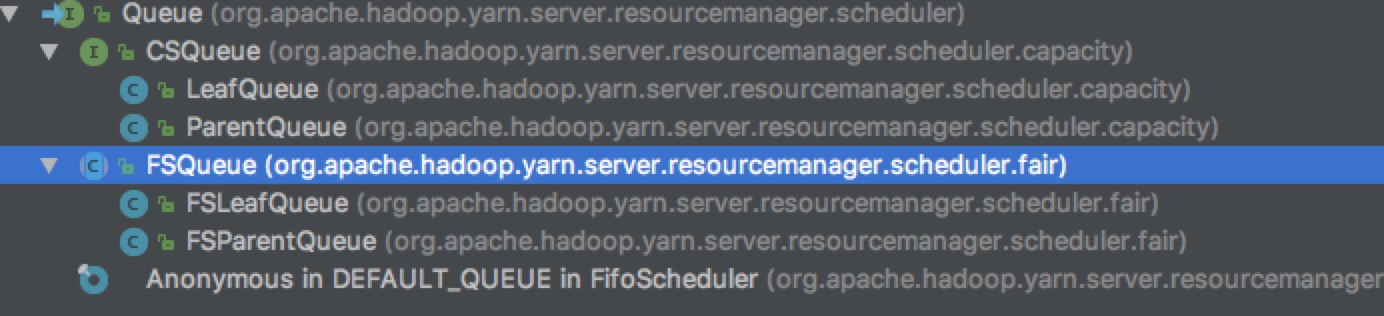
Yarn Queues
<Yarn> <Capacity Scheduler> <Source Code>的更多相关文章
- 简单物联网:外网访问内网路由器下树莓派Flask服务器
最近做一个小东西,大概过程就是想在教室,宿舍控制实验室的一些设备. 已经在树莓上搭了一个轻量的flask服务器,在实验室的路由器下,任何设备都是可以访问的:但是有一些限制条件,比如我想在宿舍控制我种花 ...
- 利用ssh反向代理以及autossh实现从外网连接内网服务器
前言 最近遇到这样一个问题,我在实验室架设了一台服务器,给师弟或者小伙伴练习Linux用,然后平时在实验室这边直接连接是没有问题的,都是内网嘛.但是回到宿舍问题出来了,使用校园网的童鞋还是能连接上,使 ...
- 外网访问内网Docker容器
外网访问内网Docker容器 本地安装了Docker容器,只能在局域网内访问,怎样从外网也能访问本地Docker容器? 本文将介绍具体的实现步骤. 1. 准备工作 1.1 安装并启动Docker容器 ...
- 外网访问内网SpringBoot
外网访问内网SpringBoot 本地安装了SpringBoot,只能在局域网内访问,怎样从外网也能访问本地SpringBoot? 本文将介绍具体的实现步骤. 1. 准备工作 1.1 安装Java 1 ...
- 外网访问内网Elasticsearch WEB
外网访问内网Elasticsearch WEB 本地安装了Elasticsearch,只能在局域网内访问其WEB,怎样从外网也能访问本地Elasticsearch? 本文将介绍具体的实现步骤. 1. ...
- 怎样从外网访问内网Rails
外网访问内网Rails 本地安装了Rails,只能在局域网内访问,怎样从外网也能访问本地Rails? 本文将介绍具体的实现步骤. 1. 准备工作 1.1 安装并启动Rails 默认安装的Rails端口 ...
- 怎样从外网访问内网Memcached数据库
外网访问内网Memcached数据库 本地安装了Memcached数据库,只能在局域网内访问,怎样从外网也能访问本地Memcached数据库? 本文将介绍具体的实现步骤. 1. 准备工作 1.1 安装 ...
- 怎样从外网访问内网CouchDB数据库
外网访问内网CouchDB数据库 本地安装了CouchDB数据库,只能在局域网内访问,怎样从外网也能访问本地CouchDB数据库? 本文将介绍具体的实现步骤. 1. 准备工作 1.1 安装并启动Cou ...
- 怎样从外网访问内网DB2数据库
外网访问内网DB2数据库 本地安装了DB2数据库,只能在局域网内访问,怎样从外网也能访问本地DB2数据库? 本文将介绍具体的实现步骤. 1. 准备工作 1.1 安装并启动DB2数据库 默认安装的DB2 ...
- 怎样从外网访问内网OpenLDAP数据库
外网访问内网OpenLDAP数据库 本地安装了OpenLDAP数据库,只能在局域网内访问,怎样从外网也能访问本地OpenLDAP数据库? 本文将介绍具体的实现步骤. 1. 准备工作 1.1 安装并启动 ...
随机推荐
- js将字符串转json
Json格式字符串 "{"rows":[{"date":"2018-11-19","money":" ...
- Arthur and Brackets CodeForces - 508E (贪心,括号匹配)
大意: n个括号, 位置未知, 给出每对括号左右间距, 求输出一个合法括号序列. 最后一个括号间距一定为1, 从右往左遍历, 每次括号划分越小越好. #include <iostream> ...
- 『TensotFlow』RNN中文文本_上
中文文字预处理流程 文本处理 读取+去除特殊符号 按照字段长度排序 辅助数据结构生成 生成 {字符:出现次数} 字典 生成按出现次数排序好的字符list 生成 {字符:序号} 字典 生成序号list ...
- Win10更改CMD控制台的代码页和字体和字号
注意:936(简体中文)时,指定Consolas等英文字体将无效,会自动变为“新宋体”. 代码页:若是UTF8(65001)应改为:0000fde9 字号:000e0000 -> 12 cmd_ ...
- PAT 1046 Shortest Distance
1046 Shortest Distance (20 分) The task is really simple: given N exits on a highway which forms a ...
- 小程序util工具
import wafer from '../lib/wafer2-client-sdk' import tip from './tip' // 时间格式化 const formatTime = tim ...
- nginx源码安装教程(CentOS)
1.说明 官方源码安装说明:http://nginx.org/en/docs/configure.html 源码包下载地址:http://nginx.org/en/download.html 版本说明 ...
- JAVA工程师面试常见问题集锦
集锦一: 一.面试题基础总结 1. JVM结构原理.GC工作机制详解 答:具体参照:JVM结构.GC工作机制详解 ,说到GC,记住两点:1.GC是负责回收所有无任何引用对象的内存空间. 注意: ...
- Win10系列:VC++ Direct3D图形绘制1
通过前面的介绍,相信读者已经了解了如何新建一个用于开发Direct3D应用程序的项目模版,以及这个项目模版中用于绘制立体图形的主要函数.在本小节中,将通过一个具体的示例来介绍如何使用Visual St ...
- laravel composer 安装指定版本以及基本的配置
1 安装指定的 laravel版本 以下的案例是安装5.2版本 composer create-project laravel/laravel=5.2.* --prefer-dist 2 配置 优化相 ...