
Why service collaboration needs choreography AND orchestration
转自:https://blog.bernd-ruecker.com/why-service-collaboration-needs-choreography-and-orchestration-239c4f9700fa
Let’s assume you want to build a simple order system covering the whole order fulfillment process with the following three microservices involved (you might name it services, components or aggregates if you prefer):
- Payment
- Inventory
- Shipping
The overall order fulfillment definitely requires these three services to collaborate. Currently there is a big fight going on as to which collaboration style to use — orchestration or choreography (for an introduction on the basic styles see Orchestration or Choreography). But is this an either or decision?
I strongly believe that in most real-life scenarios you need a clever mix of both collaboration styles so let’s go over that.
Choreography
Assume that we want to use event-based choreography as much as possible. This is in sync with the typical recommendation among microservice publications, e.g. “Building Microservices” from Sam Newman:
In general, I have found that systems that tend more toward the choreographed approach are more loosely coupled, and are more flexible and amenable to change […].
[…], asynchronous event collaboration helps us adopt a choreographed approach which can yield significantly more decoupled services — something we want to strive for to ensure our services are independently releasable.
And I agree that this make sense on a large scale. Doing so results in the following event flow for our order application:
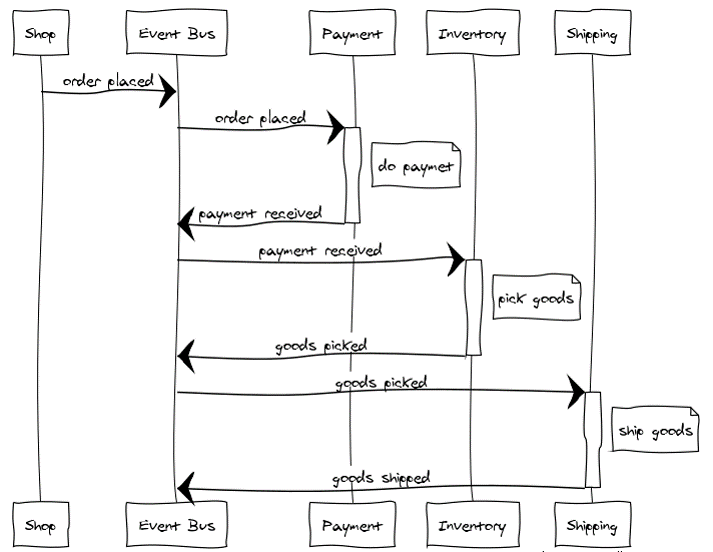
So far so good, no component is talking directly to each other and only events are used to communicate. Very de-coupled — isn’t it?
No.
Event command transformation
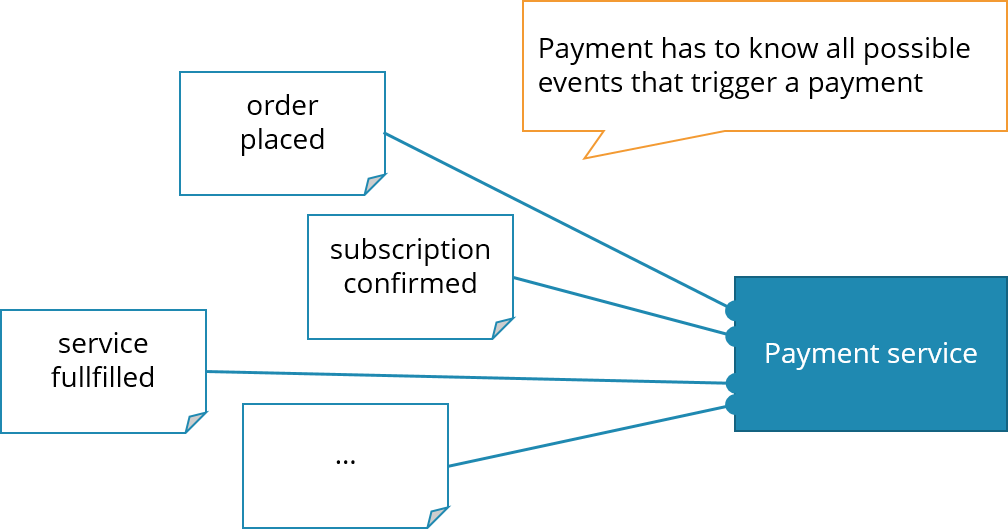
The problem is that the payment service has to react to the order placed event. It has to know its consumer! As soon as other services need payment, it has to be adjusted. This is exactly what we don’t want, at least in the case of the payment.

Another example: You want to implement the new business requirement that VIP customers can pay later by invoice. Now you have to change multiple components: The paymentneeds to know only to execute payments for non VIP customers. The inventory has to know that it reacts also on order placed but only for VIP customers. So you already had to tell two services about your VIP customer even though they should never know about it.
That’s why an additional component that decides that you have to do payment whenever an order was created improves de-coupling of the payment service from its concrete consumer. My friend Martin Schimak an I call that event command transformation:
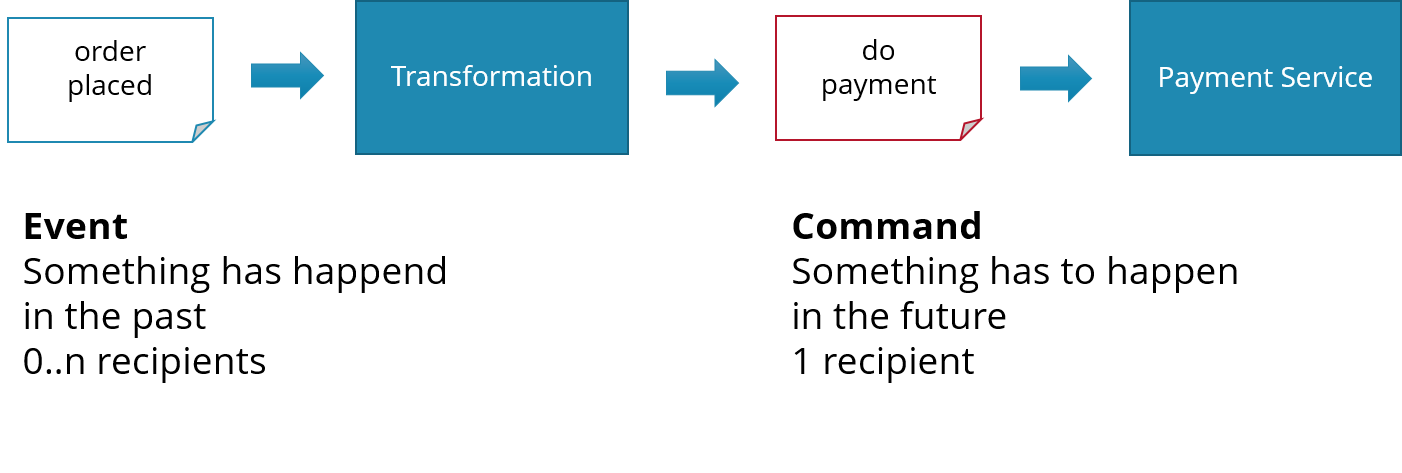
Event command transformation pattern
In our example this might be done by an order service.
Orchestration
As soon as you issue commands, you’ve taken the first step towards orchestration as the transformer automatically is some kind of conductor commanding another component. However, the command is still a message and can be sent over the normal bus. So I see good reasons to still summarize that as choreography without remorse. As wording is very important in the current discussions I think this helps to remove misconceptions that orchestration has to be avoided at any price; as you can see that the event command transformation is actually essential to build a nicely de-coupled event-based system!
State Handling
We have a second challenge. The payment might take quite long to complete. Assume we want a call center to call the customer to clear problems during payment. That might take days to weeks. So now you get a long running flowin your order service and you have to track the state. And you might face timing requirements, for example the pricing in the order might only be fixed for 7 days so you want to take action if the order is delayed too long.
I have described basic implementation approaches in How to implement long running flows, sagas, business processes or similar. A typical approach is to use a state machine to do this. This finally means you are using an orchestrated style of collaboration within your order service. It is important to notice the small word within here.
“Overall choregraphy and local orchestration”
This yields the following approach:
- Orchestration takes place locally in the order service. It is an implementation decision of that service to use a (local) brain to coordinate the flow it has to implement. There is no central conductor steering different services, no central spider in a giant spiderweb. That’s the typical misconception with orchestration engines. But there is a proper event command transformation so that the order service can command the payment service in order to improve de-coupling.
- The end-to-end business process of ordering goods can be implemented as overall choreography. Only messages (events and commands) are sent over the wire, there is no central conductor controlling everything.
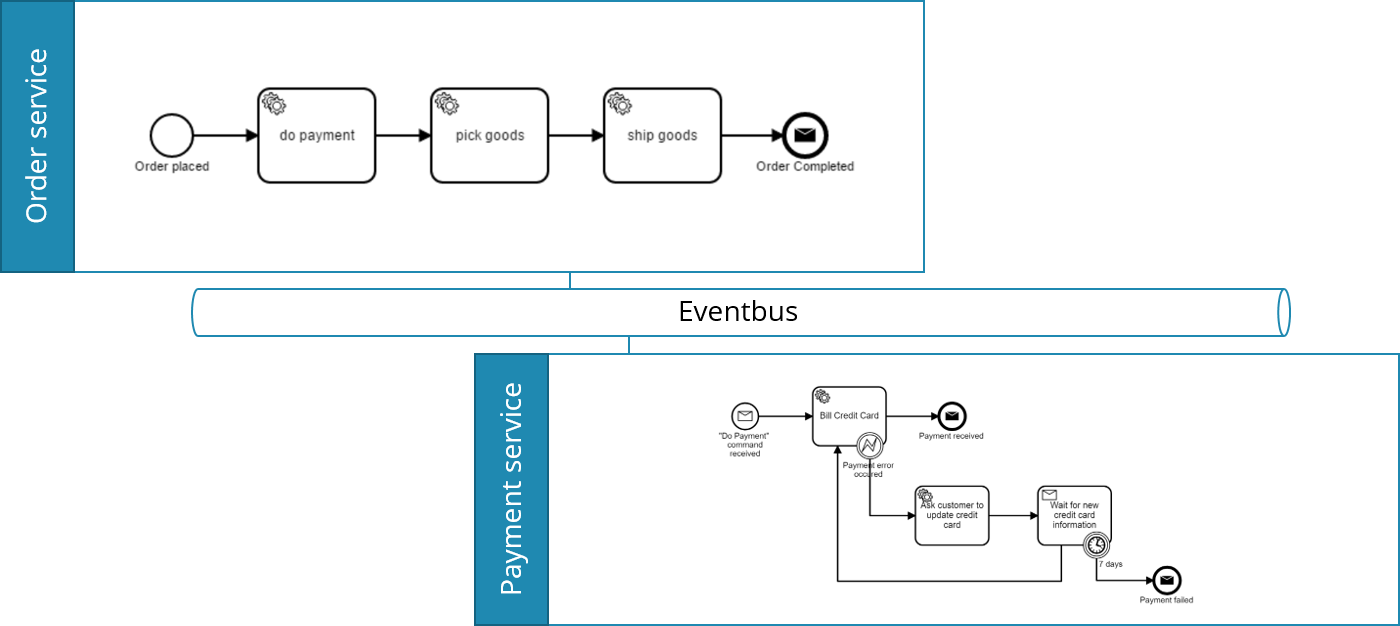
This brings the best of both worlds: Handling state and mastering control over the flow happens in a context you can easily control — one service. Choreography is used on the larger scale of collaboration of various services to improve flexibility.
Conclusion
For real-life use cases services need to collaborate. You need both: A choreographed event-based style as well as an orchestrated command-based style depending on the situation at hand. With a clever mix you reach the level of de-coupling you aim for especially when using microservices.
If you are interested in concrete code examples for the concepts discussed, there is the flowing retail sample application showing all these aspects in action.
Why service collaboration needs choreography AND orchestration的更多相关文章
- RocketMQ 4.3正式发布,支持分布式事务
冯嘉 作者 | 冯嘉 近日,Apache RocketMQ 4.3 版本宣布发布,此次发布不仅包括提升性能,减少内存使用等原有特性增强,还修复了部分社区提出的若干问题,更重要的是该版本开源了社 ...
- Apache RocketMQ 正式开源分布式事务消息
近日,Apache RocketMQ 社区正式发布4.3版本.此次发布不仅包括提升性能,减少内存使用等原有特性增强,还修复了部分社区提出的若干问题,更重要的是该版本开源了社区最为关心的分布式事务消息, ...
- BizTalk开发系列(三十)单向端口实现请求-响应
BizTalk本质上是异步的消息处理引擎.BizTalk的请求与响应模式是基于异步之上的同步消息交换.消息引擎通过消息的扩展架构链接许 多异步消息,消息的相关集关联请求与响应消息.例如,客户端发送一个 ...
- Docker Resources
Menu Main Resources Books Websites Documents Archives Community Blogs Personal Blogs Videos Related ...
- OpenStack及其构成简介
新的一年新的开始,突然想学习下Openstack,之前了解过很多,但是想系统的学习一下,第一次写博客,只想把学到的东西记录下来加深印象,如有写的不好的地方请多多见谅.下面开门见山. 1.What is ...
- centos7部署openstack-ocata
1.前言 本文旨在记录本人的一个实验过程,因为其中有一些坑,方便以后回顾查询. 其中限于篇幅(大部分是配置部分)有些内容省略掉了,官网都有,各位如果是安装部署的话可以参考官网,不建议使用本文. 以下是 ...
- The Microservices Workflow Automation Cheat Sheet
Written by Bernd Rücker on Dec 12 2018 in the Best Practices category. Editor’s Note: This post orig ...
- CentOS7.4安装部署openstack [Liberty版] (二)
继上一篇博客CentOS7.4安装部署openstack [Liberty版] (一),本篇继续讲述后续部分的内容 一.添加块设备存储服务 1.服务简述: OpenStack块存储服务为实例提供块存储 ...
- OpenStack的基本概念与架构图
https://blog.csdn.net/zjluobing/article/details/51489325 OpenStack项目是一个开源的云计算平台,旨在实现很简单,大规模可伸缩,功能丰富. ...
随机推荐
- [leetcode53]最长子数组 Maximum Subarray Kadane's算法
[题目] Given an integer array nums, find the contiguous subarray (containing at least one number) whic ...
- SQL-28 查找描述信息中包括robot的电影对应的分类名称以及电影数目,而且还需要该分类对应电影数量>=5部
题目描述 film表 字段 说明 film_id 电影id title 电影名称 description 电影描述信息 CREATE TABLE IF NOT EXISTS film ( film_i ...
- Centos7部署hadoop 3
一:ssh免密登录: 1)vim /etc/ssh/sshd_config去掉注释或添加 RSAAuthentcation yes PubkeyAuthentication yes # Authent ...
- STA/LTA方法
STA是用于捕捉地震信号的时间窗,因此STA越短,就对短周期的地震信号捕捉越有效:LTA是用于衡量时间窗内的平均噪声,STA/LTA就可以根据周围环境噪声程度自适应地调整其对于某一类型地震信号的敏感度 ...
- SharePoint REST API - 确定REST端点URL
博客地址:http://blog.csdn.net/FoxDave SharePoint REST端点URI的结构 在你能够通过REST访问SharePoint资源之前,首先你要做的就是找出对应的 ...
- Office 365 - For security reasons DTD is prohibited in this XML document
博客地址:http://blog.csdn.net/FoxDave 今天在测试东西的时候发现在本机运行CSOM代码或使用Office 365 PowerShell时,出现了如下错误: Connec ...
- github咋用昂
github-trend:https://github.com/trending github-usingway:https://zhuanlan.zhihu.com/p/41899093 githu ...
- apache 服务器配置
第一.强制www域名301跳转 RewriteEngine onRewriteCond %{HTTP_HOST} ^itbulu\.com [NC]RewriteRule ^(.*)$ https:/ ...
- 多进程于多线程的区别,cpu密集型适合用什么
多线程:在单个程序中同事运行多少个线程完成不同的工作,成为线程. 线程共享内存空间,进程的内存是独立的, 同一个进程的线程间可以直接交流: 两个进程想通信,必须通过一个中间代理来实现, 一个线程可以控 ...
- 利用python实现电影推荐
"协同过滤"是推荐系统中的常用技术,按照分析维度的不同可实现"基于用户"和"基于产品"的推荐. 以下是利用python实现电影推荐的具体方法 ...