
Deeplab v3+的结构代码简要分析
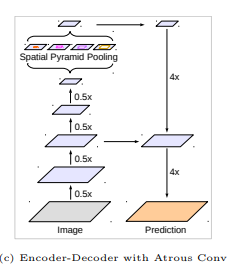
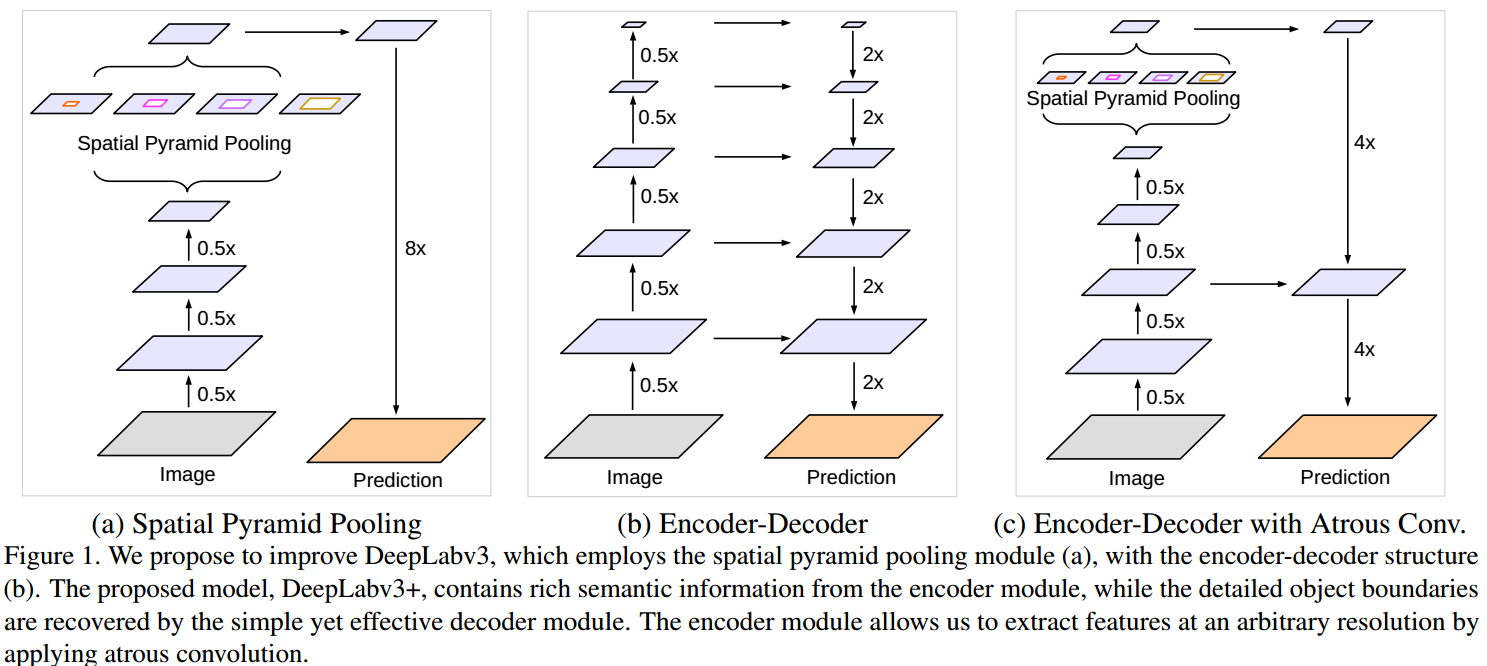
添加了解码模块来重构精确的图像物体边界。对比如图
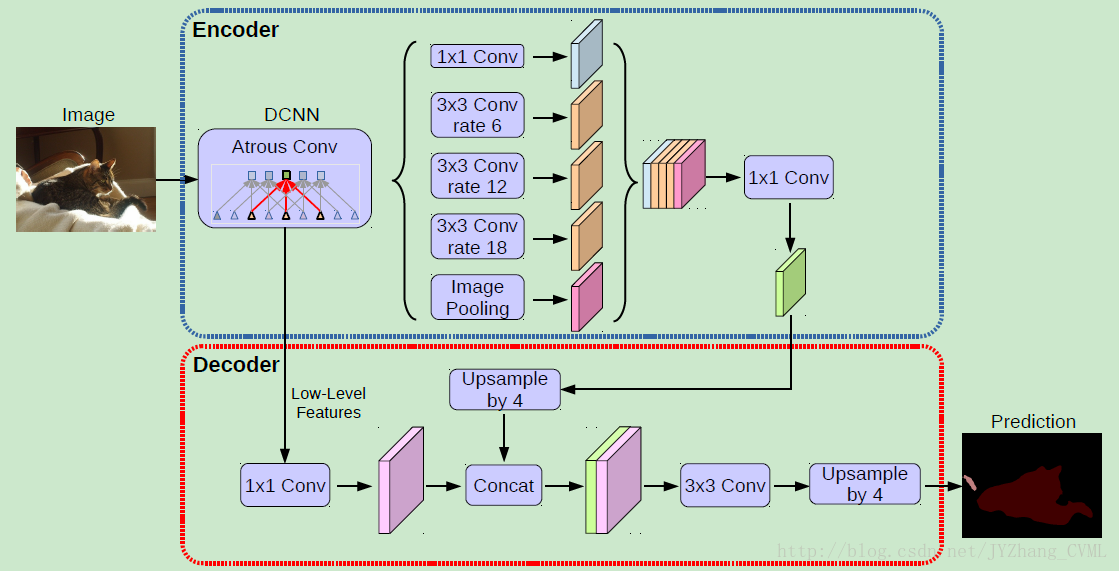
deeplab v3+采用了与deeplab v3类似的多尺度带洞卷积结构ASPP,然后通过上采样,以及与不同卷积层相拼接,最终经过卷积以及上采样得到结果。
deeplab v3:
基于提出的编码-解码结构,可以任意通过控制 atrous convolution 来输出编码特征的分辨率,来平衡精度和运行时间(已有编码-解码结构不具有该能力.).
可以用来挖掘不同尺度的上下文信息
PSPNet 对不同尺度的网络进行池化处理,处理多尺度的上下文内容信息
deeplab v3+以resnet101为backbone
 import math

 import torch

 import torch.nn as nn

 import torch.nn.functional as F

 import torch.utils.model_zoo as model_zoo

 from modeling.sync_batchnorm.batchnorm import SynchronizedBatchNorm2d

 BatchNorm2d = SynchronizedBatchNorm2d

 class Bottleneck(nn.Module):
      #'resnet网络的基本框架’

     expansion =

     def __init__(self, inplanes, planes, stride=, dilation=, downsample=None):

         super(Bottleneck, self).__init__()

         self.conv1 = nn.Conv2d(inplanes, planes, kernel_size=, bias=False)

         self.bn1 = BatchNorm2d(planes)

         self.conv2 = nn.Conv2d(planes, planes, kernel_size=, stride=stride,

                                dilation=dilation, padding=dilation, bias=False)

         self.bn2 = BatchNorm2d(planes)

         self.conv3 = nn.Conv2d(planes, planes * , kernel_size=, bias=False)

         self.bn3 = BatchNorm2d(planes * )

         self.relu = nn.ReLU(inplace=True)

         self.downsample = downsample

         self.stride = stride

         self.dilation = dilation

     def forward(self, x):

         residual = x

         out = self.conv1(x)

         out = self.bn1(out)

         out = self.relu(out)

         out = self.conv2(out)

         out = self.bn2(out)

         out = self.relu(out)

         out = self.conv3(out)

         out = self.bn3(out)

         if self.downsample is not None:

             residual = self.downsample(x)

         out += residual

         out = self.relu(out)

         return out

 class ResNet(nn.Module):

   #renet网络的构成部分

     def __init__(self, nInputChannels, block, layers, os=, pretrained=False):

         self.inplanes =

         super(ResNet, self).__init__()

         if os == :

             strides = [, , , ]

             dilations = [, , , ]

             blocks = [, , ]

         elif os == :

             strides = [, , , ]

             dilations = [, , , ]

             blocks = [, , ]

         else:

             raise NotImplementedError

         # Modules

         self.conv1 = nn.Conv2d(nInputChannels, , kernel_size=, stride=, padding=,

                                 bias=False)

         self.bn1 = BatchNorm2d()

         self.relu = nn.ReLU(inplace=True)

         self.maxpool = nn.MaxPool2d(kernel_size=, stride=, padding=)

         self.layer1 = self._make_layer(block, , layers[], stride=strides[], dilation=dilations[])

         self.layer2 = self._make_layer(block, , layers[], stride=strides[], dilation=dilations[])

         self.layer3 = self._make_layer(block, , layers[], stride=strides[], dilation=dilations[])

         self.layer4 = self._make_MG_unit(block, , blocks=blocks, stride=strides[], dilation=dilations[])

         self._init_weight()

         if pretrained:

             self._load_pretrained_model()

     def _make_layer(self, block, planes, blocks, stride=, dilation=):

         downsample = None

         if stride !=  or self.inplanes != planes * block.expansion:

             downsample = nn.Sequential(

                 nn.Conv2d(self.inplanes, planes * block.expansion,

                           kernel_size=, stride=stride, bias=False),

                 BatchNorm2d(planes * block.expansion),

             )

         layers = []

         layers.append(block(self.inplanes, planes, stride, dilation, downsample))

         self.inplanes = planes * block.expansion

         for i in range(, blocks):

             layers.append(block(self.inplanes, planes))

         return nn.Sequential(*layers)

     def _make_MG_unit(self, block, planes, blocks=[, , ], stride=, dilation=):

         downsample = None

         if stride !=  or self.inplanes != planes * block.expansion:

             downsample = nn.Sequential(

                 nn.Conv2d(self.inplanes, planes * block.expansion,

                           kernel_size=, stride=stride, bias=False),

                 BatchNorm2d(planes * block.expansion),

             )

         layers = []

         layers.append(block(self.inplanes, planes, stride, dilation=blocks[]*dilation, downsample=downsample))

         self.inplanes = planes * block.expansion

         for i in range(, len(blocks)):

             layers.append(block(self.inplanes, planes, stride=, dilation=blocks[i]*dilation))

         return nn.Sequential(*layers)

     def forward(self, input):

         x = self.conv1(input)

         x = self.bn1(x)

         x = self.relu(x)

         x = self.maxpool(x)

         x = self.layer1(x)

         low_level_feat = x

         x = self.layer2(x)

         x = self.layer3(x)

         x = self.layer4(x)

         return x, low_level_feat

     def _init_weight(self):

         for m in self.modules():

             if isinstance(m, nn.Conv2d):

                 n = m.kernel_size[] * m.kernel_size[] * m.out_channels

                 m.weight.data.normal_(, math.sqrt(. / n))

             elif isinstance(m, BatchNorm2d):

                 m.weight.data.fill_()

                 m.bias.data.zero_()

     def _load_pretrained_model(self):

         pretrain_dict = model_zoo.load_url('https://download.pytorch.org/models/resnet101-5d3b4d8f.pth')

         model_dict = {}

         state_dict = self.state_dict()

         for k, v in pretrain_dict.items():

             if k in state_dict:

                 model_dict[k] = v

         state_dict.update(model_dict)

         self.load_state_dict(state_dict)

 def ResNet101(nInputChannels=, os=, pretrained=False):

     model = ResNet(nInputChannels, Bottleneck, [, , , ], os, pretrained=pretrained)

     return model

 class ASPP_module(nn.Module):
   #ASpp模块的组成

     def __init__(self, inplanes, planes, dilation):

         super(ASPP_module, self).__init__()

         if dilation == :

             kernel_size =

             padding =

         else:

             kernel_size =

             padding = dilation

         self.atrous_convolution = nn.Conv2d(inplanes, planes, kernel_size=kernel_size,

                                             stride=, padding=padding, dilation=dilation, bias=False)

         self.bn = BatchNorm2d(planes)

         self.relu = nn.ReLU()

         self._init_weight()

     def forward(self, x):

         x = self.atrous_convolution(x)

         x = self.bn(x)

         return self.relu(x)

     def _init_weight(self):

         for m in self.modules():

             if isinstance(m, nn.Conv2d):

                 n = m.kernel_size[] * m.kernel_size[] * m.out_channels

                 m.weight.data.normal_(, math.sqrt(. / n))

             elif isinstance(m, BatchNorm2d):

                 m.weight.data.fill_()

                 m.bias.data.zero_()

 class DeepLabv3_plus(nn.Module):
  #正式开始deeplabv3+的结构组成

     def __init__(self, nInputChannels=, n_classes=, os=, pretrained=False, freeze_bn=False, _print=True):

         if _print:

             print("Constructing DeepLabv3+ model...")

             print("Backbone: Resnet-101")

             print("Number of classes: {}".format(n_classes))

             print("Output stride: {}".format(os))

             print("Number of Input Channels: {}".format(nInputChannels))

         super(DeepLabv3_plus, self).__init__()

         # Atrous Conv  首先获得从resnet101中提取的features map

         self.resnet_features = ResNet101(nInputChannels, os, pretrained=pretrained)

         # ASPP,挑选参数

         if os == :

             dilations = [, , , ]

         elif os == :

             dilations = [, , , ]

         else:

             raise NotImplementedError

     #四个不同带洞卷积的设置,获取不同感受野

         self.aspp1 = ASPP_module(, , dilation=dilations[])

         self.aspp2 = ASPP_module(, , dilation=dilations[])

         self.aspp3 = ASPP_module(, , dilation=dilations[])

         self.aspp4 = ASPP_module(, , dilation=dilations[])

         self.relu = nn.ReLU()

     #全局平均池化层的设置

         self.global_avg_pool = nn.Sequential(nn.AdaptiveAvgPool2d((, )),

                                              nn.Conv2d(, , , stride=, bias=False),

                                              BatchNorm2d(),

                                              nn.ReLU())

         self.conv1 = nn.Conv2d(, , , bias=False)

         self.bn1 = BatchNorm2d()

         # adopt [1x1, ] for channel reduction.

         self.conv2 = nn.Conv2d(, , , bias=False)

         self.bn2 = BatchNorm2d()

     #结构图中的解码部分的最后一个3*3的卷积块

         self.last_conv = nn.Sequential(nn.Conv2d(, , kernel_size=, stride=, padding=, bias=False),

                                        BatchNorm2d(),

                                        nn.ReLU(),

                                        nn.Conv2d(, , kernel_size=, stride=, padding=, bias=False),

                                        BatchNorm2d(),

                                        nn.ReLU(),

                                        nn.Conv2d(, n_classes, kernel_size=, stride=))

         if freeze_bn:

             self._freeze_bn()

   #前向传播

     def forward(self, input):

         x, low_level_features = self.resnet_features(input)

         x1 = self.aspp1(x)

         x2 = self.aspp2(x)

         x3 = self.aspp3(x)

         x4 = self.aspp4(x)

         x5 = self.global_avg_pool(x)

         x5 = F.upsample(x5, size=x4.size()[:], mode='bilinear', align_corners=True)

     #把四个ASPP模块以及全局池化层拼接起来

         x = torch.cat((x1, x2, x3, x4, x5), dim=)

     #上采样

         x = self.conv1(x)

         x = self.bn1(x)

         x = self.relu(x)

         x = F.upsample(x, size=(int(math.ceil(input.size()[-]/)),

                                 int(math.ceil(input.size()[-]/))), mode='bilinear', align_corners=True)

         low_level_features = self.conv2(low_level_features)

         low_level_features = self.bn2(low_level_features)

         low_level_features = self.relu(low_level_features)

      #拼接低层次的特征,然后再通过插值获取原图大小的结果

         x = torch.cat((x, low_level_features), dim=)

         x = self.last_conv(x)

         x = F.interpolate(x, size=input.size()[:], mode='bilinear', align_corners=True)

         return x

     def _freeze_bn(self):

         for m in self.modules():

             if isinstance(m, BatchNorm2d):

                 m.eval()

     def _init_weight(self):

         for m in self.modules():

             if isinstance(m, nn.Conv2d):

                 n = m.kernel_size[] * m.kernel_size[] * m.out_channels

                 m.weight.data.normal_(, math.sqrt(. / n))

             elif isinstance(m, BatchNorm2d):

                 m.weight.data.fill_()

                 m.bias.data.zero_()

 def get_1x_lr_params(model):

     """

     This generator returns all the parameters of the net except for

     the last classification layer. Note that for each batchnorm layer,

     requires_grad is set to False in deeplab_resnet.py, therefore this function does not return

     any batchnorm parameter

     """

     b = [model.resnet_features]

     for i in range(len(b)):

         for k in b[i].parameters():

             if k.requires_grad:

                 yield k

 def get_10x_lr_params(model):

     """

     This generator returns all the parameters for the last layer of the net,

     which does the classification of pixel into classes

     """

     b = [model.aspp1, model.aspp2, model.aspp3, model.aspp4, model.conv1, model.conv2, model.last_conv]

     for j in range(len(b)):

         for k in b[j].parameters():

             if k.requires_grad:

                 yield k

 if __name__ == "__main__":

     model = DeepLabv3_plus(nInputChannels=, n_classes=, os=, pretrained=True, _print=True)

     model.eval()

     image = torch.randn(, , , )

     with torch.no_grad():

         output = model.forward(image)

     print(output.size())
Deeplab v3+的结构代码简要分析的更多相关文章
- Deeplab v3+的结构的理解,图像分割最新成果
Deeplab v3+ 结构的精髓: 1.继续使用ASPP结构, SPP 利用对多种比例(rates)和多种有效感受野的不同分辨率特征处理,来挖掘多尺度的上下文内容信息. 解编码结构逐步重构空间信息来 ...
- tolua#代码简要分析
简介 tolua#是Unity静态绑定lua的一个解决方案,它通过C#提供的反射信息分析代码并生成包装的类.它是一个用来简化在C#中集成lua的插件,可以自动生成用于在lua中访问Unity的绑定代码 ...
- Deeplab v3+中的骨干模型resnet(加入atrous)的源码解析,以及普通resnet整个结构的构建过程
加入带洞卷积的resnet结构的构建,以及普通resnet如何通过模块的组合来堆砌深层卷积网络. 第一段代码为deeplab v3+(pytorch版本)中的基本模型改进版resnet的构建过程, 第 ...
- Uboot优美代码赏析1:目录结构和malkefile分析
Uboot优美代码赏析1:目录结构和malkefile分析 关于Uboot自己选的版本是目前最新的2011.06,官方网址为:http://www.denx.de/wiki/U-Boot/WebHom ...
- Android Hal层简要分析
Android Hal层简要分析 Android Hal层(即 Hardware Abstraction Layer)是Google开发的Android系统里上层应用对底层硬件操作屏蔽的一个软件层次, ...
- RxJava && Agera 从源码简要分析基本调用流程(2)
版权声明:本文由晋中望原创文章,转载请注明出处: 文章原文链接:https://www.qcloud.com/community/article/124 来源:腾云阁 https://www.qclo ...
- CVPR2018 关于视频目标跟踪(Object Tracking)的论文简要分析与总结
本文转自:https://blog.csdn.net/weixin_40645129/article/details/81173088 CVPR2018已公布关于视频目标跟踪的论文简要分析与总结 一, ...
- 转:InnoDB多版本(MVCC)实现简要分析
InnoDB多版本(MVCC)实现简要分析 基本知识 假设对于多版本(MVCC)的基础知识,有所了解.InnoDB为了实现多版本的一致读,采用的是基于回滚段的协议. 行结构 InnoDB表数据的组织方 ...
- java AST JCTree简要分析
JCTree简要分析 [toc] JCAnnotatedType 被注解的泛型:(注解的Target为ElementType.TYPE_USE时可注解泛型) public static class A ...
随机推荐
- 一些shell默认的变量
测试脚本如下,我这里主要想测试$0,$1,$2,$n,$@,$*默认都代表了什么? #!/bin/sh echo '$1='$1 echo '$2='$2 echo '$@='$@ echo '$*= ...
- shell之使用cut切割文本文件
我们知道可以通过工具grep或egrep按行筛选记录,这里我们可以通过cut工具对文本按列进行切分,它可以指定定界符,linux下制表符是默认的定界符. #cut -f 2,3 textfile 这个 ...
- ORACLE managed file(OMF)
ORACLE managed file (OMF) Oracle自动创建和删除OMF文件 不用操心文件的命名约定 在手动管理文件时容易错误删除数据文件(OMF降低这种风险) Oracle自动删除不再需 ...
- linux strncpy()和strcat使用总结
strcat原型:char *strcat(char *dest,const char *src); 把src所指字符串添加到dest结尾处(覆盖dest结尾处的'\0')并添加'\0'.src和de ...
- NOIP国王游戏
#include<iostream> #include<cstdio> #include<cstdlib> #include<cstring> #inc ...
- springmvc实现文件上传
springmvc实现文件上传 多数文件上传都是通过表单形式提交给后台服务器的,因此,要实现文件上传功能,就需要提供一个文件上传的表单,而该表单就要满足以下3个条件 (1)form表彰的method属 ...
- 20180925 SQL Server游标使用
之前写了一个存储过程 目标: 根据时间,获取指定范围的数据集A, 再从数据集A 中,取出每行数据中的两个时间,卡另外一个B表里面的某列时间范围的值集.得到均值进行配置值比对. 这里有个问题,就是取得B ...
- MySQL之——崩溃-修复损坏的innodb:innodb_force_recovery
转: https://blog.csdn.net/l1028386804/article/details/77199194 一.问题描述 今天在线运行的一个mysql崩溃了. 查看错误日志,如下: - ...
- python 字符串、列表和元祖之间的切换
>>> s=['http','://','www','baidu','.com'] >>> url=''.join(s) >>> url 'htt ...
- 搭建简单SBT工程实践
在本机jdk(主要配置环境变量).scala(主要配置环境变量).sbt(主要配置①私服repositories ②sbtconfig.txt)都已经安装且配置好的情况下. repositories ...