
JVM系列(五):gc实现概要01
java的一大核心特性,即是自动内存回收。这让一些人从繁琐的内存管理中解脱出来,但对大部分人来说,貌似这太理所当然了。因为现在市场上的语言,几乎都已经没有了还需要自己去管理内存这事。大家似乎都以为,语言不就应该干这事吗。
其实在我们现在的编程语言中,从某种角度上,大致可以分为多进程并发模型和多线程并发模型。进程的资源可以操作系统直接管理,而线程则依附于进程而存在。所以,从这个角度来说,也许多进程并发模型的内存回收,也许会简单些。因为,多进程运行,可能带来的就是进程的快速创建与消亡。而进程消亡后,就可以由操作系统进行管理内存了。这种编程语言多见于各种脚本语言。但实际上,并没有那么简单。虽说多线程并发模型中,必然伴随着进程的长期运行,线程的反复创建与销毁,所以内存资源需要语言自行实现。但,多进程并发模型,难道就不可以长时间运行了吗?难道就不会使用超过最大内存限制的空间了吗?难道就没有需要删除的空间了吗?其实它同样都会面临这些问题,所以,它们都会有内存回收的需求。只是各自实现的精细度不一样,也是合理的。
网上有许多的资料,讲解java gc的工作过程,参数控制,最佳实践等等。但多半只算得黑盒测试,但也足够我们从容应对工作了。业有余力之时,我们可以来看看,具体的gc如何用代码敲出来,亦是快事。
1. 垃圾回收算法及收集器简述
前面说了,有太多的文章讲解这类工作。我们只提只言片语。
如何判定一个对象是否可以回收,主要算法有: 引用计数器算法(简单加减引用)、可达性分析算法(图论分析)。
而具体的内存回收,则可以分几大算法进行描述:标记-清除算法,复制算法,标记-整理算法,混合之。具体处理过程,可以望文生义,也可以查详细资料理解。
具体的java垃圾回收器:Serial/Serial Old收集器;ParNew收集器;Parallel Scavenge收集器;Parallel Old收集器;CMS(Concurrent Mark Sweep)收集器;G1收集器;ZGC收集器;具体解释请参考其他资料。
2. hotspot垃圾回收器入口1
我们知道,垃圾回收器实际是在时刻都在工作的,比如minor空间不足时,触发一次MinorGC,当老年代空间不足时,触发MajorGC。但要说我们主动触发GC,则可以直接调用 System.gc(); 即可完成一次gc工作。
// jdk/src/share/native/java/lang/Runtime.c

JNIEXPORT void JNICALL

Java_java_lang_Runtime_gc(JNIEnv *env, jobject this)

{

    JVM_GC();

}

// jdk,hosport, share/vm/prims/jvm.h

JNIEXPORT void JNICALL

JVM_GC(void);

// hotspot/src/share/vm/prims/jvm.cpp

JVM_ENTRY_NO_ENV(void, JVM_GC(void))

  JVMWrapper("JVM_GC");

  if (!DisableExplicitGC) {

      // 调用对应的gc实现,collect 回收内存

    Universe::heap()->collect(GCCause::_java_lang_system_gc);

  }

JVM_END
其中,heap() 和 collect() 都是有许多实现版本的,即根据选择的垃圾回收器的不同,而执行不同的逻辑。

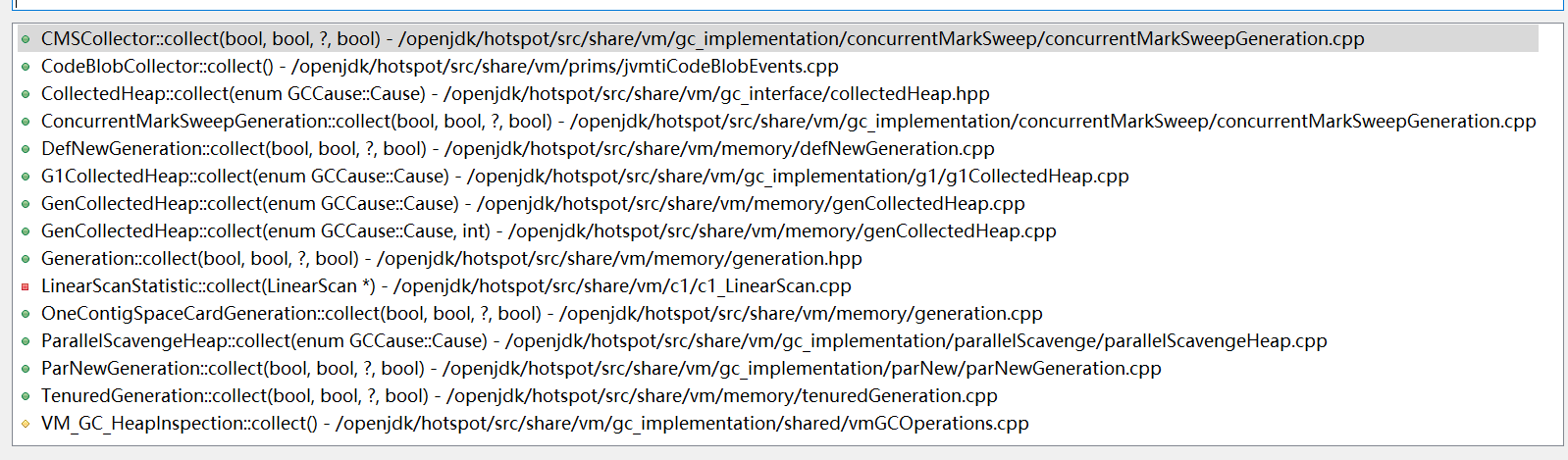
具体的heap()选择,需要依赖于外部设置。我们看两个具体的 heap 由来。一个是默认的,一个PS的,一个G1的。
  // share/memory/universe.cpp

  // The particular choice of collected heap.

  static CollectedHeap* heap() { return _collectedHeap; }

// share/vm/gc_implemention/parallelScavenge/parallelScavengeHeap.cpp

ParallelScavengeHeap* ParallelScavengeHeap::heap() {

  assert(_psh != NULL, "Uninitialized access to ParallelScavengeHeap::heap()");

  assert(_psh->kind() == CollectedHeap::ParallelScavengeHeap, "not a parallel scavenge heap");

  return _psh;

}

// share/vm/gc_implemention/g1/g1CollectionHeap.cpp

G1CollectedHeap* G1CollectedHeap::heap() {

  assert(_sh->kind() == CollectedHeap::G1CollectedHeap,

         "not a garbage-first heap");

  return _g1h;

}
具体内存回收由 collect完成,而每个垃圾回收器有各自的实现。我们就看3个实现,1.默认新生代回收;2.多线程新生代回收;3.G1新生代回收;只需看个入口框架,细节留待后续完成。
// 1. defNew 回收

// share/memory/defNewGeneration.cpp

void DefNewGeneration::collect(bool   full,

                               bool   clear_all_soft_refs,

                               size_t size,

                               bool   is_tlab) {

  assert(full || size > 0, "otherwise we don't want to collect");

  GenCollectedHeap* gch = GenCollectedHeap::heap();

  _gc_timer->register_gc_start();

  DefNewTracer gc_tracer;

  gc_tracer.report_gc_start(gch->gc_cause(), _gc_timer->gc_start());

  _next_gen = gch->next_gen(this);

  // If the next generation is too full to accommodate promotion

  // from this generation, pass on collection; let the next generation

  // do it.

  if (!collection_attempt_is_safe()) {

    if (Verbose && PrintGCDetails) {

      gclog_or_tty->print(" :: Collection attempt not safe :: ");

    }

    gch->set_incremental_collection_failed(); // Slight lie: we did not even attempt one

    return;

  }

  assert(to()->is_empty(), "Else not collection_attempt_is_safe");

  init_assuming_no_promotion_failure();

  GCTraceTime t1(GCCauseString("GC", gch->gc_cause()), PrintGC && !PrintGCDetails, true, NULL);

  // Capture heap used before collection (for printing).

  size_t gch_prev_used = gch->used();

  gch->trace_heap_before_gc(&gc_tracer);

  SpecializationStats::clear();

  // These can be shared for all code paths

  IsAliveClosure is_alive(this);

  ScanWeakRefClosure scan_weak_ref(this);

  age_table()->clear();

  to()->clear(SpaceDecorator::Mangle);

  gch->rem_set()->prepare_for_younger_refs_iterate(false);

  assert(gch->no_allocs_since_save_marks(0),

         "save marks have not been newly set.");

  // Not very pretty.

  CollectorPolicy* cp = gch->collector_policy();

  FastScanClosure fsc_with_no_gc_barrier(this, false);

  FastScanClosure fsc_with_gc_barrier(this, true);

  KlassScanClosure klass_scan_closure(&fsc_with_no_gc_barrier,

                                      gch->rem_set()->klass_rem_set());

  set_promo_failure_scan_stack_closure(&fsc_with_no_gc_barrier);

  FastEvacuateFollowersClosure evacuate_followers(gch, _level, this,

                                                  &fsc_with_no_gc_barrier,

                                                  &fsc_with_gc_barrier);

  assert(gch->no_allocs_since_save_marks(0),

         "save marks have not been newly set.");

  int so = SharedHeap::SO_AllClasses | SharedHeap::SO_Strings | SharedHeap::SO_CodeCache;

  gch->gen_process_strong_roots(_level,

                                true,  // Process younger gens, if any,

                                       // as strong roots.

                                true,  // activate StrongRootsScope

                                true,  // is scavenging

                                SharedHeap::ScanningOption(so),

                                &fsc_with_no_gc_barrier,

                                true,   // walk *all* scavengable nmethods

                                &fsc_with_gc_barrier,

                                &klass_scan_closure);

  // "evacuate followers".

  evacuate_followers.do_void();

  FastKeepAliveClosure keep_alive(this, &scan_weak_ref);

  ReferenceProcessor* rp = ref_processor();

  rp->setup_policy(clear_all_soft_refs);

  const ReferenceProcessorStats& stats =

  rp->process_discovered_references(&is_alive, &keep_alive, &evacuate_followers,

                                    NULL, _gc_timer);

  gc_tracer.report_gc_reference_stats(stats);

  if (!_promotion_failed) {

    // Swap the survivor spaces.

    eden()->clear(SpaceDecorator::Mangle);

    from()->clear(SpaceDecorator::Mangle);

    if (ZapUnusedHeapArea) {

      // This is now done here because of the piece-meal mangling which

      // can check for valid mangling at intermediate points in the

      // collection(s).  When a minor collection fails to collect

      // sufficient space resizing of the young generation can occur

      // an redistribute the spaces in the young generation.  Mangle

      // here so that unzapped regions don't get distributed to

      // other spaces.

      to()->mangle_unused_area();

    }

    swap_spaces();

    assert(to()->is_empty(), "to space should be empty now");

    adjust_desired_tenuring_threshold();

    // A successful scavenge should restart the GC time limit count which is

    // for full GC's.

    AdaptiveSizePolicy* size_policy = gch->gen_policy()->size_policy();

    size_policy->reset_gc_overhead_limit_count();

    if (PrintGC && !PrintGCDetails) {

      gch->print_heap_change(gch_prev_used);

    }

    assert(!gch->incremental_collection_failed(), "Should be clear");

  } else {

    assert(_promo_failure_scan_stack.is_empty(), "post condition");

    _promo_failure_scan_stack.clear(true); // Clear cached segments.

    remove_forwarding_pointers();

    if (PrintGCDetails) {

      gclog_or_tty->print(" (promotion failed) ");

    }

    // Add to-space to the list of space to compact

    // when a promotion failure has occurred.  In that

    // case there can be live objects in to-space

    // as a result of a partial evacuation of eden

    // and from-space.

    swap_spaces();   // For uniformity wrt ParNewGeneration.

    from()->set_next_compaction_space(to());

    gch->set_incremental_collection_failed();

    // Inform the next generation that a promotion failure occurred.

    _next_gen->promotion_failure_occurred();

    gc_tracer.report_promotion_failed(_promotion_failed_info);

    // Reset the PromotionFailureALot counters.

    NOT_PRODUCT(Universe::heap()->reset_promotion_should_fail();)

  }

  // set new iteration safe limit for the survivor spaces

  from()->set_concurrent_iteration_safe_limit(from()->top());

  to()->set_concurrent_iteration_safe_limit(to()->top());

  SpecializationStats::print();

  // We need to use a monotonically non-decreasing time in ms

  // or we will see time-warp warnings and os::javaTimeMillis()

  // does not guarantee monotonicity.

  jlong now = os::javaTimeNanos() / NANOSECS_PER_MILLISEC;

  update_time_of_last_gc(now);

  gch->trace_heap_after_gc(&gc_tracer);

  gc_tracer.report_tenuring_threshold(tenuring_threshold());

  _gc_timer->register_gc_end();

  gc_tracer.report_gc_end(_gc_timer->gc_end(), _gc_timer->time_partitions());

}

// 2. parNew 回收

// share/vm/gc_implemention/parNew/parNewGeneration.cpp

void ParNewGeneration::collect(bool   full,

                               bool   clear_all_soft_refs,

                               size_t size,

                               bool   is_tlab) {

  assert(full || size > 0, "otherwise we don't want to collect");

  // 获得堆空间的指针

  GenCollectedHeap* gch = GenCollectedHeap::heap();

  _gc_timer->register_gc_start();

  assert(gch->kind() == CollectedHeap::GenCollectedHeap,

    "not a CMS generational heap");

  AdaptiveSizePolicy* size_policy = gch->gen_policy()->size_policy();

  FlexibleWorkGang* workers = gch->workers();

  assert(workers != NULL, "Need workgang for parallel work");

  int active_workers =

      AdaptiveSizePolicy::calc_active_workers(workers->total_workers(),

                                   workers->active_workers(),

                                   Threads::number_of_non_daemon_threads());

  workers->set_active_workers(active_workers);

  assert(gch->n_gens() == 2,

         "Par collection currently only works with single older gen.");

  _next_gen = gch->next_gen(this);

  // Do we have to avoid promotion_undo?

  if (gch->collector_policy()->is_concurrent_mark_sweep_policy()) {

    set_avoid_promotion_undo(true);

  }

  // If the next generation is too full to accommodate worst-case promotion

  // from this generation, pass on collection; let the next generation

  // do it.

  if (!collection_attempt_is_safe()) {

    gch->set_incremental_collection_failed();  // slight lie, in that we did not even attempt one

    return;

  }

  assert(to()->is_empty(), "Else not collection_attempt_is_safe");

  ParNewTracer gc_tracer;

  gc_tracer.report_gc_start(gch->gc_cause(), _gc_timer->gc_start());

  gch->trace_heap_before_gc(&gc_tracer);

  init_assuming_no_promotion_failure();

  if (UseAdaptiveSizePolicy) {

    set_survivor_overflow(false);

    size_policy->minor_collection_begin();

  }

  GCTraceTime t1(GCCauseString("GC", gch->gc_cause()), PrintGC && !PrintGCDetails, true, NULL);

  // Capture heap used before collection (for printing).

  size_t gch_prev_used = gch->used();

  SpecializationStats::clear();

  age_table()->clear();

  to()->clear(SpaceDecorator::Mangle);

  gch->save_marks();

  assert(workers != NULL, "Need parallel worker threads.");

  int n_workers = active_workers;

  // Set the correct parallelism (number of queues) in the reference processor

  ref_processor()->set_active_mt_degree(n_workers);

  // Always set the terminator for the active number of workers

  // because only those workers go through the termination protocol.

  ParallelTaskTerminator _term(n_workers, task_queues());

  ParScanThreadStateSet thread_state_set(workers->active_workers(),

                                         *to(), *this, *_next_gen, *task_queues(),

                                         _overflow_stacks, desired_plab_sz(), _term);

  ParNewGenTask tsk(this, _next_gen, reserved().end(), &thread_state_set);

  gch->set_par_threads(n_workers);

  gch->rem_set()->prepare_for_younger_refs_iterate(true);

  // It turns out that even when we're using 1 thread, doing the work in a

  // separate thread causes wide variance in run times.  We can't help this

  // in the multi-threaded case, but we special-case n=1 here to get

  // repeatable measurements of the 1-thread overhead of the parallel code.

  if (n_workers > 1) {

      // 使用GcRoots 可达性分析法

    GenCollectedHeap::StrongRootsScope srs(gch);

    workers->run_task(&tsk);

  } else {

    GenCollectedHeap::StrongRootsScope srs(gch);

    tsk.work(0);

  }

  thread_state_set.reset(0 /* Bad value in debug if not reset */,

                         promotion_failed());

  // Process (weak) reference objects found during scavenge.

  ReferenceProcessor* rp = ref_processor();

  IsAliveClosure is_alive(this);

  ScanWeakRefClosure scan_weak_ref(this);

  KeepAliveClosure keep_alive(&scan_weak_ref);

  ScanClosure               scan_without_gc_barrier(this, false);

  ScanClosureWithParBarrier scan_with_gc_barrier(this, true);

  set_promo_failure_scan_stack_closure(&scan_without_gc_barrier);

  EvacuateFollowersClosureGeneral evacuate_followers(gch, _level,

    &scan_without_gc_barrier, &scan_with_gc_barrier);

  rp->setup_policy(clear_all_soft_refs);

  // Can  the mt_degree be set later (at run_task() time would be best)?

  rp->set_active_mt_degree(active_workers);

  ReferenceProcessorStats stats;

  if (rp->processing_is_mt()) {

    ParNewRefProcTaskExecutor task_executor(*this, thread_state_set);

    stats = rp->process_discovered_references(&is_alive, &keep_alive,

                                              &evacuate_followers, &task_executor,

                                              _gc_timer);

  } else {

    thread_state_set.flush();

    gch->set_par_threads(0);  // 0 ==> non-parallel.

    gch->save_marks();

    stats = rp->process_discovered_references(&is_alive, &keep_alive,

                                              &evacuate_followers, NULL,

                                              _gc_timer);

  }

  gc_tracer.report_gc_reference_stats(stats);

  if (!promotion_failed()) {

    // Swap the survivor spaces.

    eden()->clear(SpaceDecorator::Mangle);

    from()->clear(SpaceDecorator::Mangle);

    if (ZapUnusedHeapArea) {

      // This is now done here because of the piece-meal mangling which

      // can check for valid mangling at intermediate points in the

      // collection(s).  When a minor collection fails to collect

      // sufficient space resizing of the young generation can occur

      // an redistribute the spaces in the young generation.  Mangle

      // here so that unzapped regions don't get distributed to

      // other spaces.

      to()->mangle_unused_area();

    }

    swap_spaces();

    // A successful scavenge should restart the GC time limit count which is

    // for full GC's.

    size_policy->reset_gc_overhead_limit_count();

    assert(to()->is_empty(), "to space should be empty now");

    adjust_desired_tenuring_threshold();

  } else {

    handle_promotion_failed(gch, thread_state_set, gc_tracer);

  }

  // set new iteration safe limit for the survivor spaces

  from()->set_concurrent_iteration_safe_limit(from()->top());

  to()->set_concurrent_iteration_safe_limit(to()->top());

  if (ResizePLAB) {

    plab_stats()->adjust_desired_plab_sz(n_workers);

  }

  // 输出gc日志

  if (PrintGC && !PrintGCDetails) {

    gch->print_heap_change(gch_prev_used);

  }

  if (PrintGCDetails && ParallelGCVerbose) {

    TASKQUEUE_STATS_ONLY(thread_state_set.print_termination_stats());

    TASKQUEUE_STATS_ONLY(thread_state_set.print_taskqueue_stats());

  }

  if (UseAdaptiveSizePolicy) {

    size_policy->minor_collection_end(gch->gc_cause());

    size_policy->avg_survived()->sample(from()->used());

  }

  // We need to use a monotonically non-deccreasing time in ms

  // or we will see time-warp warnings and os::javaTimeMillis()

  // does not guarantee monotonicity.

  jlong now = os::javaTimeNanos() / NANOSECS_PER_MILLISEC;

  update_time_of_last_gc(now);

  SpecializationStats::print();

  rp->set_enqueuing_is_done(true);

  if (rp->processing_is_mt()) {

    ParNewRefProcTaskExecutor task_executor(*this, thread_state_set);

    rp->enqueue_discovered_references(&task_executor);

  } else {

    rp->enqueue_discovered_references(NULL);

  }

  rp->verify_no_references_recorded();

  gch->trace_heap_after_gc(&gc_tracer);

  gc_tracer.report_tenuring_threshold(tenuring_threshold());

  _gc_timer->register_gc_end();

  gc_tracer.report_gc_end(_gc_timer->gc_end(), _gc_timer->time_partitions());

}

// 3. 分代收集回收

// share/vm/memory/genCollectedHeap.cpp

void GenCollectedHeap::collect(GCCause::Cause cause) {

  // 判断是否需要进行FGC, 依据是 cms 收集器且 cause==_gc_locker

  if (should_do_concurrent_full_gc(cause)) {

#if INCLUDE_ALL_GCS

    // mostly concurrent full collection

    collect_mostly_concurrent(cause);

#else  // INCLUDE_ALL_GCS

    ShouldNotReachHere();

#endif // INCLUDE_ALL_GCS

  } else {

#ifdef ASSERT

    if (cause == GCCause::_scavenge_alot) {

      // minor collection only

      // 新生代gc

      collect(cause, 0);

    } else {

      // Stop-the-world full collection

      collect(cause, n_gens() - 1);

    }

#else

    // Stop-the-world full collection

    collect(cause, n_gens() - 1);

#endif

  }

}

void GenCollectedHeap::collect(GCCause::Cause cause, int max_level) {

  // The caller doesn't have the Heap_lock

  assert(!Heap_lock->owned_by_self(), "this thread should not own the Heap_lock");

  MutexLocker ml(Heap_lock);

  // 上锁收集内存

  collect_locked(cause, max_level);

}

// this is the private collection interface

// The Heap_lock is expected to be held on entry.

void GenCollectedHeap::collect_locked(GCCause::Cause cause, int max_level) {

  // Read the GC count while holding the Heap_lock

  unsigned int gc_count_before      = total_collections();

  unsigned int full_gc_count_before = total_full_collections();

  {

    MutexUnlocker mu(Heap_lock);  // give up heap lock, execute gets it back

    // 整个gc过程就由 VM_GenCollectFull 去实现了,而其中最重要的则是 doIt() 方法的实现

    VM_GenCollectFull op(gc_count_before, full_gc_count_before,

                         cause, max_level);

    // 交给虚拟机线程完成该工作

    VMThread::execute(&op);

  }

}

// 4. G1回收

// share/vm/gc_implemention/g1/g1CollectedHeap.cpp

void G1CollectedHeap::collect(GCCause::Cause cause) {

  assert_heap_not_locked();

  unsigned int gc_count_before;

  unsigned int old_marking_count_before;

  bool retry_gc;

  do {

    retry_gc = false;

    {

      MutexLocker ml(Heap_lock);

      // Read the GC count while holding the Heap_lock

      gc_count_before = total_collections();

      old_marking_count_before = _old_marking_cycles_started;

    }

    // FullGc 判定

    if (should_do_concurrent_full_gc(cause)) {

      // Schedule an initial-mark evacuation pause that will start a

      // concurrent cycle. We're setting word_size to 0 which means that

      // we are not requesting a post-GC allocation.

         // 整个 FGC 过程由 VM_G1IncCollectionPause 完成

      VM_G1IncCollectionPause op(gc_count_before,

                                 0,     /* word_size */

                                 true,  /* should_initiate_conc_mark */

                                 g1_policy()->max_pause_time_ms(),

                                 cause);

      VMThread::execute(&op);

      if (!op.pause_succeeded()) {

        if (old_marking_count_before == _old_marking_cycles_started) {

          retry_gc = op.should_retry_gc();

        } else {

          // A Full GC happened while we were trying to schedule the

          // initial-mark GC. No point in starting a new cycle given

          // that the whole heap was collected anyway.

        }

        if (retry_gc) {

          if (GC_locker::is_active_and_needs_gc()) {

            GC_locker::stall_until_clear();

          }

        }

      }

    } else {

      if (cause == GCCause::_gc_locker

          DEBUG_ONLY(|| cause == GCCause::_scavenge_alot)) {

        // Schedule a standard evacuation pause. We're setting word_size

        // to 0 which means that we are not requesting a post-GC allocation.

        VM_G1IncCollectionPause op(gc_count_before,

                                   0,     /* word_size */

                                   false, /* should_initiate_conc_mark */

                                   g1_policy()->max_pause_time_ms(),

                                   cause);

        VMThread::execute(&op);

      } else {

        // Schedule a Full GC.

        VM_G1CollectFull op(gc_count_before, old_marking_count_before, cause);

        VMThread::execute(&op);

      }

    }

  } while (retry_gc);

}
以上是几个收集的实现入门框架,从中我们可以窥得一些实现方式。尤其是对于 单线程类的收集器,基本思路已经形成。只是具体如何,还得看官们自花心思。
除了要了解gc从何处开始执行,我们应该还需要知道如何选择收集器,以及他们是如何初始化的。这自然是在jvm启动时完成的。


// universe初始化

// share/vm/runtime/init.cpp

jint init_globals() {

  HandleMark hm;

  management_init();

  bytecodes_init();

  classLoader_init();

  codeCache_init();

  VM_Version_init();

  os_init_globals();

  stubRoutines_init1();

  // gc 初始化入口

  jint status = universe_init();  // dependent on codeCache_init and

                                  // stubRoutines_init1 and metaspace_init.

  if (status != JNI_OK)

    return status;

  interpreter_init();  // before any methods loaded

  invocationCounter_init();  // before any methods loaded

  marksweep_init();

  accessFlags_init();

  templateTable_init();

  InterfaceSupport_init();

  SharedRuntime::generate_stubs();

  universe2_init();  // dependent on codeCache_init and stubRoutines_init1

  referenceProcessor_init();

  jni_handles_init();

#if INCLUDE_VM_STRUCTS

  vmStructs_init();

#endif // INCLUDE_VM_STRUCTS

  vtableStubs_init();

  InlineCacheBuffer_init();

  compilerOracle_init();

  compilationPolicy_init();

  compileBroker_init();

  VMRegImpl::set_regName();

  if (!universe_post_init()) {

    return JNI_ERR;

  }

  javaClasses_init();   // must happen after vtable initialization

  stubRoutines_init2(); // note: StubRoutines need 2-phase init

  // All the flags that get adjusted by VM_Version_init and os::init_2

  // have been set so dump the flags now.

  if (PrintFlagsFinal) {

    CommandLineFlags::printFlags(tty, false);

  }

  return JNI_OK;

}

// memory/universe.cpp

jint universe_init() {

  assert(!Universe::_fully_initialized, "called after initialize_vtables");

  guarantee(1 << LogHeapWordSize == sizeof(HeapWord),

         "LogHeapWordSize is incorrect.");

  guarantee(sizeof(oop) >= sizeof(HeapWord), "HeapWord larger than oop?");

  guarantee(sizeof(oop) % sizeof(HeapWord) == 0,

            "oop size is not not a multiple of HeapWord size");

  TraceTime timer("Genesis", TraceStartupTime);

  GC_locker::lock();  // do not allow gc during bootstrapping

  JavaClasses::compute_hard_coded_offsets();

  jint status = Universe::initialize_heap();

  if (status != JNI_OK) {

    return status;

  }

  Metaspace::global_initialize();

  // Create memory for metadata.  Must be after initializing heap for

  // DumpSharedSpaces.

  ClassLoaderData::init_null_class_loader_data();

  // We have a heap so create the Method* caches before

  // Metaspace::initialize_shared_spaces() tries to populate them.

  Universe::_finalizer_register_cache = new LatestMethodCache();

  Universe::_loader_addClass_cache    = new LatestMethodCache();

  Universe::_pd_implies_cache         = new LatestMethodCache();

  if (UseSharedSpaces) {

    // Read the data structures supporting the shared spaces (shared

    // system dictionary, symbol table, etc.).  After that, access to

    // the file (other than the mapped regions) is no longer needed, and

    // the file is closed. Closing the file does not affect the

    // currently mapped regions.

    MetaspaceShared::initialize_shared_spaces();

    StringTable::create_table();

  } else {

    SymbolTable::create_table();

    StringTable::create_table();

    ClassLoader::create_package_info_table();

  }

  return JNI_OK;

}

// hotspot/src/share/vm/memory/universe.cpp:

jint Universe::initialize_heap() {

  if (UseParallelGC) {

#if INCLUDE_ALL_GCS

    Universe::_collectedHeap = new ParallelScavengeHeap();

#else  // INCLUDE_ALL_GCS

    fatal("UseParallelGC not supported in this VM.");

#endif // INCLUDE_ALL_GCS

  } else if (UseG1GC) {

#if INCLUDE_ALL_GCS

    G1CollectorPolicy* g1p = new G1CollectorPolicy();

    g1p->initialize_all();

    G1CollectedHeap* g1h = new G1CollectedHeap(g1p);

    Universe::_collectedHeap = g1h;

#else  // INCLUDE_ALL_GCS

    fatal("UseG1GC not supported in java kernel vm.");

#endif // INCLUDE_ALL_GCS

  } else {

    GenCollectorPolicy *gc_policy;

    if (UseSerialGC) {

      gc_policy = new MarkSweepPolicy();

    } else if (UseConcMarkSweepGC) {

#if INCLUDE_ALL_GCS

      if (UseAdaptiveSizePolicy) {

        gc_policy = new ASConcurrentMarkSweepPolicy();

      } else {

        gc_policy = new ConcurrentMarkSweepPolicy();

      }

#else  // INCLUDE_ALL_GCS

    fatal("UseConcMarkSweepGC not supported in this VM.");

#endif // INCLUDE_ALL_GCS

    } else { // default old generation

      gc_policy = new MarkSweepPolicy();

    }

    gc_policy->initialize_all();

    Universe::_collectedHeap = new GenCollectedHeap(gc_policy);

  }

  jint status = Universe::heap()->initialize();

  if (status != JNI_OK) {

    return status;

  }

#ifdef _LP64

  if (UseCompressedOops) {

    // Subtract a page because something can get allocated at heap base.

    // This also makes implicit null checking work, because the

    // memory+1 page below heap_base needs to cause a signal.

    // See needs_explicit_null_check.

    // Only set the heap base for compressed oops because it indicates

    // compressed oops for pstack code.

    bool verbose = PrintCompressedOopsMode || (PrintMiscellaneous && Verbose);

    if (verbose) {

      tty->cr();

      tty->print("heap address: " PTR_FORMAT ", size: " SIZE_FORMAT " MB",

                 Universe::heap()->base(), Universe::heap()->reserved_region().byte_size()/M);

    }

    if (((uint64_t)Universe::heap()->reserved_region().end() > OopEncodingHeapMax)) {

      // Can't reserve heap below 32Gb.

      // keep the Universe::narrow_oop_base() set in Universe::reserve_heap()

      Universe::set_narrow_oop_shift(LogMinObjAlignmentInBytes);

      if (verbose) {

        tty->print(", %s: "PTR_FORMAT,

            narrow_oop_mode_to_string(HeapBasedNarrowOop),

            Universe::narrow_oop_base());

      }

    } else {

      Universe::set_narrow_oop_base(0);

      if (verbose) {

        tty->print(", %s", narrow_oop_mode_to_string(ZeroBasedNarrowOop));

      }

#ifdef _WIN64

      if (!Universe::narrow_oop_use_implicit_null_checks()) {

        // Don't need guard page for implicit checks in indexed addressing

        // mode with zero based Compressed Oops.

        Universe::set_narrow_oop_use_implicit_null_checks(true);

      }

#endif //  _WIN64

      if((uint64_t)Universe::heap()->reserved_region().end() > UnscaledOopHeapMax) {

        // Can't reserve heap below 4Gb.

        Universe::set_narrow_oop_shift(LogMinObjAlignmentInBytes);

      } else {

        Universe::set_narrow_oop_shift(0);

        if (verbose) {

          tty->print(", %s", narrow_oop_mode_to_string(UnscaledNarrowOop));

        }

      }

    }

    if (verbose) {

      tty->cr();

      tty->cr();

    }

    Universe::set_narrow_ptrs_base(Universe::narrow_oop_base());

  }

  // Universe::narrow_oop_base() is one page below the heap.

  assert((intptr_t)Universe::narrow_oop_base() <= (intptr_t)(Universe::heap()->base() -

         os::vm_page_size()) ||

         Universe::narrow_oop_base() == NULL, "invalid value");

  assert(Universe::narrow_oop_shift() == LogMinObjAlignmentInBytes ||

         Universe::narrow_oop_shift() == 0, "invalid value");

#endif

  // We will never reach the CATCH below since Exceptions::_throw will cause

  // the VM to exit if an exception is thrown during initialization

  if (UseTLAB) {

    assert(Universe::heap()->supports_tlab_allocation(),

           "Should support thread-local allocation buffers");

    ThreadLocalAllocBuffer::startup_initialization();

  }

  return JNI_OK;

}
3. 一个内存回收器的工作示例
该部分我们以一某个垃圾收集器的实现过程,来了解gc是如何完成的。这自然算不得真正的了解gc原理,但是有其一定的作用。
首先,一般的gc动作都会有独立的vm线程,也就是我们通过jstack查看时看到的gc线程。当然了,在代码中我们看到的是 VMThread. vm线程运行垃圾回收:
// share/vm/runtime/vmThread.cpp

void VMThread::execute(VM_Operation* op) {

  Thread* t = Thread::current();

  if (!t->is_VM_thread()) {

    SkipGCALot sgcalot(t);    // avoid re-entrant attempts to gc-a-lot

    // JavaThread or WatcherThread

    bool concurrent = op->evaluate_concurrently();

    // only blocking VM operations need to verify the caller's safepoint state:

    if (!concurrent) {

      t->check_for_valid_safepoint_state(true);

    }

    // New request from Java thread, evaluate prologue

    if (!op->doit_prologue()) {

      return;   // op was cancelled

    }

    // Setup VM_operations for execution

    op->set_calling_thread(t, Thread::get_priority(t));

    // It does not make sense to execute the epilogue, if the VM operation object is getting

    // deallocated by the VM thread.

    bool execute_epilog = !op->is_cheap_allocated();

    assert(!concurrent || op->is_cheap_allocated(), "concurrent => cheap_allocated");

    // Get ticket number for non-concurrent VM operations

    int ticket = 0;

    if (!concurrent) {

      ticket = t->vm_operation_ticket();

    }

    // Add VM operation to list of waiting threads. We are guaranteed not to block while holding the

    // VMOperationQueue_lock, so we can block without a safepoint check. This allows vm operation requests

    // to be queued up during a safepoint synchronization.

    {

      VMOperationQueue_lock->lock_without_safepoint_check();

      bool ok = _vm_queue->add(op);

    op->set_timestamp(os::javaTimeMillis());

      VMOperationQueue_lock->notify();

      VMOperationQueue_lock->unlock();

      // VM_Operation got skipped

      if (!ok) {

        assert(concurrent, "can only skip concurrent tasks");

        if (op->is_cheap_allocated()) delete op;

        return;

      }

    }

    if (!concurrent) {

      // Wait for completion of request (non-concurrent)

      // Note: only a JavaThread triggers the safepoint check when locking

      MutexLocker mu(VMOperationRequest_lock);

      while(t->vm_operation_completed_count() < ticket) {

        VMOperationRequest_lock->wait(!t->is_Java_thread());

      }

    }

    if (execute_epilog) {

      op->doit_epilogue();

    }

  } else {

    // invoked by VM thread; usually nested VM operation

    assert(t->is_VM_thread(), "must be a VM thread");

    VM_Operation* prev_vm_operation = vm_operation();

    if (prev_vm_operation != NULL) {

      // Check the VM operation allows nested VM operation. This normally not the case, e.g., the compiler

      // does not allow nested scavenges or compiles.

      if (!prev_vm_operation->allow_nested_vm_operations()) {

        fatal(err_msg("Nested VM operation %s requested by operation %s",

                      op->name(), vm_operation()->name()));

      }

      op->set_calling_thread(prev_vm_operation->calling_thread(), prev_vm_operation->priority());

    }

    EventMark em("Executing %s VM operation: %s", prev_vm_operation ? "nested" : "", op->name());

    // Release all internal handles after operation is evaluated

    HandleMark hm(t);

    _cur_vm_operation = op;

    if (op->evaluate_at_safepoint() && !SafepointSynchronize::is_at_safepoint()) {

      SafepointSynchronize::begin();

      op->evaluate();

      SafepointSynchronize::end();

    } else {

      op->evaluate();

    }

    // Free memory if needed

    if (op->is_cheap_allocated()) delete op;

    _cur_vm_operation = prev_vm_operation;

  }

}
我们看前面的 GenCollectedHeap 的垃圾回收方法,其最终向 vmThread 提交了一个 VM_GenCollectFull 的op任务,而其核心实现是在 doit() 方法中。 分代垃圾回收,由vm线程执行。
// vm/gc_implemention/shared/vmGCOperations.cpp

void VM_GenCollectFull::doit() {

  SvcGCMarker sgcm(SvcGCMarker::FULL);

  GenCollectedHeap* gch = GenCollectedHeap::heap();

  GCCauseSetter gccs(gch, _gc_cause);

  // 清理软引用,再做回收

  gch->do_full_collection(gch->must_clear_all_soft_refs(), _max_level);

}

// memory/genCollectedHeap.cpp

void GenCollectedHeap::do_full_collection(bool clear_all_soft_refs,

                                          int max_level) {

  int local_max_level;

  if (!incremental_collection_will_fail(false /* don't consult_young */) &&

      gc_cause() == GCCause::_gc_locker) {

    local_max_level = 0;

  } else {

    local_max_level = max_level;

  }

  // 具体回收动作

  do_collection(true                 /* full */,

                clear_all_soft_refs  /* clear_all_soft_refs */,

                0                    /* size */,

                false                /* is_tlab */,

                local_max_level      /* max_level */);

  // Hack XXX FIX ME !!!

  // A scavenge may not have been attempted, or may have

  // been attempted and failed, because the old gen was too full

  // 触发一次 FGC

  if (local_max_level == 0 && gc_cause() == GCCause::_gc_locker &&

      incremental_collection_will_fail(false /* don't consult_young */)) {

    if (PrintGCDetails) {

      gclog_or_tty->print_cr("GC locker: Trying a full collection "

                             "because scavenge failed");

    }

    // This time allow the old gen to be collected as well

    do_collection(true                 /* full */,

                  clear_all_soft_refs  /* clear_all_soft_refs */,

                  0                    /* size */,

                  false                /* is_tlab */,

                  n_gens() - 1         /* max_level */);

  }

}

// memory/genCollectedHeap.cpp

void GenCollectedHeap::do_collection(bool  full,

                                     bool   clear_all_soft_refs,

                                     size_t size,

                                     bool   is_tlab,

                                     int    max_level) {

  bool prepared_for_verification = false;

  ResourceMark rm;

  DEBUG_ONLY(Thread* my_thread = Thread::current();)

  assert(SafepointSynchronize::is_at_safepoint(), "should be at safepoint");

  assert(my_thread->is_VM_thread() ||

         my_thread->is_ConcurrentGC_thread(),

         "incorrect thread type capability");

  assert(Heap_lock->is_locked(),

         "the requesting thread should have the Heap_lock");

  guarantee(!is_gc_active(), "collection is not reentrant");

  assert(max_level < n_gens(), "sanity check");

  if (GC_locker::check_active_before_gc()) {

    return; // GC is disabled (e.g. JNI GetXXXCritical operation)

  }

  const bool do_clear_all_soft_refs = clear_all_soft_refs ||

                          collector_policy()->should_clear_all_soft_refs();

  ClearedAllSoftRefs casr(do_clear_all_soft_refs, collector_policy());

  const size_t metadata_prev_used = MetaspaceAux::allocated_used_bytes();

  print_heap_before_gc();

  {

    FlagSetting fl(_is_gc_active, true);

    bool complete = full && (max_level == (n_gens()-1));

    const char* gc_cause_prefix = complete ? "Full GC" : "GC";

    gclog_or_tty->date_stamp(PrintGC && PrintGCDateStamps);

    TraceCPUTime tcpu(PrintGCDetails, true, gclog_or_tty);

    GCTraceTime t(GCCauseString(gc_cause_prefix, gc_cause()), PrintGCDetails, false, NULL);

    gc_prologue(complete);

    increment_total_collections(complete);

    size_t gch_prev_used = used();

    int starting_level = 0;

    if (full) {

      // Search for the oldest generation which will collect all younger

      // generations, and start collection loop there.

      for (int i = max_level; i >= 0; i--) {

        if (_gens[i]->full_collects_younger_generations()) {

          starting_level = i;

          break;

        }

      }

    }

    bool must_restore_marks_for_biased_locking = false;

    int max_level_collected = starting_level;

    for (int i = starting_level; i <= max_level; i++) {

      if (_gens[i]->should_collect(full, size, is_tlab)) {

          // 升级FGC

        if (i == n_gens() - 1) {  // a major collection is to happen

          if (!complete) {

            // The full_collections increment was missed above.

            increment_total_full_collections();

          }

          pre_full_gc_dump(NULL);    // do any pre full gc dumps

        }

        // Timer for individual generations. Last argument is false: no CR

        // FIXME: We should try to start the timing earlier to cover more of the GC pause

        GCTraceTime t1(_gens[i]->short_name(), PrintGCDetails, false, NULL);

        TraceCollectorStats tcs(_gens[i]->counters());

        TraceMemoryManagerStats tmms(_gens[i]->kind(),gc_cause());

        size_t prev_used = _gens[i]->used();

        _gens[i]->stat_record()->invocations++;

        _gens[i]->stat_record()->accumulated_time.start();

        // Must be done anew before each collection because

        // a previous collection will do mangling and will

        // change top of some spaces.

        record_gen_tops_before_GC();

        if (PrintGC && Verbose) {

          gclog_or_tty->print("level=%d invoke=%d size=" SIZE_FORMAT,

                     i,

                     _gens[i]->stat_record()->invocations,

                     size*HeapWordSize);

        }

        if (VerifyBeforeGC && i >= VerifyGCLevel &&

            total_collections() >= VerifyGCStartAt) {

          HandleMark hm;  // Discard invalid handles created during verification

          if (!prepared_for_verification) {

            prepare_for_verify();

            prepared_for_verification = true;

          }

          Universe::verify(" VerifyBeforeGC:");

        }

        COMPILER2_PRESENT(DerivedPointerTable::clear());

        if (!must_restore_marks_for_biased_locking &&

            _gens[i]->performs_in_place_marking()) {

          // We perform this mark word preservation work lazily

          // because it's only at this point that we know whether we

          // absolutely have to do it; we want to avoid doing it for

          // scavenge-only collections where it's unnecessary

          must_restore_marks_for_biased_locking = true;

          BiasedLocking::preserve_marks();

        }

        // Do collection work

        {

          // Note on ref discovery: For what appear to be historical reasons,

          // GCH enables and disabled (by enqueing) refs discovery.

          // In the future this should be moved into the generation's

          // collect method so that ref discovery and enqueueing concerns

          // are local to a generation. The collect method could return

          // an appropriate indication in the case that notification on

          // the ref lock was needed. This will make the treatment of

          // weak refs more uniform (and indeed remove such concerns

          // from GCH). XXX

          HandleMark hm;  // Discard invalid handles created during gc

          save_marks();   // save marks for all gens

          // We want to discover references, but not process them yet.

          // This mode is disabled in process_discovered_references if the

          // generation does some collection work, or in

          // enqueue_discovered_references if the generation returns

          // without doing any work.

          ReferenceProcessor* rp = _gens[i]->ref_processor();

          // If the discovery of ("weak") refs in this generation is

          // atomic wrt other collectors in this configuration, we

          // are guaranteed to have empty discovered ref lists.

          if (rp->discovery_is_atomic()) {

            rp->enable_discovery(true /*verify_disabled*/, true /*verify_no_refs*/);

            rp->setup_policy(do_clear_all_soft_refs);

          } else {

            // collect() below will enable discovery as appropriate

          }

          // 每个年代的对象各自回收

          _gens[i]->collect(full, do_clear_all_soft_refs, size, is_tlab);

          if (!rp->enqueuing_is_done()) {

            rp->enqueue_discovered_references();

          } else {

            rp->set_enqueuing_is_done(false);

          }

          rp->verify_no_references_recorded();

        }

        max_level_collected = i;

        // Determine if allocation request was met.

        if (size > 0) {

          if (!is_tlab || _gens[i]->supports_tlab_allocation()) {

            if (size*HeapWordSize <= _gens[i]->unsafe_max_alloc_nogc()) {

              size = 0;

            }

          }

        }

        COMPILER2_PRESENT(DerivedPointerTable::update_pointers());

        _gens[i]->stat_record()->accumulated_time.stop();

        update_gc_stats(i, full);

        if (VerifyAfterGC && i >= VerifyGCLevel &&

            total_collections() >= VerifyGCStartAt) {

          HandleMark hm;  // Discard invalid handles created during verification

          Universe::verify(" VerifyAfterGC:");

        }

        if (PrintGCDetails) {

          gclog_or_tty->print(":");

          _gens[i]->print_heap_change(prev_used);

        }

      }

    }

    // Update "complete" boolean wrt what actually transpired --

    // for instance, a promotion failure could have led to

    // a whole heap collection.

    complete = complete || (max_level_collected == n_gens() - 1);

    if (complete) { // We did a "major" collection

      // FIXME: See comment at pre_full_gc_dump call

      post_full_gc_dump(NULL);   // do any post full gc dumps

    }

    if (PrintGCDetails) {

      print_heap_change(gch_prev_used);

      // Print metaspace info for full GC with PrintGCDetails flag.

      if (complete) {

        MetaspaceAux::print_metaspace_change(metadata_prev_used);

      }

    }

    for (int j = max_level_collected; j >= 0; j -= 1) {

      // Adjust generation sizes.

      _gens[j]->compute_new_size();

    }

    if (complete) {

      // Delete metaspaces for unloaded class loaders and clean up loader_data graph

      ClassLoaderDataGraph::purge();

      MetaspaceAux::verify_metrics();

      // Resize the metaspace capacity after full collections

      MetaspaceGC::compute_new_size();

      update_full_collections_completed();

    }

    // Track memory usage and detect low memory after GC finishes

    MemoryService::track_memory_usage();

    gc_epilogue(complete);

    if (must_restore_marks_for_biased_locking) {

      BiasedLocking::restore_marks();

    }

  }

  AdaptiveSizePolicy* sp = gen_policy()->size_policy();

  AdaptiveSizePolicyOutput(sp, total_collections());

  print_heap_after_gc();

#ifdef TRACESPINNING

  ParallelTaskTerminator::print_termination_counts();

#endif

}

// memory/generation.cpp

void OneContigSpaceCardGeneration::collect(bool   full,

                                           bool   clear_all_soft_refs,

                                           size_t size,

                                           bool   is_tlab) {

  GenCollectedHeap* gch = GenCollectedHeap::heap();

  SpecializationStats::clear();

  // Temporarily expand the span of our ref processor, so

  // refs discovery is over the entire heap, not just this generation

  ReferenceProcessorSpanMutator

    x(ref_processor(), gch->reserved_region());

  STWGCTimer* gc_timer = GenMarkSweep::gc_timer();

  gc_timer->register_gc_start();

  SerialOldTracer* gc_tracer = GenMarkSweep::gc_tracer();

  gc_tracer->report_gc_start(gch->gc_cause(), gc_timer->gc_start());

  // 标记清除算法调用

  GenMarkSweep::invoke_at_safepoint(_level, ref_processor(), clear_all_soft_refs);

  gc_timer->register_gc_end();

  gc_tracer->report_gc_end(gc_timer->gc_end(), gc_timer->time_partitions());

  SpecializationStats::print();

}

// memory/genMarkSweep.cpp

void GenMarkSweep::invoke_at_safepoint(int level, ReferenceProcessor* rp, bool clear_all_softrefs) {

  guarantee(level == 1, "We always collect both old and young.");

  assert(SafepointSynchronize::is_at_safepoint(), "must be at a safepoint");

  GenCollectedHeap* gch = GenCollectedHeap::heap();

#ifdef ASSERT

  if (gch->collector_policy()->should_clear_all_soft_refs()) {

    assert(clear_all_softrefs, "Policy should have been checked earlier");

  }

#endif

  // hook up weak ref data so it can be used during Mark-Sweep

  assert(ref_processor() == NULL, "no stomping");

  assert(rp != NULL, "should be non-NULL");

  _ref_processor = rp;

  rp->setup_policy(clear_all_softrefs);

  GCTraceTime t1(GCCauseString("Full GC", gch->gc_cause()), PrintGC && !PrintGCDetails, true, NULL);

  gch->trace_heap_before_gc(_gc_tracer);

  // When collecting the permanent generation Method*s may be moving,

  // so we either have to flush all bcp data or convert it into bci.

  CodeCache::gc_prologue();

  Threads::gc_prologue();

  // Increment the invocation count

  _total_invocations++;

  // Capture heap size before collection for printing.

  size_t gch_prev_used = gch->used();

  // Capture used regions for each generation that will be

  // subject to collection, so that card table adjustments can

  // be made intelligently (see clear / invalidate further below).

  gch->save_used_regions(level);

  allocate_stacks();

  // 阶段1~4

  // 1. Mark live objects

  // 2. Calculate new addresses

  // 3. Update pointers

  // 4. Move objects to new positions

  mark_sweep_phase1(level, clear_all_softrefs);

  mark_sweep_phase2();

  // Don't add any more derived pointers during phase3

  COMPILER2_PRESENT(assert(DerivedPointerTable::is_active(), "Sanity"));

  COMPILER2_PRESENT(DerivedPointerTable::set_active(false));

  mark_sweep_phase3(level);

  mark_sweep_phase4();

  restore_marks();

  // Set saved marks for allocation profiler (and other things? -- dld)

  // (Should this be in general part?)

  gch->save_marks();

  deallocate_stacks();

  // If compaction completely evacuated all generations younger than this

  // one, then we can clear the card table.  Otherwise, we must invalidate

  // it (consider all cards dirty).  In the future, we might consider doing

  // compaction within generations only, and doing card-table sliding.

  bool all_empty = true;

  for (int i = 0; all_empty && i < level; i++) {

    Generation* g = gch->get_gen(i);

    all_empty = all_empty && gch->get_gen(i)->used() == 0;

  }

  GenRemSet* rs = gch->rem_set();

  Generation* old_gen = gch->get_gen(level);

  // Clear/invalidate below make use of the "prev_used_regions" saved earlier.

  if (all_empty) {

    // We've evacuated all generations below us.

    rs->clear_into_younger(old_gen);

  } else {

    // Invalidate the cards corresponding to the currently used

    // region and clear those corresponding to the evacuated region.

    rs->invalidate_or_clear(old_gen);

  }

  Threads::gc_epilogue();

  CodeCache::gc_epilogue();

  JvmtiExport::gc_epilogue();

  if (PrintGC && !PrintGCDetails) {

    gch->print_heap_change(gch_prev_used);

  }

  // refs processing: clean slate

  _ref_processor = NULL;

  // Update heap occupancy information which is used as

  // input to soft ref clearing policy at the next gc.

  Universe::update_heap_info_at_gc();

  // Update time of last gc for all generations we collected

  // (which curently is all the generations in the heap).

  // We need to use a monotonically non-deccreasing time in ms

  // or we will see time-warp warnings and os::javaTimeMillis()

  // does not guarantee monotonicity.

  jlong now = os::javaTimeNanos() / NANOSECS_PER_MILLISEC;

  gch->update_time_of_last_gc(now);

  gch->trace_heap_after_gc(_gc_tracer);

}
害,太复杂,有空慢慢拆解吧。反正大致就是标记-清除算法步骤,在必要地方记录gc信息并打印,更新上下文信息。其中,最重要的是几个 phase, 可展开阅读。此处就当抛砖引玉了。
// genMarkSweep.cpp

void GenMarkSweep::mark_sweep_phase1(int level,

                                  bool clear_all_softrefs) {

  // Recursively traverse all live objects and mark them

  GCTraceTime tm("phase 1", PrintGC && Verbose, true, _gc_timer);

  trace(" 1");

  GenCollectedHeap* gch = GenCollectedHeap::heap();

  // Because follow_root_closure is created statically, cannot

  // use OopsInGenClosure constructor which takes a generation,

  // as the Universe has not been created when the static constructors

  // are run.

  follow_root_closure.set_orig_generation(gch->get_gen(level));

  // Need new claim bits before marking starts.

  ClassLoaderDataGraph::clear_claimed_marks();

  gch->gen_process_strong_roots(level,

                                false, // Younger gens are not roots.

                                true,  // activate StrongRootsScope

                                false, // not scavenging

                                SharedHeap::SO_SystemClasses,

                                &follow_root_closure,

                                true,   // walk code active on stacks

                                &follow_root_closure,

                                &follow_klass_closure);

  // Process reference objects found during marking

  {

    ref_processor()->setup_policy(clear_all_softrefs);

    const ReferenceProcessorStats& stats =

      ref_processor()->process_discovered_references(

        &is_alive, &keep_alive, &follow_stack_closure, NULL, _gc_timer);

    gc_tracer()->report_gc_reference_stats(stats);

  }

  // This is the point where the entire marking should have completed.

  assert(_marking_stack.is_empty(), "Marking should have completed");

  // Unload classes and purge the SystemDictionary.

  bool purged_class = SystemDictionary::do_unloading(&is_alive);

  // Unload nmethods.

  CodeCache::do_unloading(&is_alive, purged_class);

  // Prune dead klasses from subklass/sibling/implementor lists.

  Klass::clean_weak_klass_links(&is_alive);

  // Delete entries for dead interned strings.

  StringTable::unlink(&is_alive);

  // Clean up unreferenced symbols in symbol table.

  SymbolTable::unlink();

  gc_tracer()->report_object_count_after_gc(&is_alive);

}

void GenMarkSweep::mark_sweep_phase2() {

  // Now all live objects are marked, compute the new object addresses.

  // It is imperative that we traverse perm_gen LAST. If dead space is

  // allowed a range of dead object may get overwritten by a dead int

  // array. If perm_gen is not traversed last a Klass* may get

  // overwritten. This is fine since it is dead, but if the class has dead

  // instances we have to skip them, and in order to find their size we

  // need the Klass*!

  //

  // It is not required that we traverse spaces in the same order in

  // phase2, phase3 and phase4, but the ValidateMarkSweep live oops

  // tracking expects us to do so. See comment under phase4.

  GenCollectedHeap* gch = GenCollectedHeap::heap();

  GCTraceTime tm("phase 2", PrintGC && Verbose, true, _gc_timer);

  trace("2");

  gch->prepare_for_compaction();

}

void GenMarkSweep::mark_sweep_phase3(int level) {

  GenCollectedHeap* gch = GenCollectedHeap::heap();

  // Adjust the pointers to reflect the new locations

  GCTraceTime tm("phase 3", PrintGC && Verbose, true, _gc_timer);

  trace("3");

  // Need new claim bits for the pointer adjustment tracing.

  ClassLoaderDataGraph::clear_claimed_marks();

  // Because the closure below is created statically, we cannot

  // use OopsInGenClosure constructor which takes a generation,

  // as the Universe has not been created when the static constructors

  // are run.

  adjust_pointer_closure.set_orig_generation(gch->get_gen(level));

  gch->gen_process_strong_roots(level,

                                false, // Younger gens are not roots.

                                true,  // activate StrongRootsScope

                                false, // not scavenging

                                SharedHeap::SO_AllClasses,

                                &adjust_pointer_closure,

                                false, // do not walk code

                                &adjust_pointer_closure,

                                &adjust_klass_closure);

  // Now adjust pointers in remaining weak roots.  (All of which should

  // have been cleared if they pointed to non-surviving objects.)

  CodeBlobToOopClosure adjust_code_pointer_closure(&adjust_pointer_closure,

                                                   /*do_marking=*/ false);

  gch->gen_process_weak_roots(&adjust_pointer_closure,

                              &adjust_code_pointer_closure);

  adjust_marks();

  GenAdjustPointersClosure blk;

  gch->generation_iterate(&blk, true);

}

void GenMarkSweep::mark_sweep_phase4() {

  // All pointers are now adjusted, move objects accordingly

  // It is imperative that we traverse perm_gen first in phase4. All

  // classes must be allocated earlier than their instances, and traversing

  // perm_gen first makes sure that all Klass*s have moved to their new

  // location before any instance does a dispatch through it's klass!

  // The ValidateMarkSweep live oops tracking expects us to traverse spaces

  // in the same order in phase2, phase3 and phase4. We don't quite do that

  // here (perm_gen first rather than last), so we tell the validate code

  // to use a higher index (saved from phase2) when verifying perm_gen.

  GenCollectedHeap* gch = GenCollectedHeap::heap();

  GCTraceTime tm("phase 4", PrintGC && Verbose, true, _gc_timer);

  trace("4");

  GenCompactClosure blk;

  gch->generation_iterate(&blk, true);

}
JVM系列(五):gc实现概要01的更多相关文章
- jvm系列(五):Java GC 分析
Java GC就是JVM记录仪,书画了JVM各个分区的表演. 什么是 Java GC Java GC(Garbage Collection,垃圾收集,垃圾回收)机制,是Java与C++/C的主要区别之 ...
- JVM系列五:JVM监测&工具
JVM系列五:JVM监测&工具[整理中] http://www.cnblogs.com/redcreen/archive/2011/05/09/2040977.html 前几篇篇文章介绍了介 ...
- jvm系列:Java GC 分析
Java GC就是JVM记录仪,书画了JVM各个分区的表演. 什么是 Java GC Java GC(Garbage Collection,垃圾收集,垃圾回收)机制,是Java与C++/C的主要区别之 ...
- JVM系列二:GC策略&内存申请、对象衰老
JVM里的GC(Garbage Collection)的算法有很多种,如标记清除收集器,压缩收集器,分代收集器等等,详见HotSpot VM GC 的种类 现在比较常用的是分代收集(generatio ...
- jvm系列 (五) ---类的加载机制
类的加载机制 目录 jvm系列(一):jvm内存区域与溢出 jvm系列(二):垃圾收集器与内存分配策略 jvm系列(三):锁的优化 jvm系列 (四) ---强.软.弱.虚引用 我的博客目录 什么是类 ...
- jvm系列 (五) ---类加载机制
类的加载机制 目录 jvm系列(一):jvm内存区域与溢出 jvm系列(二):垃圾收集器与内存分配策略 jvm系列(三):锁的优化 jvm系列 (四) ---强.软.弱.虚引用 我的博客目录 什么是类 ...
- 【转载】JVM系列二:GC策略&内存申请、对象衰老
JVM里的GC(Garbage Collection)的算法有很多种,如标记清除收集器,压缩收集器,分代收集器等等,详见HotSpot VM GC 的种类 现在比较常用的是分代收集(generatio ...
- [转]JVM系列二:GC策略&内存申请、对象衰老
原文地址:http://www.cnblogs.com/redcreen/archive/2011/05/04/2037056.html JVM里的GC(Garbage Collection)的算法有 ...
- jvm系列五、jvm垃圾回收机制、jvm各种参数及调优
转载自:http://yufenfei.iteye.com/blog/1746914 尊重原创. 一.GC有两种类型:Scavenge GC 和Full GC 1.Scavenge GC 一般情况下, ...
随机推荐
- git修改远端仓库地址
git remote set-url origin 远端地址
- 记一次 .NET 某医院HIS系统 CPU爆高分析
一:背景 1. 讲故事 前几天有位朋友加 wx 抱怨他的程序在高峰期总是莫名其妙的cpu爆高,求助如何分析? 和这位朋友沟通下来,据说这问题困扰了他们几年,还请了微软的工程师过来解决,无疾而终,应该还 ...
- Codeforces Round #692 (Div. 2, based on Technocup 2021 Elimination Round 3)
A.In-game Chat 题目:就是从后面数连着的'('的个数是不是严格比剩下的字符多 思路:水题,直接从后往前遍历即可 代码: #include<iostream> #include ...
- 使用基于centos7 dbus问题总结
Authorization not available. Check if polkit Authorization not available. Check if polkit service is ...
- JNLP配置WIN10
依据网友的反响和我自己的考查,发觉JNLP的情况是大多数网友的困惑之处,针对此问题小编给大总结整理了(关键此)的处理技巧,并对它进以加工改善,整理出JNLP的详细教程,只用你按照1:首先配置电脑的ja ...
- Ubuntu 16.04 Bridge配置
Ubuntu 16.04 Bridge配置 一.安装网桥拓展包 bridge-utils root@ubuntu:~# apt-get install bridge-utils 二.创建网桥设备 // ...
- 与find不同,locate并不是实时查找。你需要更新数据库,以获得最新的文件索引信息。updatedb
find是实时查找,如果需要更快的查询,可试试locate:locate会为文件系统建立索引数据库,如果有文件更新,需要定期执行更新命令来更新索引库: $locate string 寻找包含有stri ...
- shell基础之函数
shell中允许将一组命令集合或语句形成一段可用代码,这些代码块称为shell函数.给这段代码起个名字称为函数名,后续可以直接调用该段代码. 格式: func() { #指定函数名 command # ...
- Linux进阶之进程管理
本节内容 1.进程管理 2.ps 3.uptime 4.top 5.ss -tnl------ lsof -i :22 一. 进程管理的概念 程序:二进制文件,静态 /bin/date,/usr/sb ...
- brk 和 sbrk 区别
转自:https://www.cnblogs.com/chengxuyuancc/p/3566710.html brk和sbrk的定义,在man手册中定义了这两个函数: 1 #include < ...