
Kafka:docker安装Kafka消息队列
安装之前先看下图
Kafka基础架构及术语

Kafka基本组成
Kafka cluster: Kafka消息队列(存储消息的队列组件)
Zookeeper: 注册中心(kafka集群依赖zookeeper来保存集群的的元信息,来保证系统的可用性)
Producer: 提供者(往队列放数据的程序或代码)
Consumer: 消费者(从队列取数据的程序或代码)
Kafka cluster 组成:
Broker:Broker是kafka实例,每个服务器上有一个或多个kafka的实例,我们姑且认为每个broker对应一台服务器。每个kafka集群内的broker都有一个不重复的编号,如图中的broker-0、broker-1等……
Topic:消息的主题,可以理解为消息的分类,kafka的数据就保存在topic。在每个broker上都可以创建多个topic。
Partition:Topic的分区,每个topic可以有多个分区,分区的作用是做负载,提高kafka的吞吐量。同一个topic在不同的分区的数据是不重复的,partition的表现形式就是一个一个的文件夹!
Replication: 每一个分区都有多个副本,副本的作用是做备胎。当主分区(Leader)故障的时候会选择一个备胎(Follower)上位,成为Leader。在kafka中默认副本的最大数量是10个,且副本的数量不能大于Broker的数量,follower和leader绝对是在不同的机器,同一机器对同一个分区也只可能存放一个副本(包括自己)。
Message:每一条发送的消息主体。
Consumer Group组成:我们可以将多个消费组组成一个消费者组,在kafka的设计中同一个分区的数据只能被消费者组中的某一个消费者消费。同一个消费者组的消费者可以消费同一个topic的不同分区的数据,这也是为了提高kafka的吞吐量!
安装Zookeeper
#docker下载zookeeper镜像

docker pull wurstmeister/zookeeper:latest
#生成zookeeper容器

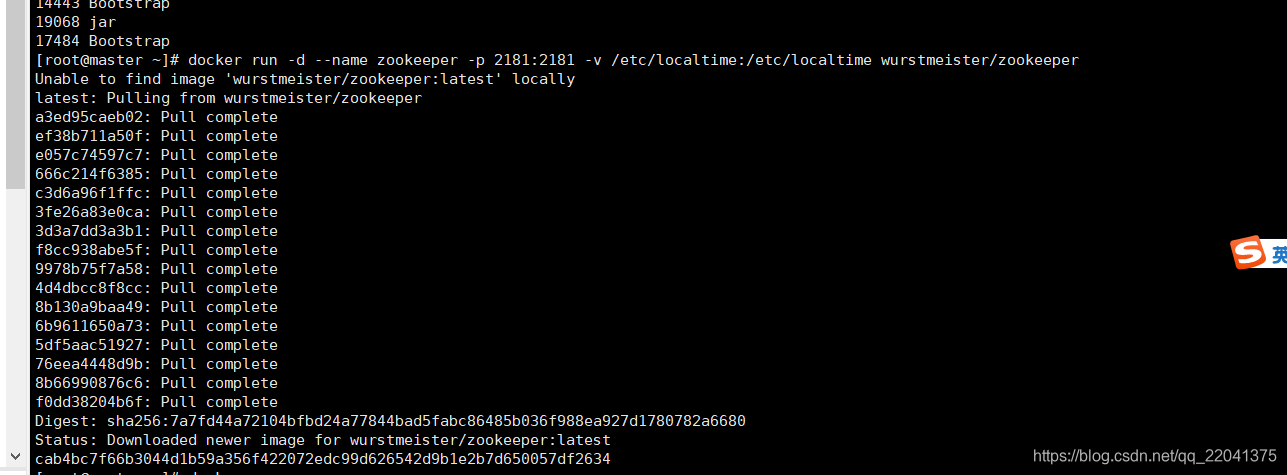
docker run -d --name zookeeper -p 2181:2181 -v /etc/localtime:/etc/localtime wurstmeister/zookeeper:latest
配置详解
- -v /etc/localtime:/etc/localtime 容器时间同步虚拟机的时间
安装Kafka
#docker下载kafka镜像

docker pull wurstmeister/kafka:latest
#生成容器

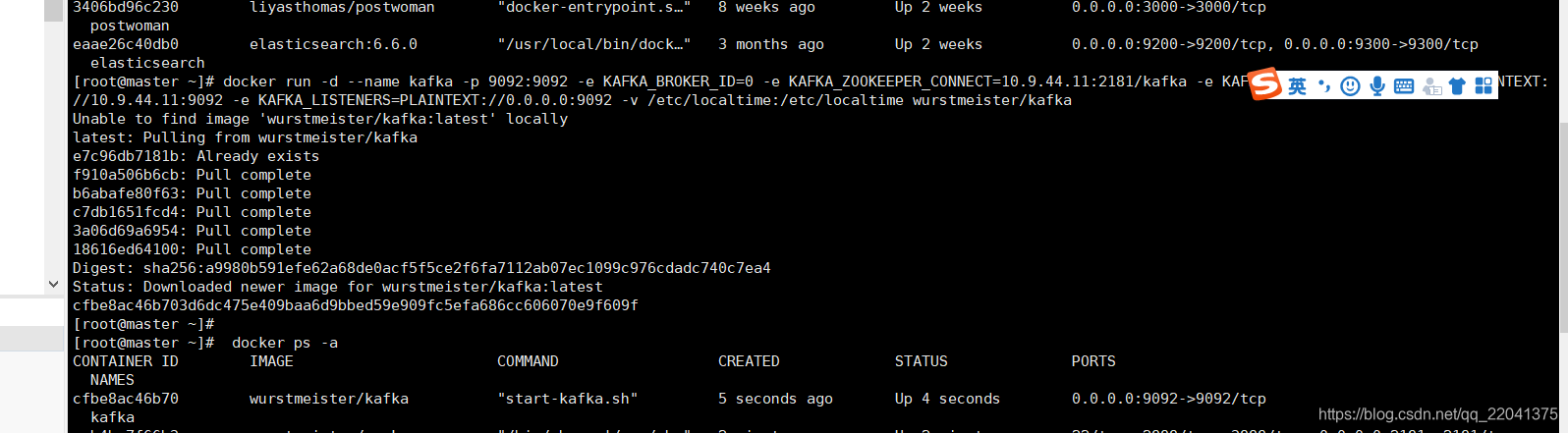
docker run  -d --name kafka -p 9092:9092 -e KAFKA_BROKER_ID=0 -e KAFKA_ZOOKEEPER_CONNECT=10.9.44.11:2181 -e KAFKA_ADVERTISED_LISTENERS=PLAINTEXT://10.9.44.11:9092 -e KAFKA_LISTENERS=PLAINTEXT://0.0.0.0:9092 -t wurstmeister/kafka:latest
配置详解
- -e KAFKA_BROKER_ID=0 #在kafka集群中,每个kafka都有一个BROKER_ID来区分自己
- -e KAFKA_ZOOKEEPER_CONNECT=10.9.44.11:2181/kafka #配置zookeeper管理kafka的路径10.9.44.11:2181/kafka
- -e KAFKA_ADVERTISED_LISTENERS=PLAINTEXT://10.9.44.11:9092 #把kafka的地址端口注册给zookeeper
- -e KAFKA_LISTENERS=PLAINTEXT://0.0.0.0:9092 #配置kafka的监听端口
完整server.properties配置文件
路径/etc/kafka/
# Licensed to the Apache Software Foundation (ASF) under one or more

# contributor license agreements.  See the NOTICE file distributed with

# this work for additional information regarding copyright ownership.

# The ASF licenses this file to You under the Apache License, Version 2.0

# (the "License"); you may not use this file except in compliance with

# the License.  You may obtain a copy of the License at

#

#    http://www.apache.org/licenses/LICENSE-2.0

#

# Unless required by applicable law or agreed to in writing, software

# distributed under the License is distributed on an "AS IS" BASIS,

# WITHOUT WARRANTIES OR CONDITIONS OF ANY KIND, either express or implied.

# See the License for the specific language governing permissions and

# limitations under the License.

# see kafka.server.KafkaConfig for additional details and defaults

############################# Server Basics #############################

##################################################################################

#  broker就是一个kafka的部署实例,在一个kafka集群中,每一台kafka都要有一个broker.id

#  并且,该id唯一,且必须为整数

##################################################################################

broker.id=10

############################# Socket Server Settings #############################

# The address the socket server listens on. It will get the value returned from

# java.net.InetAddress.getCanonicalHostName() if not configured.

#   FORMAT:

#     listeners = security_protocol://host_name:port

#   EXAMPLE:

#     listeners = PLAINTEXT://your.host.name:9092

#listeners=PLAINTEXT://:9092

# Hostname and port the broker will advertise to producers and consumers. If not set,

# it uses the value for "listeners" if configured.  Otherwise, it will use the value

# returned from java.net.InetAddress.getCanonicalHostName().

#advertised.listeners=PLAINTEXT://your.host.name:9092

##################################################################################

#The number of threads handling network requests

# 默认处理网络请求的线程个数 3个

##################################################################################

num.network.threads=3

##################################################################################

# The number of threads doing disk I/O

# 执行磁盘IO操作的默认线程个数 8

##################################################################################

num.io.threads=8

##################################################################################

# The send buffer (SO_SNDBUF) used by the socket server

# socket服务使用的进行发送数据的缓冲区大小,默认100kb

##################################################################################

socket.send.buffer.bytes=102400

##################################################################################

# The receive buffer (SO_SNDBUF) used by the socket server

# socket服务使用的进行接受数据的缓冲区大小,默认100kb

##################################################################################

socket.receive.buffer.bytes=102400

##################################################################################

# The maximum size of a request that the socket server will accept (protection against OOM)

# socket服务所能够接受的最大的请求量,防止出现OOM(Out of memory)内存溢出,默认值为:100m

# (应该是socker server所能接受的一个请求的最大大小,默认为100M)

##################################################################################

socket.request.max.bytes=104857600

############################# Log Basics (数据相关部分,kafka的数据称为log)#############################

##################################################################################

# A comma seperated list of directories under which to store log files

# 一个用逗号分隔的目录列表,用于存储kafka接受到的数据

##################################################################################

log.dirs=/home/uplooking/data/kafka

##################################################################################

# The default number of log partitions per topic. More partitions allow greater

# parallelism for consumption, but this will also result in more files across

# the brokers.

# 每一个topic所对应的log的partition分区数目,默认1个。更多的partition数目会提高消费

# 并行度,但是也会导致在kafka集群中有更多的文件进行传输

# (partition就是分布式存储,相当于是把一份数据分开几份来进行存储,即划分块、划分分区的意思)

##################################################################################

num.partitions=1

##################################################################################

# The number of threads per data directory to be used for log recovery at startup and flushing at shutdown.

# This value is recommended to be increased for installations with data dirs located in RAID array.

# 每一个数据目录用于在启动kafka时恢复数据和在关闭时刷新数据的线程个数。如果kafka数据存储在磁盘阵列中

# 建议此值可以调整更大。

##################################################################################

num.recovery.threads.per.data.dir=1

############################# Log Flush Policy (数据刷新策略)#############################

# Messages are immediately written to the filesystem but by default we only fsync() to sync

# the OS cache lazily. The following configurations control the flush of data to disk.

# There are a few important trade-offs(平衡) here:

#    1. Durability 持久性: Unflushed data may be lost if you are not using replication.

#    2. Latency 延时性: Very large flush intervals may lead to latency spikes when the flush does occur as there will be a lot of data to flush.

#    3. Throughput 吞吐量: The flush is generally the most expensive operation, and a small flush interval may lead to exceessive seeks.

# The settings below allow one to configure the flush policy to flush data after a period of time or

# every N messages (or both). This can be done globally and overridden on a per-topic basis.

# kafka中只有基于消息条数和时间间隔数来制定数据刷新策略,而没有大小的选项,这两个选项可以选择配置一个

# 当然也可以两个都配置,默认情况下两个都配置,配置如下。

# The number of messages to accept before forcing a flush of data to disk

# 消息刷新到磁盘中的消息条数阈值

#log.flush.interval.messages=10000

# The maximum amount of time a message can sit in a log before we force a flush

# 消息刷新到磁盘生成一个log数据文件的时间间隔

#log.flush.interval.ms=1000

############################# Log Retention Policy(数据保留策略) #############################

# The following configurations control the disposal(清理) of log segments(分片). The policy can

# be set to delete segments after a period of time, or after a given size has accumulated(累积).

# A segment will be deleted whenever(无论什么时间) *either* of these criteria(标准) are met. Deletion always happens

# from the end of the log.

# 下面的配置用于控制数据片段的清理,只要满足其中一个策略(基于时间或基于大小),分片就会被删除

# The minimum age of a log file to be eligible for deletion

# 基于时间的策略,删除日志数据的时间,默认保存7天

log.retention.hours=168

# A size-based retention policy for logs. Segments are pruned from the log as long as the remaining

# segments don't drop below log.retention.bytes. 1G

# 基于大小的策略,1G

#log.retention.bytes=1073741824

# The maximum size of a log segment file. When this size is reached a new log segment will be created.

# 数据分片策略

log.segment.bytes=1073741824

# The interval at which log segments are checked to see if they can be deleted according

# to the retention policies 5分钟

# 每隔多长时间检测数据是否达到删除条件

log.retention.check.interval.ms=300000

############################# Zookeeper #############################

# Zookeeper connection string (see zookeeper docs for details).

# This is a comma separated host:port pairs, each corresponding to a zk

# server. e.g. "127.0.0.1:3000,127.0.0.1:3001,127.0.0.1:3002".

# You can also append an optional chroot string to the urls to specify the

# root directory for all kafka znodes.

zookeeper.connect=uplooking01:2181,uplooking02:2181,uplooking03:2181

# Timeout in ms for connecting to zookeeper

zookeeper.connection.timeout.ms=6000
文章整合至:https://www.cnblogs.com/panpanwelcome/p/12580506.html、https://blog.csdn.net/qq_22041375/article/details/106180415、https://www.cnblogs.com/toutou/p/linux_install_kafka.html
Kafka:docker安装Kafka消息队列的更多相关文章
- centos使用docker 安装 rabbitMq 消息队列
1.拉取镜像 docker pull rabbitmq:3-management 如果出现报错: Get https://registry-1.docker.io/v2/: net/http: req ...
- docker安装kafka快速入门
docker安装kafka快速入门 1.安装zookeeper docker search zookeeperdocker pull zookeeperdocker run -d -v /home/s ...
- 基于Docker搭建分布式消息队列Kafka
本文基于Docker搭建一套单节点的Kafka消息队列,Kafka依赖Zookeeper为其管理集群信息,虽然本例不涉及集群,但是该有的组件都还是会有,典型的kafka分布式架构如下图所示.本例搭建的 ...
- docker安装kafka
文本摘自此文章 .kafka需要zookeeper管理,所以需要先安装zookeeper. 下载zookeeper镜像 $ docker pull wurstmeister/zookeeper .启动 ...
- 为什么要用kafka、rabbit等消息队列
1.解耦: 允许你独立的扩展或修改两边的处理过程,只要确保它们遵守同样的接口约束. 2.冗余: 消息队列把数据进行持久化直到它们已经被完全处理,通过这一方式规避了数据丢失风险.许多消息队列所采用的&q ...
- Kafka,Mq,Redis作为消息队列有何差异?
Kafka作为新一代的消息系统,mq是比较成熟消息系统,而redis也可以发布订阅,那么这三者有何异同? RabbitMQ 是使用Erlang编写的一个开源的消息队列,本身支持很多的协议:AMQP,X ...
- kafka概述与下一代消息队列
常用的消息中间件 消息中间件是当前处理大数据的一个非常重要的组件,用来解决应用解耦.异步通信.流量控制等问题,从而构建一个高效.灵活.消息同步和异步传输处理.存储转发.可伸缩和最终一致性的稳定系统.目 ...
- 【kafka】一、消息队列
在高并发的应用场景中,由于来不及同步处理请求,接收到的请求往往会发生阻塞.例如,大量的插入.更新请求同时到达数据库,这会导致行或表被锁住,最后会因为请求堆积过多而触发“连接数过多的异常” 的错误.因此 ...
- 在 CentOS7 上安装 RabbitMQ 消息队列中间件
RabbitMQ 是流行的开源消息队列系统,是 AMQP(Advanced Message Queuing Protocol 高级消息队列协议)的标准实现,用 erlang 语言开发.RabbitMQ ...
随机推荐
- mate-notification-daemon stopping, Mate notifications timeout
mate-notification-daemon stopping, Mate notifications timeout Ask Question Asked 9 days ago Viewed 1 ...
- mysql基础之查询缓存、存储引擎
一.查询缓存 "查询缓存",就是将查询的结果缓存下载,如果查询语句完全相同,则直接返回缓存中的结果. 如果应用程序在某个场景中,需要经常执行大量的相同的查询,而且查询出的数据不会经 ...
- 大师画PCB板子
1.低频电路对于模拟地和数字地要分开布线,不能混用 2.如果有多个A/D转换电路,几个ADC尽量放在一起,只在尽量靠近该器件处单点接地,AGND和DGND都要接到模拟地,电源端子都要接到模拟电源端子: ...
- 实操笔记:为 NSQ 配置监控服务的心路历程
在 Go 语言实现的实时消息队列中, NSQ 的热度可以排第一. NSQ 这款消息中间件简单易用,其设计目标是为在分布式环境下运行,为去中心化服务提供一个强大的基础架构.它具有分布式.去中心化的拓扑结 ...
- jrebel 插件使用
最近遇到一件神奇的事情,idea原本配置了热部署,但是修改java文件之后需要重启俩次才能编译成功,网上各种问度娘都没有解决,偶尔看到了jrebel这个插件,折腾了一番,终于完美解决,记录一下,供后来 ...
- TVMNN编译Compiler栈
TVMNN编译Compiler栈 内容纲要 前言 调研目标 TVM介绍 TVM源码架构 FrontEnd Relay BackEnd VTA实现原理及设计思想提炼 整体结构 VTA Hardware ...
- SLAM的通用框架:GSLAM
SLAM的通用框架:GSLAM GSLAM: A General SLAM Framework and Benchmark 论文链接: http://openaccess.thecvf.com/con ...
- 嵌入式Linux设备驱动程序:发现硬件配置
嵌入式Linux设备驱动程序:发现硬件配置 Embedded Linux device drivers: Discovering the hardware configuration Interfac ...
- pytest命令行参数
1.-v:可以输出用例更加详细的执行信息,如下图 C:\Users\cale\checkapi\test_cc>pytest test_m1.py -v ==================== ...
- Java代码优化:使用构造函数和使用一个个setter的效率差别
在对Java代码进行优化的时候,想方设法的要提高整体的效率,使用JProfiler看代码的时间占比,然后,看看哪些部分是可以优化的,减少运行时间的.下面有这么几个方向. 1. 能使用构造函数一步到位的 ...