
深入jvm虚拟机--第一篇 void TemplateInterpreterGenerator::generate_and_dispatch(Template* t, TosState tos_out) 函数
今天第一次使用虚拟姐打断点,断点设置在了void TemplateInterpreterGenerator::generate_and_dispatch(Template* t, TosState tos_out) 了
在TemplateInterpreterGenerator.cpp中,这个函数之前看书就不太懂,现在debug时候就能分析的比较清楚了,这个函数的介绍在解密jvm的528页中有具体介绍
void TemplateInterpreterGenerator::generate_and_dispatch(Template* t, TosState tos_out) {

  if (PrintBytecodeHistogram)                                    histogram_bytecode(t);

#ifndef PRODUCT

  // debugging code

  if (CountBytecodes || TraceBytecodes || StopInterpreterAt > 0) count_bytecode();

  if (PrintBytecodePairHistogram)                                histogram_bytecode_pair(t);

  if (TraceBytecodes)                                            trace_bytecode(t);

  if (StopInterpreterAt > 0)                                     stop_interpreter_at();

  __ verify_FPU(1, t->tos_in());

#endif // !PRODUCT

  int step = 0;

  if (!t->does_dispatch()) {

    step = t->is_wide() ? Bytecodes::wide_length_for(t->bytecode()) : Bytecodes::length_for(t->bytecode());

    if (tos_out == ilgl) tos_out = t->tos_out();

    // compute bytecode size

    assert(step > 0, "just checkin'");

    // setup stuff for dispatching next bytecode

    if (ProfileInterpreter && VerifyDataPointer

        && MethodData::bytecode_has_profile(t->bytecode())) {

      __ verify_method_data_pointer();

    }

    __ dispatch_prolog(tos_out, step);

  }

  // generate template

  t->generate(_masm);

  // advance

  if (t->does_dispatch()) {

#ifdef ASSERT

    // make sure execution doesn't go beyond this point if code is broken

    __ should_not_reach_here();

#endif // ASSERT

  } else {

    // dispatch to next bytecode

    __ dispatch_epilog(tos_out, step);

  }

}
先看这个入参函数Template

这个是一个对象,在哪里定义的呢?得往上边查看
void TemplateInterpreterGenerator::set_entry_points(Bytecodes::Code code) {

  CodeletMark cm(_masm, Bytecodes::name(code), code);

  // initialize entry points

  assert(_unimplemented_bytecode    != NULL, "should have been generated before");

  assert(_illegal_bytecode_sequence != NULL, "should have been generated before");

  address bep = _illegal_bytecode_sequence;

  address zep = _illegal_bytecode_sequence;

  address cep = _illegal_bytecode_sequence;

  address sep = _illegal_bytecode_sequence;

  address aep = _illegal_bytecode_sequence;

  address iep = _illegal_bytecode_sequence;

  address lep = _illegal_bytecode_sequence;

  address fep = _illegal_bytecode_sequence;

  address dep = _illegal_bytecode_sequence;

  address vep = _unimplemented_bytecode;

  address wep = _unimplemented_bytecode;

  // code for short & wide version of bytecode

  if (Bytecodes::is_defined(code)) {

    Template* t = TemplateTable::template_for(code);

    assert(t->is_valid(), "just checking");

    set_short_entry_points(t, bep, cep, sep, aep, iep, lep, fep, dep, vep);

  }

  if (Bytecodes::wide_is_defined(code)) {

    Template* t = TemplateTable::template_for_wide(code);

    assert(t->is_valid(), "just checking");

    set_wide_entry_point(t, wep);

  }

  // set entry points

  EntryPoint entry(bep, zep, cep, sep, aep, iep, lep, fep, dep, vep);

  Interpreter::_normal_table.set_entry(code, entry);

  Interpreter::_wentry_point[code] = wep;

}
是通过: Template* t = TemplateTable::template_for(code); 得到的; TemplateTable的定义
需要知道的是这个是个 静态类,理解是类似于java,能在全局通过类:成员,类:方法来调用(引用)
class TemplateTable: AllStatic {

 public:

  enum Operation { add, sub, mul, div, rem, _and, _or, _xor, shl, shr, ushr };

  enum Condition { equal, not_equal, less, less_equal, greater, greater_equal };

  enum CacheByte { f1_byte = 1, f2_byte = 2, f1_oop = 0x11 };  // byte_no codes

 private:

  static bool            _is_initialized;        // true if TemplateTable has been initialized

  static Template        _template_table     [Bytecodes::number_of_codes];

  static Template        _template_table_wide[Bytecodes::number_of_codes];

  static Template*       _desc;                  // the current template to be generated

  static Bytecodes::Code bytecode()              { return _desc->bytecode(); }

  static BarrierSet*     _bs;                    // Cache the barrier set.

 public:

  //%note templates_1

  static InterpreterMacroAssembler* _masm;       // the assembler used when generating templates

 private:

  // special registers

  static inline Address at_bcp(int offset);

  // helpers

  static void unimplemented_bc();

  static void patch_bytecode(Bytecodes::Code bc, Register bc_reg,

                             Register temp_reg, bool load_bc_into_bc_reg = true, int byte_no = -1);

  // C calls

  static void call_VM(Register oop_result, address entry_point);

  static void call_VM(Register oop_result, address entry_point, Register arg_1);

  static void call_VM(Register oop_result, address entry_point, Register arg_1, Register arg_2);

  static void call_VM(Register oop_result, address entry_point, Register arg_1, Register arg_2, Register arg_3);

  // these overloadings are not presently used on SPARC:

  static void call_VM(Register oop_result, Register last_java_sp, address entry_point);

  static void call_VM(Register oop_result, Register last_java_sp, address entry_point, Register arg_1);

  static void call_VM(Register oop_result, Register last_java_sp, address entry_point, Register arg_1, Register arg_2);

  static void call_VM(Register oop_result, Register last_java_sp, address entry_point, Register arg_1, Register arg_2, Register arg_3);

  // bytecodes

  static void nop();

  static void aconst_null();

  static void iconst(int value);

  static void lconst(int value);

  static void fconst(int value);

  static void dconst(int value);

  static void bipush();

  static void sipush();

  static void ldc(bool wide);

  static void ldc2_w();

  static void fast_aldc(bool wide);

  static void locals_index(Register reg, int offset = 1);

  static void iload();

  static void fast_iload();

  static void fast_iload2();

  static void fast_icaload();

  static void lload();

  static void fload();

  static void dload();

  static void aload();

  static void locals_index_wide(Register reg);

  static void wide_iload();

  static void wide_lload();

  static void wide_fload();

  static void wide_dload();

  static void wide_aload();

  static void iaload();

  static void laload();

  static void faload();

  static void daload();

  static void aaload();

  static void baload();

  static void caload();

  static void saload();

  static void iload(int n);

  static void lload(int n);

  static void fload(int n);

  static void dload(int n);

  static void aload(int n);

  static void aload_0();

  static void istore();

  static void lstore();

  static void fstore();

  static void dstore();

  static void astore();

};
那么试着摸索 能看到 _template_table,这个是一个数组,一共有239个,对应了239个字节码指令
static Template* template_for (Bytecodes::Code code) { Bytecodes::check (code); return &_template_table [code]; }

此时code值为01则返回对应的为_nop的指令,意思就是t=一个_nop字节码的信息,还接着看
step = t->is_wide() ? Bytecodes::wide_length_for(t->bytecode()) : Bytecodes::length_for(t->bytecode());
此为generate_and_dispatch函数中的,分析 t->bytecode(),值==01
//share/vm/interpreter/templateTable.cpp文件中
Bytecodes::Code Template::bytecode() const {

  int i = this - TemplateTable::_template_table;

  if (i < 0 || i >= Bytecodes::number_of_codes)
     i = this - TemplateTable::_template_table_wide;

  return Bytecodes::cast(i);

}
那么看_template_table,还是上面已经介绍的那个,接着分析
Bytecodes::wide_length_for(01)
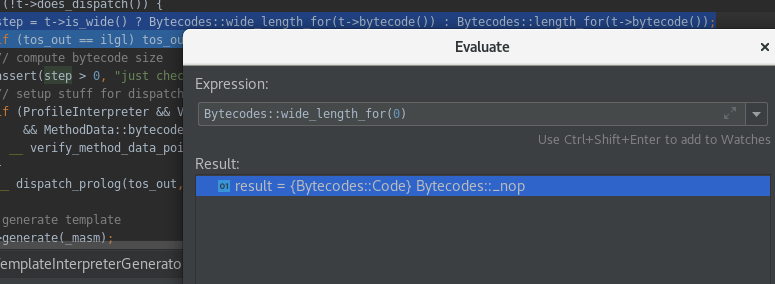
这里的用法就是静态方法调用,查看Bytecodes类
class Bytecodes: AllStatic {

 public:

  enum Code {

    _illegal              =  -1,

    // Java bytecodes

    _nop                  =   0, // 0x00

    _aconst_null          =   1, // 0x01

    _iconst_m1            =   2, // 0x02

    _iconst_0             =   3, // 0x03

    _iconst_1             =   4, // 0x04

    _iconst_2             =   5, // 0x05

    _iconst_3             =   6, // 0x06

    _iconst_4             =   7, // 0x07

    _iconst_5             =   8, // 0x08

    _lconst_0             =   9, // 0x09

    _lconst_1             =  10, // 0x0a

    _fconst_0             =  11, // 0x0b

    _fconst_1             =  12, // 0x0c

    _fconst_2             =  13, // 0x0d

    _dconst_0             =  14, // 0x0e

    _dconst_1             =  15, // 0x0f

    _bipush               =  16, // 0x10

    _sipush               =  17, // 0x11

    _ldc                  =  18, // 0x12

    _ldc_w                =  19, // 0x13

    _ldc2_w               =  20, // 0x14

    _iload                =  21, // 0x15

    _lload                =  22, // 0x16

    _fload                =  23, // 0x17

    _dload                =  24, // 0x18

    _aload                =  25, // 0x19

    _iload_0              =  26, // 0x1a

    _iload_1              =  27, // 0x1b

    _iload_2              =  28, // 0x1c

    _iload_3              =  29, // 0x1d

    _lload_0              =  30, // 0x1e

    _lload_1              =  31, // 0x1f

    _lload_2              =  32, // 0x20

    _lload_3              =  33, // 0x21

    _fload_0              =  34, // 0x22

     number_of_codes

  };

  // Flag bits derived from format strings, can_trap, can_rewrite, etc.:

  enum Flags {

    // semantic flags:

    _bc_can_trap      = 1<<0,     // bytecode execution can trap or block

    _bc_can_rewrite   = 1<<1,     // bytecode execution has an alternate form

    // format bits (determined only by the format string):

    _fmt_has_c        = 1<<2,     // constant, such as sipush "bcc"

    _fmt_has_j        = 1<<3,     // constant pool cache index, such as getfield "bjj"

    _fmt_has_k        = 1<<4,     // constant pool index, such as ldc "bk"

    _fmt_has_i        = 1<<5,     // local index, such as iload

    _fmt_has_o        = 1<<6,     // offset, such as ifeq

    _fmt_has_nbo      = 1<<7,     // contains native-order field(s)

    _fmt_has_u2       = 1<<8,     // contains double-byte field(s)

    _fmt_has_u4       = 1<<9,     // contains quad-byte field

    _fmt_not_variable = 1<<10,    // not of variable length (simple or wide)

    _fmt_not_simple   = 1<<11,    // either wide or variable length

    _all_fmt_bits     = (_fmt_not_simple*2 - _fmt_has_c),

    // Example derived format syndromes:

    _fmt_b      = _fmt_not_variable,

    _fmt_bc     = _fmt_b | _fmt_has_c,

    _fmt_bi     = _fmt_b | _fmt_has_i,

    _fmt_bkk    = _fmt_b | _fmt_has_k | _fmt_has_u2,

    _fmt_bJJ    = _fmt_b | _fmt_has_j | _fmt_has_u2 | _fmt_has_nbo,

    _fmt_bo2    = _fmt_b | _fmt_has_o | _fmt_has_u2,

    _fmt_bo4    = _fmt_b | _fmt_has_o | _fmt_has_u4

  };

 private:

  static bool        _is_initialized;

  static const char* _name          [number_of_codes];

  static BasicType   _result_type   [number_of_codes];

  static s_char      _depth         [number_of_codes];

  static u_char      _lengths       [number_of_codes];

  static Code        _java_code     [number_of_codes];

  static jchar       _flags         [(1<<BitsPerByte)*2]; // all second page for wide formats

  static void        def(Code code, const char* name, const char* format, const char* wide_format, BasicType result_type, int depth, bool can_trap);

  static void        def(Code code, const char* name, const char* format, const char* wide_format, BasicType result_type, int depth, bool can_trap, Code java_code);

  static void        pd_initialize();              // platform specific initialization

  static Code        pd_base_code_for(Code code);  // platform specific base_code_for implementation

  // Verify that bcp points into method

#ifdef ASSERT

  static bool        check_method(const methodOopDesc* method, address bcp);

#endif

  static bool check_must_rewrite(Bytecodes::Code bc);

 public:

  // Conversion

  static void        check          (Code code)    { assert(is_defined(code), "illegal code"); }

  static void        wide_check     (Code code)    { assert(wide_is_defined(code), "illegal code"); }

  static Code        cast           (int  code)    { return (Code)code; }

  static Code       code_at(const methodOopDesc* method, address bcp) {

    assert(method == NULL || check_method(method, bcp), "bcp must point into method");

    Code code = cast(*bcp);

    assert(code != _breakpoint || method != NULL, "need methodOop to decode breakpoint");

    return (code != _breakpoint) ? code : non_breakpoint_code_at(method, bcp);

  }

  static Code       java_code_at(const methodOopDesc* method, address bcp) {

    return java_code(code_at(method, bcp));

  }

  // Fetch a bytecode or a breakpoint:

  static Code       code_or_bp_at(address bcp)    { return (Code)cast(*bcp); }

  static Code       code_at(methodOop method, int bci);

  static bool       is_active_breakpoint_at(address bcp) { return (Code)*bcp == _breakpoint; }

  // find a bytecode, behind a breakpoint if necessary:

  static Code       non_breakpoint_code_at(const methodOopDesc* method, address bcp);

  // Bytecode attributes

  static bool        is_defined     (int  code)    { return 0 <= code && code < number_of_codes && flags(code, false) != 0; }

  static bool        wide_is_defined(int  code)    { return is_defined(code) && flags(code, true) != 0; }

  static const char* name           (Code code)    { check(code);      return _name          [code]; }

  static BasicType   result_type    (Code code)    { check(code);      return _result_type   [code]; }

  static int         depth          (Code code)    { check(code);      return _depth         [code]; }

  // Note: Length functions must return <=0 for invalid bytecodes.

  // Calling check(code) in length functions would throw an unwanted assert.

  static int         length_for     (Code code)    { /*no check*/      return _lengths       [code] & 0xF; }

  static int         wide_length_for(Code code)    { /*no check*/      return _lengths       [code] >> 4; }

  static bool        can_trap       (Code code)    { check(code);      return has_all_flags(code, _bc_can_trap, false); }

  static Code        java_code      (Code code)    { check(code);      return _java_code     [code]; }

  static bool        can_rewrite    (Code code)    { check(code);      return has_all_flags(code, _bc_can_rewrite, false); }

  static bool        must_rewrite(Bytecodes::Code code) { return can_rewrite(code) && check_must_rewrite(code); }

  static bool        native_byte_order(Code code)  { check(code);      return has_all_flags(code, _fmt_has_nbo, false); }

  static bool        uses_cp_cache  (Code code)    { check(code);      return has_all_flags(code, _fmt_has_j, false); }

  // if 'end' is provided, it indicates the end of the code buffer which

  // should not be read past when parsing.

  static int         special_length_at(Bytecodes::Code code, address bcp, address end = NULL);

  static int         special_length_at(methodOop method, address bcp, address end = NULL) { return special_length_at(code_at(method, bcp), bcp, end); }

  static int         raw_special_length_at(address bcp, address end = NULL);

  static int         length_for_code_at(Bytecodes::Code code, address bcp)  { int l = length_for(code); return l > 0 ? l : special_length_at(code, bcp); }

  static int         length_at      (methodOop method, address bcp)  { return length_for_code_at(code_at(method, bcp), bcp); }

  static int         java_length_at (methodOop method, address bcp)  { return length_for_code_at(java_code_at(method, bcp), bcp); }

  static bool        is_java_code   (Code code)    { return 0 <= code && code < number_of_java_codes; }

  static bool        is_aload       (Code code)    { return (code == _aload  || code == _aload_0  || code == _aload_1

                                                                             || code == _aload_2  || code == _aload_3); }

  static bool        is_astore      (Code code)    { return (code == _astore || code == _astore_0 || code == _astore_1

                                                                             || code == _astore_2 || code == _astore_3); }

  static bool        is_zero_const  (Code code)    { return (code == _aconst_null || code == _iconst_0

                                                           || code == _fconst_0 || code == _dconst_0); }

  static bool        is_invoke      (Code code)    { return (_invokevirtual <= code && code <= _invokedynamic); }

  static int         compute_flags  (const char* format, int more_flags = 0);  // compute the flags

  static int         flags          (int code, bool is_wide) {

    assert(code == (u_char)code, "must be a byte");

    return _flags[code + (is_wide ? (1<<BitsPerByte) : 0)];

  }

  static int         format_bits    (Code code, bool is_wide) { return flags(code, is_wide) & _all_fmt_bits; }

  static bool        has_all_flags  (Code code, int test_flags, bool is_wide) {

    return (flags(code, is_wide) & test_flags) == test_flags;

  }

  // Initialization

  static void        initialize     ();

};

#endif // SHARE_VM_INTERPRETER_BYTECODES_HPP
那么
static int wide_length_for(Code code) { /*no check*/ return _lengths [code] >> 4; }
这个静态类中的值

那么久能看到了 _lengths[01] 为1,
static int length_for (Code code) { /*no check*/ return _lengths [code] & 0xF; }
_lengths[01]为1 &1111111 还是为1;

今天先分析到这里,明天再续
现在准备执行
  // generate template

  t->generate(_masm);
还是要看Template这个东西,先看类的定义
//"interpreter/interpreterRuntime.hpp"

class Template VALUE_OBJ_CLASS_SPEC {

 private:

  enum Flags {

    uses_bcp_bit,                                // set if template needs the bcp pointing to bytecode

    does_dispatch_bit,                           // set if template dispatches on its own

    calls_vm_bit,                                // set if template calls the vm

    wide_bit                                     // set if template belongs to a wide instruction

  };

  typedef void (*generator)(int arg);

  int       _flags;                              // describes interpreter template properties (bcp unknown)

  TosState  _tos_in;                             // tos cache state before template execution

  TosState  _tos_out;                            // tos cache state after  template execution

  generator _gen;                                // template code generator

  int       _arg;                                // argument for template code generator

  void      initialize(int flags, TosState tos_in, TosState tos_out, generator gen, int arg);

  friend class TemplateTable;

 public:

  Bytecodes::Code bytecode() const;

  bool      is_valid() const                     { return _gen != NULL; }

  bool      uses_bcp() const                     { return (_flags & (1 << uses_bcp_bit     )) != 0; }

  bool      does_dispatch() const                { return (_flags & (1 << does_dispatch_bit)) != 0; }

  bool      calls_vm() const                     { return (_flags & (1 << calls_vm_bit     )) != 0; }

  bool      is_wide() const                      { return (_flags & (1 << wide_bit         )) != 0; }

  TosState  tos_in() const                       { return _tos_in; }

  TosState  tos_out() const                      { return _tos_out; }

  void      generate(InterpreterMacroAssembler* masm);

};
//进入函数内部
void Template::generate(InterpreterMacroAssembler* masm) {

  // parameter passing

  TemplateTable::_desc = this;

  TemplateTable::_masm = masm;

  // code generation

  _gen(_arg);  ///这个函数在 TemplateTable类中

  masm->flush();

}
进入_gen(_arg)
//templateTable_x86.cpp

void TemplateTable::nop() {

  transition(vtos, vtos);

  // nothing to do

}
这里正是对应了templateTable

特别注意上边的类的调用: Template::generater ===>调用了 TemplateTable::nop函数
这nop函数啥也没做
void TemplateTable::transition(TosState tos_in, TosState tos_out) {

  assert(_desc->tos_in()  == tos_in , "inconsistent tos_in  information");

  assert(_desc->tos_out() == tos_out, "inconsistent tos_out information");

}
这样就结束了, t->generate(_masm);生成模板的函数调用,之前看过template是 在哪里 Template TemplateTable::_template_table [Bytecodes::number_of_codes];保存
那么他是怎么创造的呢?
//templateTable.cpp
void TemplateTable::initialize() {
if (_is_initialized) return; // Initialize table
TraceTime timer("TemplateTable initialization", TraceStartupTime); _bs = Universe::heap()->barrier_set(); // For better readability
const char _ = ' ';
const int ____ = 0;
const int ubcp = 1 << Template::uses_bcp_bit;
const int disp = 1 << Template::does_dispatch_bit;
const int clvm = 1 << Template::calls_vm_bit;
const int iswd = 1 << Template::wide_bit;
// interpr. templates
// Java spec bytecodes ubcp|disp|clvm|iswd in out generator argument
def(Bytecodes::_nop , ____|____|____|____, vtos, vtos, nop , _ );
def(Bytecodes::_aconst_null , ____|____|____|____, vtos, atos, aconst_null , _ );
def(Bytecodes::_iconst_m1 , ____|____|____|____, vtos, itos, iconst , -1 );
def(Bytecodes::_iconst_0 , ____|____|____|____, vtos, itos, iconst , 0 );
def(Bytecodes::_iconst_1 , ____|____|____|____, vtos, itos, iconst , 1 );
def(Bytecodes::_iconst_2 , ____|____|____|____, vtos, itos, iconst , 2 );
def(Bytecodes::_iconst_3 , ____|____|____|____, vtos, itos, iconst , 3 );
def(Bytecodes::_iconst_4 , ____|____|____|____, vtos, itos, iconst , 4 );
def(Bytecodes::_iconst_5 , ____|____|____|____, vtos, itos, iconst , 5 );
def(Bytecodes::_lconst_0 , ____|____|____|____, vtos, ltos, lconst , 0 );
def(Bytecodes::_lconst_1 , ____|____|____|____, vtos, ltos, lconst , 1 );
def(Bytecodes::_fconst_0 , ____|____|____|____, vtos, ftos, fconst , 0 );
def(Bytecodes::_fconst_1 , ____|____|____|____, vtos, ftos, fconst , 1 );
def(Bytecodes::_fconst_2 , ____|____|____|____, vtos, ftos, fconst , 2 );
def(Bytecodes::_dconst_0 , ____|____|____|____, vtos, dtos, dconst , 0 );
def(Bytecodes::_dconst_1 , ____|____|____|____, vtos, dtos, dconst , 1 );
def(Bytecodes::_bipush , ubcp|____|____|____, vtos, itos, bipush , _ );
def(Bytecodes::_sipush , ubcp|____|____|____, vtos, itos, sipush , _ );
def(Bytecodes::_ldc , ubcp|____|clvm|____, vtos, vtos, ldc , false );
def(Bytecodes::_ldc_w , ubcp|____|clvm|____, vtos, vtos, ldc , true );
def(Bytecodes::_ldc2_w , ubcp|____|____|____, vtos, vtos, ldc2_w , _ );
def(Bytecodes::_iload , ubcp|____|clvm|____, vtos, itos, iload , _ );
def(Bytecodes::_lload , ubcp|____|____|____, vtos, ltos, lload , _ );
def(Bytecodes::_fload , ubcp|____|____|____, vtos, ftos, fload , _ );
def(Bytecodes::_dload , ubcp|____|____|____, vtos, dtos, dload , _ );
def(Bytecodes::_aload , ubcp|____|clvm|____, vtos, atos, aload , _ );
def(Bytecodes::_iload_0 , ____|____|____|____, vtos, itos, iload , 0 );
def(Bytecodes::_iload_1 , ____|____|____|____, vtos, itos, iload , 1 );
def(Bytecodes::_iload_2 , ____|____|____|____, vtos, itos, iload , 2 );
def(Bytecodes::_iload_3 , ____|____|____|____, vtos, itos, iload , 3 );
def(Bytecodes::_lload_0 , ____|____|____|____, vtos, ltos, lload , 0 );
def(Bytecodes::_lload_1 , ____|____|____|____, vtos, ltos, lload , 1 );
def(Bytecodes::_lload_2 , ____|____|____|____, vtos, ltos, lload , 2 );
def(Bytecodes::_lload_3 , ____|____|____|____, vtos, ltos, lload , 3 );
def(Bytecodes::_fload_0 , ____|____|____|____, vtos, ftos, fload , 0 );
def(Bytecodes::_fload_1 , ____|____|____|____, vtos, ftos, fload , 1 );
def(Bytecodes::_fload_2 , ____|____|____|____, vtos, ftos, fload , 2 );
def(Bytecodes::_fload_3 , ____|____|____|____, vtos, ftos, fload , 3 );
def(Bytecodes::_dload_0 , ____|____|____|____, vtos, dtos, dload , 0 );
def(Bytecodes::_dload_1 , ____|____|____|____, vtos, dtos, dload , 1 );
def(Bytecodes::_dload_2 , ____|____|____|____, vtos, dtos, dload , 2 );
def(Bytecodes::_dload_3 , ____|____|____|____, vtos, dtos, dload , 3 );
def(Bytecodes::_aload_0 , ubcp|____|clvm|____, vtos, atos, aload_0 , _ );
def(Bytecodes::_aload_1 , ____|____|____|____, vtos, atos, aload , 1 );
def(Bytecodes::_aload_2 , ____|____|____|____, vtos, atos, aload , 2 );
def(Bytecodes::_aload_3 , ____|____|____|____, vtos, atos, aload , 3 );
def(Bytecodes::_iaload , ____|____|____|____, itos, itos, iaload , _ );
def(Bytecodes::_laload , ____|____|____|____, itos, ltos, laload , _ );
def(Bytecodes::_faload , ____|____|____|____, itos, ftos, faload , _ );
def(Bytecodes::_daload , ____|____|____|____, itos, dtos, daload , _ );
def(Bytecodes::_aaload , ____|____|____|____, itos, atos, aaload , _ );
def(Bytecodes::_baload , ____|____|____|____, itos, itos, baload , _ );
def(Bytecodes::_caload , ____|____|____|____, itos, itos, caload , _ );
def(Bytecodes::_saload , ____|____|____|____, itos, itos, saload , _ );
def(Bytecodes::_istore , ubcp|____|clvm|____, itos, vtos, istore , _ );
def(Bytecodes::_lstore , ubcp|____|____|____, ltos, vtos, lstore , _ );
def(Bytecodes::_fstore , ubcp|____|____|____, ftos, vtos, fstore , _ );
def(Bytecodes::_dstore , ubcp|____|____|____, dtos, vtos, dstore , _ );
def(Bytecodes::_astore , ubcp|____|clvm|____, vtos, vtos, astore , _ );
def(Bytecodes::_istore_0 , ____|____|____|____, itos, vtos, istore , 0 );
def(Bytecodes::_istore_1 , ____|____|____|____, itos, vtos, istore , 1 );
def(Bytecodes::_istore_2 , ____|____|____|____, itos, vtos, istore , 2 );
def(Bytecodes::_istore_3 , ____|____|____|____, itos, vtos, istore , 3 );
def(Bytecodes::_lstore_0 , ____|____|____|____, ltos, vtos, lstore , 0 );
def(Bytecodes::_lstore_1 , ____|____|____|____, ltos, vtos, lstore , 1 );
def(Bytecodes::_lstore_2 , ____|____|____|____, ltos, vtos, lstore , 2 );
def(Bytecodes::_lstore_3 , ____|____|____|____, ltos, vtos, lstore , 3 );
def(Bytecodes::_fstore_0 , ____|____|____|____, ftos, vtos, fstore , 0 );
def(Bytecodes::_fstore_1 , ____|____|____|____, ftos, vtos, fstore , 1 );
def(Bytecodes::_fstore_2 , ____|____|____|____, ftos, vtos, fstore , 2 );
def(Bytecodes::_fstore_3 , ____|____|____|____, ftos, vtos, fstore , 3 );
def(Bytecodes::_dstore_0 , ____|____|____|____, dtos, vtos, dstore , 0 );
def(Bytecodes::_dstore_1 , ____|____|____|____, dtos, vtos, dstore , 1 );
def(Bytecodes::_dstore_2 , ____|____|____|____, dtos, vtos, dstore , 2 );
def(Bytecodes::_dstore_3 , ____|____|____|____, dtos, vtos, dstore , 3 );
def(Bytecodes::_astore_0 , ____|____|____|____, vtos, vtos, astore , 0 );
def(Bytecodes::_astore_1 , ____|____|____|____, vtos, vtos, astore , 1 );
def(Bytecodes::_astore_2 , ____|____|____|____, vtos, vtos, astore , 2 );
def(Bytecodes::_astore_3 , ____|____|____|____, vtos, vtos, astore , 3 );
def(Bytecodes::_iastore , ____|____|____|____, itos, vtos, iastore , _ );
def(Bytecodes::_lastore , ____|____|____|____, ltos, vtos, lastore , _ );
def(Bytecodes::_fastore , ____|____|____|____, ftos, vtos, fastore , _ );
def(Bytecodes::_dastore , ____|____|____|____, dtos, vtos, dastore , _ );
def(Bytecodes::_aastore , ____|____|clvm|____, vtos, vtos, aastore , _ );
def(Bytecodes::_bastore , ____|____|____|____, itos, vtos, bastore , _ );
def(Bytecodes::_castore , ____|____|____|____, itos, vtos, castore , _ );
def(Bytecodes::_sastore , ____|____|____|____, itos, vtos, sastore , _ );
def(Bytecodes::_pop , ____|____|____|____, vtos, vtos, pop , _ );
def(Bytecodes::_pop2 , ____|____|____|____, vtos, vtos, pop2 , _ );
def(Bytecodes::_dup , ____|____|____|____, vtos, vtos, dup , _ );
def(Bytecodes::_dup_x1 , ____|____|____|____, vtos, vtos, dup_x1 , _ );
def(Bytecodes::_dup_x2 , ____|____|____|____, vtos, vtos, dup_x2 , _ );
def(Bytecodes::_dup2 , ____|____|____|____, vtos, vtos, dup2 , _ );
def(Bytecodes::_dup2_x1 , ____|____|____|____, vtos, vtos, dup2_x1 , _ );
def(Bytecodes::_dup2_x2 , ____|____|____|____, vtos, vtos, dup2_x2 , _ );
def(Bytecodes::_swap , ____|____|____|____, vtos, vtos, swap , _ );
def(Bytecodes::_iadd , ____|____|____|____, itos, itos, iop2 , add );
def(Bytecodes::_ladd , ____|____|____|____, ltos, ltos, lop2 , add );
def(Bytecodes::_fadd , ____|____|____|____, ftos, ftos, fop2 , add );
def(Bytecodes::_dadd , ____|____|____|____, dtos, dtos, dop2 , add );
def(Bytecodes::_isub , ____|____|____|____, itos, itos, iop2 , sub );
def(Bytecodes::_lsub , ____|____|____|____, ltos, ltos, lop2 , sub );
def(Bytecodes::_fsub , ____|____|____|____, ftos, ftos, fop2 , sub );
def(Bytecodes::_dsub , ____|____|____|____, dtos, dtos, dop2 , sub );
def(Bytecodes::_imul , ____|____|____|____, itos, itos, iop2 , mul );
def(Bytecodes::_lmul , ____|____|____|____, ltos, ltos, lmul , _ );
def(Bytecodes::_fmul , ____|____|____|____, ftos, ftos, fop2 , mul );
def(Bytecodes::_dmul , ____|____|____|____, dtos, dtos, dop2 , mul );
def(Bytecodes::_idiv , ____|____|____|____, itos, itos, idiv , _ );
def(Bytecodes::_ldiv , ____|____|____|____, ltos, ltos, ldiv , _ );
def(Bytecodes::_fdiv , ____|____|____|____, ftos, ftos, fop2 , div );
def(Bytecodes::_ddiv , ____|____|____|____, dtos, dtos, dop2 , div );
def(Bytecodes::_irem , ____|____|____|____, itos, itos, irem , _ );
def(Bytecodes::_lrem , ____|____|____|____, ltos, ltos, lrem , _ );
def(Bytecodes::_frem , ____|____|____|____, ftos, ftos, fop2 , rem );
def(Bytecodes::_drem , ____|____|____|____, dtos, dtos, dop2 , rem );
def(Bytecodes::_ineg , ____|____|____|____, itos, itos, ineg , _ );
def(Bytecodes::_lneg , ____|____|____|____, ltos, ltos, lneg , _ );
def(Bytecodes::_fneg , ____|____|____|____, ftos, ftos, fneg , _ );
def(Bytecodes::_dneg , ____|____|____|____, dtos, dtos, dneg , _ );
def(Bytecodes::_ishl , ____|____|____|____, itos, itos, iop2 , shl );
def(Bytecodes::_lshl , ____|____|____|____, itos, ltos, lshl , _ );
def(Bytecodes::_ishr , ____|____|____|____, itos, itos, iop2 , shr );
def(Bytecodes::_lshr , ____|____|____|____, itos, ltos, lshr , _ );
def(Bytecodes::_iushr , ____|____|____|____, itos, itos, iop2 , ushr );
def(Bytecodes::_lushr , ____|____|____|____, itos, ltos, lushr , _ );
def(Bytecodes::_iand , ____|____|____|____, itos, itos, iop2 , _and );
def(Bytecodes::_land , ____|____|____|____, ltos, ltos, lop2 , _and );
def(Bytecodes::_ior , ____|____|____|____, itos, itos, iop2 , _or );
def(Bytecodes::_lor , ____|____|____|____, ltos, ltos, lop2 , _or );
def(Bytecodes::_ixor , ____|____|____|____, itos, itos, iop2 , _xor );
def(Bytecodes::_lxor , ____|____|____|____, ltos, ltos, lop2 , _xor );
def(Bytecodes::_iinc , ubcp|____|clvm|____, vtos, vtos, iinc , _ );
def(Bytecodes::_i2l , ____|____|____|____, itos, ltos, convert , _ );
def(Bytecodes::_i2f , ____|____|____|____, itos, ftos, convert , _ );
def(Bytecodes::_i2d , ____|____|____|____, itos, dtos, convert , _ );
def(Bytecodes::_l2i , ____|____|____|____, ltos, itos, convert , _ );
def(Bytecodes::_l2f , ____|____|____|____, ltos, ftos, convert , _ );
def(Bytecodes::_l2d , ____|____|____|____, ltos, dtos, convert , _ );
def(Bytecodes::_f2i , ____|____|____|____, ftos, itos, convert , _ );
def(Bytecodes::_f2l , ____|____|____|____, ftos, ltos, convert , _ );
def(Bytecodes::_f2d , ____|____|____|____, ftos, dtos, convert , _ );
def(Bytecodes::_d2i , ____|____|____|____, dtos, itos, convert , _ );
def(Bytecodes::_d2l , ____|____|____|____, dtos, ltos, convert , _ );
def(Bytecodes::_d2f , ____|____|____|____, dtos, ftos, convert , _ );
def(Bytecodes::_i2b , ____|____|____|____, itos, itos, convert , _ );
def(Bytecodes::_i2c , ____|____|____|____, itos, itos, convert , _ );
def(Bytecodes::_i2s , ____|____|____|____, itos, itos, convert , _ );
def(Bytecodes::_lcmp , ____|____|____|____, ltos, itos, lcmp , _ );
def(Bytecodes::_fcmpl , ____|____|____|____, ftos, itos, float_cmp , -1 );
def(Bytecodes::_fcmpg , ____|____|____|____, ftos, itos, float_cmp , 1 );
def(Bytecodes::_dcmpl , ____|____|____|____, dtos, itos, double_cmp , -1 );
def(Bytecodes::_dcmpg , ____|____|____|____, dtos, itos, double_cmp , 1 );
def(Bytecodes::_ifeq , ubcp|____|clvm|____, itos, vtos, if_0cmp , equal );
def(Bytecodes::_ifne , ubcp|____|clvm|____, itos, vtos, if_0cmp , not_equal );
def(Bytecodes::_iflt , ubcp|____|clvm|____, itos, vtos, if_0cmp , less );
def(Bytecodes::_ifge , ubcp|____|clvm|____, itos, vtos, if_0cmp , greater_equal);
def(Bytecodes::_ifgt , ubcp|____|clvm|____, itos, vtos, if_0cmp , greater );
def(Bytecodes::_ifle , ubcp|____|clvm|____, itos, vtos, if_0cmp , less_equal );
def(Bytecodes::_if_icmpeq , ubcp|____|clvm|____, itos, vtos, if_icmp , equal );
def(Bytecodes::_if_icmpne , ubcp|____|clvm|____, itos, vtos, if_icmp , not_equal );
def(Bytecodes::_if_icmplt , ubcp|____|clvm|____, itos, vtos, if_icmp , less );
def(Bytecodes::_if_icmpge , ubcp|____|clvm|____, itos, vtos, if_icmp , greater_equal);
def(Bytecodes::_if_icmpgt , ubcp|____|clvm|____, itos, vtos, if_icmp , greater );
def(Bytecodes::_if_icmple , ubcp|____|clvm|____, itos, vtos, if_icmp , less_equal );
def(Bytecodes::_if_acmpeq , ubcp|____|clvm|____, atos, vtos, if_acmp , equal );
def(Bytecodes::_if_acmpne , ubcp|____|clvm|____, atos, vtos, if_acmp , not_equal );
def(Bytecodes::_goto , ubcp|disp|clvm|____, vtos, vtos, _goto , _ );
def(Bytecodes::_jsr , ubcp|disp|____|____, vtos, vtos, jsr , _ ); // result is not an oop, so do not transition to atos
def(Bytecodes::_ret , ubcp|disp|____|____, vtos, vtos, ret , _ );
def(Bytecodes::_tableswitch , ubcp|disp|____|____, itos, vtos, tableswitch , _ );
def(Bytecodes::_lookupswitch , ubcp|disp|____|____, itos, itos, lookupswitch , _ );
def(Bytecodes::_ireturn , ____|disp|clvm|____, itos, itos, _return , itos );
def(Bytecodes::_lreturn , ____|disp|clvm|____, ltos, ltos, _return , ltos );
def(Bytecodes::_freturn , ____|disp|clvm|____, ftos, ftos, _return , ftos );
def(Bytecodes::_dreturn , ____|disp|clvm|____, dtos, dtos, _return , dtos );
def(Bytecodes::_areturn , ____|disp|clvm|____, atos, atos, _return , atos );
def(Bytecodes::_return , ____|disp|clvm|____, vtos, vtos, _return , vtos );
def(Bytecodes::_getstatic , ubcp|____|clvm|____, vtos, vtos, getstatic , f1_byte );
def(Bytecodes::_putstatic , ubcp|____|clvm|____, vtos, vtos, putstatic , f2_byte );
def(Bytecodes::_getfield , ubcp|____|clvm|____, vtos, vtos, getfield , f1_byte );
def(Bytecodes::_putfield , ubcp|____|clvm|____, vtos, vtos, putfield , f2_byte );
def(Bytecodes::_invokevirtual , ubcp|disp|clvm|____, vtos, vtos, invokevirtual , f2_byte );
def(Bytecodes::_invokespecial , ubcp|disp|clvm|____, vtos, vtos, invokespecial , f1_byte );
def(Bytecodes::_invokestatic , ubcp|disp|clvm|____, vtos, vtos, invokestatic , f1_byte );
def(Bytecodes::_invokeinterface , ubcp|disp|clvm|____, vtos, vtos, invokeinterface , f1_byte );
def(Bytecodes::_invokedynamic , ubcp|disp|clvm|____, vtos, vtos, invokedynamic , f1_oop );
def(Bytecodes::_new , ubcp|____|clvm|____, vtos, atos, _new , _ );
def(Bytecodes::_newarray , ubcp|____|clvm|____, itos, atos, newarray , _ );
def(Bytecodes::_anewarray , ubcp|____|clvm|____, itos, atos, anewarray , _ );
def(Bytecodes::_arraylength , ____|____|____|____, atos, itos, arraylength , _ );
def(Bytecodes::_athrow , ____|disp|____|____, atos, vtos, athrow , _ );
def(Bytecodes::_checkcast , ubcp|____|clvm|____, atos, atos, checkcast , _ );
def(Bytecodes::_instanceof , ubcp|____|clvm|____, atos, itos, instanceof , _ );
def(Bytecodes::_monitorenter , ____|disp|clvm|____, atos, vtos, monitorenter , _ );
def(Bytecodes::_monitorexit , ____|____|clvm|____, atos, vtos, monitorexit , _ );
def(Bytecodes::_wide , ubcp|disp|____|____, vtos, vtos, wide , _ );
def(Bytecodes::_multianewarray , ubcp|____|clvm|____, vtos, atos, multianewarray , _ );
def(Bytecodes::_ifnull , ubcp|____|clvm|____, atos, vtos, if_nullcmp , equal );
def(Bytecodes::_ifnonnull , ubcp|____|clvm|____, atos, vtos, if_nullcmp , not_equal );
def(Bytecodes::_goto_w , ubcp|____|clvm|____, vtos, vtos, goto_w , _ );
def(Bytecodes::_jsr_w , ubcp|____|____|____, vtos, vtos, jsr_w , _ ); // wide Java spec bytecodes
def(Bytecodes::_iload , ubcp|____|____|iswd, vtos, itos, wide_iload , _ );
def(Bytecodes::_lload , ubcp|____|____|iswd, vtos, ltos, wide_lload , _ );
def(Bytecodes::_fload , ubcp|____|____|iswd, vtos, ftos, wide_fload , _ );
def(Bytecodes::_dload , ubcp|____|____|iswd, vtos, dtos, wide_dload , _ );
def(Bytecodes::_aload , ubcp|____|____|iswd, vtos, atos, wide_aload , _ );
def(Bytecodes::_istore , ubcp|____|____|iswd, vtos, vtos, wide_istore , _ );
def(Bytecodes::_lstore , ubcp|____|____|iswd, vtos, vtos, wide_lstore , _ );
def(Bytecodes::_fstore , ubcp|____|____|iswd, vtos, vtos, wide_fstore , _ );
def(Bytecodes::_dstore , ubcp|____|____|iswd, vtos, vtos, wide_dstore , _ );
def(Bytecodes::_astore , ubcp|____|____|iswd, vtos, vtos, wide_astore , _ );
def(Bytecodes::_iinc , ubcp|____|____|iswd, vtos, vtos, wide_iinc , _ );
def(Bytecodes::_ret , ubcp|disp|____|iswd, vtos, vtos, wide_ret , _ );
def(Bytecodes::_breakpoint , ubcp|disp|clvm|____, vtos, vtos, _breakpoint , _ ); // JVM bytecodes
def(Bytecodes::_fast_agetfield , ubcp|____|____|____, atos, atos, fast_accessfield , atos );
def(Bytecodes::_fast_bgetfield , ubcp|____|____|____, atos, itos, fast_accessfield , itos );
def(Bytecodes::_fast_cgetfield , ubcp|____|____|____, atos, itos, fast_accessfield , itos );
def(Bytecodes::_fast_dgetfield , ubcp|____|____|____, atos, dtos, fast_accessfield , dtos );
def(Bytecodes::_fast_fgetfield , ubcp|____|____|____, atos, ftos, fast_accessfield , ftos );
def(Bytecodes::_fast_igetfield , ubcp|____|____|____, atos, itos, fast_accessfield , itos );
def(Bytecodes::_fast_lgetfield , ubcp|____|____|____, atos, ltos, fast_accessfield , ltos );
def(Bytecodes::_fast_sgetfield , ubcp|____|____|____, atos, itos, fast_accessfield , itos ); def(Bytecodes::_fast_aputfield , ubcp|____|____|____, atos, vtos, fast_storefield , atos );
def(Bytecodes::_fast_bputfield , ubcp|____|____|____, itos, vtos, fast_storefield , itos );
def(Bytecodes::_fast_zputfield , ubcp|____|____|____, itos, vtos, fast_storefield , itos );
def(Bytecodes::_fast_cputfield , ubcp|____|____|____, itos, vtos, fast_storefield , itos );
def(Bytecodes::_fast_dputfield , ubcp|____|____|____, dtos, vtos, fast_storefield , dtos );
def(Bytecodes::_fast_fputfield , ubcp|____|____|____, ftos, vtos, fast_storefield , ftos );
def(Bytecodes::_fast_iputfield , ubcp|____|____|____, itos, vtos, fast_storefield , itos );
def(Bytecodes::_fast_lputfield , ubcp|____|____|____, ltos, vtos, fast_storefield , ltos );
def(Bytecodes::_fast_sputfield , ubcp|____|____|____, itos, vtos, fast_storefield , itos ); def(Bytecodes::_fast_aload_0 , ____|____|____|____, vtos, atos, aload , 0 );
def(Bytecodes::_fast_iaccess_0 , ubcp|____|____|____, vtos, itos, fast_xaccess , itos );
def(Bytecodes::_fast_aaccess_0 , ubcp|____|____|____, vtos, atos, fast_xaccess , atos );
def(Bytecodes::_fast_faccess_0 , ubcp|____|____|____, vtos, ftos, fast_xaccess , ftos ); def(Bytecodes::_fast_iload , ubcp|____|____|____, vtos, itos, fast_iload , _ );
def(Bytecodes::_fast_iload2 , ubcp|____|____|____, vtos, itos, fast_iload2 , _ );
def(Bytecodes::_fast_icaload , ubcp|____|____|____, vtos, itos, fast_icaload , _ ); def(Bytecodes::_fast_invokevfinal , ubcp|disp|clvm|____, vtos, vtos, fast_invokevfinal , f2_byte ); def(Bytecodes::_fast_linearswitch , ubcp|disp|____|____, itos, vtos, fast_linearswitch , _ );
def(Bytecodes::_fast_binaryswitch , ubcp|disp|____|____, itos, vtos, fast_binaryswitch , _ ); def(Bytecodes::_fast_aldc , ubcp|____|clvm|____, vtos, atos, fast_aldc , false );
def(Bytecodes::_fast_aldc_w , ubcp|____|clvm|____, vtos, atos, fast_aldc , true ); def(Bytecodes::_return_register_finalizer , ____|disp|clvm|____, vtos, vtos, _return , vtos ); def(Bytecodes::_shouldnotreachhere , ____|____|____|____, vtos, vtos, shouldnotreachhere , _ );
// platform specific bytecodes
pd_initialize(); _is_initialized = true;
}
看这个函数:TemplateTable::initialize(),这里为每个字节码指令进行了一次def(....)命令,
def(Bytecodes::_nop , ____|____|____|____, vtos, vtos, nop , _ );
def就是定义的意思,关注这个nop参数,他是一个函数位于templateTable.cpp
void TemplateTable::nop() {

  transition(vtos, vtos);

  // nothing to do

}
看def函数
void TemplateTable::def(Bytecodes::Code code, int flags, TosState in, TosState out, void (*gen)(int arg), int arg) {

  // should factor out these constants

  const int ubcp = 1 << Template::uses_bcp_bit;

  const int disp = 1 << Template::does_dispatch_bit;

  const int clvm = 1 << Template::calls_vm_bit;

  const int iswd = 1 << Template::wide_bit;

  // determine which table to use

  bool is_wide = (flags & iswd) != 0;

  // make sure that wide instructions have a vtos entry point

  // (since they are executed extremely rarely, it doesn't pay out to have an

  // extra set of 5 dispatch tables for the wide instructions - for simplicity

  // they all go with one table)

  assert(in == vtos || !is_wide, "wide instructions have vtos entry point only");

  Template* t = is_wide ? template_for_wide(code) : template_for(code);

  // setup entry

  t->initialize(flags, in, out, gen, arg);

  assert(t->bytecode() == code, "just checkin'");

}
关键点就在 Template* t = is_wide ? template_for_wide(code) : template_for(code);
之前分析过t=? : template_for(code);是在 static Template _template_table [];数组中保存的
那么这句话就是获取一个得到数组中的一个引用,应该这个t不能是null,否则就会空指针异常了,应该在哪里初始化过了,那么接下了
生成具体内容 t->initialize(flags, in, out, gen, arg);
// Implementation of Template

void Template::initialize(int flags, TosState tos_in, TosState tos_out, generator gen, int arg) {

  _flags   = flags;

  _tos_in  = tos_in;

  _tos_out = tos_out;

  _gen     = gen;

  _arg     = arg;

}
也没干别的就是把 templateTable中的函数指针,数据等赋值给了 Template对象(模板对象)
接着分析 dispatch_epilog(tos_out, step);

__ dispatch_epilog 其中的开头__ 代表 masm 这在揭秘虚拟机中有解释,
void InterpreterMacroAssembler::dispatch_epilog(TosState state, int step) {

  dispatch_next(state, step);

}
void InterpreterMacroAssembler::dispatch_next(TosState state, int step, bool generate_poll) {

  // load next bytecode (load before advancing _bcp_register to prevent AGI)

  load_unsigned_byte(rbx, Address(_bcp_register, step));

  // advance _bcp_register

  increment(_bcp_register, step);

  dispatch_base(state, Interpreter::dispatch_table(state), true, generate_poll);

}
对应的
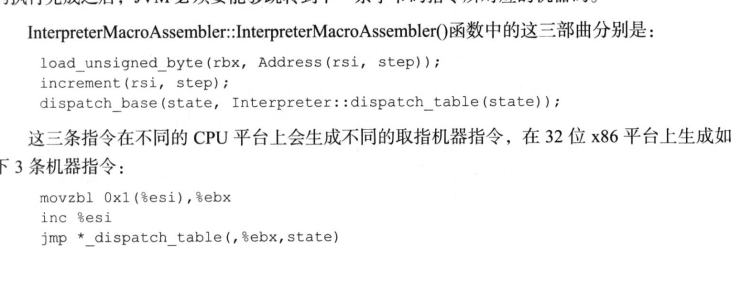
那么今天就结束了,下次再续
深入jvm虚拟机--第一篇 void TemplateInterpreterGenerator::generate_and_dispatch(Template* t, TosState tos_out) 函数的更多相关文章
- JVM学习第一篇思考:一个Java代码是怎么运行起来的-上篇
JVM学习第一篇思考:一个Java代码是怎么运行起来的-上篇 作为一个使用Java语言开发的程序员,我们都知道,要想运行Java程序至少需要安装JRE(安装JDK也没问题).我们也知道我们Java程序 ...
- SQL&EF优化第一篇 各种情况下的性能测试之count函数篇
测试环境 mssql 08 +win7 数据 30W条 二〇一六年十月二十九日 09:04:43 结论:1>主键> *>可空列 推测未论证: 根据情况优先选择 顺便提 ...
- JVM学习篇-第一篇
JVM学习篇-第一篇 JDK( Java Development Kit): Java程序设计语言.Java虚拟机.Java类库三部分统称为JDK,JDK是用于支持Java程序开发的最小环境** ...
- 深入理解Java虚拟机之JVM内存布局篇
内存布局**** JVM内存布局规定了Java在运行过程中内存申请.分配.管理的策略,保证了JVM的稳定高效运行.不同的JVM对于内存的划分方式和管理机制存在部分差异.结合JVM虚拟机规范,一起来 ...
- [转帖]java架构之路-(面试篇)JVM虚拟机面试大全
java架构之路-(面试篇)JVM虚拟机面试大全 https://www.cnblogs.com/cxiaocai/p/11634918.html 下文连接比较多啊,都是我过整理的博客,很多答案都 ...
- 【JVM第三篇--运行时数据区】程序计数器、虚拟机栈、本地方法栈
写在前面的话:本文是在观看尚硅谷JVM教程后,整理的学习笔记.其观看地址如下:尚硅谷2020最新版宋红康JVM教程 一.运行时数据区 我们在编写Java程序时,使用JVM的流程主要如下所示: 虚拟机在 ...
- 【JVM虚拟机】(9)-- JVM是如何处理异常的
[JVM虚拟机](9)-- JVM是如何处理异常的 上篇博客我们简单说过异常信息是存放在属性表集合中的Code属性表里,那么这篇博客就单独讲Code属性表中的exception_table. 在讲之前 ...
- 【JVM虚拟机】(8)--深入理解Class中--方法、属性表集合
#[JVM虚拟机](8)--深入理解Class中--方法.属性表集合 之前有关class文件已经写了两篇博客: 1.[JVM虚拟机](5)---深入理解JVM-Class中常量池 2.[JVM虚拟机] ...
- 【JVM虚拟机】(7)---深入理解Class中-属性集合
#[JVM虚拟机](7)---深入理解Class中-属性集合 之前有关class文件已经写了两篇博客: 1.[JVM虚拟机](5)---深入理解JVM-Class中常量池 2.[JVM虚拟机](6)- ...
随机推荐
- 【NX二次开发】属性操作总结
内容包括:1.属相创建2.判断属性是否存在3.读取属性值4.时间属性转换成字符串5.统计属性的数量6.删除指定属性7.删除全部属性 源码: 1 #include <stdlib.h> 2 ...
- 【Azure 机器人】微软Azure Bot 编辑器系列(2) : 机器人/用户提问回答模式,机器人从API获取响应并组织答案 (The Bot Framework Composer tutorials)
欢迎来到微软机器人编辑器使用教程,从这里开始,创建一个简单的机器人. 在该系列文章中,每一篇都将通过添加更多的功能来构建机器人.当完成教程中的全部内容后,你将成功的创建一个天气机器人(Weather ...
- SpringBoot 结合 Spring Cache 操作 Redis 实现数据缓存
系统环境: Redis 版本:5.0.7 SpringBoot 版本:2.2.2.RELEASE 参考地址: Redus 官方网址:https://redis.io/ 博文示例项目 Github 地址 ...
- 合宙Luat | 电源设计——模块应用必看的2个要点
在模块应用设计中,电源设计是很重要的一部分. 由于射频发射时,会在短时间有一个较大电流的突发脉冲.在突发脉冲阶段内,电源必须能够提供高的峰值电流,不然有可能会引起供电电压的跌落. 而很多初学的朋友 ...
- 08-ADMM算法
08-ADMM算法 目录 一.ADMM 算法动机 二.对偶问题 三.对偶上升法 四.对偶分割 五.乘子法(增广拉格朗日函数) 5.1 步长为 $\rho$ 的好处 六.ADMM算法 6.1 ADMM ...
- hdu5438 拓扑排序+DFS
解析 对一个有向无环图(Directed Acyclic Graph,简称DAG)G进行拓扑排序,是将G中所有顶点排成一个线性序列,使得图中任意一对顶点u和v,若<u,v> ∈E(G),则 ...
- Netty 框架学习 —— 预置的 ChannelHandler 和编解码器
Netty 为许多提供了许多预置的编解码器和处理器,几乎可以开箱即用,减少了在烦琐事务上话费的时间和精力 空闲的连接和超时 检测空闲连接以及超时对于释放资源来说至关重要,Netty 特地为它提供了几个 ...
- salesforce零基础学习(一百零四)Salesforce Optimizer
本篇参考: https://admin.salesforce.com/blog/2017/analyzing-org-salesforce-optimizer-webinar-recap 假设你在做一 ...
- 关于tinymce的一些记事
之前能看的懂一部分英文,但是总是没有全局观,以至于我之前使用tinymce一直都有一些疑问:那就是为什么我在tinymce初始化中添加了比如字体,字体大小等设置按钮,但是为什么在前 台没有办法现实出来 ...
- CSS经典布局——圣杯布局与双飞翼布局
一.圣杯布局和双飞翼布局的目的 实现三栏布局,中间一栏最先加载和渲染 两侧内容固定,中间内容随着宽度自适应 一般用于PC网 二.圣杯布局的实现 技术要点: 设置最小宽度min-width 使用floa ...