
A guide to analyzing Python performance
来源:http://www.huyng.com/posts/python-performance-analysis/
While it’s not always the case that every Python program you write will require a rigorous performance analysis, it is reassuring to know that there are a wide variety of tools in Python’s ecosystem that one can turn to when the time arises.
Analyzing a program’s performance boils down to answering 4 basic questions:
- How fast is it running?
- Where are the speed bottlenecks?
- How much memory is it using?
- Where is memory leaking?
Below, we’ll dive into the details of answering these questions using some awesome tools.
Coarse grain timing with time
Let’s begin by using a quick and dirty method of timing our code: the good old unix utility time.
$ time python yourprogram.py

real    0m1.028s

user    0m0.001s

sys     0m0.003s
The meaning between the three output measurements are detailed in thisstackoverflow article, but in short
- real - refers to the actual elasped time
- user - refers to the amount of cpu time spent outside of kernel
- sys - refers to the amount of cpu time spent inside kernel specific functions
You can get a sense of how many cpu cycles your program used up regardless of other programs running on the system by adding together the sys and user times.
If the sum of sys and user times is much less than real time, then you can guess that
most your program’s performance issues are most likely related to IO waits.
Fine grain timing with a timing context manager
Our next technique involves direct instrumentation of the code to get access to finer grain timing information. Here’s a small snippet I’ve found invaluable for making ad-hoc timing measurements:
timer.py
import time

class Timer(object):

    def __init__(self, verbose=False):

        self.verbose = verbose

    def __enter__(self):

        self.start = time.time()

        return self

    def __exit__(self, *args):

        self.end = time.time()

        self.secs = self.end - self.start

        self.msecs = self.secs * 1000  # millisecs

        if self.verbose:

            print 'elapsed time: %f ms' % self.msecs
In order to use it, wrap blocks of code that you want to time with Python’s withkeyword and this Timer context
manager. It will take care of starting the timer when your code block begins execution and stopping the timer when your code block ends.
Here’s an example use of the snippet:
from timer import Timer

from redis import Redis

rdb = Redis()

with Timer() as t:

    rdb.lpush("foo", "bar")

print "=> elasped lpush: %s s" % t.secs

with Timer() as t:

    rdb.lpop("foo")

print "=> elasped lpop: %s s" % t.secs
I’ll often log the outputs of these timers to a file in order to see how my program’s performance evolves over time.
Line-by-line timing and execution frequency with a profiler
Robert Kern has a nice project called line_profiler which I often use to see how fast and how often each line of code is running in my scripts.
To use it, you’ll need to install the python package via pip:
$ pip install line_profiler
Once installed you’ll have access to a new module called “line_profiler” as well as an executable script “kernprof.py”.
To use this tool, first modify your source code by decorating the function you want to measure with the @profile decorator. Don’t worry, you don’t have to import anyting
in order to use this decorator. The kernprof.py script automatically injects it into your script’s runtime during execution.
primes.py
@profile

def primes(n):

    if n==2:

        return [2]

    elif n<2:

        return []

    s=range(3,n+1,2)

    mroot = n ** 0.5

    half=(n+1)/2-1

    i=0

    m=3

    while m <= mroot:

        if s[i]:

            j=(m*m-3)/2

            s[j]=0

            while j<half:

                s[j]=0

                j+=m

        i=i+1

        m=2*i+3

    return [2]+[x for x in s if x]

primes(100)
Once you’ve gotten your code setup with the @profile decorator, usekernprof.py to
run your script.
$ kernprof.py -l -v fib.py
The -l option tells kernprof to inject the @profile decorator into your script’s
builtins, and -v tells kernprof to display timing information once you’re script finishes. Here’s one the output should look like for the above script:
Wrote profile results to primes.py.lprof

Timer unit: 1e-06 s

File: primes.py

Function: primes at line 2

Total time: 0.00019 s

Line #      Hits         Time  Per Hit   % Time  Line Contents

==============================================================

     2                                           @profile

     3                                           def primes(n):

     4         1            2      2.0      1.1      if n==2:

     5                                                   return [2]

     6         1            1      1.0      0.5      elif n<2:

     7                                                   return []

     8         1            4      4.0      2.1      s=range(3,n+1,2)

     9         1           10     10.0      5.3      mroot = n ** 0.5

    10         1            2      2.0      1.1      half=(n+1)/2-1

    11         1            1      1.0      0.5      i=0

    12         1            1      1.0      0.5      m=3

    13         5            7      1.4      3.7      while m <= mroot:

    14         4            4      1.0      2.1          if s[i]:

    15         3            4      1.3      2.1              j=(m*m-3)/2

    16         3            4      1.3      2.1              s[j]=0

    17        31           31      1.0     16.3              while j<half:

    18        28           28      1.0     14.7                  s[j]=0

    19        28           29      1.0     15.3                  j+=m

    20         4            4      1.0      2.1          i=i+1

    21         4            4      1.0      2.1          m=2*i+3

    22        50           54      1.1     28.4      return [2]+[x for x in s if x]
Look for lines with a high amount of hits or a high time interval. These are the areas where optimizations can yield the greatest improvements.
How much memory does it use?
Now that we have a good grasp on timing our code, let’s move on to figuring out how much memory our programs are using. Fortunately for us, Fabian Pedregosa has implemented a nice memory
profiler modeled after Robert Kern’s line_profiler.
First install it via pip:
$ pip install -U memory_profiler

$ pip install psutil
(Installing the psutil package here is recommended because it greatly improves the performance of the memory_profiler).
Like line_profiler, memory_profiler requires that you decorate your function of interest with an @profile decorator like so:
@profile

def primes(n):

    ...

    ...
To see how much memory your function uses run the following:
$ python -m memory_profiler primes.py
You should see output that looks like this once your program exits:
Filename: primes.py

Line #    Mem usage  Increment   Line Contents

==============================================

     2                           @profile

     3    7.9219 MB  0.0000 MB   def primes(n):

     4    7.9219 MB  0.0000 MB       if n==2:

     5                                   return [2]

     6    7.9219 MB  0.0000 MB       elif n<2:

     7                                   return []

     8    7.9219 MB  0.0000 MB       s=range(3,n+1,2)

     9    7.9258 MB  0.0039 MB       mroot = n ** 0.5

    10    7.9258 MB  0.0000 MB       half=(n+1)/2-1

    11    7.9258 MB  0.0000 MB       i=0

    12    7.9258 MB  0.0000 MB       m=3

    13    7.9297 MB  0.0039 MB       while m <= mroot:

    14    7.9297 MB  0.0000 MB           if s[i]:

    15    7.9297 MB  0.0000 MB               j=(m*m-3)/2

    16    7.9258 MB -0.0039 MB               s[j]=0

    17    7.9297 MB  0.0039 MB               while j<half:

    18    7.9297 MB  0.0000 MB                   s[j]=0

    19    7.9297 MB  0.0000 MB                   j+=m

    20    7.9297 MB  0.0000 MB           i=i+1

    21    7.9297 MB  0.0000 MB           m=2*i+3

    22    7.9297 MB  0.0000 MB       return [2]+[x for x in s if x]
IPython shortcuts for line_profiler and memory_profiler
A little known feature of line_profiler and memory_profiler is that both programs
have shortcut commands accessible from within IPython. All you have to do is type the following within an IPython session:
%load_ext memory_profiler

%load_ext line_profiler
Upon doing so you’ll have access to the magic commands %lprun and %mprunwhich behave
similarly to their command-line counterparts. The major difference here is that you won’t need to decorate your to-be-profiled functions with the@profile decorator. Just
go ahead and run the profiling directly within your IPython session like so:
In [1]: from primes import primes

In [2]: %mprun -f primes primes(1000)

In [3]: %lprun -f primes primes(1000)
This can save you a lot of time and effort since none of your source code needs to be modified in order to use these profiling commands.
Where’s the memory leak?
The cPython interpreter uses reference counting as it’s main method of keeping track of memory. This means that every object contains a counter, which is incremented when a reference to the object is stored somewhere, and decremented when a reference to it
is deleted. When the counter reaches zero, the cPython interpreter knows that the object is no longer in use so it deletes the object and deallocates the occupied memory.
A memory leak can often occur in your program if references to objects are held even though the object is no longer in use.
The quickest way to find these “memory leaks” is to use an awesome tool calledobjgraph written by Marius Gedminas. This tool allows you to see the number of objects in memory and also locate
all the different places in your code that hold references to these objects.
To get started, first install objgraph:
pip install objgraph
Once you have this tool installed, insert into your code a statement to invoke the debugger:
import pdb; pdb.set_trace()
Which objects are the most common?
At run time, you can inspect the top 20 most prevalent objects in your program by running:
(pdb) import objgraph

(pdb) objgraph.show_most_common_types()

MyBigFatObject             20000

tuple                      16938

function                   4310

dict                       2790

wrapper_descriptor         1181

builtin_function_or_method 934

weakref                    764

list                       634

method_descriptor          507

getset_descriptor          451

type                       439
Which objects have been added or deleted?
We can also see which objects have been added or deleted between two points in time:
(pdb) import objgraph

(pdb) objgraph.show_growth()

.

.

.

(pdb) objgraph.show_growth()   # this only shows objects that has been added or deleted since last show_growth() call

traceback                4        +2

KeyboardInterrupt        1        +1

frame                   24        +1

list                   667        +1

tuple                16969        +1
What is referencing this leaky object?
Continuing down this route, we can also see where references to any given object is being held. Let’s take as an example the simple program below:
x = [1]

y = [x, [x], {"a":x}]

import pdb; pdb.set_trace()
To see what is holding a reference to the variable x, run theobjgraph.show_backref() function:
(pdb) import objgraph

(pdb) objgraph.show_backref([x], filename="/tmp/backrefs.png")
The output of that command should be a PNG image stored at/tmp/backrefs.png and it should look something like this:
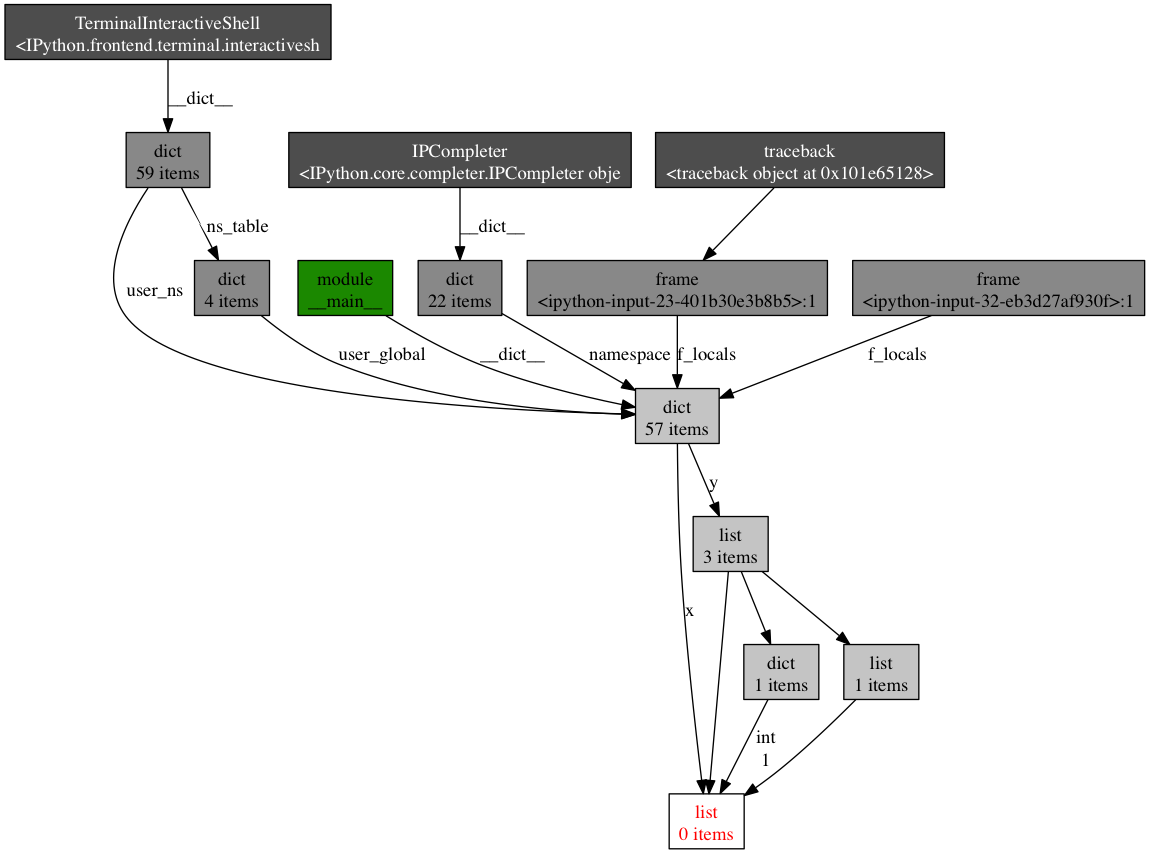
The box at the bottom with red lettering is our object of interest. We can see that it’s referenced by the symbol x once and by the list y three
times. If x is the object causing a memory leak, we can use this method to see why it’s not automatically being deallocated by tracking down all of its references.
So to review, objgraph allows us to:
- show the top N objects occupying our python program’s memory
- show what objects have been deleted or added over a period of time
- show all references to a given object in our script
Effort vs precision
In this post, I’ve shown you how to use several tools to analyze a python program’s performance. Armed with these tools and techniques you should have all the information required to track down most memory leaks as well as identify speed bottlenecks in a Python
program.
As with many other topics, running a performance analysis means balancing the tradeoffs between effort and precision. When in doubt, implement the simplest solution that will suit your current needs.
Refrences
will send out interesting links on twitter so follow me if you like this kind stuff.
Related Posts
A guide to analyzing Python performance的更多相关文章
- Android 性能优化(25)*性能工具之「Systrace」Analyzing UI Performance with Systrace:用Systrace得到ui性能报告
Analyzing UI Performance with Systrace In this document Overview 简介 Generating a Trace 生成Systrace文件 ...
- Analyzing UI Performance with Systrace 使用systrace工具分析ui性能
While developing your application, you should check that user interactions are buttery smooth, runni ...
- Analyzing Storage Performance using the Windows Performance Analysis ToolKit (WPT)
https://blogs.technet.microsoft.com/robertsmith/2012/02/07/analyzing-storage-performance-using-the-w ...
- 转帖:Python应用性能分析指南
原文:A guide to analyzing Python performance While it’s not always the case that every Python program ...
- [Python]程序性能分析
有些脚本发现比预期要慢的多,就需要找到瓶颈,然后做相应的优化,参考A guide to analyzing Python performance,也可以说是翻译. 指标 运行时间 时间瓶颈 内存使用 ...
- Python学习资料下载地址(转)
[转]Python学习资料和教程pdf 开发工具: Python语言集成开发环境 Wingware WingIDE Professional v3.2.12 Python语言集成开发环境 Wingwa ...
- python面试大全
问题一:以下的代码的输出将是什么? 说出你的答案并解释. class Parent(object): x = 1 class Child1(Parent): pass class Child2(Par ...
- [转]Python学习资料和教程pdf
开发工具: Python语言集成开发环境 Wingware WingIDE Professional v3.2.12 Python语言集成开发环境 Wingware WingIDE Professio ...
- python公司面试题集锦 python面试题大全
问题一:以下的代码的输出将是什么? 说出你的答案并解释. class Parent(object): x = 1 class Child1(Parent): pass class Child2(Par ...
随机推荐
- Sublime Theme
Package Control Messages======================== Theme - Spacegray----------------- Thanks for insta ...
- hexo 使用教程
hexo 使用教程 这个早就用起来了,写给需要的小伙伴 mayufo.github.io 先扔出自己的地址 安装 想玩hexo,需要安装以下应用 git node 安装完成在终端输入 $ npm in ...
- yoman搭建你的react-webpack应用
还没有npm和node的要提前做好准备工作 做好这一切之后 我们安装yo,记住安装在全局变量中,我们需要用他的命令工具 npm install -g yo 接下来安装yo提供的react-webpac ...
- svn上检出的项目在myeclipse中报错的解决
项目本身应该是没问题的,应该是验证方面导致的错误的报错,取消验证即可:右键项目,如下操作: 除此之外,还应考虑是否环境问题引起的报错,比如:项目jar包是否发布,jdk的版本,tomcat的版本,等等
- bye 2013 hello 2014
最近两个月除了必要的工作外,其余时间都在干一些我其实平时很少干的事, 喝酒.唱歌.打麻将.玩牌.以及到处跑找朋友玩,也许是过年的原因我放纵了自己,也许是自己心中的烦恼.我的博客记录着我每次看书学习的笔 ...
- android之ScrollView里嵌套ListView(转)
hi,大家好,研究完ScrollView嵌套ScrollView之后,本人突然又想研究ScrollView里嵌套ListView了. 如果还不知道ScrollView嵌套ScrollView是怎么实现 ...
- redis实践一些要注意的事项
不要放垃圾数据,及时清理无用数据实验性的数据和下线的业务数据及时删除; key尽量都设置过期时间对具有时效性的key设置过期时间,通过redis自身的过期key清理策略来降低过期key对于内存的占用, ...
- Xilinx下载方式(具体可以参考配置MCS文件时右下角help调出的doc)
1.两者都属高速并行配置模式.SelectMAP是早期的FPGA两类配置模式之一,是相对于串行(Serial)配置而言的,与主串(Master Serial)和从串(Slave Serial)模式对应 ...
- Sql常用语法总结
SQL分类: DDL—数据定义语言(CREATE,ALTER,DROP,DECLARE) DML—数据操纵语言(SELECT,DELETE,UPDATE,INSERT) DCL—数据控制语言(GRAN ...
- 分布式计算中WebService的替代方案: RPC (XML-RPC | JSON-RPC)
XML-RPC http://zh.wikipedia.org/wiki/XML-RPC XML-RPC是一个远程过程调用(远端程序呼叫)(remote procedure call,RPC)的分布式 ...