
JdkDynamicAopProxy与CglibAopProxy介绍
继续上一篇的介绍
1、上一篇分析到createAopProxy方法,创建Aop代理对象
	protected final synchronized AopProxy createAopProxy() {

		if (!this.active) {

			activate();

		}

		return getAopProxyFactory().createAopProxy(this);

	}
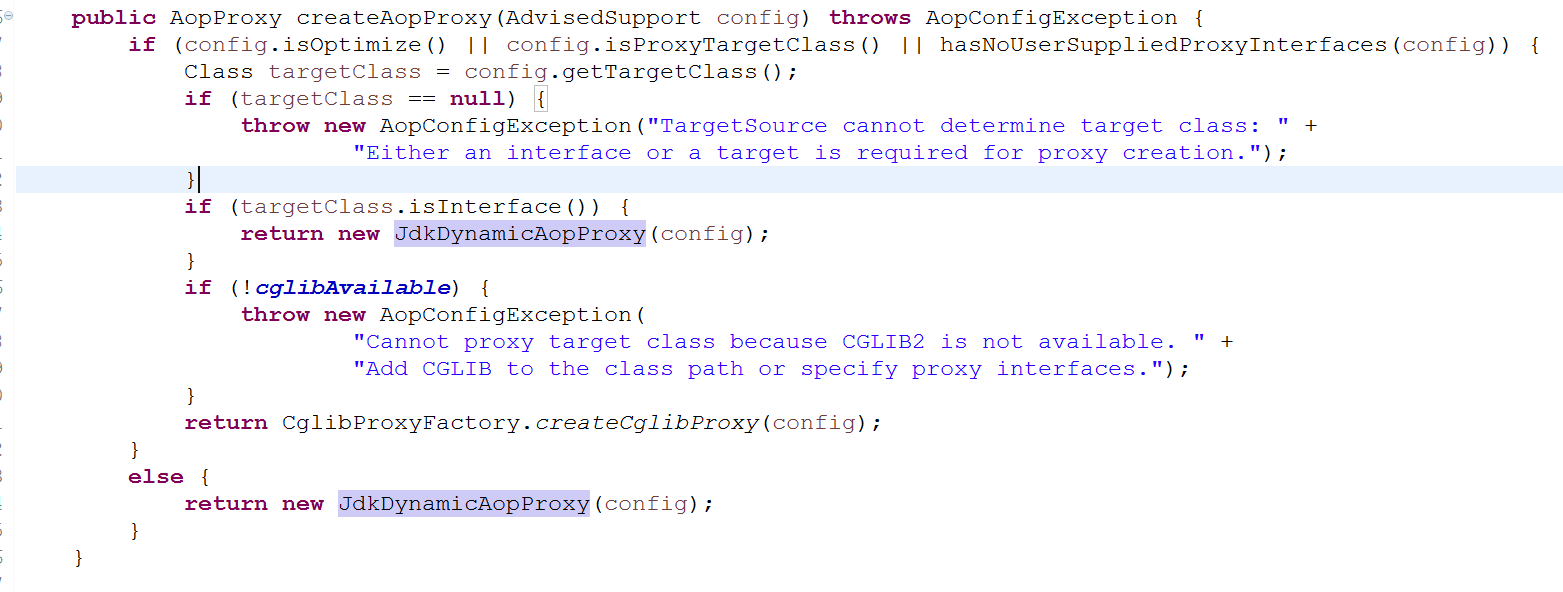
2、进入DefaultAopProxyFactory类的createAopProxy方法
3、创建代理对象后,进入getProxy方法
this.singletonInstance = getProxy(createAopProxy());
	protected Object getProxy(AopProxy aopProxy) {

		return aopProxy.getProxy(this.proxyClassLoader);

	}
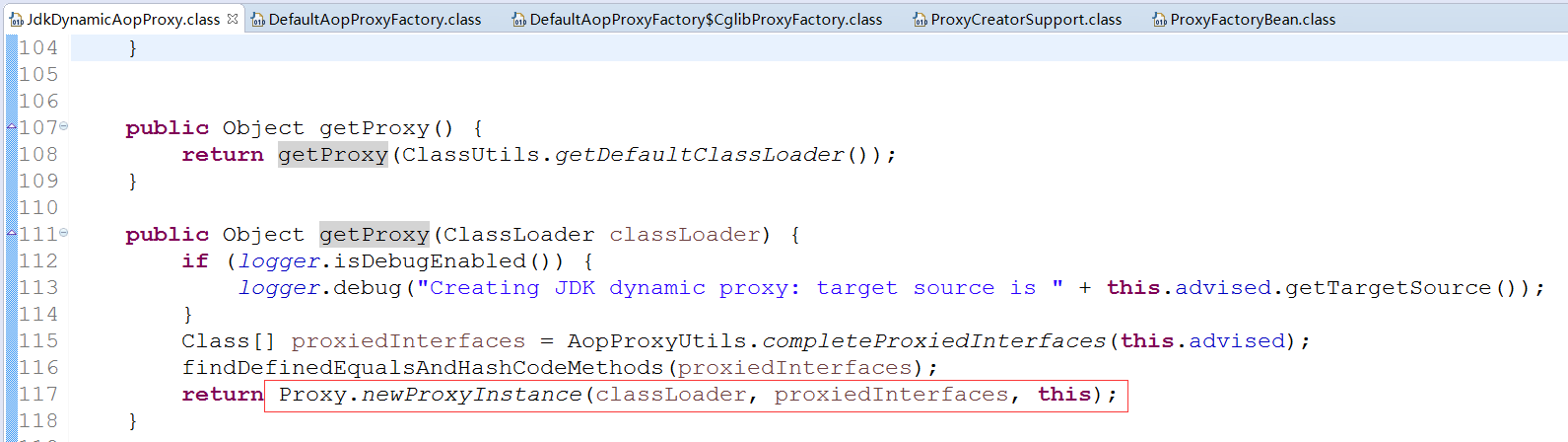
分别进入对应的JdkDynamicAopProxy与CglibAopProxy的getProxy方法
JdkDynamicAopProxy类对应的getProxy方法如下图:
JdkDynamicAopProxy中的invoke方法
public Object invoke(Object proxy, Method method, Object[] args) throws Throwable {

		MethodInvocation invocation;

		Object oldProxy = null;

		boolean setProxyContext = false;

		TargetSource targetSource = this.advised.targetSource;

		Class targetClass = null;

		Object target = null;

		try {

			if (!this.equalsDefined && AopUtils.isEqualsMethod(method)) {

				// The target does not implement the equals(Object) method itself.

				return equals(args[0]);

			}

			if (!this.hashCodeDefined && AopUtils.isHashCodeMethod(method)) {

				// The target does not implement the hashCode() method itself.

				return hashCode();

			}

			if (!this.advised.opaque && method.getDeclaringClass().isInterface() &&

					method.getDeclaringClass().isAssignableFrom(Advised.class)) {

				// Service invocations on ProxyConfig with the proxy config...

				return AopUtils.invokeJoinpointUsingReflection(this.advised, method, args);

			}

			Object retVal;

			if (this.advised.exposeProxy) {

				// Make invocation available if necessary.

				oldProxy = AopContext.setCurrentProxy(proxy);

				setProxyContext = true;

			}

			// May be null. Get as late as possible to minimize the time we "own" the target,

			// in case it comes from a pool.

			target = targetSource.getTarget();

			if (target != null) {

				targetClass = target.getClass();

			}

			// Get the interception chain for this method.

			List<Object> chain = this.advised.getInterceptorsAndDynamicInterceptionAdvice(method, targetClass);

			// Check whether we have any advice. If we don't, we can fallback on direct

			// reflective invocation of the target, and avoid creating a MethodInvocation.

			if (chain.isEmpty()) {

				// We can skip creating a MethodInvocation: just invoke the target directly

				// Note that the final invoker must be an InvokerInterceptor so we know it does

				// nothing but a reflective operation on the target, and no hot swapping or fancy proxying.

				retVal = AopUtils.invokeJoinpointUsingReflection(target, method, args);

			}

			else {

				// We need to create a method invocation...

				invocation = new ReflectiveMethodInvocation(proxy, target, method, args, targetClass, chain);

				// Proceed to the joinpoint through the interceptor chain.

				retVal = invocation.proceed();

			}

			// Massage return value if necessary.

			if (retVal != null && retVal == target && method.getReturnType().isInstance(proxy) &&

					!RawTargetAccess.class.isAssignableFrom(method.getDeclaringClass())) {

				// Special case: it returned "this" and the return type of the method

				// is type-compatible. Note that we can't help if the target sets

				// a reference to itself in another returned object.

				retVal = proxy;

			}

			return retVal;

		}

		finally {

			if (target != null && !targetSource.isStatic()) {

				// Must have come from TargetSource.

				targetSource.releaseTarget(target);

			}

			if (setProxyContext) {

				// Restore old proxy.

				AopContext.setCurrentProxy(oldProxy);

			}

		}

	}
4、CglibAopProxy的getProxy方法
	public Object getProxy(ClassLoader classLoader) {

		if (logger.isDebugEnabled()) {

			logger.debug("Creating CGLIB2 proxy: target source is " + this.advised.getTargetSource());

		}

		try {

			Class rootClass = this.advised.getTargetClass();

			Assert.state(rootClass != null, "Target class must be available for creating a CGLIB proxy");

			Class proxySuperClass = rootClass;

			if (ClassUtils.isCglibProxyClass(rootClass)) {

				proxySuperClass = rootClass.getSuperclass();

				Class[] additionalInterfaces = rootClass.getInterfaces();

				for (Class additionalInterface : additionalInterfaces) {

					this.advised.addInterface(additionalInterface);

				}

			}

			// Validate the class, writing log messages as necessary.

			validateClassIfNecessary(proxySuperClass);

			// Configure CGLIB Enhancer...

			Enhancer enhancer = createEnhancer();

			if (classLoader != null) {

				enhancer.setClassLoader(classLoader);

				if (classLoader instanceof SmartClassLoader &&

						((SmartClassLoader) classLoader).isClassReloadable(proxySuperClass)) {

					enhancer.setUseCache(false);

				}

			}

			enhancer.setSuperclass(proxySuperClass);

			enhancer.setStrategy(new UndeclaredThrowableStrategy(UndeclaredThrowableException.class));

			enhancer.setInterfaces(AopProxyUtils.completeProxiedInterfaces(this.advised));

			enhancer.setInterceptDuringConstruction(false);

			Callback[] callbacks = getCallbacks(rootClass);

			enhancer.setCallbacks(callbacks);

			enhancer.setCallbackFilter(new ProxyCallbackFilter(

					this.advised.getConfigurationOnlyCopy(), this.fixedInterceptorMap, this.fixedInterceptorOffset));

			Class[] types = new Class[callbacks.length];

			for (int x = 0; x < types.length; x++) {

				types[x] = callbacks[x].getClass();

			}

			enhancer.setCallbackTypes(types);

			// Generate the proxy class and create a proxy instance.

			Object proxy;

			if (this.constructorArgs != null) {

				proxy = enhancer.create(this.constructorArgTypes, this.constructorArgs);

			}

			else {

				proxy = enhancer.create();

			}

			return proxy;

		}

		catch (CodeGenerationException ex) {

			throw new AopConfigException("Could not generate CGLIB subclass of class [" +

					this.advised.getTargetClass() + "]: " +

					"Common causes of this problem include using a final class or a non-visible class",

					ex);

		}

		catch (IllegalArgumentException ex) {

			throw new AopConfigException("Could not generate CGLIB subclass of class [" +

					this.advised.getTargetClass() + "]: " +

					"Common causes of this problem include using a final class or a non-visible class",

					ex);

		}

		catch (Exception ex) {

			// TargetSource.getTarget() failed

			throw new AopConfigException("Unexpected AOP exception", ex);

		}

	}
JdkDynamicAopProxy与CglibAopProxy介绍的更多相关文章
- Spring AOP高级——源码实现(3)AopProxy代理对象之JDK动态代理的创建过程
spring-aop-4.3.7.RELEASE 在<Spring AOP高级——源码实现(1)动态代理技术>中介绍了两种动态代理技术,当然在Spring AOP中代理对象的生成也是运用 ...
- 转 分享我在阿里工作十年接触过Java框架设计模式
转 原文: 分享我在阿里工作十年接触过Java框架设计模式 一.前言 说起来设计模式,大家应该都耳熟能详,设计模式代表了软件设计的最佳实践,是经过不断总结提炼出来的代码设计经验的分类总结,这些模式或者 ...
- spring---aop(4)---Spring AOP的CGLIB动态代理
写在前面 前面介绍了Spring AOP的JDK动态代理的过程,这一篇文章就要介绍下Spring AOP的Cglib代理过程. CGLib全称为Code Generation Library,是一个强 ...
- Spring Aop技术原理分析
本篇文章从Aop xml元素的解析开始,分析了Aop在Spring中所使用到的技术.包括Aop各元素在容器中的表示方式.Aop自动代理的技术.代理对象的生成及Aop拦截链的调用等等.将这些技术串联起来 ...
- spring---aop(2)---Spring AOP的JDK动态代理
写在前面 spring 事务是springAOP 的一个实现.我们以分析spring的事务,来分析spring的AOP实现. 基本知识 如果目标方法被spring的事务声明,则执行该目标方法的对象就会 ...
- Spring里的aop实现方式和源码分析
使用"横切"技术,AOP把软件系统分为两个部分:核心关注点和横切关注点.业务处理的主要流程是核心关注点,与之关系不大的部分是横切关注点.横切关注点的一个特点是,他们经常发生在核心关 ...
- spring源码解析之AOP原理
一.准备工作 在这里我先简单记录下如何实现一个aop: AOP:[动态代理] 指在程序运行期间动态的将某段代码切入到指定方法指定位置进行运行的编程方式: 1.导入aop模块:Spring AOP:(s ...
- spring源码系列8:AOP源码解析之代理的创建
回顾 首先回顾: JDK动态代理与CGLIB动态代理 Spring中的InstantiationAwareBeanPostProcessor和BeanPostProcessor的区别 我们得知 JDK ...
- Spring AOP 源码分析
一.准备工作 在这里我先简单记录下如何实现一个aop: AOP:[动态代理] 指在程序运行期间动态的将某段代码切入到指定方法指定位置进行运行的编程方式: 1.导入aop模块:Spring AOP: ...
随机推荐
- js获取任意一天的0点和23:59:59时间
最近写代码时,需要获取任意一天的起始和结束时间,0点和23:59:59这两个时间的时间戳 使用了setHours() 方法 setHours() 方法用于设置指定的时间的小时字段 1. 获取当天开始时 ...
- Web开发基础知识
综述 最近开始Java Web方面的工作,千里之行始于足下,我们在开发过程中要善于总结自己遇到的问题.善于管理一些优秀的代码片段.本文的主要内容是Web开发的基础知识,对于大牛来说可以忽略,对于初入W ...
- Oracle SQL函数-NLSSORT
Syntax 用途: NLSSORT返回字符值char的排序规则键和显式或隐式指定的排序规则.排序规则键是一个用于根据指定的排序规则对char进行排序的字节字符串.排序规则键的属性是:按二进制比较由给 ...
- 常用的PHP字符串操作函数
1.strlen 但是要注意!如果字符串中是汉字等其他字符时候呢? $str = "我"; echo strlen($str); //一个汉字,在UTF8格式下,显示3, ANSI ...
- Linux CentOs下安装lnmp
1.下载源码包 以root目录为例: cd ~ # 下载安装包 wget http://nginx.org/download/nginx-1.17.2.tar.gz # nginx wget http ...
- 洛谷 P1032 字串变换题解
题目链接:https://www.luogu.org/problem/P1032 题目描述 已知有两个字串A,BA,B及一组字串变换的规则(至多66个规则): A_1A1 ->B_1B1 A ...
- Centos7-Gnome安装
查看grouplist yum grouplist 安装gnome yum groupinstall "GNOME Desktop" root用户权限下,设置centos系统默认的 ...
- PS——使用切片工具切出透明图片
前言 最近有点烦,不说话~ 步骤 首先要保证您的格式为PSD且底色为透明 参考线 标出参考线,方便后面划分 切图 保存 效果
- SparkSQL读写外部数据源--数据分区
import com.twq.dataset.Utils._ import org.apache.spark.sql.{SaveMode, SparkSession} object FileParti ...
- Java 第12次作业--你的生日
题目:计算自己的出生日期距今天多少天,再将自己的出生日期利用SimpleDateFormat类设定的格式输出显示. 代码: import java.util.*; import java.text.* ...