
BST 解析 (二)height and deletion
前面一章介绍了BST的结构和一些简单的基本功能,例如:insert,findMin,nextLarger等等。这一节主要讲解一些BST的delete node操作还有BST的height的分析以及一些潜在的问题。即本节主要包括以下2个部分;
1,Analysis of deletion
2,Tree height analysis
一:Node deletion
delete node的过程是需要依靠前一章的知识,需要了解nextLarger的过程和含义。然后在此基础之上,我们可以将删除node分为以下几类:
1)node是BST的leaf,即left child和right child 都为NULL;
2)node含有left subtree,但是没有right subtree;
3) node 含有right subtree, 但是没有left subtree;
4) node 含有right subtree和left subtree;
那么这4中情况下,如何删除相应的node,有什么规定需要遵守呢?如何删除的呢?下面2图分别展示了如何在上面的4中情况下删除相应的node
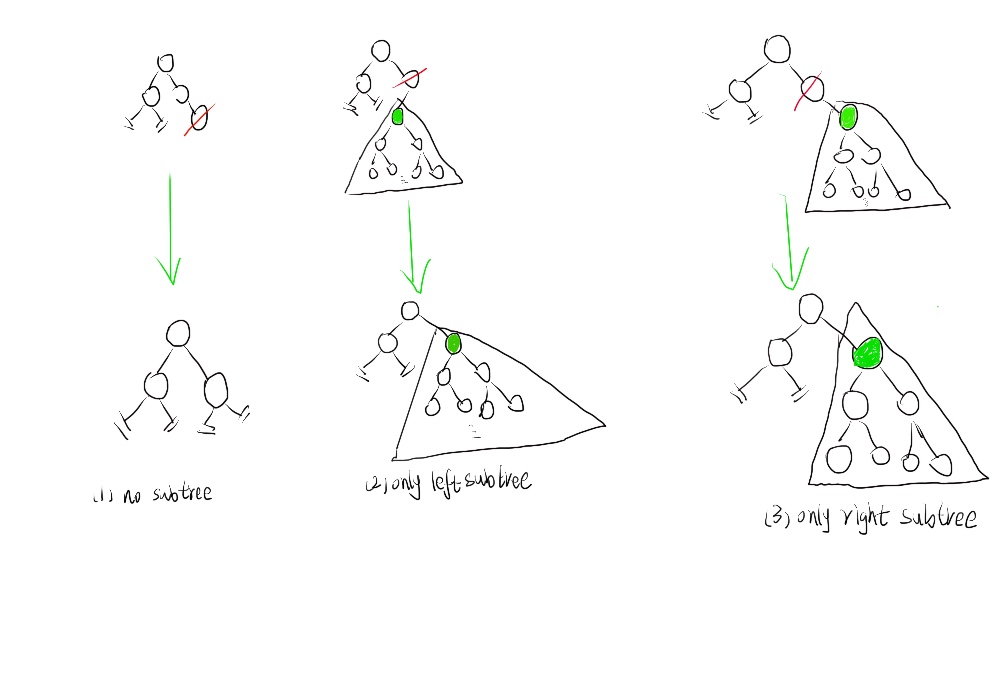

前三种的情况都比较简单,可以直观的了解。第四中情况,即node包含左右2个subtree的时候,情况就比较复杂了,我在这把流程解释一遍。当node包含左右2个subtree的时候,首先第一步是找到这个node的nextLarger,第二步copy nextLarger的key到node,第三步删除这个nextLarger node。至此删除node的操作结束。其具体的实现代码如下:(每个人的实现过程可能都不一样,仅供参考学习交流)
/*

 *Description: search the node's parent node

 *

 *parameters:

 1. key //the value which we want to find within the BST

 2. node//the node which we want to find out who is its parent node

 *

 *return Node

 *

 */

Node *BST::searchParent(int key, Node *node){

    if (this->root == NULL) {//the BST has not initialzed yet

        return NULL;

    }else{

        if (node==NULL) {//we have found all the nodes, but no one matches, which means it is not within the BST

            return NULL;

        }else if (key == node->getRight()->getKey()||key == node->getLeft()->getKey()) {//we spot on the key, return the node

            return node;

        }else if (key < node->getKey()){//the key is smaller than the node, so it is must be in the left subtree.

            return searchParent(key, node->getLeft());

        }else{// the key is bigger than the node, so it is must be in the right subtree.

            return searchParent(key, node->getRight());

        }

    }

}

/*

 *Description: delete a node from BST

 *

 *

 *parameter:

 *          1: key//the key that you want to delete

 *

 *          2:node //the node that we need to delete

 *return void

 *

 */

void BST::deleteNode(int key, Node *node){

    Node *parentNode;

    if (node != this->root) {//node is not the root of the BST

        parentNode = searchParent(node->getKey(), this->root);

    }else{//the node is the root of BST

        parentNode = NULL;

    }

    if (node->getLeft() == nullptr && node->getRight() == nullptr) {//The node has not got any leaf

        if (parentNode->getKey()>node->getKey()) {

            parentNode->setLeft(NULL);

        }else{

            parentNode->setRight(NULL);

        }

        delete(node);

        node = NULL;

    }else if (node->getRight() == nullptr){//has left tree

        if (parentNode->getKey()>node->getKey()) {

            parentNode->setLeft(node->getLeft());

        }else{

            parentNode->setRight(node->getLeft());

        }

        delete node;

        node= NULL;

    }else if(node->getLeft() == nullptr){//has right tree

        if (parentNode->getKey()>node->getKey()) {

            parentNode->setLeft(node->getRight());

        }else{

            parentNode->setRight(node->getRight());

        }

        delete node;

        node = NULL;

    }else{//has two subtrees

        Node *nextLargerNode = findNextLarger(node);

        int keyValue = nextLargerNode->getKey();

        deleteNode(nextLargerNode->getKey(),nextLargerNode);

        node->setKey(keyValue);

    }

}
二:BST height 分析
根据前面几节的分析,BST 的insert, nextLarger,search,delete的running time = O (h). 那么具体这个h是多少呢?它跟node 的数量有什么关系呢?根据现在所掌握的知识,一个随机任意的BST的h跟node的数量并没有具体的函数关系,但是我们至少可以知道h的范围是多少,即lgN<=h<=N。其原因如下图所示:
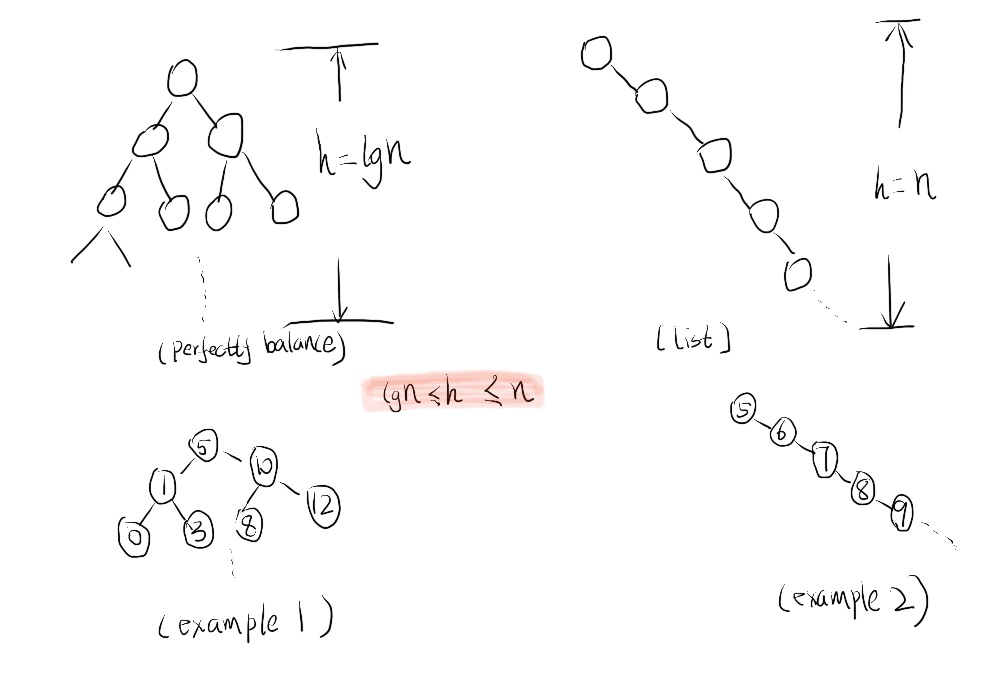
根据上图的实例和分析,我们可以很清晰的分辨出h的范围,所以对于一个不加处理随机的BST,它的时间复杂度是:O(lgN)<=running time<=O(N); 很显然我们只希望要lgN, 而不是线性的N; 因为如果是O(N)的话,BST的有些操作甚至效果不过Heap. 上图左边的视图是一个perfectly balanced的BST,它的时间复杂度是O(lgN),这正式我们想要的。上面的右图则是一个完全不平衡的BST,其时间复杂度=O(N),这种情况是我们应该避免的。 所以接下来的问题就是如何判断一个BST是不是平衡的, 如果不是平衡的,我们应该如何将不平衡的BST转化成平衡的BST。那么下一节我将介绍BST的rotation,平衡和AVL Tree。谢谢
BST 解析 (二)height and deletion的更多相关文章
- java二维码之利用谷歌的zxing生成二维码,解析二维码
生成二维码 @RequestMapping("/123") public void test(HttpServletRequest request,HttpServletRespo ...
- ZXing 生成、解析二维码图片的小示例
概述 ZXing 是一个开源 Java 类库用于解析多种格式的 1D/2D 条形码.目标是能够对QR编码.Data Matrix.UPC的1D条形码进行解码. 其提供了多种平台下的客户端包括:J2ME ...
- Java生成、解析二维码
今天遇到需求,使用Java生成二维码图片,网搜之后,大神们早就做过,个人总结一下. 目标:借助Google提供的ZXing Core工具包,使用Java语言实现二维码的生成和解析. 步骤如下: 1.m ...
- (转)ZXing解析二维码
1 ZXing解析二维码 上一篇文件已经说过如何用ZXing进行生成二维码和带图片的二维码,下面说下如何解析二维码 二维码的解析和生成类似,也可以参考google的一个操作类 BufferedImag ...
- BST 解析 (一)
这篇博文主要初步介绍Binary Search Tree(BST)的一些基本功能以及应用场景,由于BST的相关知识比较多,下一节会接着补充BST的一些功能.这一节主要分为以下三个要素: BST 的定义 ...
- JAVA中生成、解析二维码图片的方法
JAVA中生成.解析二维码的方法并不复杂,使用google的zxing包就可以实现.下面的方法包含了生成二维码.在中间附加logo.添加文字功能,并有解析二维码的方法. 一.下载zxing的架包,并导 ...
- 使用zxing生成解析二维码
1. 前言 随着移动互联网的发展,我们经常在火车票.汽车票.快餐店.电影院.团购网站以及移动支付等各个场景下见到二维码的应用,可见二维码以经渗透到人们生活的各个方面.条码.二维码以及RFID被人们应用 ...
- java生成/解析二维码
package a; import java.awt.BasicStroke; import java.awt.Graphics; import java.awt.Graphics2D; import ...
- .net Core 调用微信Jsapi接口,H5解析二维码
项目里需要用到扫描二维码,自己实现,不会. 找到了两种解决方案: 通过reqrcode.js,这是一个前端解析二维码内容的js库.如果二维码比较清晰,用这种效果也不错 调用微信扫一扫功能,这种效果很好 ...
- APS.NET MVC4生成解析二维码简单Demo
一.视图 @{ Layout = null; } <!DOCTYPE html> <html> <head> <meta name="viewpor ...
随机推荐
- C++点滴20130802
1.sprintf与printf,fprintf为三兄弟.其中printf输出到屏幕,fprintf输出到文件,而sprintf输出到字符串中.通常情况下,屏幕是可以输出的,文件也可以写的(除非磁盘满 ...
- (七)php运算符
一:算数运算符 +(加).-(减).*(成)./(除) %(取模,求余的意思) <?php $a=7/3; echo $a; //2.3333333333333.因为float类型的最大精度为1 ...
- Ajax.Nodejs.跨域访问
使用环境: 客户端: jQuery 服务器: Node.js 在通过Ajax调用非本域的链接/接口时, 一般是不能成功的, 就算是同一个IP下不同的端口也被认作跨域访问 解决办法记录如下: 客户端: ...
- 【20171028早】ubuntu 16.04 LTS 安装php遇到的问题
背景: 10月28日的一个早上,老黑一如往常地练习,我测试不破坏,当时我找到sqli-libs 游戏,可是我没有立即开始,于是,奇妙的事情就由php开始了.ubuntu16.04安装相关环境 apac ...
- web 开发中的路由是什么意思
路由: 就是一个路径的解析,根据客户端提交的路径,将请求解析到相应的控制器上 从 URL 找到处理这个 URL 的类和函数
- PHP开发框架之YII框架学习——碾压ThinkPHP不是梦
前 言 JRedu 程序猿是一种慵懒的生物!能少敲一行代码,绝对不会多敲一个字符!所以,越来越多的开发框架应运而生,在帮助我们完成功能的同时,极大程度上也帮我们节省了人力物力,而且也提高了系统的 ...
- web service实例
一.准备工作(以下为本实例使用工具) 1.MyEclipse10.7.1 2.JDK 1.6.0_22 二.创建服务端 1.创建[Web Service Project],命名为[TheService ...
- win10 安装Node.js 报错:2503
解决方法: 使用管理员打开CMD
- mybatis 分页问题 (个人认为算是个bug)
问题描述:相同的查寻条件, 分页显示的结果和.net版本的分页结果数量一样,排序不一样, 不同的页有相同的数据.比如:第2面和第3页都有同一条相同的数据. 核心代码: //自己实现 int total ...
- 【唯星宠物】——CSS/BootStrap/Jquery爬坑之响应式首页
前言:唯星宠物产品官网,分为首页.子页和登录注册页三个页面,除网页内容设计与图片素材的部分使用网上的材料之外,其余内容呈现以及功能模块全部为自己重构. 一.响应式轮播banner 思路:使用BootS ...