
LogisticRegression in MLLib
例子
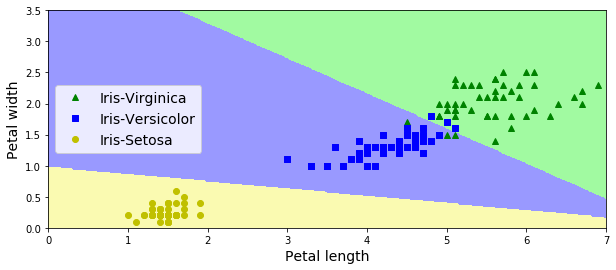
iris数据训练Logistic模型。特征petal width和petal height,分类目标有三类。
import org.apache.spark.mllib.classification.LogisticRegressionWithLBFGS

import org.apache.spark.mllib.evaluation.MulticlassMetrics

import org.apache.spark.mllib.linalg.Vectors

import org.apache.spark.mllib.regression.LabeledPoint

import org.apache.spark.rdd.RDD

import org.apache.spark.sql.SparkSession

object Test1 extends App {

  val spark = SparkSession

    .builder

    .appName("StructuredNetworkWordCountWindowed")

    .master("local[3]")

    .config("spark.sql.shuffle.partitions", 3)

    .config("spark.sql.autoBroadcastJoinThreshold", 1)

    .getOrCreate()

  spark.sparkContext.setLogLevel("INFO")

  val sc = spark.sparkContext

  val data: RDD[LabeledPoint] = sc.textFile("iris.txt").map { line =>

    val linesp = line.split("\\s+")

    LabeledPoint(linesp(2).toInt, Vectors.dense(linesp(0).toDouble, linesp(1).toDouble))

  }

  // Split data into training (60%) and test (40%).

  val splits = data.randomSplit(Array(0.6, 0.4), seed = 11L)

  val training = splits(0).cache()

  val test = splits(1)

  // Run training algorithm to build the model

  val model = new LogisticRegressionWithLBFGS()

    .setIntercept(true)

    .setNumClasses(3)

    .run(training)

  // Compute raw scores on the test set.

  val predictionAndLabels = test.map { case LabeledPoint(label, features) =>

    val prediction = model.predict(features)

    (prediction, label)

  }

  // Get evaluation metrics.

  val metrics = new MulticlassMetrics(predictionAndLabels)

  val accuracy = metrics.accuracy

  println(s"Accuracy = $accuracy")

}
训练结果
Accuracy = 0.9516129032258065

model : org.apache.spark.mllib.classification.LogisticRegressionModel: intercept = 0.0, numFeatures = 6, numClasses = 3, threshold = 0.5

weights = [10.806033250918638,59.0125055499883,-74.5967318848371,15.249528477342315,72.68333443959429,-119.02776352645247]
模型将特征空间划分结果(画图代码参见 http://www.cnblogs.com/luweiseu/p/7826679.html):
ML LogisticRegress算法
算法流程在:
org.apache.spark.ml.classification.LogisticRegression

protected[org.apache.spark] def train(dataset: Dataset[_],

                                      handlePersistence: Boolean): LogisticRegressionModel
主要算法在:
val costFun = new LogisticCostFun(instances, numClasses, $(fitIntercept),

          $(standardization), bcFeaturesStd, regParamL2, multinomial = isMultinomial,

          $(aggregationDepth))
LogisticCostFun 实现了Breeze's DiffFunction[T]函数,计算multinomial (softmax) logistic loss
function, as used in multi-class classification (it is also used in binary logistic regression).
It returns the loss and gradient with L2 regularization at a particular point (coefficients).
该函数分布式计算参数梯度矩阵和损失
val logisticAggregator = {

      // 每个训练数据instance参与计算梯度矩阵

      val seqOp = (c: LogisticAggregator, instance: Instance) => c.add(instance)

      // 各个partition的aggregator merge

      val combOp = (c1: LogisticAggregator, c2: LogisticAggregator) => c1.merge(c2)

      // spark聚合调用

      instances.treeAggregate(

        new LogisticAggregator(bcCoeffs, bcFeaturesStd, numClasses, fitIntercept,

          multinomial)

      )(seqOp, combOp, aggregationDepth)

    }
Breeze凸优化:
LogisticCostFun 作为Breeze的凸优化模块(例如LBFGSB)的参数,计算最优的参数结果:
val states = optimizer.iterations(new CachedDiffFunction(costFun),

          new BDV[Double](initialCoefWithInterceptMatrix.toArray))
LogisticCostFun 梯度计算(LogisticAggregator)
该模块包含了LogisticRegression训练多类分类器时迭代(online)的逻辑。
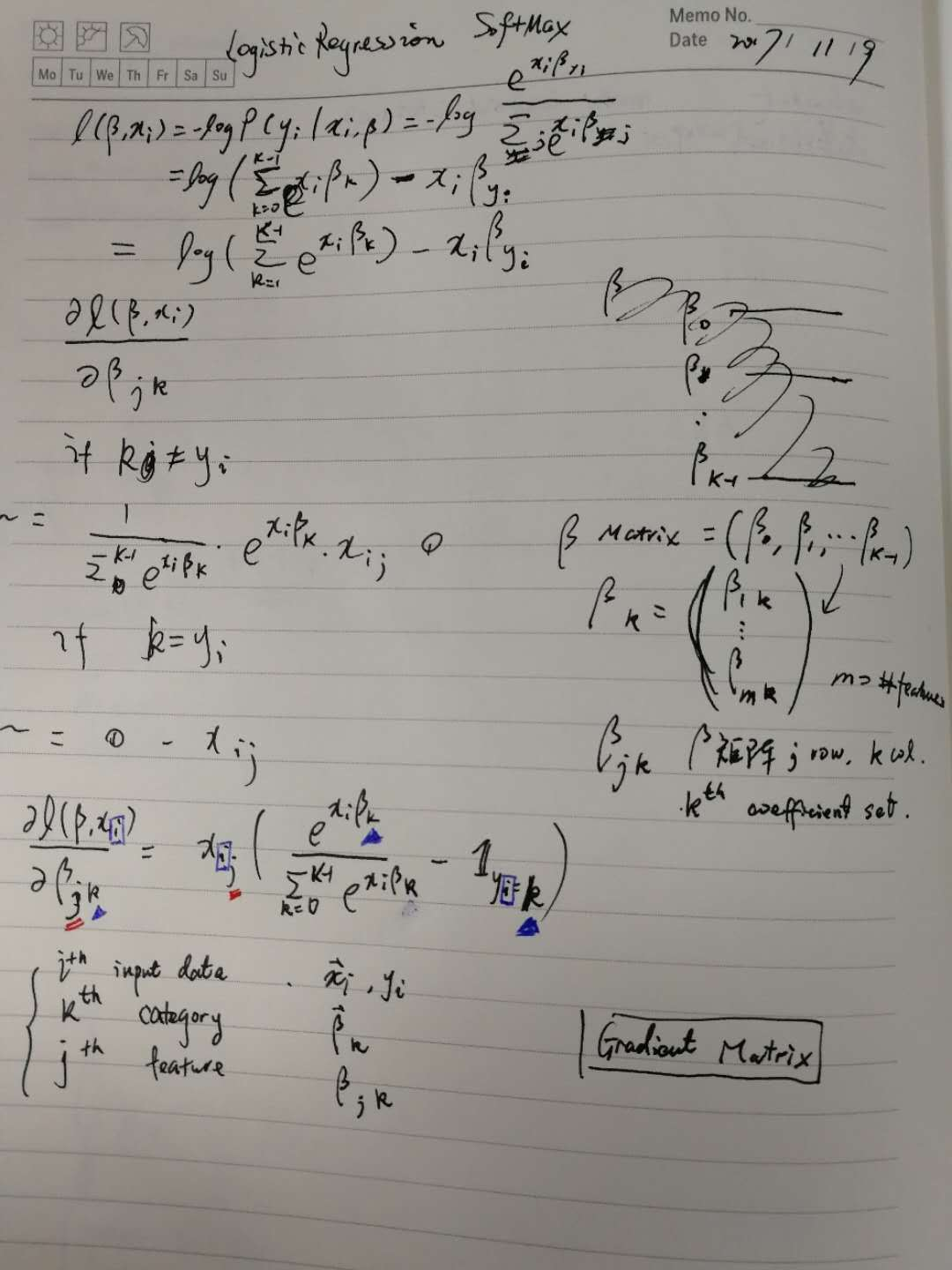
主要逻辑是给定一个训练样本\(x_i\),计算该样本对梯度矩阵中各个元素\(\beta_{j,k}\)的贡献。
LogisticAggregator computes the gradient and loss for binary or multinomial logistic (softmax)
loss function, as used in classification for instances in sparse or dense vector in an online
fashion.
Two LogisticAggregators can be merged together to have a summary of loss and gradient of
the corresponding joint dataset.
For improving the convergence rate during the optimization process and also to prevent against
features with very large variances exerting an overly large influence during model training,
packages like R's GLMNET perform the scaling to unit variance and remove the mean in order to
reduce the condition number. The model is then trained in this scaled space, but returns the
coefficients in the original scale. See page 9 in
http://cran.r-project.org/web/packages/glmnet/glmnet.pdf
However, we don't want to apply the [[org.apache.spark.ml.feature.StandardScaler]] on the
training dataset, and then cache the standardized dataset since it will create a lot of overhead.
As a result, we perform the scaling implicitly when we compute the objective function (though
we do not subtract the mean).
Note that there is a difference between multinomial (softmax) and binary loss. The binary case
uses one outcome class as a "pivot" and regresses the other class against the pivot. In the
multinomial case, the softmax loss function is used to model each class probability
independently. Using softmax loss produces K sets of coefficients, while using a pivot class
produces K - 1 sets of coefficients (a single coefficient vector in the binary case). In the
binary case, we can say that the coefficients are shared between the positive and negative
classes. When regularization is applied, multinomial (softmax) loss will produce a result
different from binary loss since the positive and negative don't share the coefficients while the
binary regression shares the coefficients between positive and negative.
The following is a mathematical derivation for the multinomial (softmax) loss.
The probability of the multinomial outcome \(y\) taking on any of the K possible outcomes is:
e^{\vec{x}_i^T \vec{\beta}_k}} \\
P(y_i=1|\vec{x}_i, \beta) = \frac{e^{\vec{x}_i^T \vec{\beta}_1}}{\sum_{k=0}^{K-1}
e^{\vec{x}_i^T \vec{\beta}_k}}\\
P(y_i=K-1|\vec{x}_i, \beta) = \frac{e^{\vec{x}_i^T \vec{\beta}_{K-1}}\,}{\sum_{k=0}^{K-1}
e^{\vec{x}_i^T \vec{\beta}_k}}
\]
The model coefficients \(\beta = (\beta_0, \beta_1, \beta_2, ..., \beta_{K-1})\) become a matrix
which has dimension of \(K \times (N+1)\) if the intercepts are added. If the intercepts are not
added, the dimension will be \(K \times N\).
Note that the coefficients in the model above lack identifiability. That is, any constant scalar
can be added to all of the coefficients and the probabilities remain the same.
\frac{e^{\vec{x}_i^T \left(\vec{\beta}_0 + \vec{c}\right)}}{\sum_{k=0}^{K-1}
e^{\vec{x}_i^T \left(\vec{\beta}_k + \vec{c}\right)}}
= \frac{e^{\vec{x}_i^T \vec{\beta}_0}e^{\vec{x}_i^T \vec{c}}\,}{e^{\vec{x}_i^T \vec{c}}
\sum_{k=0}^{K-1} e^{\vec{x}_i^T \vec{\beta}_k}}
= \frac{e^{\vec{x}_i^T \vec{\beta}_0}}{\sum_{k=0}^{K-1} e^{\vec{x}_i^T \vec{\beta}_k}}
\end{align}
\]
However, when regularization is added to the loss function, the coefficients are indeed
identifiable because there is only one set of coefficients which minimizes the regularization
term. When no regularization is applied, we choose the coefficients with the minimum L2
penalty for consistency and reproducibility. For further discussion see:
Friedman, et al. "Regularization Paths for Generalized Linear Models via Coordinate Descent"
The loss of objective function for a single instance of data (we do not include the
regularization term here for simplicity) can be written as
\ell\left(\beta, x_i\right) &= -log{P\left(y_i \middle| \vec{x}_i, \beta\right)} \\
&= log\left(\sum_{k=0}^{K-1}e^{\vec{x}_i^T \vec{\beta}_k}\right) - \vec{x}_i^T \vec{\beta}_y\\
&= log\left(\sum_{k=0}^{K-1} e^{margins_k}\right) - margins_y
\end{align}
\]
where \({margins}_k = \vec{x}_i^T \vec{\beta}_k\).
For optimization, we have to calculate the first derivative of the loss function, and a simple
calculation shows that
\frac{\partial \ell(\beta, \vec{x}_i, w_i)}{\partial \beta_{j, k}}
&= x_{i,j} \cdot w_i \cdot \left(\frac{e^{\vec{x}_i \cdot \vec{\beta}_k}}{\sum_{k'=0}^{K-1}
e^{\vec{x}_i \cdot \vec{\beta}_{k'}}\,} - I_{y=k}\right) \\
&= x_{i, j} \cdot w_i \cdot multiplier_k
\end{align}
\]
where \(w_i\) is the sample weight, \(I_{y=k}\) is an indicator function
1 & y = k \\
0 & else
\end{cases}
\]
and
e^{\vec{x}_i \cdot \vec{\beta}_k}} - I_{y=k}\right)
\]
If any of margins is larger than 709.78, the numerical computation of multiplier and loss
function will suffer from arithmetic overflow. This issue occurs when there are outliers in
data which are far away from the hyperplane, and this will cause the failing of training once
infinity is introduced. Note that this is only a concern when max(margins) > 0.
Fortunately, when max(margins) = maxMargin > 0, the loss function and the multiplier can
easily be rewritten into the following equivalent numerically stable formula.
margins_{y} + maxMargin
\]
Note that each term, \((margins_k - maxMargin)\) in the exponential is no greater than zero; as a
result, overflow will not happen with this formula.
For \(multiplier\), a similar trick can be applied as the following,
e^{\vec{x}_i \cdot \vec{\beta}_{k'} - maxMargin}} - I_{y=k}\right)
\]
@param bcCoefficients The broadcast coefficients corresponding to the features.

@param bcFeaturesStd The broadcast standard deviation values of the features.

@param numClasses the number of possible outcomes for k classes classification problem in

Multinomial Logistic Regression.

@param fitIntercept Whether to fit an intercept term.

@param multinomial Whether to use multinomial (softmax) or binary loss

@note In order to avoid unnecessary computation during calculation of the gradient updates

we lay out the coefficients in column major order during training. This allows us to

perform feature standardization once, while still retaining sequential memory access

for speed. We convert back to row major order when we create the model,

since this form is optimal for the matrix operations used for prediction.
LogisticRegression in MLLib的更多相关文章
- LogisticRegression in MLLib (PySpark + numpy+matplotlib可视化)
参考'LogisticRegression in MLLib' (http://www.cnblogs.com/luweiseu/p/7809521.html) 通过pySpark MLlib训练lo ...
- Spark Mllib框架1
1. 概述 1.1 功能 MLlib是Spark的机器学习(machine learing)库,其目标是使得机器学习的使用更加方便和简单,其具有如下功能: ML算法:常用的学习算法,包括分类.回归.聚 ...
- spark MLlib Classification and regression 学习
二分类:SVMs,logistic regression,decision trees,random forests,gradient-boosted trees,naive Bayes 多分类: ...
- Spark MLlib 机器学习
本章导读 机器学习(machine learning, ML)是一门涉及概率论.统计学.逼近论.凸分析.算法复杂度理论等多领域的交叉学科.ML专注于研究计算机模拟或实现人类的学习行为,以获取新知识.新 ...
- Spark的MLlib和ML库的区别
机器学习库(MLlib)指南 MLlib是Spark的机器学习(ML)库.其目标是使实际的机器学习可扩展和容易.在高层次上,它提供了如下工具: ML算法:通用学习算法,如分类,回归,聚类和协同过滤 特 ...
- Spark中ml和mllib的区别
转载自:https://vimsky.com/article/3403.html Spark中ml和mllib的主要区别和联系如下: ml和mllib都是Spark中的机器学习库,目前常用的机器学习功 ...
- spark mllib和ml类里面的区别
mllib是老的api,里面的模型都是基于RDD的,模型使用的时候api也是有变化的(model这里是naiveBayes), (1:在模型训练的时候是naiveBayes.run(data: RDD ...
- Spark MLlib框架详解
1. 概述 1.1 功能 MLlib是Spark的机器学习(machine learing)库,其目标是使得机器学习的使用更加方便和简单,其具有如下功能: ML算法:常用的学习算法,包括分类.回归.聚 ...
- Spark之MLlib
目录 Part VI. Advanced Analytics and Machine Learning Advanced Analytics and Machine Learning Overview ...
随机推荐
- 最详细的Axure动态面板使用教程
1.打开[Axure]软件,在index文件上新建一个375*667大小的背景矩形并绘制页面. 具体如图所示. 2.在banner的位置上新建一个[动态面板],双击动态面板在其中新建state1.st ...
- linux内socket服务器无法连接windows
今天在试socket的时候出现了一个问题:问题概述是这样的: 1.linux采用centOS7(mini)版本,虚拟机版本VMware12,网卡设置NAT 2.服务器和客户端都在windows上,通讯 ...
- 微信小程序bug
2017-11-21 微信movable-view有bug,它不能在style里面设置z-index,一旦设置了,不是层间的元素就会有干扰,比如我移动0层的movable-view,但是1层的mova ...
- Python 语法糖装饰器的应用
Python中的装饰器是你进入Python大门的一道坎,不管你跨不跨过去它都在那里. 为什么需要装饰器 我们假设你的程序实现了say_hello()和say_goodbye()两个函数. def sa ...
- Peter的烟(水题测试2017082401&洛谷1150)
题目链接:Peter的烟 这道题基本做法很水,不解释. #include<bits/stdc++.h> using namespace std; int main(){ int n,k; ...
- linux_配置三台虚拟机免密登录
在node01上面直接生成公钥和私钥 ssh-keygen --> 四下回车 ll -a 进行查看,发现出现.ssh文件即已经生成 将此node01的公钥拷贝到第二台机器上 ssh-copy-i ...
- kbmmw 中JSON 中使用SQL 查询
前面讲到了kbmmw 的JSON 对象操作,如何快速的查找JSON 中的值? 一种办法就是通过遍历的方法,其实在kbmmw 还有一种灵活的查询方式, 就是通过SQL 方式查询JSON 中的值.也就是说 ...
- JSON转JS对象,JS对象转JSON
一.从服务端发来的json字符串,怎么才能作为JavaScript对象(JSON对象)在web端调用呢? 1.如果使用jQuery,就很方便了,可以在ajax一系列函数中,把参数Datatype传js ...
- ac自动机板子
hdu2222 #include<bits/stdc++.h> #define ll long long #define M 500005 using namespace std; int ...
- vetur插件提示 [vue-language-server] Elements in iteration expect to have 'v-bind:key' directives
错误如下图所示: 错误提示: [vue-language-server] Elements in iteration expect to have 'v-bind:key' directives.Re ...