
管道/FIFO
管道:
 #include<stdio.h>

 #include<unistd.h>

 #include<stdlib.h>

 #include<string.h>

 #include<wait.h>

 /*管道没有名字,只能用于有亲缘关系的进程间通信*/

 typedef struct stu

 {

     int id;

     char name[];

 }Stu;

 int main()

 {

     int pfd[];

     int ret=pipe(pfd);//创建管道(管道只能在父进程中创建)

     if(ret<)

         perror("pipe");//判断是否创建成功

     int pid=fork();//创建子进程

     if (pid<)

         perror("fork");

     else if(pid>)//父进程写文件

     {

         close(pfd[]);//关闭读文件描述符

         Stu s[];

         int i;

         for(i=;i<;i++)

         {

             printf("id=");

             scanf("%d",&s[i].id);getchar();

             printf("name=");

             scanf("%s",s[i].name);getchar();

         }

             write(pfd[],s,*sizeof(Stu));//写文件,放入s数组

             printf("id\tname\n");

         close(pfd[]);//关闭写文件

         waitpid(pid,NULL,);//等待子进程结束

         return ;

     }

     else if(pid==)//子进程读文件

     {

         close(pfd[]);//关闭写文件标识符

         int i;

         Stu s2[];

         while()

         {

             ret=read(pfd[],s2,*sizeof(Stu));//读取文件放入s2数组

             if(ret<)//判断读取是否成功

             {

                 perror("read");

             }

             if(ret==)//判断是否读取完毕

             {

                 printf("read over\n");

                 exit();

             }

             else//输出读取文件

             {

                 for(i=;i<;i++)

                 printf("%d\t%s\n",s2[i].id,s2[i].name);

                 i++;

             }

         }

         close(pfd[]);//关闭读文件

         return ;

     }

 }
运行结果:
id=1001    //---------------------------输入(写文件)

name=aaa

id=

name=bbb

id=

name=ccc

id=

name=ddd

id=

name=eee//---------------------------输出(读文件)

id    name

    aaa

    bbb

    ccc

    ddd

    eee

read over
FIFO(有名管道):
代码1:写文件程序
#include <sys/types.h>

#include <sys/stat.h>

#include <stdio.h>

#include <stdlib.h>

#include <errno.h>

#include <unistd.h>

#include <fcntl.h>

#include <string.h>

#include <signal.h>

typedef struct stu

{

    int id;

    char name[];

}Stu;

void fun(int sig)

{

    printf("中断..\n");

    return;

}

int main()

{

    int fd;

    int ret;

    char buf[];

    signal(SIGPIPE,fun);//给一个已经关闭的终端发送信息会产生13信号

    //创建管道

    ret = mkfifo("file_f",);

    if(ret<)

    {

        if(errno != EEXIST)//判断创建是否出错(除去已经创建错误)

        {

            perror("mkfifo");

            return -;

        }

    }

    printf("mkfifo success.\n");

    //打开管道

    printf("open ..\n");

    fd = open("file_f",O_WRONLY);//只写方式打开

    printf("open fd = %d\n",fd);

    if(fd<)

    {

        printf("open error.\n");

    }

    //写操作

    Stu s[];int i;

    //while(1)

    printf("input the len\n");//输入创建多少个数据

    int len;

    scanf("%d",&len);

    for(i=;i<len;i++)

    {

        printf("id=");

        scanf("%d",&s[i].id);getchar();

        printf("name=");

        scanf("%s",s[i].name);getchar();

    }

        ret = write(fd,s,len*sizeof(struct stu) );//写入到数组中

        if(ret<)

        {

            printf("write error.\n");

            goto END;

        }

    printf("write success.\n");

END:

    close(fd);

    return ;

}
代码2:读文件程序:
#include <sys/types.h>

#include <sys/stat.h>

#include <stdio.h>

#include <stdlib.h>

#include <errno.h>

#include <unistd.h>

#include <fcntl.h>

typedef struct stu

{

    int id;

    char name[];

}Stu;

int main()

{

    int fd;

    int ret;

    //创建

    ret = mkfifo("file_f",);

    if(ret<)

    {

        if(errno!=)

        {

            perror("mkfifo");

            return -;

        }

    }

    printf("mkfifo success.\n");

    //打开管道

    printf("open ..\n");

    fd = open("file_f",O_RDONLY);

    printf("open fd = %d\n",fd);

    if(fd<)

    {

        printf("open error.\n");

    }

    printf("id\tname\n");

    printf("in put the len\n");

    int len;

    scanf("%d",&len);//输入要读取几个数据

    Stu s[];int i;

        ret = read(fd,s,sizeof(Stu)*len);

    for(i=;i<len;i++)

    {

        if(ret<)

        {

            printf("read error.\n");

            goto END;

        }

        if(ret == )

        {

            printf("pipe broken.\n");

            goto END;

        }

        if(s[i].id==)// 一旦数据读取完毕就退出

        {

            goto END;

        }

        printf("%d\t%s\n",s[i].id,s[i].name);//打印读取到的数据

    }

END:

    printf("read success\n");

    close(fd);

    return ;

}
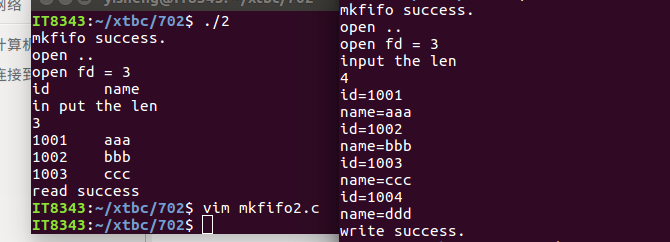
运行结果:右边输入,左边输出
另一种FIFO(边读边写)
代码1:
 #include <sys/types.h>

 #include <sys/stat.h>

 #include <stdio.h>

 #include <stdlib.h>

 #include <errno.h>

 #include <unistd.h>

 #include <fcntl.h>

 #include <string.h>

 #include <signal.h>

 void fun(int sig)

 {

     printf("中断..\n");

     return;

 }

 int main()

 {

     int fd;

     int ret;

     char buf[];

     signal(SIGPIPE,fun);

     //创建

     ret = mkfifo("file_f",);

     if(ret<)

     {

         if(errno != EEXIST)

         {

             perror("mkfifo");

             return -;

         }

     }

     printf("mkfifo success.\n");

     //打开管道

     printf("open ..\n");

     fd = open("file_f",O_WRONLY);

     printf("open fd = %d\n",fd);

     if(fd<)

     {

         printf("open error.\n");

     }

     //写操作

     while()

     {

         fgets(buf,,stdin);//输入

         ret = write(fd,buf,strlen(buf)+ );

         if(ret<)

         {

             printf("write error.\n");

             goto END;

         }

     }

     printf("write success.\n");

 END:

     close(fd);

     return ;

 }
代码2:
 #include <sys/types.h>

 #include <sys/stat.h>

 #include <stdio.h>

 #include <stdlib.h>

 #include <errno.h>

 #include <unistd.h>

 #include <fcntl.h>

 int main()

 {

     int fd;

     int ret;

     char buf[];

     //创建

     ret = mkfifo("file_f",);

     if(ret<)

     {

         if(errno != EEXIST)

         {

             perror("mkfifo");

             return -;

         }

     }

     printf("mkfifo success.\n");

     //打开管道

     printf("open ..\n");

     fd = open("file_f",O_RDONLY);

     printf("open fd = %d\n",fd);

     if(fd<)

     {

         printf("open error.\n");

     }

     while()

     {

         ret = read(fd,buf,);//读取输出

         if(ret<)

         {

             printf("read error.\n");

             goto END;

         }

         if(ret == )

         {

             printf("pipe broken.\n");

             goto END;

         }

         printf("read buf:%s\n",buf);

     }

 END:

     close(fd);

     return ;

 }
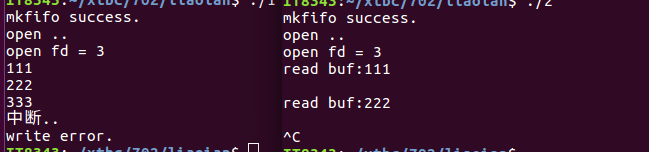
输出结果:
管道/FIFO的更多相关文章
- Linux学习笔记25——命名管道(FIFO)
1 命名管道(FIFO) 管道应用的一个重大缺陷就是没有名字,因此只能用于亲缘进程之间的通信.后来从管道为基础提出命名管道(named pipe,FIFO)的概念,该限制得到了克服.FIFO不同于管道 ...
- 进程间通信系列 之 命名管道FIFO及其应用实例
进程间通信系列 之 概述与对比 http://blog.csdn.net/younger_china/article/details/15808685 进程间通信系列 之 共享内存及其实例 ...
- Linux进程间通信之管道(pipe)、命名管道(FIFO)与信号(Signal)
整理自网络 Unix IPC包括:管道(pipe).命名管道(FIFO)与信号(Signal) 管道(pipe) 管道可用于具有亲缘关系进程间的通信,有名管道克服了管道没有名字的限制,因此,除具有管道 ...
- 进程间通信___命名管道(FIFO)
命名管道(FIFO) 基本概念 命名管道和一般的管道基本相同,但也有一些显著的不同: 命名管道是在文件系统中作为一个特殊的设备文件而存在的. 不同祖先的进程之间可以通过管道共享数据. 当共享管道的进程 ...
- 命名管道FIFO
首先我得检讨一下自己,这几天有些颓呀,打不起精神,板子出了点问题,果真自学还是很困难呀,硬件方面难解决呀,理想与现实还是很有差距的,伤透了,凌乱了. 一直在理解进程间通信的问题.发现上次忽略了一个问题 ...
- linux有名管道fifo,进程间通信
命名管道(FIFO)不同于无名管道之处在于它提供了一个路径名与之关联,以 FIFO 的文件形式存在于文件系统中,这样,即使与 FIFO 的创建进程不存在亲缘关系的进程,只要可以访问该路径,就能够彼此通 ...
- 进程间通信IPC-命名管道FIFO
FIFO又被称为命名管道,未命名的管道只能在两个相关的进程之间使用,而这两个相关的进程还要有一个共同创建了它们的祖先进程,但是FIFO,不相关的进程之间也能交换数据. FIFO是一种文件类型.通过st ...
- 有名管道FIFO
管道和FIFO的特征之一是它们的数据是一个字节流.这是UNIX的原生I/O模型.进程往其中写入的是字节流,系统不对它作解释. FIFO不存数据,只是通过它找到内核文件. 一.建立有名管道 1.命令mk ...
- 命名管道FIFO和mkfifo函数
进程间通信必须通过内核提供的通道,而且必须有一种办法在进程中标识内核提供的某个通道,前面讲过的匿名管道是用打开的文件描述符来标识的.如果要互相通信的几个进程没有从公共祖先那里继承文件描述符,它们怎么通 ...
随机推荐
- C#移除URL上指定的参数
/// <summary> /// 移除URL上指定的参数,不区分参数大小写 /// </summary> public static ...
- ES6学习笔记(函数)
1.函数参数的默认值 ES6 允许为函数的参数设置默认值,即直接写在参数定义的后面. function log(x, y = 'World') { console.log(x, y); } log(' ...
- Python人工智能第二篇
Python人工智能之路 - 第二篇 : 现成的技术 预备资料: 1.FFmpeg: 链接:https://pan.baidu.com/s/1jonSAa_TG2XuaJEy3iTmHg 密码:w ...
- c#: TextBox添加水印效果(PlaceHolderText)
基于他人代码修改,不闪,以做备忘. 与SendMessage EM_SETCUEBANNER消息相比,它能改变字体绘制颜色,EM_SETCUEBANNER只限定了DimGray颜色,太深 //与Sen ...
- Win10系统,开机后提示Desktp不可用的故障解决方法。
WIN10桌面位置不可用的故障解决方法 今天电脑开机 (Win10系统).桌面空了,然后就蒙了. 系统并弹出以下框,如下图: 原因可能是因为昨天晚上熬夜测试脚本.网上下载的脚本大多都是有毒的.但是人懒 ...
- ORACLE设置用户密码不过期
1.查看用户的 profile 是哪个,一般是 default SELECT USERNAME, PROFILE FROM dba_users; 2.查看指定概要文件(这里是1中对应的profile) ...
- scrapy Mongodb 储存
pipelines.py # -*- coding: utf-8 -*- # Define your item pipelines here # # Don't forget to add your ...
- 《笨方法学Python》加分题35
sys.exit 用于结束程序 from sys import exit # 进入黄金房间后的逻辑 def gold_room(): print("This room is full of ...
- U-Mail企业邮箱如何导入授权文件
首先,由于U-Mail有Linux版本与Windows版本的区别,并且都非常简单,所以就有了下面的步骤: Windows版本 <点击快速跳转> Linux版本 <点击快速跳转> ...
- pd16.5增加字段备注
EXEC sp_addextendedproperty 'MS_Description', %.q:COLNNAME%, 'user', dbo, 'table', %TABLE%, 'column' ...