
python六剑客:map()、lambda()、filter()、reduce()、推导类表、切片
一:map():映射
map()有两个参数,一个函数,一个序列,序列中每一个元素都会做为参数传给前边的函数,然后生成新的列表,
第二个参数必须用一个序列:元祖,列表,字符串
>>> map(str,[1,2,3,4])
['1', '2', '3', '4']
也可以自己定义函数
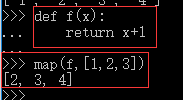
搭配lambda函数
>>> map(lambda x:x.upper(),"abc")
['A', 'B', 'C']
map()函数搭配lambda传多个参数
例子:2个list,[1,2,3][4,5,6],合并为[(1, 4), (2, 5), (3, 6)]
>>> a=[1,2,3]
>>> b=[4,5,6]
>>> map(lambda x,y:(x,y),a,b)
[(1, 4), (2, 5), (3, 6)]
map()传多个参数(序列)时,每次取元素进行map时,是在每个序列的相同位置取值,
然后作为一个元祖传给参数前边的函数的,所以用这个原理,把函数设置None,也可以生成题中的结果,由此也能看到map函数在取值时的逻辑
>>> map(None,list1,list2)
[(1, 4), (2, 5), (3, 6)]
或者用zip()函数也可以
>>> zip(a,b)
[(1, 4), (2, 5), (3, 6)]
二:lambda匿名函数
lambda语句被用来创建新的函数对象,并且在运行时返回它们。
Python使用lambda关键字来创建匿名函数。这种函数得名于省略了用def声明函数的标准步骤。
lambda只是一个表达式,函数体比def简单很多
lambda的主体是一个表达式,而不是一个代码块。仅仅能在lambda表达式中封装有限的逻辑进去。
#如下边例子,x,y,z相当于匿名函数中的参数,x+y+z是函数体,匿名函数的定义赋值给了a,a就是一个函数,可以用a()来调用这个函数
>>> a=lambda x,y,z:x+y+z
>>> a(1,2,3)
6
三:filter()
filter和map的区别是,filter保留函数返回为true的值,不返回的不显示
map是保留返回的结果,无论返回的是啥,filter会把不满足true条件的结果忽略掉
例子:删除字符串中的小写字母
#encoding=utf-8
def delete_lowercase(s):
if s>='a' and s<='z':
return ""
else:
return s
print map(delete_lowercase,"AABBaabb")
print "".join(map(delete_lowercase,"AABBaabb"))
结果:
D:\>python test.py
['A', 'A', 'B', 'B', '', '', '', '']
AABB
保留数字中大于5的位
#-*-coding:utf-8-
def func(n):
if int(n)>5:
return n
print filter(func,"123467")
#只要return的是True,就会保留
结果:
D:\>python test.py
67
或者一行搞定
>>> filter(lambda x:int(x)>=5,"12345678")
'5678'
filter()根据参数中的序列,返回相同形式的序列,列表返回列表,字符串返回字符串
或者一行搞定
>>> filter(lambda x:int(x)>=5,"12345678")
'5678'
>>> filter(lambda x:int(x)>=5,list("12345678"))
['5', '6', '7', '8']
>>> filter(lambda x:int(x)>=5,"12345678")
'5678'
>>> filter(lambda x:int(x)>=5,tuple("12345678"))
('5', '6', '7', '8')
>>> tuple("12345678")
('1', '2', '3', '4', '5', '6', '7', '8')
四:推导列表
>>> [i for i in range(10)]
[0, 1, 2, 3, 4, 5, 6, 7, 8, 9]
相当于把for循环中每次循环得到的数作为一个列表的一个元素,知道所有循环执行结束
各个元素生成的过程相当于以下两句得到的:
for i in range(10):
print i
>>> [i for i in range(10) if i !=5]
[0, 1, 2, 3, 4, 6, 7, 8, 9]
练习:a=[[1,2,3],[4,5,6]]用推导列表生成[[1, 4], [2, 5], [3, 6]]
[[j[i] for j in a] for i in range(3)]
结果:
[[1, 4], [2, 5], [3, 6]]
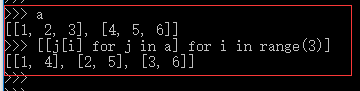
以上推导列表过程转换成for循环:最外层的for也对应转换成for循环的最外层
>>> for i in range(3):
... print "\n**************"
... for j in a:
... print j[i],
...
结果中有三个元素,每个元素又是包含2个元素的列表,这个元素是执行一次for循环得到的值
拆解过程:
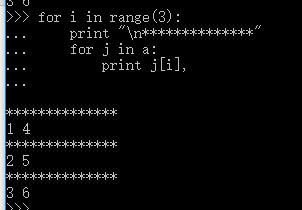
每执行一次完整的循环,生成两个数,这个两个数会以列表的形式作为最后结果列表的一个元素,
也就是说,推导列表的每一步生成的结果会以列表的形式存在,包括最终的结果
>>> for i in range(3):
... print "\n**************"
... for j in a:
... print j[i],
...
**************
1 4
**************
2 5
**************
3 6
五:reduce()累计操作
Reduce()累计操作,要搭配函数来执行
>>> reduce(lambda x,y:x+y,[1,2,3,4])
10
第一次x=1,y=2, x+y=3,之后x+y的结果3赋值给x,y为3
第二次x=3,y=3,x+y=6,之后x+y的结果6赋值给x,y为4
第三次x=3,y=4,x+y=10
>>> 1:1+2 2:3+3 3:6+4
>>> reduce(lambda
x,y:x+y,range(1,101))
5050
>>> reduce(lambda x,y:x+y,[1,2,3])
6
X=1,y=2
结果3传给x
y从第二次开始存结果
reduce(lambda x,y:x+y+y,[1,2,3])
x=1,y=2,y=2
x=5,y=3,y=3
x+y+y=5+3+3=11
x是5就对了
>>> reduce(lambda
x,y:x+x+y,[1,2,3])
x=1,x=1,y=2
x+x+y=1+1+2=4
x=4,x=4,y=3
x+x+y=4+4+3=11
>>> reduce(lambda
x,y:x+x+y,['1','2','3'])
x=1,x=1,y=2
x=’112’,x=’112’,y=’3’
x+x+y='1121123'
六:切片,就是数列的切片,比较基本也比较常用
>>> [1,2,3,4,5][3:5]
[4, 5]
练习:用map,lambda,推到列表,正则,join,去掉字符串中的小写字母
>>> import re
>>> "".join([i for i in map(lambda x:(re.match(r"[A-Z]*",x).group()),"abcABC") if i !=""])
'ABC'
拆解过程:
>>> [i for i in map(lambda x:(re.match(r"[A-Z]*",x).group()),"abcABC") if i !=""]
['A', 'B', 'C']
>>> [i for i in range(10)]
[0, 1, 2, 3, 4, 5, 6, 7, 8, 9]
>>> [i for i in range(10) if i !=5]
[0, 1, 2, 3, 4, 6, 7, 8, 9]
>>> map(lambda x:(re.match(r"[A-Z]*",x).group()),"abcABC")
['', '', '', 'A', 'B', 'C']
>>> lambda x:(re.match(r"[A-Z]*",x).group())("abcABC")
<function <lambda> at 0x00000000054EDB38>
>>> re.match(r"[A-Z]*","ABC").group()
'ABC'
练习:统计字符串中一共有几个数字
s="sdfa45ads46723"
#lambda
>>> filter(lambda x:x.isdigit(),list(s))
['4', '5', '4', '6', '7', '2', '3']
>>> len(filter(lambda x:x.isdigit(),list(s)))
7
>>> reduce(lambda x,y:x+y,map(lambda x:x.isdigit(),list("sdfa45ads46723")))
7
>>> reduce(lambda x,y:x+y,map(lambda x:len(x),filter(lambda x:x.isdigit(),[i for i in s][::-1])))
7
python六剑客:map()、lambda()、filter()、reduce()、推导类表、切片的更多相关文章
- python一些内建函数(map,zip,filter,reduce,yield等)
python一些内建函数(map,zip,filter,reduce,yield等) map函数 Python实际上提供了一个内置的工具,map函数.这个函数的主要功能是对一个序列对象中的每一个元素应 ...
- Python中Lambda, filter, reduce and map 的区别
Lambda, filter, reduce and map Lambda Operator Some like it, others hate it and many are afraid of t ...
- Python中的map()函数和reduce()函数的用法
Python中的map()函数和reduce()函数的用法 这篇文章主要介绍了Python中的map()函数和reduce()函数的用法,代码基于Python2.x版本,需要的朋友可以参考下 Py ...
- python 练习用python六剑客实现一个统计数字的个数,六剑客:(map、lambda、reduce、filter、切片、推到列表)
统计一共有几个数字 s="sdfa45ads46723" #lambda >>> filter(lambda x:x.isdigit(),list(s)) ['4 ...
- Python高级特性: 函数编程 lambda, filter,map,reduce
一.概述 Python是一门多范式的编程语言,它同时支持过程式.面向对象和函数式的编程范式.因此,在Python中提供了很多符合 函数式编程 风格的特性和工具. 以下是对 Python中的函数式编程 ...
- Python -- map, Lambda, filter and reduce
map(func, seq)对seq中的每一个元素,调用func并返回结果.典型的应用是使用lambda函数. >>> def square(x): return x**2 > ...
- python Lambda, filter, reduce and map
1. lambda The lambda operator or lambda function is a way to create small anonymous functions , i.e. ...
- python中的map、filter、reduce函数
三个函数比较类似,都是应用于序列的内置函数.常见的序列包括list.tuple.str. 1.map函数 map函数会根据提供的函数对指定序列做映射. map函数的定义: map(function ...
- 简单易懂之python 中的map,filter,reduce用法
map(function,sequence) 把sequence中的值当参数逐个传给function,返回一个包含函数执行结果的list. 重点是结果返回一个列表,这样对返回的列表就可以干很多的活了. ...
随机推荐
- parent.relativePath' points at wrong local POM
这个错误通常是下载了子项目,没有把父项目下载下来. 子项目要依赖父项目的pom The relative path of the parent pom.xml file within the chec ...
- Centos7.2修改时区
设置时区同样, 在 CentOS 7 中, 引入了一个叫 timedatectl 的设置设置程序. 用法很简单: # timedatectl # 查看系统时间方面的各种状态 Local time: 四 ...
- HIT 2739 - The Chinese Postman Problem - [带权有向图上的中国邮路问题][最小费用最大流]
题目链接:http://acm.hit.edu.cn/hoj/problem/view?id=2739 Time limit : 1 sec Memory limit : 64 M A Chinese ...
- gis 相关资料
--gis原理学习 http://group.cnblogs.com/GIS/best-1.html http://www.cnblogs.com/SuperXJ/tag/移动GIS/ --gis坐标 ...
- free详解
用法: [oracle@server36 ~]$ free -help free: invalid option -- h usage: free [-b|-k|-m|-g] [-l] [-o] [- ...
- .Net Identity OAuth 2.0 SecurityStamp 使用
起源: 近期帮别人做项目,涉及到OAuth认证,服务端主动使token失效,要使对应用户不能再继续访问,只能重新登陆,或者重新授权. 场景: 这种场景OAuth2.0是支持的,比如用户修改了密码,那所 ...
- REQUEST FORM 实例
https://www.programcreek.com/python/example/51524/flask.request.form
- 做一个完整的Java Web项目需要掌握的技能[转]
转自:http://blog.csdn.net/JasonLiuLJX/article/details/51494048 最近自己做了几个Java Web项目,有公司的商业项目,也有个人做着玩的小项目 ...
- 2018/04/04 每日一个Linux命令 之 ps
ps 用于查看系统内的进程状态. 这个命令比较重要,也比较长,会通过实践出常用的命令 -- 当我们敲下一个 ps 之后会发生什么? ubuntu@hong:~/nginx/sites-enabled$ ...
- 打造自己的 JavaScript 武器库
原文 https://segmentfault.com/a/1190000011966867 github:https://github.com/proYang/outils 前言 作为战斗在业务一线 ...